
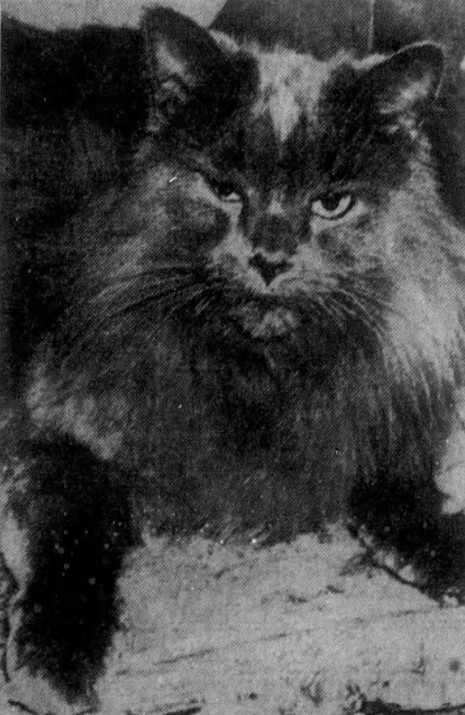
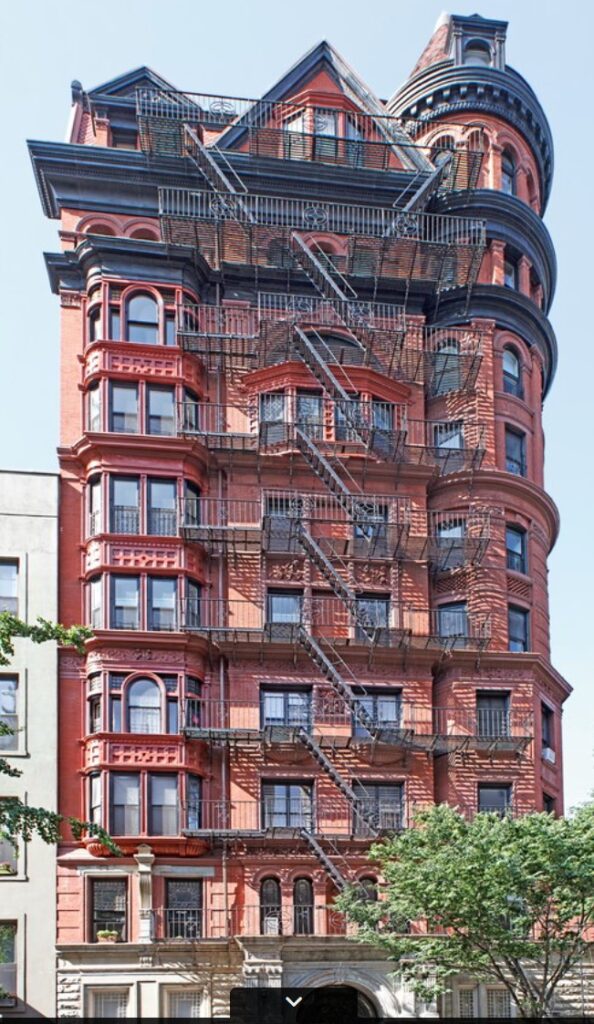
Johnny was a fancy-schmancy feline. So it’s no surprise that the pampered pet lived in one of the fanciest apartment buildings in Brooklyn Heights, at 62 Montague Street.
Johnny was a black Persian cat owned by Mrs. Gordon Gray (nee Jane Donaldson Myers). Jane Gray was a childless widow and a proud Daughter of the American Revolution. A graduate of Fordham University, Mrs. Gray worked most of her life as a registered nurse.
Jane Gray and Johnny lived in apartment 3B, a small one-bedroom apartment with a view of the harbor, for which Jane paid $40 a month (about $640 today). Johnny loved watching the birds and all the action on the docks from his velvet-lined window seat.
One day, Jane Gray invited a reporter into her home to meet Johnny and take his picture for the newspaper. Jane told the reporter that her feline companion was a long-haired gentleman with glamour pants, which is what she called the tufts of fur on his legs. (I now tell my male cats that they are wearing glamour pants!)
She than bragged about how Johnny could understand her commands, like when she called him to see the birds in the window or when she asked him to sit up and box or do standing jumps.
According to Jane–who called herself Mother when addressing the cat–Johnny was a finicky feline who would only eat one brand of canned shrimp. He also liked codfish and chopped calves’ liver, followed by some ice cream or rice pudding for desert. In addition to the comfy window seat, Johnny had his own scratching chair. I wonder if that really worked?
In addition to watching the birds, Johnny loved listening to Jane on her piano and music on the radio. Specifically, he liked classical music. That modern swing music was not his thing.
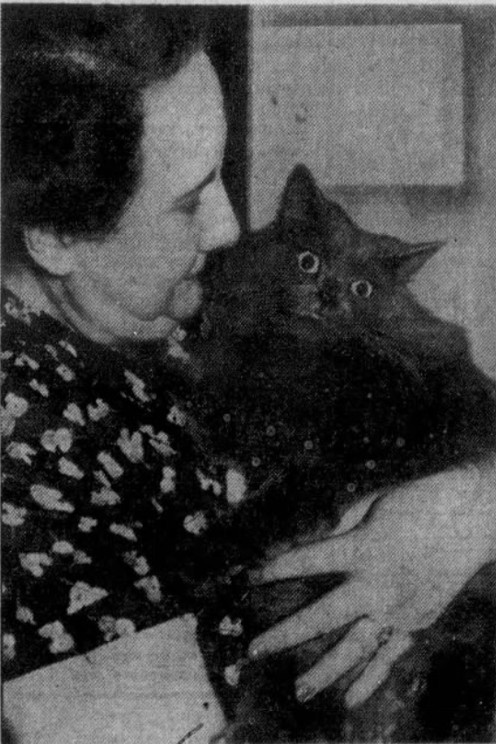
Every year, Johnny would have a birthday party. One of the guests of honor was his girlfriend, Miss Ann, a blond Angora cat who lived in the apartment above them (the feline Romeo and Juliet of Montague Street, perhaps?). Hopefully, Jane chaperoned the two pedigreed Brooklyn Heights felines to prevent any hanky panky.
Jane told the reporter that Johnny would always be well cared for, even if she passed away before he did. Her will stipulated that the cat would go to her niece with a $20 monthly allowance for food and veterinary care. I don’t know when Johnny passed, but Jane Gray died in 1962 at the age of 78.
Snooky Bandbox
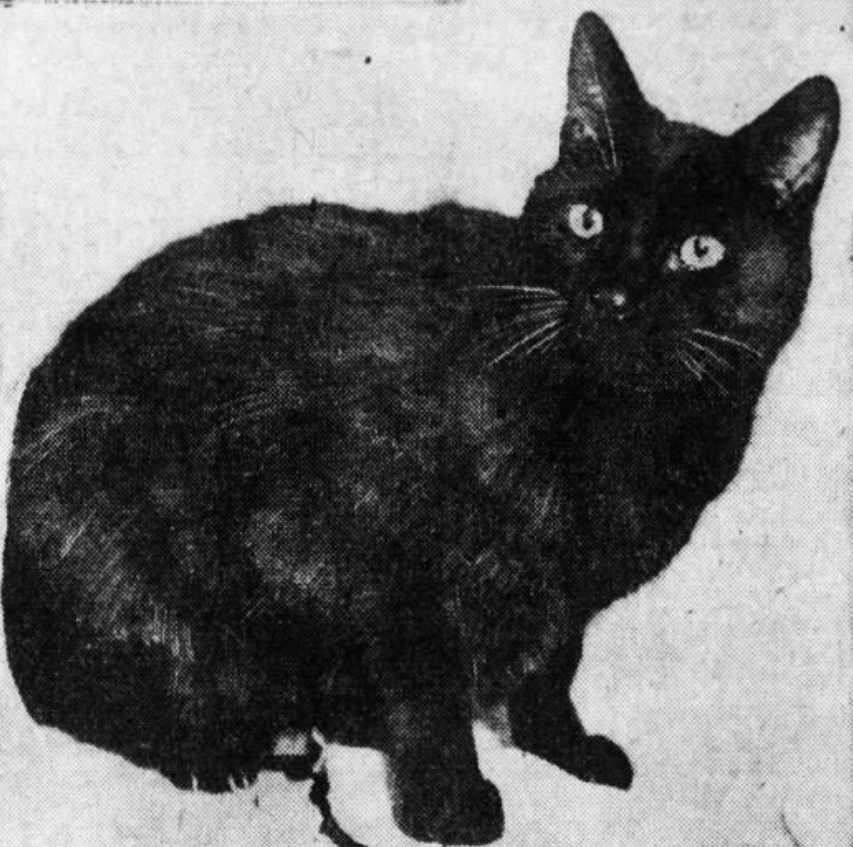
During this same time period, another unwed woman on Montague Street also felt that her cat was deserving of publicity in the Brooklyn newspapers. The cat had the unusual name of Snooky Bandbox, and she lived with Miss Anna Juliette Osborne (aka Osborn), a hat and dressmaker who lived and worked at 154 Montague Street.
(Incidentally, Bandbox Snooky is the name of an early 20th-century animal behavior experiment involving a cat named Snooky who was trained to stop jumping into a bandbox [aka cardboard hatbox] when her owner placed a bowl of water in the box. Snooky was also the name of a famous cat who lived in New York’s City Hall.)
According to Miss Osborne, Snooky was born on an oil tanker in Africa in 1924. When the captain of the ship was transferred to another ship that already had a cat, he had to find a new home for Snooky. He presented the black cat to his lady friend, Miss Osborn.
Like many of the high-society cats of the Heights during this time, Snooky never went calling on other aristocratic cats without her engraved calling card, which Miss Osborne would would dole out to the other cat ladies. Snooky also had a gentleman feline friend in Loudonville, NY, named Lucky Strike, who sent her cards every year at Christmas, Valentine’s Day, and Easter.
A Brief History of 62 Montague Street
When we hear the name Montague, we may think of Lord and Lady Montague of Shakespeare’s Romeo and Juliet. Brooklyn’s Montague Street was named for a Lady Montague, but this lady of the house lived during the 18th century.
Originally, the street was named Constable Street in honor of Anna Maria Constable, the wife of Brooklyn Heights developer Hezekiah Beers Pierrepont. According to legend, locals often joked about the street sharing a name with the constables, or police officers.
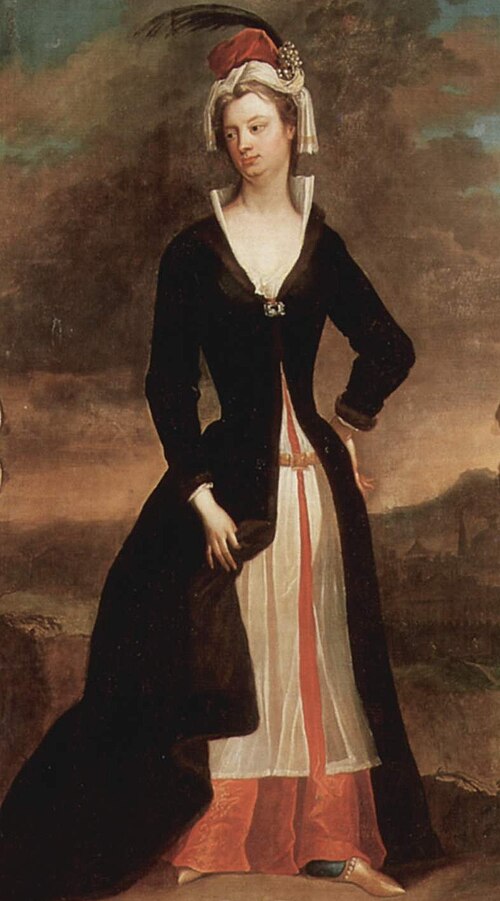
In 1840, Pierrepont’s son, Henry Evelyn Pierrepont, changed the name in honor of Lady Mary Wortley Montagu, a well-known English writer, aristocrat, and feminist who was a distant relative of the Pierrepont family.
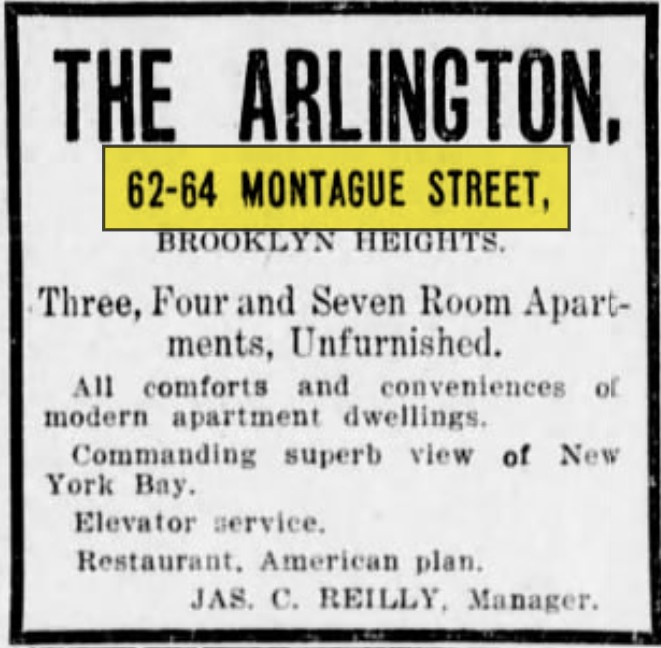
The historic 10-story building at 62 Montague Street, originally called The Arlington, was designed by Montrose Whiting Morris for Mr. C.D. Burwell, president of the Brooklyn Hotel Company. Completed in 1887 at a cost of $125,000, it was located just steps from the Wall Street Ferry landing at the foot of Montague Street.
The Arlington originally had 17 rooms on each floor, which accommodated 20 family apartments and 10 “bachelor” (studio) units. The elevated building also had a restaurant on the second floor.
In September 1907, a late-night fire destroyed the 7th floor up to the cupolas on the roof. The four top stories were gutted in the four-alarm fire, and 43 families were displaced.
According to numerous news reports of the fire, many residents jumped onto the roof of the neighboring building or descended the fire escapes wearing nothing but their nightclothes. Following the speedy renovations, the building was renamed the Harbor View Apartments.
One of the most famous human residents of 62 Montague was the playwright Arthur Miller, who moved into the building after marrying his college sweetheart, Mary Slattery. For about one year, Arthur and Mary shared a 7-room apartment on the 10th floor with Mary’s roommates. A plaque on the building honors his brief residence there.
A Brief History of 154 Montague Street
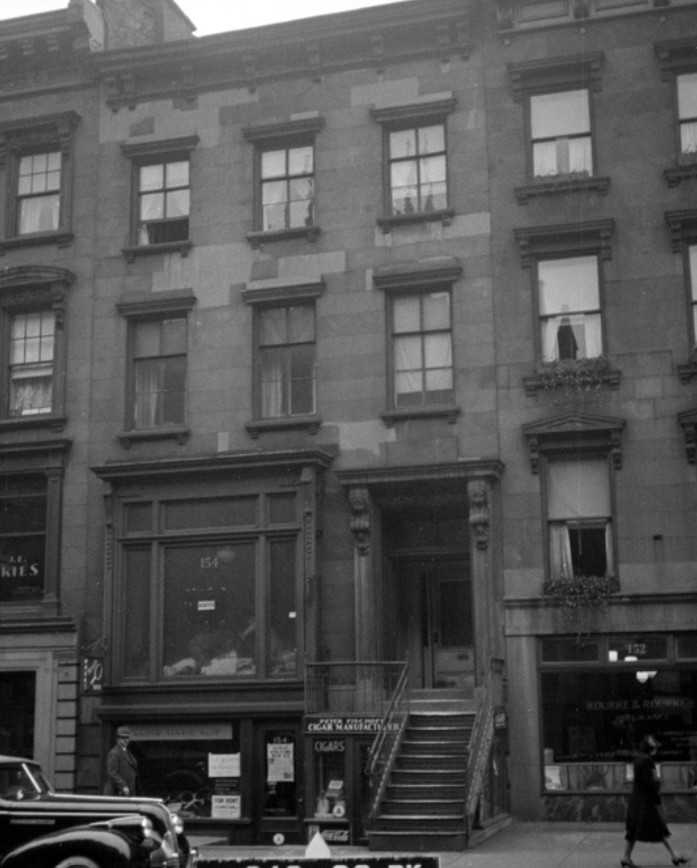
The three-story Italianate brownstone at 154 Montague Street was originally a private residence, and later, one of several schools for girls in Brooklyn Heights during the late late 19th century. The school, which opened in 1875 with 16 young girls, was first under the direction of Miss Clara F. Hall. In addition to primary lessons, the school provided instruction in English and other languages.
In the 1880s, 154 Montague Street was known as Mrs. Robert Goodwin’s School for Girls (Young Ladies’ Seminary). Under Mrs. Goodwin, a native of Germany, and her business partner, Miss Agnes Goodwin, the institution was referred to as a “parlor school,” aka “fireside school,” which provided primary education in private homes. The school offered its students–many of them from prominent families–individualized instruction with an emphasis on German language education.
During the 1940s, Miss Osborn’s shop, Osborn & West Hats & Gowns, was known as a high-end millinery and dressmaking shop for the well-to-do. Miss Osborne shared the space with James Stuart Gillespie (who called himself Guy Pierrepont), the long-time publisher of the Brooklyn Blue Book and Long Island Society Register (a register dating back to 1858).
According to an article published in The New Yorker, visitors to the publishing office had to walk past the dressmakers’ sewing room. I wonder if Snooky Bandit greeted them all?