Cats in the Mews: September 16, 1910

Cats Wanted for Manhattan Opera House.

On September 16, 1910, The New York Times ran a small article about a want-ad soliciting 300 cats for performances at the Manhattan Opera House on 34th Street. The stage director would accept all cats–with or without stage experience–to take part in the production of “Hans, the Flute Player.”

The comedic opera was going to be the opening act for Oscar Hammerstein’s newly branded venue on West 34th Street.

According to a full review of the play in The New York Times, “Hans, the Flute Player” is set in the imaginary village of Milkatz, once celebrated for its dolls, but now for its grain and commerce. Hans, who carries a magic flute, lures all the cats from their homes in order to drown them. This allows him to release the mice that he carries in a cage on his shoulder, so that they may destroy all the grain.

Oh yes, I see comedy written all over this scene.

The press agent explained that all cats for consideration should be brought to the stage door the following morning at 10. (I can picture the chaotic cat scene now; comedic opera indeed!) The opera in three acts was scheduled to open in a week, leaving little time to find and train 300 cats.

Hans, the Flute Player was adapted from the French opera by Maurice Vaucaire and Georges Mitchell. It was produced by Oscar Hammerstein and featured music by M. Louis Ganne and lyrics by A. St. John Brennan;
Hans, the Flute Player was adapted from the French opera by Maurice Vaucaire and Georges Mitchell. It was produced by Oscar Hammerstein and featured music by M. Louis Ganne and lyrics by A. St. John Brennan.

According to the “want-ad” for the cats, the felines were not required to sing. All they had to do was appear for a few moments at the end of the first scene, when the flute player–a sort of second cousin to the Pied Piper of Hamelin–lured them with his magic flute.

The plan was to have all the cats come “snooping out of the front doors and back gates of the stage residences, and surround the principal baritone while he plays on a property flute with the aid of the orchestra. That is all the cats will have to do, absolutely.”

(Note: the opera ends happily, with the departure of the mice and the safe return of the cats to their cozy Milkatz homes.)

I have no idea if the stage director thought through all the logistics: How would they gather and collect all the cats when the scene was over? Who would care for the cats during the two-month run at the theater? What if the cats had to relieve themselves while on stage? How would 300 cats perform together without getting into any cat fights? Where would the cats go after the show ended?

Luckily, the ASPCA came to the rescue before all these issues and more had to be addressed by Oscar Hammerstein and his crew.

Joseph Weiss was a pied piper with catnip

The ASPCA Comes to the Rescue

One week before the comedic opera was scheduled to open, an article about the cats appeared in the Topeka Daily Capital. “Oscar Hammerstein’s hopes that 300 howling cats, real ones, would make Richard Strauss music at the opening of the Manhattan Opera House next Tuesday, were ended today by the Society for the Prevention of Cruelty to Animals. Several hundred cats were at the stage door, but they did not get inside.”

Topeka Daily Capital, September 19, 1910
Article about Manhattan Opera House
Topeka Daily Capital, September 19, 1910

According to this article, the plan was not to have the cats come snooping from behind doors, but to have them suspended from wires above the stage. As explained by stage director Jacques Coini, when the piper marched toward the painted river, the cats would be lowered with a rush. The reporter noted, “They were counted upon to become frightened and utter the usual unearthly yowls.”

The morning after the help-wanted ad for cats appeared, a young man drove up to the stage door of the Manhattan Opera House with a wagon filled with a few hundred cats. He began selling the cats for $7 each to people who thought they would get a higher price from Hammerstein.

Soon a hubbub was heard up Thirty-fifth Street. It grew nearer and out of the dust emerged two flying figures. In the lead was a boy with two cats under his arms. He was pursued by a middle-aged man in his shirt sleeves and wearing a cobbler’s apron. They arrived at the stage door together. The man seized the cats, shouting that the boy had stolen them.

Thomas F. Freel, superintendent of the SPCA

A few minutes later, ASPCA Superintendent (and cat-man hero) Thomas F. Freel arrived in the animal ambulance. He asked how the cats were going to be used. When he learned that they were desired primarily for their yowls, he said: “If those cats are used, I’ll see that the performance is stopped.”

“I’ve been hiring human cats for so long it seems to me they ought to let me have a few real ones,” muttered Oscar Hammerstein. He told the reporter he would use stuffed cats for the scene.

A day after the opening show, The New York Times gave it a very positive review. Even the stuffed cats got a brief mention: “The rain of municipal kitties comes at the end of the first act, and is a spectacle worthy of attention.”

Oscar Hammerstein’s Manhattan Opera House

Built by Oscar Hammerstein, grandfather of the famous lyricist, in 1906, the Manhattan Opera House was meant to be a lower-priced alternative to the fancier Metropolitan Opera. Although the opera house was successful, it folded as a venue for grand opera in 1910 when the Met bought off its competition–Hammerstein–for $1.2 million.

Manhattan Opera House
Manhattan Opera House at 311 West 34th Street, between 8th and 9th Avenues.

Under the 1910 agreement with the Met, Hammerstein had to promise that he would not produce grand opera again in New York for 10 years. “Hans, the Flute Player” was not a grand opera, so Hammerstein got away with running this comedic opera after signing the agreement with the Met.
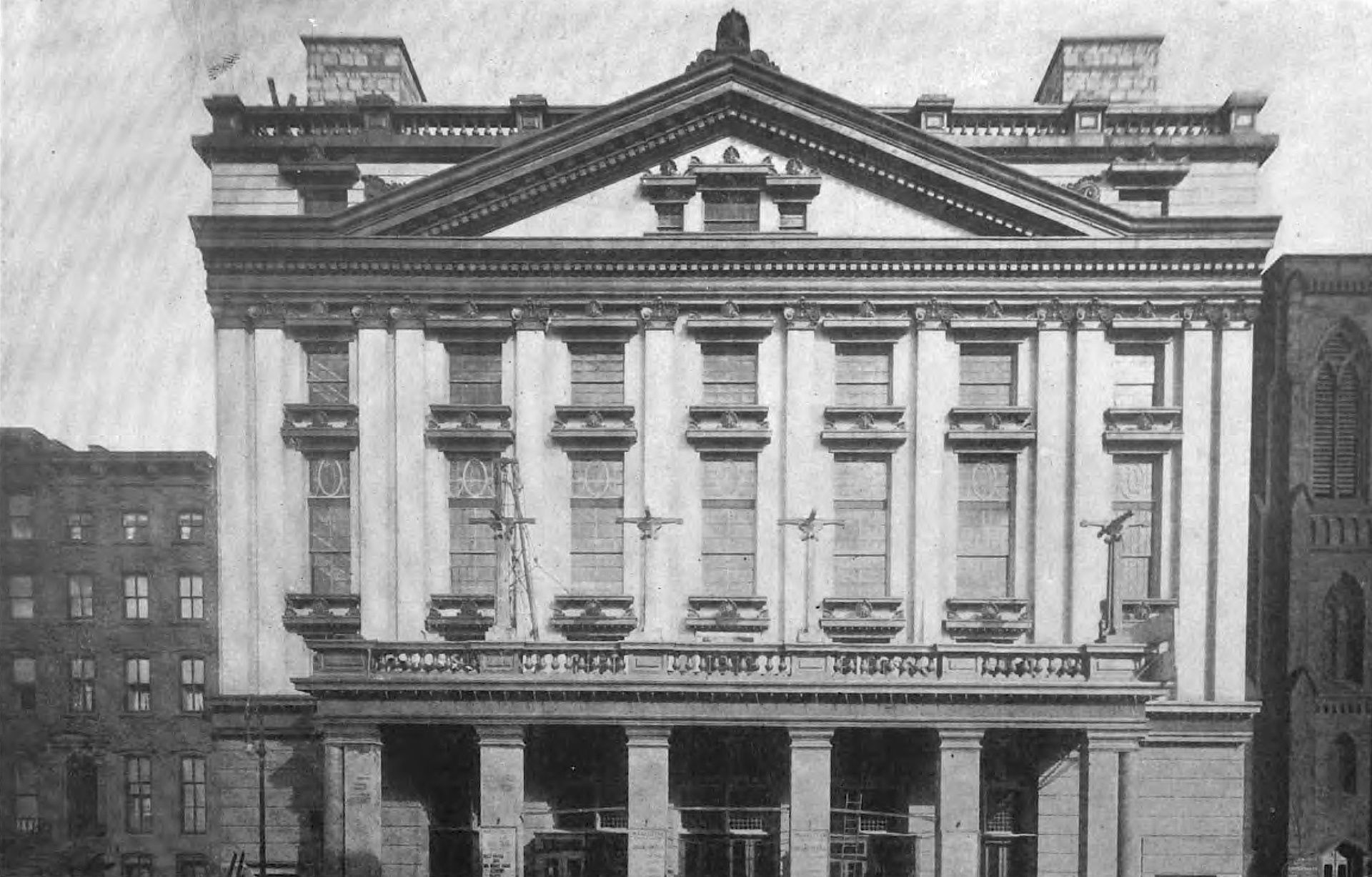
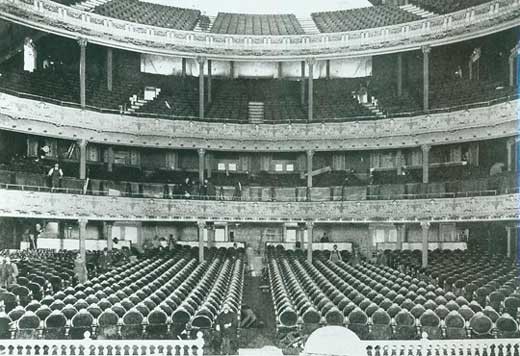
The old Manhattan Opera House.
The three-balcony Manhattan Opera House had seating for 3,000 people.

In 1922, after several years as a vaudeville and movie house, the opera house was purchased by the Ancient and Accepted Scottish Rite of Freemasonry, who added several floors and made extensive renovations. Basically, they built a new, more modern building over the shell of the former opera house.

The building was renovated again in 1938; the former theater gained in popularity over the years as a meeting place for unions and political groups, such as the Communist Party and the John Birch Society.
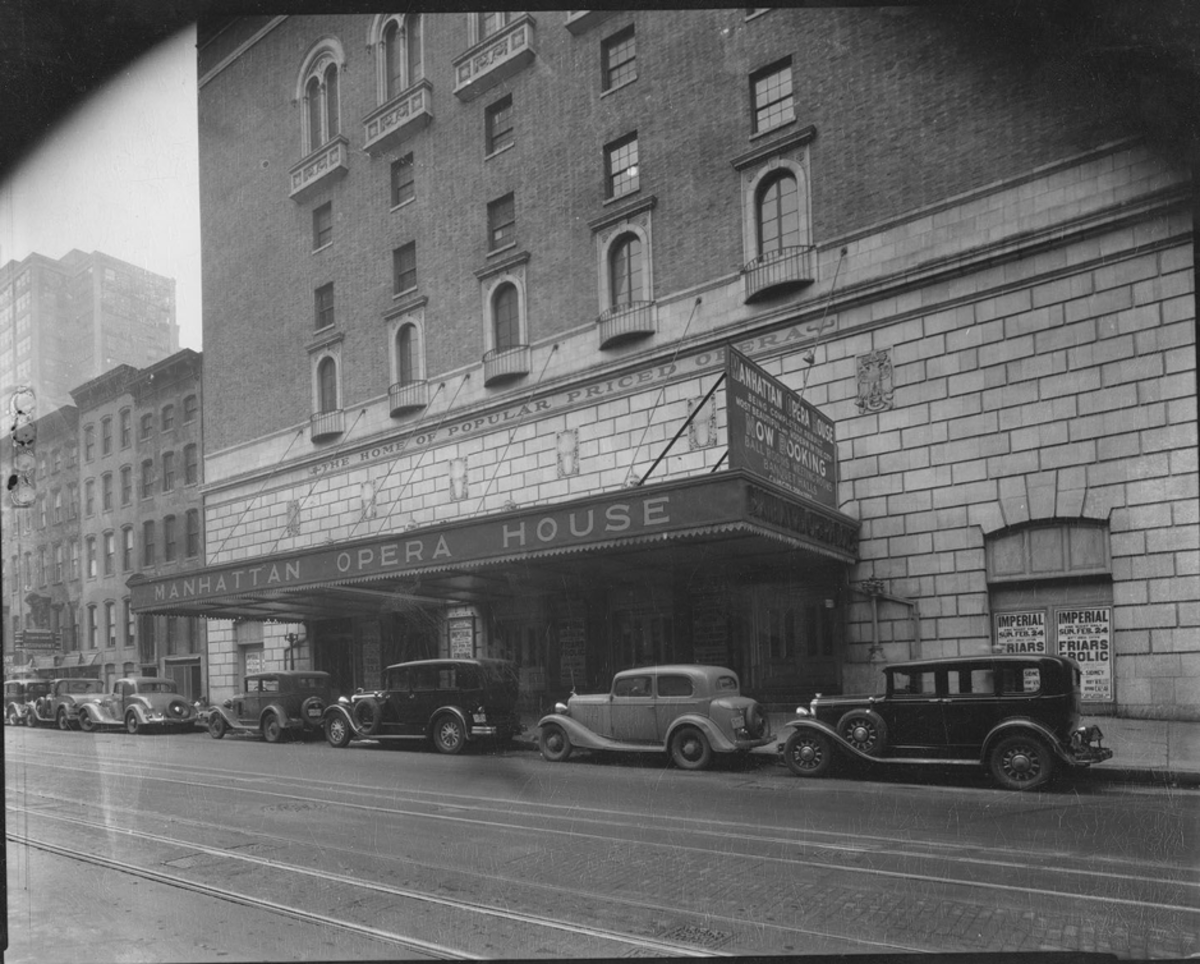
The old Manhattan Opera House after major reconstruction.

During the late 20th century, the building was owned by the Unification Church, which also owned the adjoining New Yorker Hotel on Eighth Avenue. Called the Manhattan Center, it featured audio and video studios, a computer graphics shop, and a large hall on the seventh floor that was perfect for recording classical music and hosting special events.
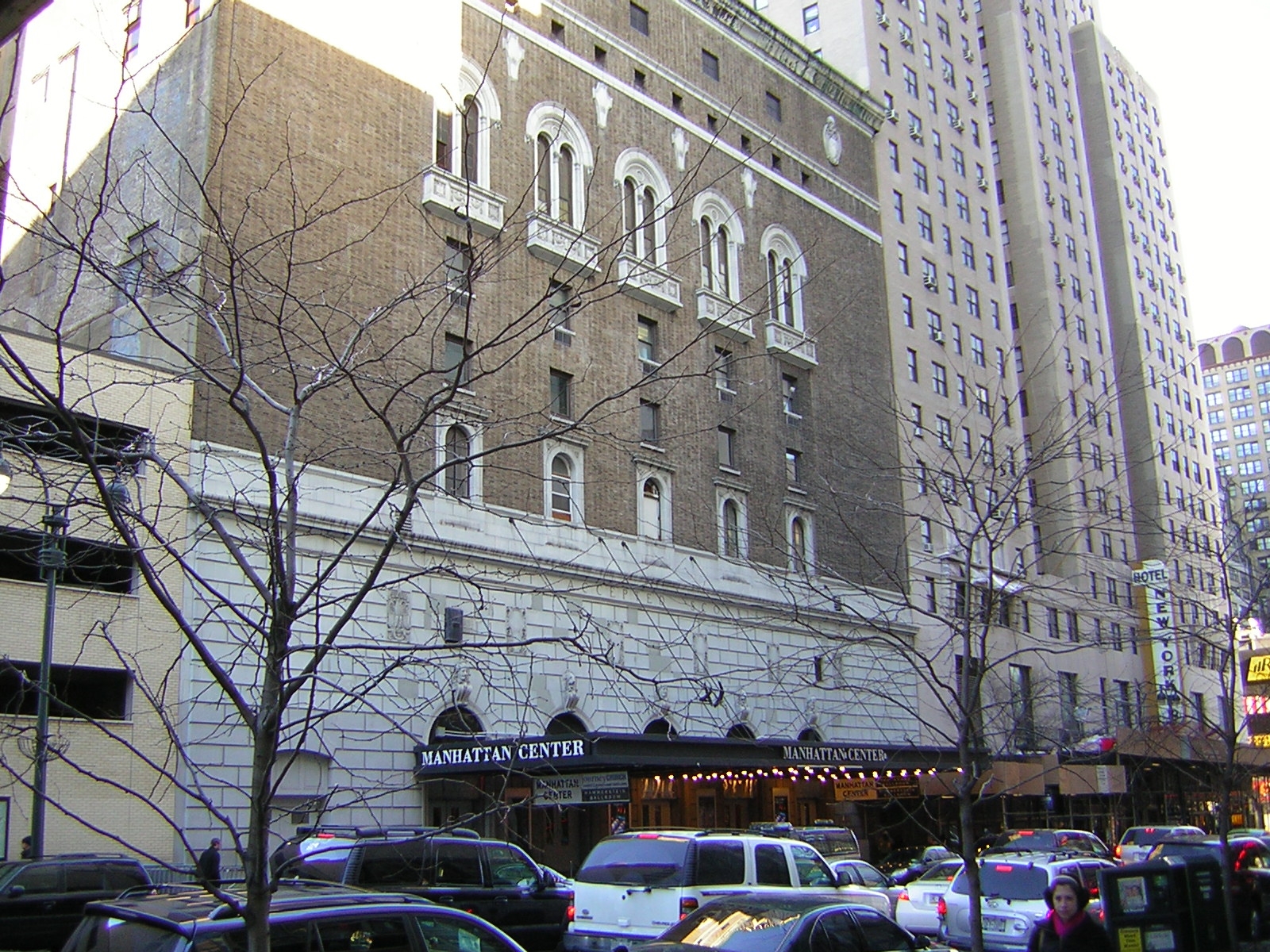
The Manhattan Center was constructed over the old Manhattan Opera House.

Today, The Manhattan Center comprises the Grand Ballroom, the Hammerstein Ballroom, and the Manhattan Center Studios (TV and sound production studios). In recent years, the building has been used for trade shows, concerts, game shows, special events, and radio shows.

If you enjoyed this tale, you may also like reading about the cats that starred in a musical comedy called the “Soap Bubble” at the Grand Street Museum in Williamsburg.

Cats in the Mews: September 8, 1902

This story about the pet cat of Edwin Gould is a sad summer tale, but it provides a window into a world in which the wealthy treated their jewels and other inanimate objects far better than their pets.

Deserted pet cat on the steps of the Edwin Gould residence. New York Evening World, September 8, 1902.
This photo allegedly depicts a deserted pet cat on the steps of the Edwin Gould residence, West 56th Street and Fifth Avenue. New York Evening World, September 8, 1902.

On September 8, 1903, the New York Evening World reported that a gray and white cat had been living on the steps of the Edwin Gould house at 7 West Fifty-Sixth Street for more than a week. The reporter surmised that she may have been a family pet that was left behind when the Goulds left the city house and went to their new country estate on the Hudson River at the start of the summer.

Passersby said the emaciated cat looked like a former pet cat that had once seen better days. Others thought that perhaps the cat was one of the many forgotten pet cats who spent their summers scavenging from the garbage pails in the nearby Central Park when their wealthy owners left town.

New York Evening World, September 8, 1902.

Whichever theory was true, the poor kitty had been spending every day lounging on the stoop or standing on the window sill and peering inside the empty house. The only time she left the house was when a stray dog chased her away, or when a more fortunate pet dog walked by with its owner.

At night, she kept the neighborhood awake with her cries.

I don’t know what happened to this poor cat, but I have a feeling it did not have a fairy-tale ending. According to the ASCPA, cats were abandoned more than any other family pet when the well-to-do of the Gilded Age left their city homes to spend the summer abroad or at a country estate.

Although some wealthy families boarded their cats for the summer, and a few lucky cats, like Rusty of the Algonquin Hotel, traveled with their owners to their summer homes. many cats were left behind. Way too many abandoned cats were picked up by the ASPCA and sent to the gas chamber if no one came to claim them within a few days.

The Mystery of the Edwin Gould Story

As I was writing this story, I discovered a few discrepancies with the Evening World news article. The first thing I noticed was that the cat appears to be “Photoshopped” in the picture from the Evening World. It looks like the photographer took a picture of the stoop and then superimposed another photo of a cat on top of that, giving the cat an odd, 3D appearance.

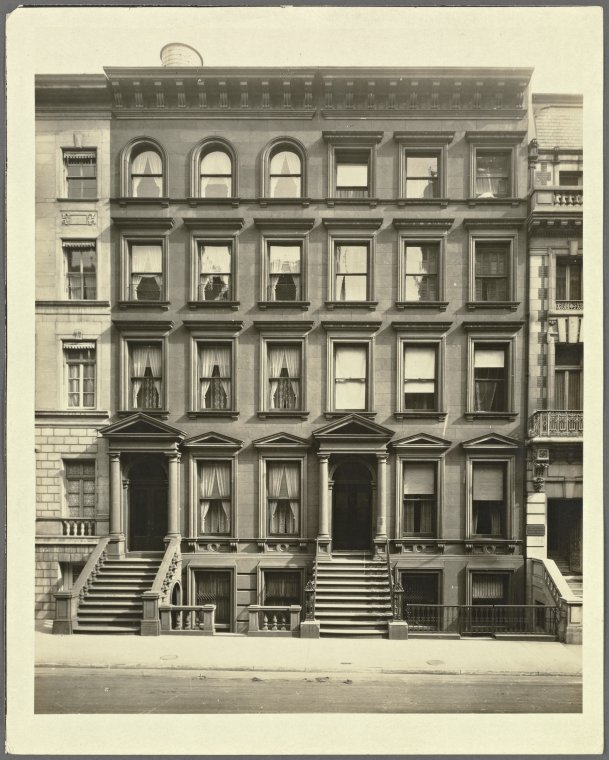
I’m not even sure if the stoop belongs to 7 West 56th Street either. If you compare the architectural details of the photo above with the photo below, there are quite a few differences. (I don’t know when the photo below was taken, so the house could have undergone extensive renovations.)

This is the house at 7 West 56th Street (right). New York Public Library Digital Collections

The second problem is that Edwin Gould did not live at 7 West 56th Street. According to an article in the New York Herald, William H. Garden owned the home on 56th Street.

Edwin Gould lived in the mansion directly across the street from this house, at 720 Fifth Avenue. Big difference.

The five-story, 50-foot mansion on Fifth Avenue was constructed in 1879 for a millionaire named George Kemp, who made his fortune in perfumes and body-splashes. Kemp died in the home in 1893, and his wife passed away in 1897. Shortly after her death, the home was leased to Edwin Gould.

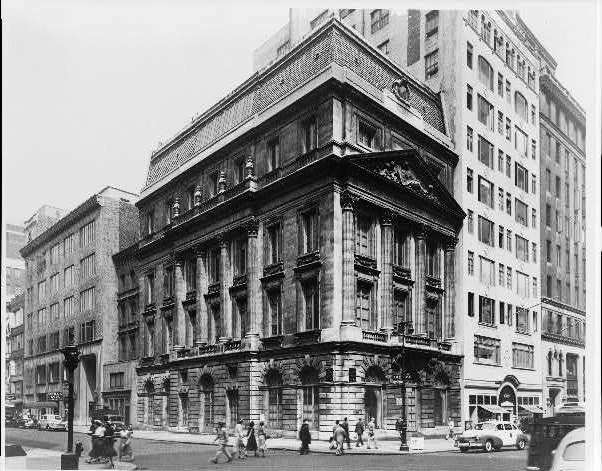
This is the former Gould mansion at 720 Fifth Avenue. When this photo was taken, the building was already undergoing demolition. Library of Congress
This is the former Gould mansion at 720 Fifth Avenue. When this photo was taken, the building was already undergoing demolition. I don’t see a stoop. Library of Congress

The Goulds lived in this home at least until 1908. Although they made extensive renovations to the mansion, it doesn’t appear to have any stoops on which a cat could sit. I have a feeling the reporter may have exaggerated the story to get a larger headline, but that’s my opinion only, based on the facts provided.

In 1911, the Duveen Brothers, dealers in fine art, leased the building at 720 Fifth Avenue for a term of 20 years. In October 1952, Emery Roth & Sons designed the $1.25 million, 15-story office building that still stands today. Directly across the street on Fifth Avenue is Trump Tower.

The Very Charitable Edwin Gould, Sr.

“Edwin was probably the happiest of the Goulds, and he might well have been the richest of them all, had he not persisted in giving away large sums of capital and much of his annual, income each year.”–The New York Times

Edwin Gould was born in Manhattan on February 26, 1866. The son of railroad magnate and financier Jay Gould and Helen Day Miller, Edwin was born into wealth and privilege. With a very large inheritance and three years of studies at Columbia University under his belt, he was worth $20 million by the time he turned 27 (including $8 million that he made on his own, without his family’s help).

Edwin Gould, Sr.
Edwin Gould, Sr.

In 1892, Edwin married Sarah Cantine Shrady. The couple had two children: Frank Miller Gould and Edwin Gould, Jr., who died during a hunting accident in 1917 at the age of 23 (he accidentally shot himself with his own gun).

In 1902, Edwin Gould purchased 88 acres of land in the Wickers Creek section of Dobbs Ferry on the Hudson River (the present site of Mercy College). There, he built a 40-room mansion of Spanish architecture.

The Goulds call their estate “Agawam.” It may have been here that the family spent the summer of 1903, leaving their alleged cat behind.

According to historians, it was during the funeral services for Edwin Jr. that Edwin Gould decided to devote the rest of his life to helping children. Apparently, the children of a local children’s home called Sheltering Arms sent a large basket of roses–one rose for each child–to the funeral home.

Edwin and Sarah were already friends and benefactors of the home (they often gave the children circus tickets and ice cream), but it was this special memorial to their son that inspired the couple to devote their fortune and time to kids in need. Over the years, thousands of young people benefited from the schools, parks, playgrounds, and other facilities that the Goulds helped finance.

Edwin Gould with some children of Sheltering Arms.

In 1923, Edwin established the Edwin Gould Foundation for Children to ensure that his legacy and commitment to helping children would continue after his death. He died at his summer home in Oyster Bay, Long Island, on July 11, 1933, at the age of 67. He was buried in the family plot at Woodlawn Cemetery.

October 7, 2020: 6:00 PM (ET)

The Dog Days of Gotham Virtual Event for Dog Lovers
A virtual presentation for the dogs and all dog lovers!

Back by popular demand for the dog lovers and the cat people who also love dogs!

In the late 1800s and early 1900s, Pomeranians, terriers, bulldogs, and other small breeds were extremely popular with socialites of the “fairer sex” and starlets of stage and screen. Pet dogs were as much a status symbol for these wealthy ladies as were their diamonds and furs. Many women of the Gilded Age loved their dogs more than they loved their children or husbands.

Join me and the Boonton Public Library on a virtual tour of Old New York as I share fascinating and hilarious stories of wealthy and eccentric women and the pampered pooches they adored. Hear about:

Meet Aimee Crocker, a wealthy heiress who enjoyed collecting things, including bulldogs (at least 25) and husbands (5).
Dog Days of Gotham Virtual Event
Meet Aimee Crocker, a wealthy heiress who enjoyed collecting things, including bulldogs (at least 25) and husbands (5).
  • The spoiled monkey griffon responsible for America’s first doggie day care at the Plaza Hotel
  • The French poodle with a $1 million dog yard on Fifth Avenue
  • The terrier that inspired Margaret Wise Brown’s last children’s picture book
  • The pug reportedly buried with her humans at Green-Wood Cemetery—and more!

Fun for dog lovers and New York City history fans alike!

TO REGISTER: This is a free event. To get your personal Zoom link, send an email to registrations@boontonholmeslibrary.org and put “Happy Hour” in the subject line. You will then get the link and code to use on the day of the presentation. If you don’t receive a code from the library, please contact me on the day of the event and I can share my code with you.

Author Events

I am available for virtual author events across the United States and in-person presentations in the New York City metropolitan region (including northern New Jersey and the Hudson Valley). If your organization or library is interested in hosting a program, please visit my Author Events page for more information.

Cats in the Mews: August 19, 1897

Raining Cats

On this day in history, the business district of Huntington, Long Island, was reportedly “much disturbed” by a strange phenomenon “which was without precedent in the annals of local tradition or the memory of the oldest inhabitant.” According to The New York Times and Brooklyn Times Union, on that day, it rained cats in front of the Brush Block building on Main Street and New York Avenue.

The first person to notice the cats was James Madison Brush, president of the Bank of Huntington, and co-owner of the Brush Block building, where he also ran a general store. James was going about his business as usual when he noticed that his store was suddenly filled with feline customers of all shapes, sizes, and colors.

As James began leading the cats back outside, he was amazed to find the street filled with cats! For every cat he drove out of the store, 15 more rushed in. He told a reporter from the Brooklyn Times Union that he couldn’t walk anywhere without stepping on a cat.

Soon, every businessman in the neighborhood was hard at work chasing the cats out of their stores. Customers of the human kind could do nothing but walk cautiously along the sidewalk as the men used brooms to sweep cats out and hold others at bay. For more than an hour, the community was engaged in hunting out, dislodging, and pursuing the feline invaders.

Brooklyn Daily Eagle, August 20, 1897
Shower of Cats at Huntington
Brooklyn Times Union, August 20, 1897

Although no one could say exactly how many cats there were, “Everybody was sure that the meteorological eccentricities of the season had culminated at last in a downpour such as had never before occurred, even on Long Island, where the air is likely at any time to yield strange things.”

Showers of toads, grasshoppers, small snakes, and fish were not infrequent in Huntington, but a downpour of cats led to all kinds of superstitions. Soon, everyone was calling their friends in other towns to ask, “Is it raining cats with you?”

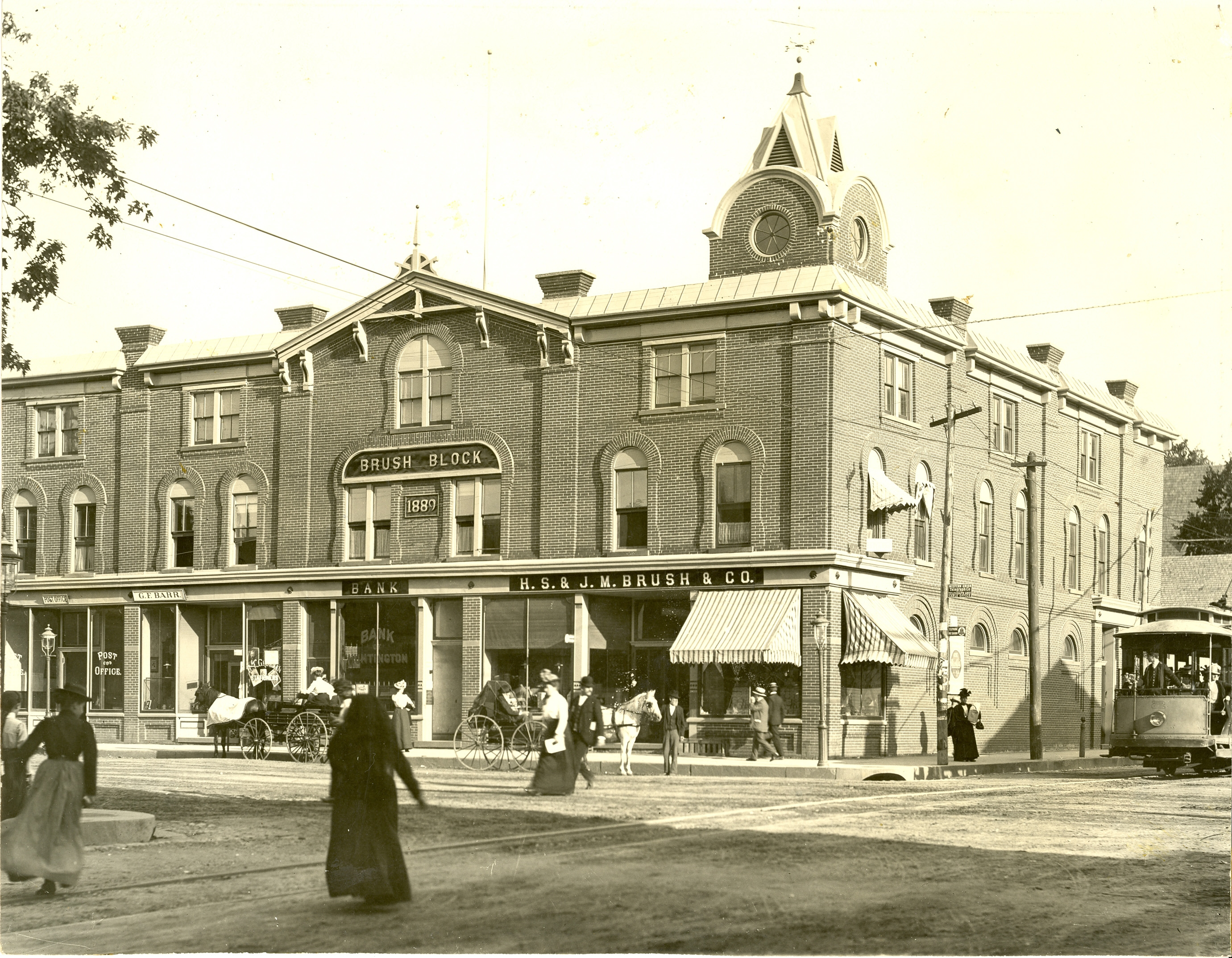
The Brush Block, on the South East corner of Main Street and New York Avenue, Huntington, around 1906.
The Brush Block, on the South East corner of Main Street and New York Avenue. This picture was taken about 10 years after it rained cats in front of this building.

Just as soon as the cats appeared, they all seemed to disappear. So, how were the people of Huntington to prove that they had not all gone cat crazy?

According to The New York Times, James had captured and kept one cat, thinking he could use it as evidence. But many argued that one cat was not enough to prove that it had rained cats on Main Street. (The cat ended up winning over James, who decided to keep the cat for his store.)

Real estate men suggested various schemes for using the phenomenon as a way of promoting the sale of lots in town. However, there was serious doubt that a reputation for having a deluge of cats would be to the town’s advantage, even if it was the only town in the world where such a thing had happened.

Cashier Conklin Lets the Cat of the Bag

Finally, it was Douglas Conklin, the cashier at the Bank of Huntington, who let the cat out of the bag. He told everyone that he had seen four men drive up Main Street in a wagon containing filled bags. The men drove down a side street, where they opened the bags and released the cats. Then they drove away.

Douglas said he did not know the men, but when he realized they were pulling a big practical joke on the town, he played along and remained quiet. It is not known where the cats went after they disappeared from the streets, but we can only hope that they all had homes to return to.

As the newspapers noted, the men obviously spent a lot of time and some money gathering all the cats (and how did they get them into the bags?!). It was surmised that they “exhausted the available cat supply of half a dozen Long Island towns.”

I’m wondering if these weren’t some of the excess postal cats that the New York City post office used to ship by mail bags to other post office sub-stations when the feline population got out of control…

The Brush Block Building

The Brush Block, Huntington, sometime around 1900.
The Brush Block, sometime around 1900. Can you picture this scene with dozens of cats?

During the mid-1800s, the block on the south side of Main Street east of New York Avenue was occupied by a row of wood frame buildings. The general store owned by James Brush and his brother-in-law Henry S. Brush was in the two-story corner building (an attorney named Thomas Young rented the second floor). Next was the Bank of Huntington, a stationery store owned by Edward C. Grumman, and George F. Barr’s jewelry store.

At the end of what was called the Brush block was the post office; the law offices of Charles R. Street, who was also the postmaster, occupied rooms above the post office. To the east of this block of buildings were the carriage factory of Ebenezer Jarvis, James B. Scudder’s harness shop, and the Second Presbyterian Church.

On September 12, 1888, a large fire destroyed all the buildings along Main Street from New York Avenue to the Second Presbyterian Church. Henry and James quickly erected a new, three-story Brush Block building on the site, which was then one of the largest buildings in Huntington.

The building still exists, although it no longer has a third floor (part of the floor was removed in 1927 and the other part in 1937).

James Madison Brush

James Madison Brush, the son of James Madison Brush and Sarah Downing, was born on the old family farm at Old Fields (now Greenlawn) on November 20, 1845. Fifth in a family of 12 children, he was a descendant of Richard Brush, who settled in West Neck after emigrating from England in 1672.

Map of Greenlawn and Centerport, Huntington
When this map was created in the early 1900s, Frederick Brush had taken ownership of the eastern portion of the Brush farm in Greenlawn. Just to the north is Centerport, where my family has owned property since the 1920s. New York Public Library Digital Collections

Following his schooling at the local district school, Brush worked with Captain John Dickerson in his country store at Centerport for several years. After attending business college in Poughkeepsie, New York, he worked as a clerk in the general store of Rogers, Sammis and Scudder in the Village of Huntington.

James Madison Brush
James Madison Brush

In 1875, James and his brother-in-law, Supervisor Henry S. Brush, started a general store on Main Street in Huntington, which brought the men much success. Ten years later, he organized the private bank of James M. Brush & Co., which was later merged into the Bank of Huntington. Brush served as president of this bank until his death.

Brush died on January 29, 1902, following a diabetic incident at his home. He was survived by his wife, Emma, his daughter, Emma, and several siblings.

At the time of his death, Frederick Brush took over the eastern half of the family farm.


The old Brush Block building today.
One of the many kittens featured in Regeneration, co-written and directed by Raoul Walsh.

One of the many positive things I have been doing during the COVID-19 pandemic is watching The Alienist, which is set in 1896 New York City. I’ve also been watching various old and classic movies also set in Manhattan. In addition to favorites such as West Side Story and Breakfast at Tiffany’s, I discovered a 1915 silent film called Regeneration, which was co-written and directed by Raoul Walsh.

I was pleased to find the complete film online. I was even happier to discover that the film starred several cats and one dog. Having written about Elizabeth Kingston, who rented cats from her Richmond Hill, Queens cattery to film studios during this same time period, I immediately wondered if any of the cats in this film were from her Kingston Kattery.

The first kitten to make a cameo  appears in the opening scene (do you see it?), after Owen discovers he is now a poor orphan boy.
The first kitten to make a cameo appears in the opening scene of Regeneration (do you see it?), after Owen discovers he is now a poor orphan boy.

Cited as one of the first full-length gangster films, Regeneration tells the story of Owen, a poor orphan who is forced into a life of poverty after his mother dies. Using three actors of various ages, the film portrays Owen’s journey from his young life with abusive adoptive parents to his teenage years working on the docks and his adult years controlling the mob. One of the most memorable scenes–other than the cat and dog scenes–is a fire aboard an excursion ferry, much like the General Slocum disaster of 1904.

A few minutes into the film, several more cats appear on the steps with some children inside a dingy tenement building.

Regeneration was shot on location in New York City’s Lower East Side (down on the docks and the Bowery), and, in addition to several cats and one dog, the film used real prostitutes, gangsters, and homeless people as extras. It was the first film produced by Fox Film Corporation (a forerunner of the 20th Century Fox) and was released on September 13, 1915, to critical acclaim.

Regeneration also featured one dog, who appeared outside the window of Marie Deering.
Regeneration also features one dog, who appears outside the window of Marie Deering, a benevolent social workers who reforms Owen.

Pets and animals were apparently a recurring theme in Walsh’s films. The majority of his many films featured dogs, but lions, horses, monkeys, seals, birds, and elephants also made appearances. In addition to Regeneration, cats had cameo roles in The Strawberry Blonde, and lions and tigers were featured in The Thief of Baghdad and Esther and the King.

The kitten from the opening scene of Regeneration makes another appearance--he was the star kitty!
The kitten from the opening scene makes another appearance–he was the star kitty!

Reporting on the feline film stars of the Kingston Kattery in 1916, The New York Sun said:

“These cats have been in more motion picture shows than most of the actors, and their acting reaps a nice harvest for their owner. They don’t get rattled when the camera man begins to grind, and seem to enjoy posing.” According to Miss Kingston, her tabbies “registered very well” (showed well on the screen), they photographed beautifully when it came to close-ups, and “they never turn a hair in the most thrilling of scenes and stunts.”

This orange tabby (I assume) was one of my favorites.
This orange tabby (I assume) was one of my favorites in the film.

The Cats of The Alienist

As an aside, if you enjoy psycho-killer movies (my favorite genre), have a strong stomach, and want to journey back in time to gritty Old New York in full color, I highly recommend this series. My husband and I binge-watched Season 1 in three days, and I can’t wait to delve into Season 2.

Not only does it bring 19th-century New York to life, but, like Regeneration, it also features some cameo cats (albeit, the scenes are gruesome, to say the least). My husband and I now look for cats in every episode. I must admit, though, I was quite disappointed that the scenes depicting Bellevue Hospital did not feature any cats. The director should have read my blog or consulted me first….just saying.