Amazing Animals of Old Brooklyn
Brooklyn History: True and Unusual Animal Tales Virtual Presentation

Once upon a time:
Hundreds of cats worked at the Brooklyn Navy Yard…
America’s first canine police unit was established in Parkville…
The Dyker Meadow Golf Club had a feline mascot that loved to go fishing…
A turtle made an annual pilgrimage to a Bay Ridge bar…

A dog was an honored guest on the first train through the Joralemon Street Tunnel…
The last horse-driven fire engines of the FDNY ran down Court Street…
And a blind cat who wore glasses saved Brooklyn Borough Hall from burning down when he was 27 years old.

Lillian Russell Dyker Meadow Cat

Join me and the Brooklyn Historical Society on Wednesday, July 1, at 7 p.m. (ET) as I take you back in time to explore the city’s history in depth via amazing stories about Brooklyn cats, dogs, horses, and other animals that made the newspaper headlines in the late 1800s and early 1900s. These are all some of my favorite tales from my Hatching Cat website and my book, The Cat Men of Gotham, with lots of Brooklyn historical content and great old pictures from newspapers and historical archives.

Fun for animal lovers and Brooklyn history fans alike!

Brooklyn History: True and Unusual Animal Tales Virtual Presentation

Details:
Wednesday, July 1, 7-8 p.m. (ET)
Virtual Zoom presentation
Hosted by the Brooklyn Historical Society

To REGISTER for True and Unusual Animal Tales of Old Brooklyn, clink on this link: https://us02web.zoom.us/…/register/WN_R7wbkK2RRgWCNhm5FjxhkQ

True and Unusual Animal Tales of Old Brooklyn

Book Offer: During the month of June, you can get “The Cat Men of Gotham: Tales of Feline Friendships in Old New York” for 50% off using the code RUPFIFTY at the following link: https://www.rutgersuniversitypress.org/the-cat-men-of-gotham/9781978800229

Seafaring Cats of Gotham presentation
The Seafaring Cats of Gotham

Join me on Tuesday, June 30, at noon, as I take you back in time to explore New York’s maritime history while sharing some amazing stories of famous (and not-so-famous) seafaring cats of Old New York. These are all some of my favorite nautical tales from my Hatching Cat website and my book, The Cat Men of Gotham, with lots of historical content and great pictures.

We’ll explore the history of the Chelsea Piers, Brooklyn Navy Yard, New York Docks, and Red Hook while meeting some memorable nautical felines and the sailors, dock workers, and ship captains who came to their rescue–and came to love them.

Hear about:
The Pirate Cats of Chelsea Piers Who Celebrated Christmas on the RMS Olympic
The Mascot Cats of the Seaman’s Church Institute of New York
The Little Black Kitten Presented to Captain Arthur Rostron, the Hero of the RMS Carpathia
The Viking Cat Who Was Rescued by Lifeboat en Route to Brooklyn
The Navy Cat Who Survived the Explosion on the USS Maine
The Brave and Brawny Cats of the Brooklyn Navy Yard — and more

Fun for cat lovers and New York maritime history fans alike!

Seafaring Cats of Gotham presentation

Details:
Tuesday, June 30, 12-1 p.m. (ET)
Virtual Zoom presentation
Hosted by Untapped New York

To REGISTER for the Seafaring Cats of Gotham, click on this link and use the code STAYHOME for a free 2-month membership:  https://untappedcities.com/…/the-seafaring-cats-of-gotham-…/

Book Offer: To all attendees: During the month of June, you can get “The Cat Men of Gotham: Tales of Feline Friendships in Old New York” for 50% off using the code RUPFIFTY at the following link: https://www.rutgersuniversitypress.org/the-cat-men-of-gotham/9781978800229

Seafaring Cats of Gotham presentation
Cats in the Mews: June 17, 1903
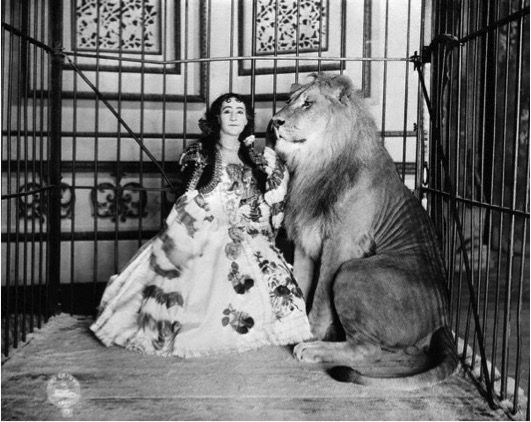
Madame Adjie Castillo with one of her lions in 1897. It was in this cage that a mother cat gave birth to kittens at the Circle Theatre.
Madame Adjie Castillo with one of her trained lions in 1897. It was in this small cage that a mother cat gave birth to kittens at the Circle Theatre.

During the week of June 14, 1903, Madame Adjie and Her Trained Lions was the headline act at the Circle Theatre on Broadway. At the beginning of the week, Adjie had 1 male lion and two lionesses. By the end of the week, she also had a mother cat and several kittens.

Madame Adjie Castillo was born in Saginaw, Michigan, on December 25, 1867. According to news reports, her mother was a Pueblo Indian and her father was a Spanish Jew. Apparently one or both of her parents performed with animals; Adjie was welcomed into the Bostock show when she was a young child, where she learned how to train all kinds of animals.

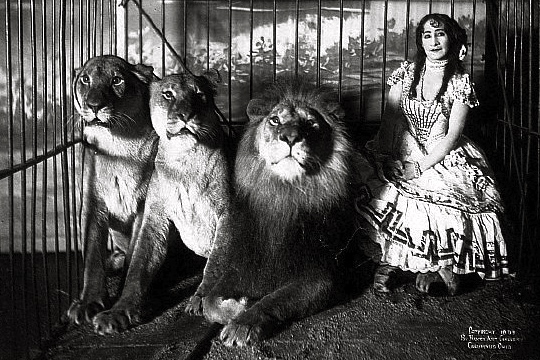
Adjie Castillo and her lions.

Sometime during the late 1890s, Adjie teamed up with a lion trainer named Frank Hall on the vaudeville circuit. On stage, she played guitar and sang Spanish songs to the lions. She also wore ruffled Spanish costumes, which the lions pawed at and tore. “The paid for the dresses,” she once told a reporter. “They made money for me, so why not?”

Adjie Castillo and her lions.
I can’t imagine how the photographer was able to keep these lions still long enough to get such a great photo. The details in this old print are amazing.

Adjie’s relationship to Hall is sketchy: one newspaper article from 1899 said they were married at that time; another said they married in 1910. Still another newspaper said Adjie was engaged to a Brooklyn man named Emerson D. Dietrich, who was “killed and partly devoured” by six of Adjie’s lions during a show in Chicago in June 1914. According to the Fort Wayne News, Emerson was Adjie’s manager and press representative; the two were going to get married that summer.  

Brooklyn Daily Eagle, June 1914.
The Mother Cat Joins the Pride

On June 17, 1903, the New York Evening World reported that a very daring cat gave birth in the cage occupied by Adjie’s lions at the Circle Theatre. Why she chose that dangerous and awkward space to have her kittens is anyone’s guess. The question of why the lions didn’t attack her is also up for grabs.

At first, the lions did not know what to make of the intrusion. They growled a bit and swished their tails.

The mother cat did not let the lions disturb her, and she acted as if she didn’t have a care in the world. She would blink back at them whenever they glanced in her direction, as if to say “leave me alone, I’m busy now.” The little kittens also appeared quite content in their new world on the Circle Theatre stage.

The Evening World, June 17, 1903
Adjia and Her Lions at the Circle Theatre
The Evening World, June 17, 1903

Eventually, the lions began to wag their tails good naturedly, and then “they marched over and paid Mrs. Cat a congratulatory call.” At one point, the smallest of the kittens tried to poke the largest lion in the eye, but all the lions and kittens got along famously together.

According to the Evening World, the mother cat and the lions had a long talk, and it was decided that the two families should live together.

Image may contain: 1 person

Madame Adjie continued working with lions for about 25 years, during which time she raised 116 lions to maturity. In addition to the death of her fiance in 1914, she had one other reported bad accident in 1899, while performing at the Dewey Theatre in New York City.

Adjie Castillo

Apparently, she had tried to coax a lioness over a hurdle, but the large cat attacked her and ripped her right arm from shoulder to wrist. Thirty stitches were required to close the wound. Several women in the audience fainted.

In her later years, Adjie appeared in two silent films: “The Christian” and “The Sign of the Cross” (in both films, a lion was the menace).

A big fan of Franklin D. Roosevelt, Adjie joined the Works Progress Administration in 1936 at the age of 60 (photo at left) and worked on jobs in New York City.  

There is very little information published about Adjie and her lions, so I do not know where or when Adjie passed away. I also do not know how long the cat family remained with her lions.

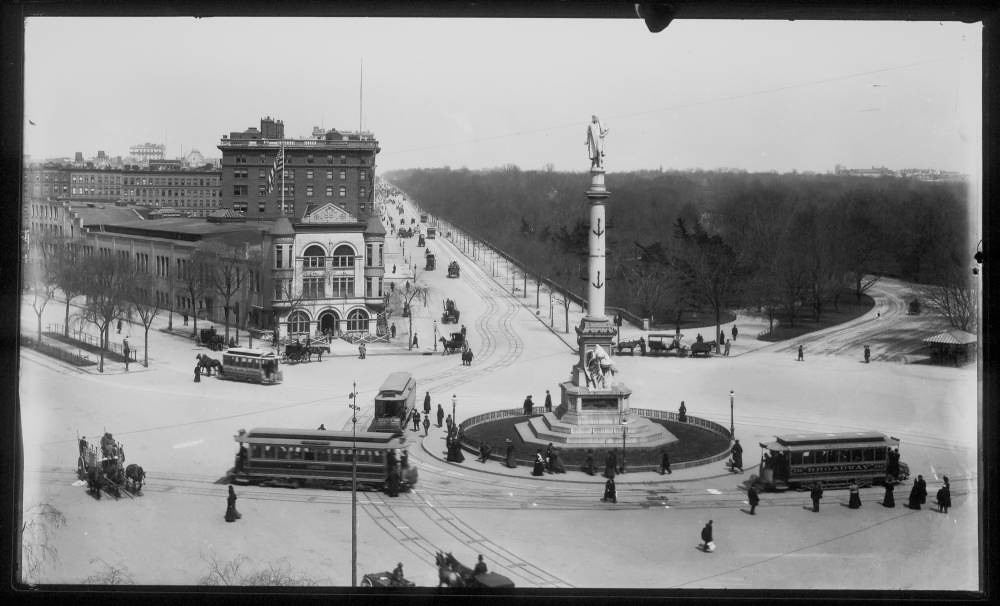
Columbus Circle and the Circle Theatre

Opened in 1901 by Charles E. Evans and his theatrical manager and partner, W.D. Mann, the Circle Music Hall at 1825 Broadway in Columbus Circle was designed to present “high class, polite vaudeville” aimed at middle-class families who lived in the neighborhood. I guess for one cat, at least, this also meant that the venue was a great place to bring kittens into the world.

The location of the theater, at Broadway and 60th Street, was formerly the farm of John H. Tallman, depicted in the map and illustration below.

 Randel Farm Map, showing 53rd to 61st Street, from Sixth Avenue to Ninth Avenue, September 1, 1820.
Randel Farm Map, showing 53rd to 61st Street, from Sixth Avenue to Ninth Avenue, September 1, 1820. The Tallman farm is in the top left corner.
 An illustration of 59th and Eighth Avenue from 1861, with Bloomingdale Road emerging from the bottom center towards the left. The farmland of John H Tallman is depicted. Forty years later, this was the site of Columbus Circle and the Circle Music Hall (later, Circle Theatre).
An illustration of 59th and Eighth Avenue created in 1861, with Bloomingdale Road (Broadway) emerging from the bottom center towards the left, and Eighth Avenue and Central Park on the right. The farmland of John H. Tallman is depicted. Ten years later, this would be the site of Columbus Circle, the gateway to Central Park. Lithograph by George Hayward for D.T. Valentine’s Manual, 1862.  
Columbus Circle was designed as a traffic circle for horses and carts in 1857 by Frederick Law Olmsted, the landscape architect who partnered with Calvert Vaux and Jacob Wrey Mould to design much of Central Park.
Columbus Circle was designed as a traffic circle for horses and carts in 1857 by Frederick Law Olmsted, the landscape architect who partnered with Calvert Vaux and Jacob Wrey Mould to design much of Central Park. Clearing of the farmland began in 1868; the current circle was redesigned in 1905.

Shortly after the music hall opened, a neighboring church reportedly objected to an entertainment venue so close. Following a nearly-year-long legal battle, the church won out, and Evans and Mann were forced to change their venue to an orchestra hall. The public had no interest in such a venue, and thus is was closed by the end of 1901.

The original Circle Theatre at Broadway and 60th Street, 1903--the year the cat gave birth to her kittens in the lion cage. Museum of the City of New York Collections.
The original Circle Theatre at Broadway and 60th Street was designed by architect Charles Cavenaught. This photo was taken in 1903–the year the cat gave birth to her kittens in the lion cage. Museum of the City of New York Collections.

In 1902, an agreement was reached with the church and the Music Hall became the Circle Theatre, now under new management. For a few years, the theater presented only legitimate theater, but within a couple of years, vaudeville was back in. By 1905, when the nearby Colonial Theatre began presenting vaudeville acts, the Circle Theatre switched from lion shows and other acts to burlesque. Occasionally, early motion pictures were also presented at the Circle Theatre.

Columbus Circle in 1912. The Circle Theatre is at the very far left.

In 1906, the Circle Theatre was completely remodeled by Thomas W. Lamb (the roof was raised, a second balcony was added, and the Broadway facade was rebuilt in Neo-Classical style). The Circle Theatre returned to legitimate theater for a few more years until returning to vaudeville and burlesque before Loew’s stepped in to run the theater as a movie house.

Inside the Circle Theatre, 1902. MCNY Collections

Loew’s shut the theater down in 1931, and it operated for the next few years as an independent movie theater. In 1935, during a labor dispute, a bomb tossed into the theater caused massive damage to the lobby and box office.

In August 1935, labor bombers tossed lethal “pineapple bombs” into the lobbies of the Circle and Park Theaters, both owned by the Consolidated Theater Company at that time.
Columbus Circle Roller Rink, 1942. MCNY Collections

The Circle Theatre was gutted in 1939 and rebuilt as the Columbus Circle Roller Rink. The rink survived until 1954, when most of the western side of Columbus Circle was bulldozed for the construction of the old New York Coliseum Convention Center.

The Coliseum closed in January 1998; demolition began in the winter of 2000. The Time Warner/Related joint project, called the Time Warner Center, now stands on the site where a mother cat once gave birth to kittens in a lion’s cage.

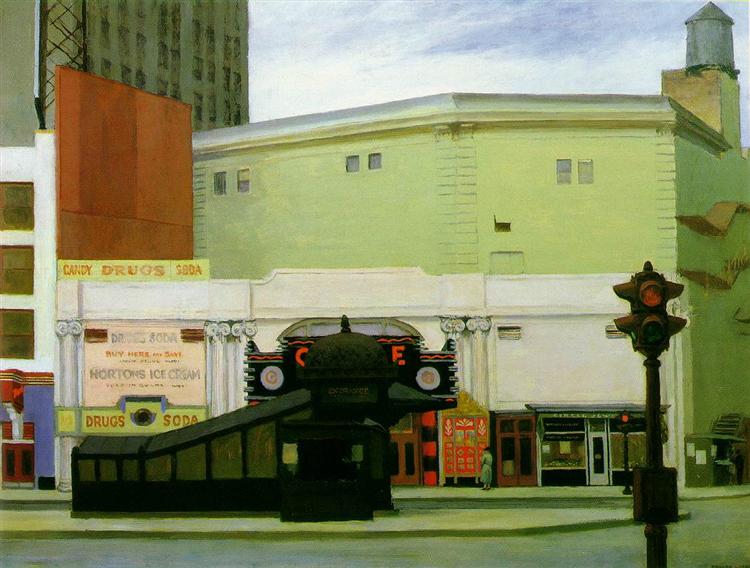
The Circle Theatre, 1936 - Edward Hopper
Edward Hopper’s The Circle Theatre, 1936
Cats in the Mews: June 9, 1907
New York Sun, June 9, 1907
The Cats of Hell's Kitchen
New York Sun, June 9, 1907

The following story is taken word-for-word from the New York Sun. While I seldom ever repeat a news article in full, I don’t feel I can do these poor Hell’s Kitchen cats of Old New York any more justice than the Sun reporter tried to do 113 years ago.

It’s also a great article with the timeless themes of rich vs poor and weak vs strong, and a novel way to explore how one’s birth place and environment greatly affect one’s odds of survival — from a cat’s perspective. So without further ado…

The Cats of Hell’s Kitchen

The cats of Hell’s Kitchen are tough cats. They are tough for the same reason that the cats of Fifth Avenue are genteel. It is all a question of environment.

A Hell’s Kitchen cat transported to Fifth Avenue would probably dive beneath the sofa and remain there until it died. Were a Fifth Avenue cat suddenly dropped off in Hell’s Kitchen, it would die foolishly within a half hour from one (or more) of a dozen causes.

Tommy Casanova Lamb was a Hell's Kitchen cat whose luck turned when he wandered into the Lambs Club on 44th Street when he was just a kitten. Tommy became a life member of The Lambs. To this day, his picture hangs in their clubhouse on West 51st Street.
Tommy Casanova Lamb was a Hell’s Kitchen cat whose luck changed for the good when he wandered into the Lambs Club on 44th Street when he was just a kitten. Tommy became a life member of The Lambs. To this day, his picture hangs in their clubhouse on West 51st Street.

Along all the length of Tenth Avenue from Thirty-second to Forty-fifth there is not a tabby that takes a kind word at its worth. Stop in the middle of a sidewalk some midnight when all the street is deserted save for the shadows that slink from ash barrel to areaway and back to the random lumber pile and call kindly after one of the black streaks that dash across the line of light from the street lamp. It will stop for a fraction of a minute.

Whisper after it soothingly and bend down in inviting attitude and that blotch against the gray of the pavement will dart out of sight in a twinkling. The law of life for cats and men in Hell’s Kitchen is the same; only the swift and the ready in battle live to eat.

A Hell’s Kitchen cat is born where no boy can find it and where no man can crush out its life. Nor must the lean mother forget that there are dogs and larger cats to worry the life out of her young. Away back in the darkness under some tenement or in the loft of a ramshackle barn is the nursery.

Through some hidden crack the mother dodges in and out in the forage for food and while she is gone the infants must not so much as peep lest there come that way a pair of strange green eyes and a ravening mouth. Fear is the first lesson of the kitten, and it is also the stern faith of the grown cat.

Gangs of young street urchins and older boys were a common sight in tenement neighborhoods such as Hell’s Kitchen, pictured here in the early 1900s.
Gangs of young street urchins and older boys were a common sight in tenement neighborhoods such as Hell’s Kitchen, pictured here in the early 1900s. Imagine being a cat trying to survive on this street. New York Public Library Digital Collections

When the sprawling legs have got strength and the blue eyes of the kitten are open and staring then only will the gaunt mother cat allow the toddlers to slip through the hole in the basement boarding or out to the shed roof near the nursery nest. The little fellows roll and tumble over one another, bat with their weak paws in mimic warfare, and claw their brothers as they will claw another cat someday when the supremacy of the alley is at stake between two champions.

The mother lolls near the edge of the corner board where she can keep her eye on the approaches, for even in the brief period when the Hell’s Kitchen kitten may play before the serious work of fighting and eating begins there is ever the danger that lurks behind every kitten’s shoulder.

Abe, the pampered cat of the Hotel Lincoln, was born on the very edge of Hell's Kitchen in 1927.
Abe, the pampered cat of the Hotel Lincoln, was born on the very edge of Hell’s Kitchen in 1927. He got lucky when he decided to patiently wait for an opportunity to enter the hotel when the doorman was not looking. It took a while, but his patience paid off. Here he is with his own chamber maid and French chef.

The infant matures quickly in Hell’s Kitchen, whether he be kitten or baby. Babies are left to fight the flies and the dogs on the doorstep of their mother’s house before they can walk. Kittens must soon begin the sharp fight to live. It is quickly and sternly decisive. Either the kitten can skulk better than his fellow, fight better than his fellow when cornered and thus drive his fellow to the gutter and the street sweeper’s can or his life is short.

The lean, sickly looking shadow that slips warily from ashcan to ashcan by night or hides under the fruit vendor’s shelf in the blazing noonday, dashing out for the scrap of meat flung from the butcher’s stall and back again to cover before a brick or a broom can reach it, is the cat that gains wisdom with each pinched day. He knows no code but that of self-preservation. His enemies are legion.

There is a boy who will train him with a baseball bat for sport. There is the bulldog belonging to the colored sport around the corner, whose cat killing record is the boast of his master. The shopkeeper misses a fish and slays the first cat he corners forthwith. The woman who finds her wash streaked with paw marks wields a murderous broom.

Hells Kitchen tenement, Richard Hoe Lawrence
How can we expect that the cats of Hell’s Kitchen had good lives, when humans lived in even worse conditions? How can we fully blame the humans for treating cats so poorly when their families were starving, afraid, and miserable, too? Photo: Richard Hoe Lawrence. MCNY Collections

One fearful lesson the young cat learns early down in Hell’s Kitchen, avoid the road. How many mangled heaps of fur does he see on those two lines of steel where runs the clanging yellow car? A horse cares nothing for a cat; he will step on one rather than shy and get a lashing from his master. The wagons that roll back and forth in a tangle of spokes first terrify and bewilder, then they kill.

The starveling youngster in draggled fur that lives a day and then another down in Hell’s Kitchen has little choice of foraging. There are the ashcans where scraps of tainted meat may be burrowed for, but if a cat drops into an ashcan his head is below the rim and he cannot see approaching danger.

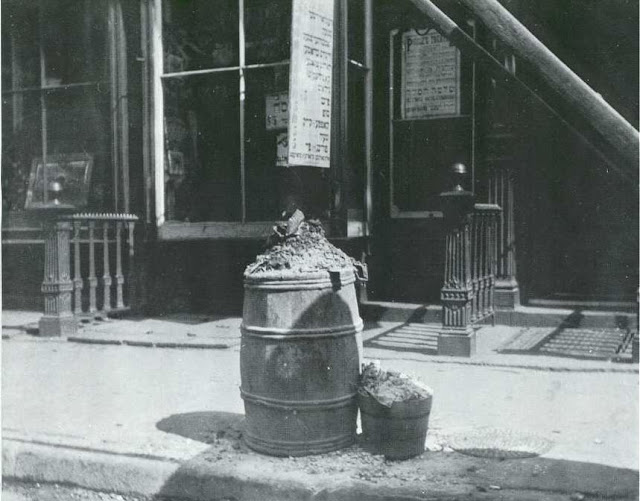
The ashcan, or ash barrel, was a poor source of food for the Hell's Kitchen cats. Photo, Jacob Riis, 1888.
The ashcan, or ash barrel, was a poor source of food for the Hell’s Kitchen cats. Photo, Jacob Riis, 1888.

Or perhaps there is a trail over fences and sheds up to the back stoop where the housewife keeps her meat in a wire safe; should she by any chance forget to latch the door there is more than a meal there, and the whole joint may be carried off to be devoured at leisure. But beware of the meat that lies temptingly within reach in the back yard; it is probably poisoned.

Of course down by the packing houses on Eleventh Avenue there are meat scraps, bones and bits of hides that may be chewed upon. But then there are the dogs — great starved curs that fight all day long. When they have crept to their holes at night there is little left for the cats and the biggest get the pickings. Then, too, where they clean fish at the markets there are delicious morsels if one can dodge between the legs of the cleaners.

 How could a cat safely cross the streets of Old New York? What car, trolley, horse, train, or man would even bother to stop? 

How could a cat safely cross the streets of Old New York? What car, trolley, horse, train, or man would even bother to stop for a lowly feline?

For those that survive the hard months of youth there is one pleasure and one alone. That is the midnight gathering. When all the roaring men and women have gone to their burrows up and down the length of the darkened streets, when the last piano tinkle is stilled and the midnight squad have tramped away from the police station, then come the cats of Hell’s Kitchen to mingle in sweet intercourse.

Out of the dark areaways, hidden alley ends and shadowy lumber yards they come; dodging up the street from shadow to shadow, dashing across lighted spaces like smoky flickerings of an oil light. They slink up the street in the shadows of the tenements to gather in groups of twos and threes and squat with unblinking eyes to yowl into each other’s faces the gossip of the street or to screech sweet nothings of love.

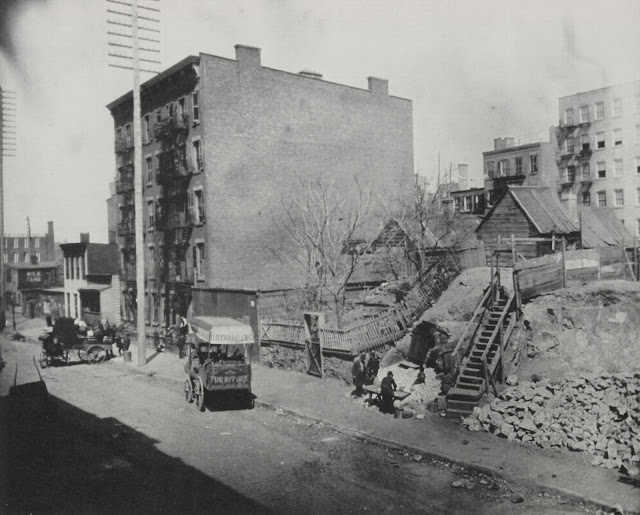
Hell's Kitchen and the Sebastopol slum (rocks) where many goats made their home before 1890. Perhaps some cats found refuge among the rocks and goats.
Hell’s Kitchen and the Sebastopol slum (rocks) where many goats made their home before 1890. Perhaps some cats found refuge among the rocks and goats.

Sometimes two of the younger cats will crouch and spring at each other in mock battle or chase a rubber ball that a youngster has lost in the crack of the coping, but their play is done rather shamefacedly and only in halting fits and starts, for a Hell’s Kitchen cat knows that play is not for him.

These three boys, sitting on a fence in Hell’s Kitchen in 1900, look like they probably took great pleasure in making life miserable for the cats of Hell’s Kitchen. Museum of the City of New York Collections

Cat Men of Gotham Virtual Presentation

Once upon a time, the New York City Post Office employed a feline police squad to protect the mail from rats and mice…

The country’s oldest Brooklyn Navy Yard cat survived a massive explosion on board the USS Maine…

New York City’s first theatrical club hosted a black-tie dinner in honor of its famous feline mascot…

The TWA pilots at the brand-new LaGuardia Airport had a flying feline mascot who won numerous trophies at cat shows…

And a blind cat who wore glasses saved Brooklyn Borough Hall from burning down when he was 27 years old.

Cat Men of Gotham Virtual Presentation

Join me this Wednesday, June 3, for a virtual trip back in time to explore New York City’s history via amazing stories about fire cats, police cats, theatrical cats, and other fabulous felines that made the news headlines in the late 1800s and early 1900s. I’ll be sharing about a dozen of my favorite cat-men tales from my book and blog in a 55-minute presentation on ZOOM via the Boonton Public Library.

If you have read The Cat Men of Gotham, this “Happy Hour” event will give you a chance to see some old news photos of the cats that I couldn’t publish in the book (I could only use high-res photos in the book) as well as maps, actual news headlines, and pictures of some cat-men heroes.

Register to Attend

If you are interested in attending, send an email to: registrations@boontonholmeslibrary.org Put “cat stories” in the subject line. You will then get the link and code to use on Wednesday.

If the library does not get back to you for some reason by Wednesday afternoon, send me an email at pgavan@optonline.net and I’ll send you the link to join the ZOOM presentation.

Registration is limited to a set number of people, so please sign up ASAP.

I look forward to “seeing you” on Wednesday!

Cat Men of Gotham Virtual Presentation
Cat Men of Gotham presentation