Today we have another story about a sailor cat-man, but unlike our hero from the telephone pole rescue story, this sailor ended up on the other side of the law. (And sadly, the ending to this tale is not as happy.)
On January 27, 1897, a sailor named John Dolan was fined $3 in the Essex Market Police Court for being drunk in public. During his arraignment, he carried a tiny pet kitten under his coat.
Unable to pay the fine, Dolan was committed to the workhouse on Blackwell’s Island (now Roosevelt Island). As he left for the island, Keeper Eidensheim of the Essex Market Prison took the kitten away from him.
A few days later, Magistrate Herman C. Kudlich received a letter from Mrs. C.L. King of Flat 6, 252 West 22nd Street, who had read about the incident in the newspaper. Here’s what she wrote:
I read in a newspaper a touching account of the sailor, John Dolan, and the little cat he was carrying around with him. Now my father was a sailor, and has gone safe into the port of heaven these many years. I have, therefore, in my heart always a tender spot for these men who go down to the sea in ships, and my purpose in writing you is to ask you if I may keep the little kitten at my home until John Dolan comes back to claim it, as I have no doubt I could give it better care than Mr. Eidensheim, as I have a nice home and no children to annoy it.
If you will kindly answer per enclosed envelope, I will come to the station after the kitten, and guarantee to return it to poor John when he comes back.
The Essex Market Police Court was bounded by Grand, Broome, Essex, and Ludlow Streets (today the site of the New Design High School). The building was designed by John Correja, Sr., and completed in 1857. The street in this photo at left is the old Essex Market Street, a narrow cross street between Essex and Ludlow streets (closed in 1926).
When Magistrate Kudlick read the letter, he remarked that when it came to cases of destitution that were reported in the news, no letters of assistance ever arrived when humans were involved. “But if a cat obtained the distinction of a newspaper notice, some tender-hearted woman could always be depended on to come to its defense.” The judge nonetheless agreed to send the letter to the prison so Mrs. King could rescue the kitten.
In the late 19th and early 20th centuries, it was common to see 50 or more defendants lined up outside when the Essex Market Police Court opened in the morning. This photo is from an October 8, 1905, New York Times article about plans to abandon the building.
Sadly, when Keepers Eidensheim and O’Brien went searching for the cat, they could not find it anywhere. Apparently, some time during the night Dolan’s pet had escaped from the jail and walked out into the cold, cruel world. Keeper Eidensheim traced the tiny kitten paws in the snow to the rear fence, which explained how the poor kitty had escaped.
If you would like to read more about the Essex Market Court and Prison, check out this story about Minnie, the prison’s mascot cat in the early 1900s. Hmmm, I wonder if Minnie was the little kitten from this story? We can only hope!
On this day in history, the Alexander Avenue police station (former 37th Precinct) in the Mott Haven section of the Bronx acquired a new mascot. It was a “half-starved, black and white kitten not more than four or five inches long.” According to the Evening World, if Policeman Bill O’Malley hadn’t been a sailor in his previous life, the kitten “would have met a terrible fate, instead of lapping up cream from a saucer.”
The feline saga began when Mrs. Solomon Erickson of 576 East 135th Street came into the police station to report some wicked boys abusing a cat near her home. In between sobs, she told Captain Joe Post that she could see the boys through her kitchen window. Her window overlooked what was then Southern Boulevard, between Brook and St. Ann’s Avenue.
“It was a shame, Captain, an outrage” she said. “You must send your men right away and have it stopped.” Her tears reportedly flowed so heavily that the captain could barely make sense of her words.
“Calm yourself, madam, and speak slowly, and I will help you,” he told her. Mrs. Erickson told him about the little kitten on top of a telephone pole, where it had perched since the day before.
“Wicked boys are throwing pieces of ice and sticks at it,” she said in between sobs. “If you don’t send your men right away to stop them I will climb the pole myself and bring down that kitten if it breaks my neck.”
Captain Post called for Policeman O’Malley, knowing he had once been a sailor. “You’re always bragging how you used to be a sailorman and loved to lay aloft in a howling gale,” the captain said. “Now, here’s your chance. If you can climb like you say you can, go with this lady and shin up that pole and save that kitten.”
“Aye, aye, sir,” O’Malley said, while leading Mrs. Erickson out the door.
This photo is from 1931 Brooklyn, but I imagine the scene was very similar in 1909 Mott Haven.
When O’Malley and Mrs. Erickson reached the pole, a large group of boys scattered in all directions. Without removing his coat or cap, the stout policeman (the newspaper used this word, noting that he had put on weight since his sailing days) shinned up the pole with hardly any effort.
In two minutes, he reached the top and came face-to-face with the kitten. She arched her back, swelled her tail, and spat at him.
“Don’t mind that, she can’t hurt you,” Mrs. Erickson reassured him from the street below.
O’Malley seized the clawing and scratching kitten, tucked her under his arm, and slowly made his way down the pole in three minutes time. When he reached the ground, the crowd gathered around the pole began to cheer.
Mrs. Erickson asked the policeman if he wanted to keep the kitten. “You saved her and you deserve her.” O’Malley replied, “Lord bless you, I’ve got two cats of my own and no room for any more. But I’ll take her to the station and we’ll make a mascot of her.”
When the kitten and her cat-man hero returned to the station, Captain Post immediately adopted her as station mascot.
In 1896, the city created a new 37th Precinct in Mott Haven for territory previously covered by the 33rd Precinct, which was headquartered in the old Morrisania Town Hall building (shown here). The new station was constructed at the corner of Alexander Avenue and 138th Street, on land leased to the city by William H. Payne at a rate of $3,500 per year.
Today, the Alexander Avenue police station is the 40th Precinct (aka, the 4-0). Construction is underway on a modern new station for the precinct.
If you enjoyed this story, you may enjoy reading this cat story from 1901, about the cats that took over a Bronx tenement–which, incidentally, was just around the corner from Mrs. Erickson’s house.
On January 24, 1899, a cat reportedly named Eurita sprang out of a mail pouch after the pouch had been unlocked at Branch Post Office H on Lexington Avenue and 44th Street. The unexpected contents gave the postal employees quite a startle, to say the least.
According to The New York Times, there were no postage stamps on the cat, and no tags indicating ownership or providing any explanation for its presence in the mail bag. The only clue was that the bag had been collected from a postal sub-station in F.W. Schoonmaker’s drug store on 42nd Street and Park Avenue (the new Grand Central Terminal had not yet been built on this site).
In 1899, Branch Post Office H was located on the first floor of the Grand Central Palace on Lexington Avenue and 44th Street. Incidentally, the Empire Poultry Show, featuring cats from the Empire Cat Club, took place here n the early 1900s. New York Public Library Digital Collections
The mail clerks soon learned that the cat was named Eurita. She belonged to Mr. Schoonmaker, and had full run of the drug store.
The mail at this particular sub-station was sent down a chute in front of the drug store, where it then dropped into an open mail pouch at the bottom of the chute in the store’s basement. The mail clerks thought that the curious cat must have jumped into the pouch to investigate the items falling into it. Once in the bag, the cat could not get out.
Postal clerks receive mail at the General Post Office at City Hall Park in 1905. New York Public Library Digital Collections
It was further surmised that Eurita had fallen asleep, and was thus taking a cat nap when the pouch was locked up and delivered. According to the Times, “The animal was in the bag only a few hours and did not appear any the worse for its experience.”
If you enjoyed this cat story, you may also like this story about a cat that was mailed through the pneumatic mail tubes in 1897, or this story about a cat and rabbits that were mailed to the Brooklyn Post Office in 1926.
Edward Reinhardt relaxing with a cigar and two of his three cats the night before his execution by hanging at the Richmond County Jail on Staten Island on November 14, 1881.
The Pregnant Woman
On September 15, 1878, three boys tending to their cows near Silver Lake Park on Staten Island found a barrel buried in a patch of soft dirt near a wagon track called Little Serpentine Road. Inside the barrel was the decomposing body of a naked woman with long, dark, braided hair. She appeared to have been pregnant.
The boys ran to New Brighton and told Sheriff Connor they had found a woman stuffed inside a barrel. The news spread quickly through the village, and soon a large crowd had gathered near the lake to watch the sheriff and his deputies remove the barrel from the shallow grave.
Dr. William C. Walser, who conducted the initial examination, discovered that the woman had been about eight months pregnant when her death occurred. Although the woman’s skull was also fractured, the doctor thought she had died in the throes of childbirth–probably from internal hemorrhaging, and possibly during a botched abortion.
Silver Lake Park—once known as Fresh Pond—is located on Staten Island’s north shore, bounded by Forest Avenue and Victory Boulevard. During the 19th century, the area featured a casino and saloon; several companies also harvested ice from the lake. Residents used the lake for boating, picnicking, fishing, and ice skating; later, a golf course, tennis courts, ball fields, and playground were added.
At first, everyone assumed the body was that of Ellen Murphy, a woman who had been described as being “unlawfully intimate” with a Staten Island man named Louis Reige of Clifton. It didn’t take long for the rumors to begin flying that Ellen had probably been the victim of a female abortionist who lived just 300 hundred yards from the burial site.
However, Ellen’s landlady said no such thing had happened. According to her, Ellen had quit her job, packed a trunk, and left her house in August to visit family in Ireland for a few months.
The Potter’s Field at the Richmond County Poor House, where the unidentified remains of the woman were originally placed after the boys discovered her body at Silver Lake.
A Witness Identifies the Killer
Many families came forward to claim the body during the next few days, but all leads came to a dead end (no pun intended). On September 18, the coroner ordered her remains be buried in the Potter’s Field.
Edward Reinhardt, aka The Silver Lake Murderer and the Dandy Dutchman
Authorities finally caught a break, however, when Mr. Gustave “August” Keymer came forward with an important tip. August told Coroner Daniel Dempsey he had encountered a man digging a hole near the lake about six weeks earlier. When he asked the man what he was doing, the man said he was burying a Newfoundland dog that was inside a barrel.
August suggested the man take the dead dog somewhere else so the smell would not offend those using the lake. The man put the barrel in a wheelbarrow and wheeled it down to the ravine, where the woman’s body was later found. (This man was obviously not very bright.)
New York Daily Herald, October 8, 1878
With August’s tip and additional evidence left at the crime scene, the sheriff and his deputies were finally able to identify the mystery barrel man. As additional pieces began to fall into place, they soon were convinced that the “canine undertaker” was also the Silver Lake killer.
The suspect was Edward Reinhardt, 25, who had operated a candy and tobacco store on Gore Street (now Broad Street) in Stapleton for a short time while he lived there.
According to his landlady, Mrs. Josephine Herborn, Reinhardt was married to a woman named Annie (later determined to be Mary Anne Degnan of Newark, NJ). Annie had told Mrs. Herborn that she was pregnant and worried because her husband was abusing her.
During the trial, Mrs. Herborn testified that Reinhardt had moved out of her home on July 19, 1878. Before he left, he told her that he had to deliver a heavy barrel full of crockery to his sister’s house. She did not see Annie that day, although she did hear Reinhardt call out her name the morning he left.
Rhinehardt was last seen wheeling the beer barrel up the Richmond Road (now Van Duzer Street). Annie was never seen again.
The beer barrel was traced to the George Bechtel Brewery in Stapleton, which was less than a half mile from Mrs. Herborn’s home. The brewery, founded in 1853, was the largest brewery on the island. Old stables on Van Duzer Street are all that remain of the brewery, which closed in 1907.
Edward Reinhardt lived in a home on what was then still called Gore Street, somewhere very close to the George Bechtel Brewing Company. Today this is the intersection of Broad and Van Duzer Streets. New York Public Library, 1884 map.
So Where Do the Cats Come In?
By the time the authorities caught up with Reinhardt, he was living at 132 Broome Street on Manhattan’s Lower East Side with his new wife, Pauline Ditmar, whom he had reportedly married on July 13–just six days before killing his wife. He was employed at a marble shop at 125 Attorney Street.
It was August Keymer who broke the case by identifying Reinhardt as the man he saw digging the hole. Following further investigations, Reinhardt was arrested and sent to trial for murder.
There is a lot more to this story, but in the end, Reinhardt was eventually sentenced to hang for the murder of Mary Anne Degnan Reinhardt. He was sent to the Richmond County Jail, where–when he wasn’t trying to escape–he spent his time making miniature ship models out of wood and barrel beads, painting murals on his cell wall, and conversing with three cats who shared his cell with him.
According to The New York Times, Reinhardt had raised the cats since they were kittens. For more than two years, as Reinhardt awaited his final destiny, the cats lived with him in his jail cell.
Edward Reinhardt gets some attention from one of the three cats that shared his cell as he paints a mural on the wall.
On the last night of his life, Reinhardt spent the night in the jail corridor. The “death watch” assigned to stay with him comprised sheriff deputies John G. Vaughan, John J. Warner, and C. Rutan, and police officers Fitzpatrick and Clarins.
After smoking a few cigars and tearing up a letter from his second wife telling him about their young child, Reinhardt asked Officer Fitzpatrick to take care of two of his prison cats. He requested Deputy Rutan to take charge of the third cat. I hope his final requests were granted.
The Public Execution
On January 13, 1881, the gallows from New York City’s Tombs prison were transported to the Richmond County Jail courtyard, where a temporary fence had been installed to provide some privacy. Numerous arrangements were made throughout the village to accommodate the hundreds of people expected to turn out for Staten Island’s first execution in more than 100 years.
On the morning of January 14, Reinhardt was led into the courtyard and stationed under the rope with his back to the crowd. The sheriff drew a black cap down Reinhardt’s face and gave the signal for the hangman to drop the weight at 10:04 a.m.
The attending physician pronounced Reinhardt dead at 10:17–a very long 13 minutes after the weight had dropped. Reinhardt was buried at the Silver Mount Cemetery, not far from Silver Lake.
Richmond County Courthouse (left) and Jail in New Dorp, where Reinhardt was executed.
The Last of the Executions by Hanging
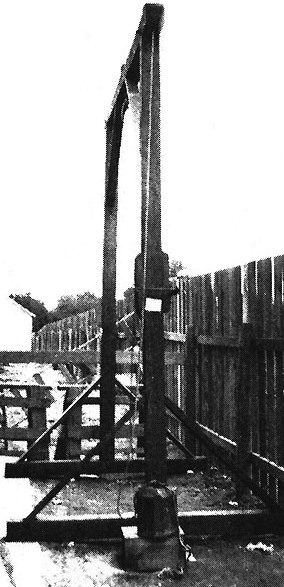
This device, called a gibbet, was probably like those used in executions at The Tombs and at Edward Reinhardt’s hanging. It was operated by releasing a counter weight, which, if set up properly, caused a rope and noose to lift up with such sudden force as to break the person’s neck.
The last legal execution by hanging in New York City at The Tombs took place on December 5, 1889: that of Henry “Handsome Harry” Carlton, 27, who had killed a police officer on October 28, 1888. The last legal execution by hanging in New York State took place just one day later at Brooklyn’s Raymond Street Jail. John Greenwall, 30, a tailor, was hung for being found guilty of a burglary-murder.
On January 1, 1889, a new law went into effect that required the state—rather than the county—to carry out death sentences using electricity, which was considered to be a more humane method to take someone’s life. However, individual counties continued to conduct executions by hanging until August 6, 1890, when the world’s first electrical execution took place in Auburn Penitentiary for ax-murderer William Kemmler.
If you enjoyed this tale of murder and feline friendship, check out this story about Tipsy, a midtown mouser who helped solve another gruesome murder in 1912. h
This is not Angelic Schuyler Reed, but I imagine she may have looked like the woman in this vintage photo.
In November 1908, a “well born and well bred” woman was forced to move out of her old Yorkville mansion at 122 East 83rd Street. The woman, Mrs. Angelica Schuyler Reed, was described as a “tall, gaunt, gray woman” who had been a “childless widow for 15 years.”
According to the New York Evening World, she was also a member of Old New York’s most aristocratic families, the Schuylers.
For seven years, Mrs. Reed had lived in the Yorkville home with numerous cats and dogs. Although she had originally leased the home from the Presbyterian Synod, she said the property changed hands following a lawsuit in 1906, and she no longer knew who her landlord was.
For several weeks leading to that fateful day in November, Mrs. Reed had been sharing her rapidly dwindling resources with her cats and dogs. Neighbors said she had been destitute for about a month, and would go searching through ash barrels for bits of food to feed her pets.
Although the animals seemed to be doing fairly well, Mrs. Reed was starving herself to death. Her condition was finally brought to the attention of the Health Department via a report on the condition of her home from the Bide-a-Wee Society for animals.
Angelica Schuyler Reed was a descendant of Philip Schuyler, a general during the Revolutionary War and a US Senator.