Uno cross-dressing dog
I couldn’t find an actual photo of Uno, but don’t you just love this funny, dressed-up pooch?

During vaudeville’s heyday in the late 1800s and early 1900s, animal performances were a dime a dozen on New York stages and rooftop gardens, such as Proctor’s Fifth Avenue Theatre.

Performing dogs like Dan the Drunken Dog and Don the Talking Dog were favorites with the crowds at places like Hammerstein’s Roof Garden and Tony Pastor’s Fourteenth Street Theatre.

One of the most famous performing pooches was Uno, a nondescript male terrier that was billed as “The Mind-Reading Dog,” “The Educated Dog,” and “The Dog with a Human Brain.” Uno was the prodigy of J.C. Pope, a vaudeville performer and agent aligned with John R. Price’s Popular Players touring theater troupe.

After spending several years performing in California and the Midwest, Uno and Pope made their New York debut in 1909 at Keith & Proctor’s Fifth Avenue Theatre, which was located just off Broadway at 31 West 28th Street. According to a review of the 13-minute show in Variety, Uno was a big hit with the audience, not so much for what he did, but for how he did it (in other words, I think he was a bit of a drama queen).

Don the Talking Dog
Don the Talking Dog was one of the headliners at Hammerstein’s Roof Garden and other theaters in the early 1900s.

The performance began with Uno walking on stage all dressed in female attire, from cloak and dress to corset and other feminine undergarments. One by one, J.C. Pope would remove each item of clothing in a manner that mimicked burlesque – which got a lot of laughs – and then he’d ask Uno to pick them up as he called for each item.

Uno also picked up coins of various denominations as well articles from the audience, such as a watch or pipe. The act would always conclude with Uno and Pope playing a musical selection on the bells (J.C. played all but one bell and Uno was trained to chime in with his bell at the appropriate time).

According to most reviews, Uno was a male dog. But in one theater review, the critic reported that Uno was a female dog:

Uno is a success and her stay in vaudeville may only he determined by the years she remains upon Mother Earth. The fourteen minutes of her act were none too many.—The New York Dramatic Mirror, April 30, 1910

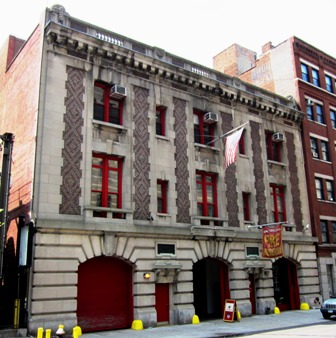
Fifth Avenue Theatre
Uno and J.C. Pope performed for audiences on this stage at the Fifth Avenue Theatre in 1909-1910.

Uno also apparently had an understudy in case she (or he) was unable to perform for whatever reason. As for actual mind reading, my research did not reveal any demonstrations of this talent.

The Fifth Avenue Theatre

The Fifth Avenue Theatre on West 28th Street – and the ground on which it was built – has some very interesting history going back to the 1600s. I’ve also discovered some old photos from an architectural review of the new theater (Scientific American Building Monthly, January 1893) that I think many readers will enjoy.

The land goes back in American history to about 1670, when Sir Edmond Andros granted a land patent to Solomon Peters, the son of Pieter Santomee, a free African American who had once worked for the Dutch West India Company. In his will dated November 30, 1694, Solomon bequeathed his land, including 30 acres bounded by Abington Road (21st Street), the Bloomingdale Road (Broadway), Seventh Avenue, and 28th Street, to his wife, Maria Antonis Portugues.

Randel Farm Map 1818
A portion of the old Solomon Peters tract — later the Isaac Varian farm — is shown on the 1818 Randel Farm Map. Notice the structures to the right at the foot of 26th Street, between Sixth Avenue and Broadway — this is the old Varian homestead.

In 1716, Maria’s heirs (which may have included grandson William Smith of Orange County, NY), conveyed the land to John Horn, a wheelwright, and Cornelius Webber, Horn’s brother-in-law. In 1751, Jacob Horn conveyed about 17 northerly acres of the Horn farm to John De Witt, a Dutch farmer.

Along comes Isaac Varian, a butcher and farmer, who purchased the land from De Witt’s executors for 1,280 pounds in 1787. Isaac established his homestead on the Bloomingdale Road (Broadway) just north of 26th Street (see map above), where he lived until his death. (And Varian lived quite the life: He was married three times, had 16 children, and was 79 years old when he died in 1820.)

Isaac Varian Homestead
At least two generations lived at the old Varian homestead until it was demolished in 1850 to make way for new townhouses. At that time, a grandson, Richard Varian, was living in the house with his wife and their children, all of whom were born there. With the old homestead gone, Richard had a new home built at 27 West 26th Street, where he lived until his death in 1864.

Over the years, starting around 1830, the many heirs to the Varian estate began selling off their allotted lots to individual buyers and speculators. But one great-granddaughter, Lucy Varian, held fast to her land.

The Varian Homestead Tree
One of the last reminders of the Varian homestead was this tree in front of 1151 Broadway, near 26th Street. The tree had once marked the gateway to the old Varian farm and homestead, and it stood until just before 1880.

Even after Lucy married Henry Gilsey, the son of real estate mogul and city alderman Peter Gilsey, she refused to sell to her own father-in-law. He had to lease the land on which he built his house and performance hall on West 28th Street.

Gilsey’s Apollo Hall

The Fifth Avenue Hotel began as Apollo Hall, which was erected by Peter Gilsey on the north side of 28th Street, a few doors west of Broadway, in 1868. Gilsey also built a rowhouse next door at 33 West 28th, where he and his family lived.

Apollo Hall was only two stories, with the upper floor used for lectures, readings, balls, and political meetings; the lower floor for public amusements. It opened October 16, 1868, with a concert by Jerome Charles Hopkins, founder of the Orphean Free Schools for musical instruction, the proceeds of which went to the school’s fund.

1863 Draft Riots New York
Many buildings on West 28th and 29th streets were burned down during the 1863 Draft Riots, including the offices of Provost-Marshal Benjamin F. Manierre, shown here, at 1190 Broadway (southeast corner of Broadway and 29th). The small wooden structure in the foreground may be the old Casper Samler cottage, which stood at the northeast corner of Broadway and 29th until 1869, when Peter Gilsey built the iconic Gilsey House on the site (still extant).

Soon thereafter, the hall underwent a complete overhauling and was reopened April 17, 1871, as Newcomb’s Hall (W. W. Newcomb, manager). Six months later, John E. McDonough and H. A. Eamshaw took over management and reopened the hall on October 23, 1871, as The St. James Hall and then the St. James Theatre.

Peter Gilsey house and Apollo Hall
The old Fifth Avenue Theatre at #31 West 28th Street (center) and Peter Gilsey’s home at #33 (left) as they appeared before 1891. Peter died in the home on April 8, 1873, and was buried in Green-Wood Cemetery in Brooklyn. Family members continued to live at the home.

In June 1873, the Gilsey estate began transforming the building into a true theater with seating for 1,900 people. The work was completed in December 1873, whereupon theater manager and playwright John Augustin Daly obtained a lease for the new venue. Daly was in need of a new theater, having lost his Fifth Avenue Theatre on 24th Street (adjacent to the Fifth Avenue Hotel) in a fire on January 1, 1873.

Daly opened the new theater on December 3, 1873, and renamed it the New Fifth Avenue Theatre. He continued as proprietor until 1877, which was the same year a ventilation system was installed that blew air over blocks of ice, making the venue the world’s first air-conditioned theater (there’s a good trivia question for you).

Daly was followed by John T. Ford, who removed “New” from the name, and then Eugene Tompkins, “the Napoleon of theater managers,” took over the lease on the building.

Here’s where the plot thickens a bit.

Fifth Avenue Theatre 24th Street
In 1865, the Christy Minstrels converted an illegal stock exchange next to the Fifth Avenue Hotel into a theater. Augustin Daly managed the theater from 1869 to 1873, when it burned down. The theater was rebuilt in 1879 and demolished in 1908 to make way for an office building.

In 1889, Andrew and Henry Gilsey, two of Peter’s seven children, decided to demolish the house and the old theater and build a new theater facing Broadway.

To help finance this plan, they told Tompkins they would only renew his lease in 1891 if he agreed to make repairs to the old theater and also build a new theater at a cost from $100,000 to $150.000 in 1891.

Tompkins refused the terms of the deal. Turns out he had discovered that while the ground covered by the auditorium belonged to Peter’s sons, the ground covered by the stage still belonged to Lucy Varian Gilsey (remember her?), who, surprise, surprise, refused to renew the lease under any terms (so much for building a new theater).

Tompkins turned the lease over to H.C. Miner for the 1890-91 season. Those in the theater industry who read the terms of the lease felt that Miner was getting a bad deal, since it would probably cost more than $150,000 to build a new theater.

A Timely Conflagration

Augustin Daly
Augustin Daly was only 35 when he took over the New Fifth Avenue Theatre on 28th Street.

“They did all in their power, but the place was like a tinder box, and its four high walls were like a chimney. The fire whirled and swirled in it pits, and as it rolled upward and spread out in the wind it made one of the most imposing spectacles that New York has seen in years.”—New York Times, January 2, 1891

Well, wouldn’t you know that a curious thing happened on January 2, 1891, about a half hour after all the performers in that Friday evening’s production of “Cleopatra” had left the building. At about 11:45, night watchman Daniel Finn reported flames coming from the cellar of the theater. There was barely enough time to grab a few stage props and run.

By the time firemen arrived on that windy night, the fast-moving fire was not only burning down the theater but also threatening to destroy several other nearby buildings, including 1185-1193 (I.&I. Slater), 1195 Broadway (Herrmann’s Theater), 1182-1196 Broadway (Sturtevant House), and 33 West 28th Street (Mrs. Peter Gilsey’s residence).

Gilsey family
Mary C. Gilsey, seen here with their two daughters in this 1854 portrait by Louis Lang, was still living at #33 next to the theater when it burned down in 1891. She died on September 13, 1891.

According to a report in The New York Times the next day, the Gilsey brothers, and Harry Miner, in particular, didn’t seem too upset as they watched the flames destroy their property:


“Harry Miner, the proprietor of the Fifth Avenue Theatre, was one of the coolest of the spectators. He looked on the flames that were consuming his property and was not once heard to bemoan his misfortune.”

Andrew Gilsey estimated the total loss at $156,000, including damage to the home and complete destruction of the theater. He told the press he had $80,000 in insurance coverage (a nice amount to put toward a new building). Harry Miner’s loss was about $30,000, but he had $20,000 of insurance coverage.

Iron framework, new Fifth Avenue Theatre
The new theater was built to be completely fireproof, with an iron framework, seen here, a cement and asphalt scene pit, and fireproof arching erected by the Guastavino Fireproof Construction Company.

An investigation into the origin of the fire was made by the Fire Marshal, and it was his opinion that the flames were started by a lighted cigarette (and maybe an accelerant of some sorts?).

A New Fifth Avenue Theatre

With insurance money and a good excuse to build a new theater (and by this time Lucy had finally given in and began selling off her lots), the Gilsey estate promptly hired architect Francis Hatch Kimball to rebuild a new, fireproof Fifth Avenue Theatre.

Fifth Avenue Theatre foyer
“The W. 28th Street lobby was a sumptuous sight to behold, with various shades of marble on the walls, gilded columns, plasterwork and intricate stained glass windows. The halls were lined with mirrors, adding a feel of depth to the narrow space, and lined with marble Ionic columns and pilasters. Persian carpets, imported draperies and artwork added to the luxurious atmosphere.”–Scientific American

The Neo-Classical structure featured heavy terra-cotta decoration, gilt plasterwork, and a richly decorated entrance on West 28th Street (the main entrance was later moved to 1187 Broadway). The auditorium was parallel with 28th Street, while the stage occupied the site of the old Gilsey home.

Fifth Avenue Theatre
The theater could accommodate 1,400 patrons, but unlike its predecessor, and many of its contemporaries, it featured rows of seats, both on the orchestra floor and in the balconies, rather than benches.

The new Fifth Avenue Theatre opened on Saturday night, May 28, 1892, with Maurice Barrymore’s and Charles Poemer’s comic opera, “The Robber of the Rhine.”

Henry Miner continued to manage the theater until Frederick Freeman Proctor took control in 1900. Proctor teamed up with Benjamin Franklin Keith, and in 1906 the vaudeville chain redecorated the theater for vaudeville presentations — like Uno the mind-reading dog.

When their partnership dissolved in 1911, the theater was renamed Proctor’s Fifth Avenue Theatre.

By 1915, Proctor was showing motion pictures in addition to vaudeville acts. Sometime after 1929, Proctor bowed out and movies were replaced by burlesque shows. On April 8, 1936, Emigrant Industrial Savings Bank acquired the property in a foreclosure.

The old theater was demolished in 1939.

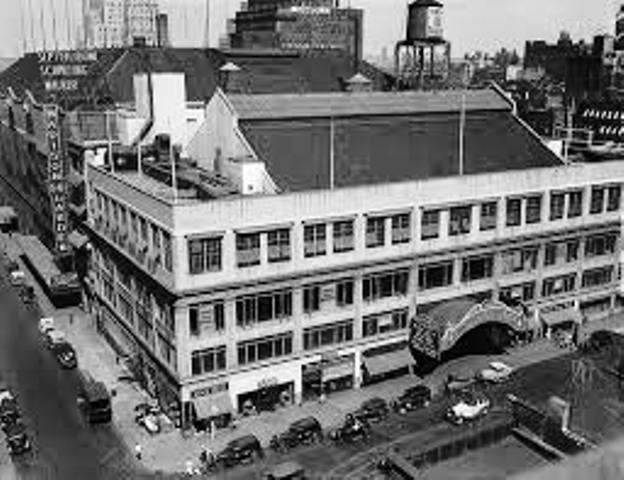
Fifth Avenue Theatre
In 1939, the Fifth Avenue Theatre was demolished forever. In order to reduce taxes for the company, Emigrant Industrial Savings Bank decided to turn the site into a parking lot. Today it’s a multi-level parking garage and one-story structure with retail shops.
1151 Broadway
The old Varian tree, the gateway to the Varian farm and homestead, once stood in front of 1151 Broadway, pictured today (Rico Wholesale). If you ever happen to walk by here, close your eyes and picture an old frame house and farmland.
Organ Grinder and Monkey, Washington Heights
In 1935, this Washington Heights performer was one of the last organ grinders legally allowed to perform in New York City. Museum of the City of New York Collections

If you’re like most people reading this, when you hear the term “organ grinder” you immediately picture a man of Italian descent playing the bulky instrument with a Capuchin monkey at his side collecting coins in a tin cup. I would not expect you to envision an Irish organ grinder like Timothy McGrath.

It may be stereotypical, but you can’t be blamed for thinking this way. By 1880, according to author Tyler Anbinder in his book Five Points, nearly one in 20 Italian immigrant men in New York City’s Five Points neighborhood were organ grinders. And most of them had a companion of the primate persuasion.

One organ grinder who broke the mold was Irishman Timothy McGrath, who, for over 10 years, played his hand-organ along 7th and 8th avenues in New York City’s Tenderloin District. Instead of a monkey, Timothy had a grizzly-haired Skye terrier who would sit on top of the organ wrapped in a blanket and holding a basket in his mouth. Women passersby simply could not resist placing a few coins in the basket, even when their male companions scorned their actions.

“Beggar’s dog – Hoboken,” ca. 1910-1915
Many street performers and beggars, like this man in Hoboken, N.J. in the early 1900s, used pet dogs to win over women and children, who were more apt than men to place coins in the dogs’ baskets. Library of Congress

Like many street performers in those days, Timothy was nearly blind. But he was able to get around the neighborhood and live on his own in a small third-floor room at 402 West 38th Street.

Timothy moved into the small room around 1881, shortly after his wife and two children took ill and died within weeks of each other in the family’s small brick home, also on West 38th Street. (They may have died of diphtheria, which killed almost 5,000 Manhattan residents in 1881.)

Save for his daily organ playing, Timothy lead a very secluded life for the next 20 years. In fact, his only true human companion was James Brown, a tailor who had a shop on the ground floor and also served as the building’s janitor.

402-408 West 38th Street
Timothy McGrath lived in the tenement building at the very left of this 1932 photo of 402-408 W. 38th Street. Today this area is a vacant lot. Museum of the City of New York Collections

Timothy was no doubt familiar with the neighborhood because he had spent all his teenage and adult years living in the West 30s along 9th Avenue. It was here he attended the New York Institution for the Blind from about 1855 to 1860, receiving not only general education lessons but also taking part in a pilot manufacturing workshop in which adult residents made basketry, mattresses, and other items for sale.

Timothy McGrath’s Neighborhood

The history of the Old New York neighborhood in which Timothy the organ grinder lived – today located on the edge of Hell’s Kitchen and the Garment District – goes back to about 1639, when it was leased by Dutch settler Hendrick Pietersen van Wesel. (Hendrick’s farmhouse was identified on the 1639 “Manatus Map” as farm number 15.)

In 1647, Governor Willem Kieft granted this farm to Adriaen Pietersen van Alckmaer, and following the death of his heirs (around 1657), the land reverted to the Dutch East India Company.

The Weylandt Patent

Blue Book Map of Farms, Weylandt Patent
The Weylandt Patent extended from the shores of the Hudson to just west of Bloomingdale Road (present Broadway), north to Reed Valley and the Great Kill (40th to 42nd Streets), and south to 28th Street. Take notice of the large structure on the Isaac Moses farm, right center, which comes into play later. Blue Book Map of Farms, 1815; NYPL Digital Collections

In 1668 the first English governor, Richard Nicolls, granted the land now known as the Weylandt (meadow) Patent to three Dutch farmers for the purpose of pasturing their cattle and horses. The patent encompassed 300 acres and was bounded by the Hudson River, the Bloomingdale Road (Broadway), the Great Kill (where three streams converged at 10th Avenue and 40th Street), and Clapboard Valley, a small semi-circular fenced-in meadow with a little stream between 28th and 30th Street.

The three recipients of the Weylandt Patent divided the area into six parallel lots, running east to west, for the entire width of the grant: Cornelis van Ruyven (Lots 1-2), Allard Anthony (3-4), and Paulus Leendertse van der Grift (5-6).

Fast-forward 100 years to 1757, when Lot 5 (about 38th-42nd Street), now owned by Mathias Ernest, included a dock at the river and a small wooden house that was once a roadhouse and now used for the manufacture of glass bottles. (Although Ernest’s glass venture failed, the entire neighborhood came to be known as the Glass House Farm through much of the nineteenth century.)

Rapelje Farm
Sometime after the Revolution, merchant and ship builder Rem Rapelje purchased the northeast portion of the old Weylant Patent from about 30th to 42nd Street between 8th Avenue and the Hudson. He built his farmhouse, seen here, at the foot of 35th Street. A portion of this land was purchased by the Chemical Manufacturing Company (later, Chemical Bank) in 1827 and the farmhouse was torn down in 1865. Today this is the site of the Jacob K. Javits Convention Center.

By 1780, most of the patent land was owned by Rem Rapelje and Jacobus Van Orden, who had inherited several southern lots from his grandfather, Johannes van Couwenhoven. When Jacobus died in 1782, his lots went to his daughter Madgalena, the wife of Thomas Tibbet Warner.

Two years later, Warner conveyed the land, which included a large house and barn, to John Watts, who in turn sold it in 1795 to Isaac Moses and Benjamin Seixas. (Talk about real estate flipping!)

In 1832, wealthy iron merchant James Boorman purchased the old Isaac Moses farm from Moses L. Moses and adjacent lots from Samuel Watkins. (By now, the original six lots of the Weylandt Patent had been subdivided into numerous building lots for future development, but most of the land had yet to be improved.

The roads in this part of Manhattan were still not paved, and city water, sewer, and gas lines did not yet exist.) Boorman named his new estate Abington Place.

New York Institution for the Blind
The New York Institution for the Blind, pictured here in about 1840, was built on the former Isaac Moses and Samuel Watkins farms, between 8th and 9th Avenue and 33rd and 34th Streets. The large, turreted Gothic revival building faced Ninth Avenue. The building in back may be large house shown on the map above.

The New York Institution for the Blind

At the same time all these real estate transactions were taking place in the 1830s, three prominent New Yorkers were in the process of starting a school for blind children — first in a private home on Mercer Street and later, at 62 South Street. On March 15, 1832, the New York Institution for the Blind, under the leadership of founders Samuel Wood, a Quaker philanthropist; Dr. Samuel Akerly, a physician; and Dr. John Dennison Russ, a philanthropist and physician, held its first class for three blind children. Two months later, the school had six students.

Looking to greatly expand the school, the Institution sought benefactors to donate land or money. James Boorman responded by offering to lease to the school, for nine years, 32 lots with buildings, including a large, two-story marble mansion that was unoccupied. The rent: one peppercorn per year.

James Boorman
James Boorman was born in Kent County, England, in 1783. In addition to being a successful merchant, he was the director, vice-president, and president of the Hudson River Railroad Company and one of the founders of the Bank of Commerce.

As described in the New York Evening Post, August 15, 1833:

The main building on the premises is a large substantial two story house, 100 by 54 feet, situated on a rising ground overlooking the Hudson River. There are also two stone kitchens apart from the main building, and a well of good water near the house.

The ground is now in good order, under cultivation as a garden, and contains a little’ over two acres. The situation is stated to be one of the pleasantest on Manhattan Island, in the immediate vicinity of the city, and offers fine air, good soil for cultivation, a shady grove and flower garden, with wide and level paths.

The house is very large, two stories high, with a spacious attic, abundantly large enough for a workshop and place for exercise in bad weather, while the distance from the City Hall is only about three miles.

Classes began at the new school building on October 10, 1833. By the end of 1834, the school had 26 pupils.

In 1837, the Institution purchased the western half of the large lot and began construction on a stone Gothic revival building. The original marble estate was demolished in 1840, and in 1850, a three-story brick workshop called the Manufacturing Department was erected on the site of the former estate. It is here Timothy McGrath received occupational training and made products for which he received about $300 after graduating the school in 1860.

New York Institution for the Blind, 1870
In 1870, a fourth floor was added to the school in addition to central steam heating. In 1922, the school began construction on a new facility in the Bronx on an 18-acre parcel of the Vincent Astor Farm just off today’s Pelham Parkway. Today the institution is called the New York Institute for Special Education.

The Passing of Timothy McGrath, the Irish Organ Grinder

In January 1901, the Irish organ grinder took ill. James Brown, his only companion, started checking on him daily to make sure he had enough food to eat (his diet consisted of bread and condensed milk).

About a month later, the dog, whom I call Timothy II, passed away, reportedly from starvation. For several days later James tapped on Timothy’s door to see if he needed more food, but each time Timothy said, “No, nothing. I have plenty of bread left for several days.”

William Sloane House YMCA
On January 1, 1930, the William Sloane House, the largest YMCA residence in the U.S., opened on the site of the former Institution for the Blind. In the 1993 the building converted to condos. The building in front is occupied by B&H Photo and Video.

On February 9, 1901, Brown got no answer when he knocked on Timothy’s door. He summoned a policeman, who broke down the door and found the organ grinder dead. An ambulance surgeon said Timothy, who was 58 years old, had died from the cold and lack of nourishment.

The big surprise came when police opened a tin box that they had found in the room. Inside were two bank books (Emigrants’ Savings Bank and Bank of Savings), showing credits totaling $15,000. They also found the deeds for a house on 40th Street, off Fifth Avenue, two lots near Greenwood Cemetery, a life insurance policy, and deeds for a lot and monument in Calvary Cemetery.

Timothy II the dog had obviously collected a lot of pennies in his basket over the years he worked as the mascot for an organ grinder.

According to news reports, Timothy McGrath had a brother who had two daughters and a son who worked as a letter carrier. But even after his story was published in several New York newspapers, no one came to the city morgue to claim his body or his property.

Snooky New York City Hall Cat

Fusion, aka Snooky, had white fur flecked with russet and dirty yellow markings – and patches of coal from having just discovered Mayor LaGuardia’s coal bin. Here she poses in her first official photo shoot with Councilman J.E. Kinsley.

On May 3, 1939, one month after popular City Hall cat Tammany died at the Ellin Prince Speyer Hospital, an 11-month-old multicolored female cat from Woodside, Queens, made her debut at City Hall. The cat was the pet of City Hall night watchman Tom Halton, who had been greatly saddened by the passing of Tammany.

Upon her arrival, the City Hall reporters named her Fusion, both for her coloring and for the newly formed City Fusion Party, a coalition of progressive Republicans, liberal Democrats, good-government types and independent Socialists who helped put Fiorello H. LaGuardia in the mayoral office. (A few reporters wanted to call her Confusion.) The reporters also welcomed her with catnip and a dish of ice cream.

Fiorello Henry LaGuardia

Fiorello Henry LaGuardia was the 99th Mayor of New York City for three terms from 1934 to 1945.

Although the name fit her very well, Tom Halton insisted that her name – the name he had already given her – was Snooky. To prove that her name was Snooky, he even produced a white collar for her on which was printed “Snooky—City Hall.” Some reporters obliged, but for years many newsmen continued to call her Fusion.

Snooky immediately fell into a daily routine, which included wandering from room to room with a rather proprietary air, stretching out on the city budget report (a large volume kept in the press room), and attending conferences in Mayor LaGuardia’s office and meetings of the Board of Estimate. Every night at 5 p.m. Tom would feed her dinner of canned salmon or tuna fish, which he kept cold in the press room water cooler.

Brooklyn-Long Island Cat Show

In December 1941, Snooky was a guest of honor at the inaugural cat show of the Brooklyn-Long Island Cat Club at the Hotel St. George Roof Garden. Each guest cat sat on a dais, with his or her personal history written on the seat. Here, Mrs. Silas H. Andrews, president of the Brooklyn-Long Island Cat Club, holds Boots during the inaugural cat show.

No More Salmon for Snooky

Soon after America entered World War II, it became apparent that voluntary conservation of goods would not be adequate, so numerous restrictions were put in place. On January 30, 1942, the Emergency Price Control Act granted the Office of Price Administration (OPA) the authority to set price limits and ration food and other commodities to discourage hoarding and ensure equal access to scarce resources.

Sugar was the first item to be rationed (and only available for purchase via government-issued food coupons), followed by coffee, meat, cheese, fats, canned fish, canned milk and other processed foods.

When the initial freeze on canned fish went into effect in 1943 (a freeze preceded rationing for canned fish), Tom Halton had only one can of salmon in reserve for Snooky. As he told a reporter for The New York Times, he feared that Snooky would resort to killing the sparrows and pigeons in City Hall Park if she did not approve of the fish substitutes.

War Ration Book WWII

Every American was entitled to a series of war ration books filled with stamps that, along with payment, could be used to buy restricted items. I have a feeling City Hall did not use any of their stamps to purchase canned salmon for Snooky.

Slippers, a cat who lived in Lawrence, Long Island, “read” the story and sent Snooky a can of soy substitute with a note stating that she too was saddened to hear that the Office of Price Administration had applied a freeze to salmon. “The dehydrated sawdust we are given now is singularly unpalatable – only fit for dogs, who have no sense of discrimination,” she wrote.

Snooky Goes AWOL

On October 31, 1944, Halloween night, Snooky ran away from City Hall after reportedly getting into a tiff with a black cat that had been trying to take her place. City Hall called in the police, who were instructed to leave no stone unturned in their search for the missing cat.

Tom also conducted his own search in places he knew Snooky might be expected to hide. For some reason she wasn’t wearing her collar and ID tag, but Tom held onto them with hopes that the prodigal cat would return to him.

New York State Building

After disappearing from City Hall in 1944, Snooky was last seen in front of the New York State Office Building at 80 Centre Street, a nine-story structure that housed all State offices in Manhattan, Bronx, Brooklyn, and Queens.
When the State Building was built in 1929-30, it replaced the former factory of Andrew Dougherty, a famous manufacturer of playing-cards who invented many of the printing devices used to make the cards. Dougherty built his factory at 76-80 Centre Street in 1872 on the site of several two-story frame houses from the early 1800s. NYPL Digital Collections

A few days after Snooky’s disappearance, the black cat had the nerve to return to City Hall and try taking over her territory again. The cat actually made it as far as the lobby of City Hall, but Tom, who had just arrived for his shift, gave the interloper the boot.

“I bet someone stole Snooky and put this black cat in here,” he told the City Hall reporters.

Snooky Is Found at Oak and Roosevelt

Oak Street and Roosevelt Street

Police found Snooky at the intersection of Oak Street and Roosevelt Street in the Lower East Side (shown here in the 1930s), two of the many streets that were demapped in 1947 and 1950 to make way for the Alfred E. Smith Houses and the Chatham Green apartments. NYPL Digital Collections

Four weeks later, on November 25, Patrolman William Mahoney of the 4th Precinct Police Station at 9 Oak Street spotted Snooky near the station house at Oak and Roosevelt streets while driving his patrol car through the Lower East Side.

He triumphantly returned Snooky to Patrolman James Byrnes at City Hall, where the cat was welcomed back with a ceremony fit for a queen cat (in other words, a large can of salmon).

Even stodgy City Council President and Acting Mayor Augustus Newbold Morris welcomed the cat back, saying, “Glad to see you back, old boy.” (Snooky was a female cat.)

Gotham Court, Lower East Side

In 1850, Quaker philanthropist Silas Wood developed Gotham Court, a “model tenement” situated on the block bounded by Oak Street, Roosevelt Street, Cherry Street, New Bowery (now St. James Place), and Franklin Square. The complex comprised two rows of six, five-story tenements standing back to back. Gotham Court was notorious for overcrowding, filth, and crime. The housing complex was demolished in 1895 under the Tenement House Law and replaced by New Law tenements. This photo of Gotham Court at 38 Cherry Street was taken by Richard Hoe Lawrence around 1885.

Oak Street and Catherine Street, 1944

This view from Oak Street and Catherine Street, looking southeast toward the Brooklyn Bridge, was taken in 1944, the year Snooky was miraculously found among this maze of tenements. This entire area up to the bridge and the East River waterfront was cleared away to build Governor Alfred E. Smith Houses in the late 1940s.


The Oak Street Police Station prior to 1900.

The Oak Street police station in the 1930s or 1940s.


Oak Street station house of the 4th Police Precinct

The old Oak Street station house of the 4th Police Precinct was among the last structures to be removed when the Lower East Side neighborhood where Snooky was found was demolished. This photo was taken around 1950.

In May 1944, six months after her disappearance act, Snooky celebrated her fifth anniversary at City Hall sporting a new collar and dining on her favorite, a rationed can of salmon. As the Tipton Daily Tribune (Indiana) reported on May 30, 1944: “When Snooky first arrived she was dirty, disdainful, and debonair. Today, she is dirty, disdainful, and debonair.”

Kitty Hall stowaway cat

Kitty Hall was discovered by passengers aboard a Pan-Am flight from Ireland to New York in 1946. She was taken to City Hall and sworn in as an American citizen of the feline persuasion.

In September 1945, Snooky went AWOL again, and Tom, now 67 years old, feared that someone had stolen the cat he had so adored for almost seven years. Snooky never did return, and a year later a new cat had taken her place at City Hall.

This new cat was presented to Tom on January 29, 1946, by Dorothy Mills, a stewardess for Pan-American World Airways. The cat, first named O’Clipper, had been discovered as a stowaway aboard a clipper flight from Shannon, County Limerick, Ireland, to LaGuardia Airport.

City Hall reporters renamed the reddish-brown tabby Kitty Council, and later, Kitty Hall. Tom Halton was happy to receive the new cat, and immediately took to feeding her and instructing her on her new duties at City Hall.

Here are a few more photos of the adorable Kitty Hall:

Kitty Kouncil, New York City Hall Cat, 1946

“The love of a man for a dog is as nothing compared to a hockey player’s love for his cat.” Brooklyn Daily Eagle, article about the New York Rangers, February 6, 1931

This is not Ranger
This is not Ranger — it’s actually Blackie, the cat of LIFE magazine photographer Gjon Mili — but he looks the part.

As I’m writing this post, I want to point out that Albert the Dog has just named me one of his top 5 favorite New Yorkers for the month of May. Who happens to share this great honor with me? Why, it’s Henrik Lundqvist, the former goaltender for the New York Rangers!

If you’re a New York Ranger fan, or just a big hockey fan in general, you may have heard of the Curse of 1940, also called Dutton’s Curse.

The curse was a superstitious explanation for why the New York Rangers did not win the league’s championship trophy after 1940 for another 54 years. Some say the curse was caused when the management of the Madison Square Garden Corporation symbolically burned the mortgage for the arena in the bowl of the Cup after the 1939-40 season. I say there was no curse at all.

The reason the Rangers didn’t win the Stanley Cup during all those years was because the team no longer had their black cat mascot.

1927-28 New York Rangers
The 1927-28 New York Rangers team, minus one cat. Top row (left to right): Ching Johnson, Billy Boyd, Paul Thompson, Lorne Chabot, Lester Patrick, Bill Cook (C), Taffy Abel, Sparky Vail, Bun Cook. Bottom row: Harry Westerby (trainer), Murray Murdoch, Art Chapman, Leo Bourgeault, Laurie Scott, Reg Mackey, Frank Boucher, Alex Gray.

Okay, I know that if you’re a New York Rangers fan, you’re saying to yourself, hey, the New York Rangers don’t have a mascot now, and they never did. True, they are one of only three NHL teams today that don’t have a silly costumed mascot (like the New York Yankees, they’re too cool for a dopey mascot), but in the 1920s and 1930s, they did have a real cat mascot named Ranger (and later, Ranger III).

Madison Square Garden III
Ranger the black cat was discovered outside a steel door leading into Madison Square Garden III, located on Eighth Avenue between 49th and 50th Street.

New York Rangers trainer Harry Westerby discovered Ranger in the winter of 1927. The little girl cat was cold and whimpering outside the steel door of the hockey dressing room in back of Madison Square Garden III, so Westerby brought her indoors.

When team manager Lester Patrick saw the cat in the dressing room, he asked Westerby about it. “Don’t you think a black cat’s unlucky?” he asked him.

“Why should it be?” Westerby responded (unlike baseball players, hockey players were not superstitious when it came to black cats.) Unable to answer the question, Lester Patrick agreed to let the cat stay. He’d never regret the decision.

Madison Square Garden III

Madison Square Garden III was built in 1925, shortly after the more famous Madison Square Garden II was demolished by the New York Life Insurance Company. The new Garden was built on the site of the 18th-century Hopper Farm, aka, The Great Kill Farm, a large 300-acre estate that extended from about 6th Avenue to the Hudson River between 48th and 55th Street.

Hopper Homestead
The 1740 Hopper homestead, located on Broadway at 50th Street, was still standing in 1872 when The New York Times wrote about the quaint old house. At that time, it was said a wild, savage-looking cat could be seen on the property hunting for sparrows. Perhaps this was one of Ranger’s ancestors. Museum of the City of New York Collections

The Great Kill was a small stream that emptied into the Hudson River at the foot of what is now 42nd Street. All the territory north of this stream was called the Great Kill region.

Originally established by descendants of Andries (Andreas) Hoppe (no “r”) and his wife, Geertje Hendricks, Dutch settlers who came to New Amsterdam in 1652, the farm was acquired by Matthys (Matthias) Hopper in 1714. Matthias built his home just north of Hopper’s Lane (a diagonal road that ran between today’s 51st and 53rd Street) and west of Broadway. With most of the upper Great Kill region owned by the Hopper family, the area became known as Hopperville.

1885 E. Robinson Hopper's Lane
In this 1885 E. Robinson map, you can see the old Hopper’s Lane running diagonally east to west at top, and the old 8th Avenue car stables, where the new Garden would be built 40 years later, on the bottom right.

Sometime around 1750, Matthias’ son, General John Hopper, a soldier in the Revolution, took possession of the farm. He in turn gave each of his four sons acreage and a house. His oldest son, John, inherited a home at the terminus of Hopper’s Lane near the Hudson River; Yellis received a home on 51st Street between Broadway and 8th Avenue; Matthew got a stone house at the foot of 43rd Street (near today’s 11th Avenue); and his youngest son, Andrew, inherited the stone and brick homestead on the northeast corner of 50th and Broadway.

Hopper burial ground
Members and descendents of the Hopper family had a small family graveyard along the southwest corner of today’s 9th Avenue and 50th Street. In 1885, Ellsworth L. Striker, a Hopper family descendant, had it removed to build an apartment house (some graves were reportedly reinterred at Trinity Cemetery uptown or Woodlawn Cemetery in the Bronx.)

In later years, the land on Eighth Avenue between 49th and 50th Street was occupied by the Eighth Avenue Railroad Company stables. These wood frame stables were constructed sometime around August 1852, when the Eighth Avenue Railroad opened its new line between 51st Street and Chambers Street.

The stables were destroyed in a horrific fire in November 1879 that started in a fourth-story hay storage area and killed approximately 130 of the 950 horses stabled there. A year later, the railroad company replaced the stables with a three-story brick structure constructed by John Correga.


The Largest Arena in the World

In June 1923, boxing promoter George L. “Tex” Rickard and a team of wealthy businessmen formed the New Madison Square Garden Corporation and proposed building “the largest indoor arena in the world” along with a 26-story office building on 7th Avenue and 50th Street, which was then occupied by the car barns of the Broadway-Seventh Avenue Railway Company. The Madison Square Garden Corporation comprised Tex Rickard, president; circus man John Ringling, chairman of the board; and William F. Carey, VP and Treasurer.

Southeastern corner of 51st Street and 7th Avenue.
Tex Rickard and the New Madison Square Garden Corporation originally considered building on the site of the 7th Avenue car barns of the New York Railways Company, shown here in 1915. The trolley depot was located between 7th and 6th Avenue and and 50th and 51st Street. Museum of the City of New York Collections

At the same time, circus man Frank Bailey, chairman of the board of directors of Realty Associates, was making plans with Bing & Bing of Brooklyn to build the largest amphitheater in the world on the same site.

Unfortunately for Rickard, the 7th Avenue sale got held up in ongoing litigation. So when the New York Life Insurance Company announced plans on June 17, 1924, to demolish the old Madison Square Garden — giving Rickard until August 1, 1925, to vacate the premises — Rickard and his associates decided they needed to move ahead with a new plan rather than wait for a settlement. That same day, Rickard announced that they had purchased the old trolley depot from the Eighth Avenue Railway Company for $2 million.

On January 9, 1925, 400 men began wrecking the old trolley depot to make way for the new Madison Square Garden. The new Garden’s gala opening took place December 15, 1925.

That year, the New York Americans joined the National Hockey League, becoming the second team to play in the U.S. The team proved to be a great success at the new Garden, which encouraged Tex Rickard to seek his own franchise. Rickard originally planned to name his new team the “New York Giants,” but when the franchise was granted in April 1926, the official name was the “New York Rangers Professional Hockey Club.

Madison Square Garden III, Eighth Avenue, where New York Rangers played hockecy
Plans for the new Madison Square Garden included a mammoth swimming pool, ice skating carnivals, the annual six-day bicycle race, Ringling Brothers and Barnum and Bailey circuses, horse shows, and many other expositions. One of the most notable events at the third Garden was the birthday party where Marilyn Monroe sang to President John F. Kennedy.

Ranger Brings Good Luck to Her Team

Ranger I was described as a fighting hockey cat that snarled and used her claws while boxing with feline opponents (the cat equivalent to throwing off the gloves). She was also quite charming — a good-luck charm, that is — for the Rangers during their successful 1927-28 season. That season, 10 teams played 44 games each, with the New York Rangers winning the Stanley Cup by beating the Montreal Maroons three games to two.

The team was so successful that year, in fact, that many of the players became minor celebrities in New York. Playing so close to Times Square also earned the Rangers their now-famous nickname, “The Broadway Blueshirts.”

The New York Americans, 1931-32
Rival team to the New York Rangers
The New York Americans, pictured here in 1931, also played at Madison Square Garden III until the team folded in 1942. (This was another basis for the “curse” that supposedly prevented the Rangers from winning the Stanley Cup again until 1994).

Although the Rangers did not take the Cup during the next two seasons, the guys still considered Ranger to be their good-luck mascot. In fact, as long as Ranger I was patrolling the Garden, the Rangers were always in the playoffs.

Ranger stayed with the team for almost four years, but during that time she remained fairly wild, except with Harry and a few of the players. She also had several litters of kittens, but as soon as the kittens grew up, she’d shew them away from the Garden to fend for themselves — it was as if she knew she was the mascot and didn’t want any competition.

In January 1931, Ranger started refusing to eat and drink. Westerby would lock her in a room and bring milk and raw meat, but she’d barely take a bite.

Some sources say the New York Rangers got their name from Tex Rickard, who once served as a marshal of Henrietta, Texas. People dubbed the team “Tex’s Rangers” and the name stuck.

Then one night as Westerby was coming back from his own supper, a group of employees called him over to that same steel door where he had found Ranger four years earlier. He dropped to his knees and started petting and cooing the poor cat, and then called for some brandy so she wouldn’t suffer. Ranger was “cremated” in the big furnace at the Garden – the same furnace where she kept warm on winter nights.

The day she died, January 10, 1931, all the hockey players, ticket-takers, and doorkeepers at the Garden mourned her passing. After losing a game the following night, Bill Cook, the team’s first captain, told the press, “That’s why we lost to the Black Hawks Sunday night. We’d already lost our mascot.”

The Rangers went without a win for more than a week, losing five and coming in tied in the eight games after Ranger’s death. By this time, the cat-less Rangers were in fourth place.

Lester Patrick
New York Rangers
Lester Patrick was coaching the Rangers in the second game of the 1928 Stanley Cup finals when goaltender Lorne Chabot was knocked out by a puck to the eye. Donning Chabot’s skates and equipment, the 44-year-old coach faced 19 shots, including several in sudden death overtime. “The Silver Fox” stopped all but one in leading his team to a 2-1 victory.

“You’d better get a new mascot in here in a hurry,” Bill Cook told management. “If you don’t, I’ll go out on the back fences, looking for one myself.”

Ranger III

Bill Cook didn’t didn’t have to look on the fences to find the team’s next mascot. As luck would have it, one of Ranger’s youngest offspring, whom the team called Ranger III, was living with the Rangers’ publicity man, Willis “Jersey” Jones. (Another of her kittens, Ranger II, was living in Nutley, N.J., but was too old at the time to be a mascot.) Jersey Jones told the team he’d bring the young cat to the Garden to serve as their new mascot.

“Ranger III is a carbon copy of the old lady,” Jersey told the Brooklyn Daily Eagle on February 3, 1931. “It’s marked the same kind of a way and is the same fresh kind of a cat – all claws and scratchy disposition. It’s grown up, too, since I took it home. The other day it killed his first mouse.”

Cecil Dillon
The little black kitten loved rookie player Cecil Dillon – perhaps it was his mop of black hair. On February 5, Cecil scored both goals to help the Rangers beat the Americans.

On February 5, 1931, Ranger III was put to the test against Pete, the big black Newfoundland mascot dog of the rival Americans. Following the Ranger’s win, the young cat looked quite smug as she gave herself a bath under a table in the dressing room, while Pete moped about the American’s locker room.

The players warned the reporters not to step on the cat after the game. “If you do there’s going to be a couple of dead reporters around here,” Murray Murdoch said.

Ranger III disappeared a few seasons later. No one knows where she went, and no other cat ever replaced her as the New York Rangers mascot.

Worldwide Plaza
Worldwide Plaza, a three-building, commercial and residential complex, was completed in 1989 on the former site of Madison Square Garden III.

Madison Square Garden III disappeared when it was demolished in 1968-1969. The space remained a parking lot for 20 years, until William Zeckendorf Jr. and Victor Elmaleh of the World Wide Group purchased the property to construct the Worldwide Plaza office skyscraper.

Fred Lane, an employee of J.W. Gorman, is pictured holding the reigns of King and Queen sometime around 1906. Photo courtesy of Jane Petersen.
Hatching Cat
Fred Lane, an employee of J.W. Gorman, is pictured holding the reigns of King and Queen sometime around 1906. Photo courtesy of Jane Petersen.
King and Queen high diving horses
“King and Queen are pink-skinned and have black eyes, a very pretty combination, coupled with almost milk-white coats that shimmer in the sunlight like the moire silk of a bridal dress.”—The Strand Magazine, Volume 19 (January – June 1900).

A while back, I wrote about Topsy, the elephant that was executed by electrocution in 1903 at the brand-new Luna Park in Coney Island. In this post, I’ll tell you another old tale of Coney Island about two horses named King and Queen, that would make most animal lovers cringe today, and, I hope, would lead to an arrest on charges of animal cruelty.

In August 1899, Captain Paul Boyton, the owner of Sea Lion Park and the famous Shooting-the-Chutes aquatic toboggan slide, introduced a new act to Coney Island. Billed as the amazing high-diving horses, King and Queen were two pure white Arabian horses who had a knack for diving on their own from great heights into almost any body of water.

According to one report, King and Queen were the direct descendants of Linden Tree and Leopard, two Arabian horses that were presented as gifts to President Ulysses S. Grant by Ismail Pasha, the Khedive of Egypt, in May 1879. Another more reliable source – The Strand Magazine, an illustrated monthly published in London – says the horses grew up wild and free in the Everglades of Florida. I don’t know if I believe that one either.

King and Queen
Diving horse Crystal Palace 1902
Hatching Cat
In 1902, King and Queen took part in a photo shoot at the Crystal Palace in London. Here, one of the horses gets ready to walk up the incline ramp to the diving platform.

What we do know, as confirmed by both The Strand and Brooklyn’s own Daily Eagle, is that King and Queen were born sometime around 1895 and were trained and owned by George Frederick Holloway, an avid horse breeder with 80 acres of pastureland in Bancroft, Iowa. As George Holloway tells the story in a Daily Eagle article dated August 30, 1899:

King and Queen diving horse
Hatching Cat
George Holloway reportedly tried to train 85 of his horses to dive into water, but all of his efforts failed. Every horse “dove” with his or her head held high — more like a leap — unlike King and Queen, who could dive in a more human-like vertical position.

“When King and Queen were small colts they were kept in one pasture and their mothers in another. A river and a high bluff intervented (sic) and it was considered that no animal could get from one pasture to another, so no fence was built. The colts had not been in the pasture many days before I found them one morning in the lower pasture with their mothers.

It was such a puzzle to me as to how they got there that I decided to watch King and Queen one night. I found that the colts jumped from the high bluffs into the river below and swam the shallow water.”

Recognizing a potential money-making opportunity, George began training the colts to dive from gradually increasing heights. “The most remarkable thing about the performance was that the horses came to like it, and on more than one occasion when the door of their stable had been left open they escaped from their loose boxes and remounted the chute and took the dive on their own accord,” George told the Eagle. He said no whips or prodding had ever been used and he rewarded the horses only with kindness.

King and Queen, diving horses
When a venue didn’t have access to a lake, like shown here or at Sea Lion Park, the horses would dive into a portable 12-foot deep tank, which was fitted into an excavation on the site. The water was kept at 65 to 85 degrees, depending on the season, with steam pipes used to warm the water in cooler months.

When Paul Boyton heard about the diving horse act, he immediately got in touch with George and his nephew John Whalen, who was now managing the horses and taking the act on the road. The horses made their Coney Island debut in August 1899, performing twice a day for thousands of people at Sea Lion Park by diving from a 32-foot tall platform into about 20 feet of water in the Shooting-the Chutes lagoon.

It was during one of these performances that King almost lost his life. As the story goes, Paul kept several huge turtles in the lagoon – along with the sea lions – and one day a turtle popped up only a few feet away from where King had just struck the water. Had King’s head hit the hard shell, it may have been lights out for both horse and turtle.

King and Queen, the diving horses
Hatching Cat
I’m not totally convinced that the horses really enjoyed diving (although who knows?), but I do believe that when they weren’t performing they were probably very well cared for by John Whalen.

Oh, but it gets better. When the turtle refused to budge from that spot in the lake, they lowered a dynamite cartridge directly over where they turtle had sunk and fired away. The poor turtle was blown from its home, and although it supposedly was not physically harmed, it was an emotional wreck for about a week. (You can’t make this stuff up.)

The American Mutoscope and Biograph Company Scores a Hit With the Diving Ponies

Frederick S. Armitage
Frederick S. Armitage spent much of his career working as a cinematographer and director for AMB, creating more than 400 short films, many of them about life in New York City. One of his most famous films was a time-lapse film showing the demolition of the Star Theatre near Union Square in 1902.

That summer, New York cinematographer Frederick S. Armitage directed a short film for the American Mutoscope and Biograph Company (AMB) featuring the diving horses at Coney Island. In 1902, the AMB Picture Catalogue said of the film:

“This picture has created a sensation wherever it has been shown. It is one of the popular ‘hits’ of the Biograph. Taken at Paul Boynton’s chutes at Coney Island, and shows Prof. G.H. Holloway’s trained horses diving into the water from a platform 35 feet high. Their action is purely voluntary, there being no mechanical aids or impulses whatever.”

The AMB Company was founded in 1895 by William Kennedy Dickson, an inventor who worked at Thomas Edison’s laboratory and who helped pioneer the technology of capturing moving images on film. In its early years, AMB produced “actualities” or documentary footage of actual persons, places and events. Each film was usually less than two minutes long.

Originally headquartered in New Jersey, the company’s first studio was located on the roof of the Roosevelt Building at 841 Broadway (also known as the Hackett Carhart Building, for the menswear company that occupied much of the building at that time).

In 1906, the company moved to a brownstone at 11 East 14th Street near Union Square (the brownstone was torn down in the 1960s), and in 1913, AMB relocated again to 807 East 175th Street in the Bronx (now the site of a New York City Department of Sanitation garage.)

Roosevelt Building
Six small buildings on Cornelius Roosevelt’s property at Broadway and 13th Street were demolished to make way for the Roosevelt Building in 1893. Despite a big fire in 1903 that destroyed the top stories, the building is still standing, and, having been recently restored,looks almost the same today as it did over 100 years ago.

The Roosevelt Building

The Roosevelt Building was constructed in 1893 on land that was once a garden on the Broadway estate of Cornelius Van Schaack Roosevelt, Teddy Roosevelt’s grandfather. (And prior to that, the land was part of the 40-acre Elias Brevoort farm.)

Cornelius Roosevelt’s mansion, located on the southwest corner of 14th Street, was demolished following his death in 1871 and replaced by the Domestic Sewing Machine Company building.

American Mutoscope and Biograph Company
The AMB studio set-up on the roof of the Broadway Building was similar to Thomas Edison’s “Black Maria” studio in West Orange, New Jersey, with the studio “box” mounted on a circular track to allow for the best possible sunlight. As late as 1988, the foundations of this machinery were still extant; however a bird’s-eye view of the roof on Google Earth today does not show anything that looks like a remnant of this studio.
Cornelius Roosevelt mansion
In this photograph, Abraham Lincoln’s funeral procession is passing down Broadway on April 25, 1865. The mansion (with the flag) across from Union Square was the home of Cornelius Van Schaack Roosevelt. If you zoom in on the second-floor window, you can actually see two boys watching the procession. They are Teddy Roosevelt, six years old, and his brother, Elliott, four.

Back to the Diving Horses

After starring in the AMB documentary filmed at Coney Island, King and Queen spent many more years touring the country and performing their high-dive feat at numerous parks and arenas. Sometime around 1902 the horses were sold to William H. O’Neill of Boston. By 1906, they were owned by J. W. Gorman, who signed them up to perform at Palisades Amusement Park in New Jersey, Revere Beach in Massachusetts, and many other venues.

King and Queen Revere Beach
Here you can see the horse diving into a portable tank at the Revere Beach Carnival in 1906.

Over the years, other diving horse acts came and went, but none of the horses ever dove head-first into the water on their own accord as did King and Queen. Today, there is still a diving horse show at Magic Forest Amusement Park in Lake George, New York, but these horses “dive” only nine feet — and it looks like they go feet first.

Incidentally, in October 1915, the S.P.C.A. charged several employees of the Fox Film Corporation in New York — including renowned veterinarian Dr. Martin J. Potter (of the Thespian Horse College at Ben Hur Stables) — for filming a horse and rider diving 83 feet from the Ausable Chasm at Lake Placid, New York. The rider broke his leg. The horse was not injured.

King grave marker
Hatching Cat

According to Jane Petersen, a distant relative of the horse’s caretaker, Fred Lane, King died in 1924 and was buried on her family’s property in Falmouth, Maine. She sent me a photo of his carved headstone, at left.