A creepy true tale of scandal, murder, and a cat that made his home at The Tombs prison in Old New York.

Tombs prison cat
This is not the Tombs prison cat, but I thought this vintage cat looks like he would have fit right in with the crooked men of Tammany Hall and Murderers’ Row.

“Old Nig,” my friend, comes every day—
A silent friend and leal;
No confidence does he betray,
He is as true as steel.

“When I have shrunk from baser man,
And would my woe impart;
I’ve turned to Nig for no more than
a sympathetic heart.”

—Carlyle Wentworth Harris, Murderers’ Row, the Tombs, New York City, 1893

On March 23, 1891, Carlyle W. Harris, a 22-year-old medical student at the New York College of Physicians and Surgeons, was arrested for the death of his young wife, Helen Potts. District Attorney Charles E. Simms Jr. charged him with first-degree murder for poisoning his bride with an overdose of morphine in the form of sleeping pills.

Carlyle W. Harris
Carlyle Harris was only 22 when he was charged with killing his young bride. His first response upon seeing his dead wife was, “My God, what can they do to me?” When asked why they would do anything to him, Harris said that he had made out a prescription for her but he was not yet a physician.

The Helen Potts murder was one of the most notorious crimes of the 19th century. It was loaded with scandal, and had everything the public could want in a news story: sex, murder, drugs, and an attractive, well-to-do young couple.

First there was the secret marriage ceremony at Civil Hall under alias names that neither family knew about until Carlyle’s botched abortion on Helen forced them to reveal the marriage (he reportedly killed the fetus but did not remove it from her uterus).

Then there was the medical class in which Carlyle learned all about the effects of morphine. And finally, there was the fact that Carlyle had admitted to a friend that he would often lace a girl’s ginger ale with whiskey to break down her inhibitions – and had even gone as far as marrying some girls by using a different name to get them into bed.

Helen Potts
Helen Neilson Potts was an 18-year-old student at The Comstock School, an elite finishing school for girls at 32 W. 40th Street, when she secretly married Carlyle Harris at City Hall in February 1890. She died just before dawn on January 31, 1891, at the age of 19.

Yes, Carlyle Harris was the Robert Chambers (aka Preppie Killer) of the 1890s, and the New York press couldn’t get enough of him in the months and days leading to his trial and execution.

Following a trial in the Court of General Sessions in January 1892, the jury found Carlyle guilty of murder in the first degree.

Despite defense attorney William F. Howe’s request for an appeal, he was sentenced to death. Carlyle spent the last 15 months of his life in cell #8 on Murderers’ Row at New York City’s Halls of Justice – better known as The Tombs.

The Rotunda 32 Chambers Street
On the site of the Court of General Sessions at 23 Chambers Street — where Carlyle Harris’ trial took place — was once a circular building known as The Rotunda. This unique building was constructed around 1820 and used for the exhibition of large panoramic paintings, statuary, and other displays. The Common Council leased the Rotunda to artist John Vanderlyn for 10 years, with the condition that the building become the property of the city at the termination of the grant.

There are hundreds of old news articles, books, and websites about the Carlyle Harris case, so I’m not going to get into further details. However, there appears to be only one publication that made mention of Carlyle’s four-footed friend who visited him every day on Murderers’ Row at the Tombs.

In a story titled “The Tombs Cat Is Dead” on June 1, 1901, the Syracuse Evening Telegram noted that Carlyle had written a short poem about Old Nig, the large black cat that worked for 18 years catching mice in New York City’s prison (although certainly not proper today, Nig was a very popular name for black-haired cats, dogs, and horses in the 1800s).

Court of General Sessions
The trial of Carlyle Harris took place at the New York City Court of General Sessions of the Peace at 32 Chambers Street. This brownstone building replaced the Rotunda, and was also known as the Marine Court and City Court.

A Kitten Arrives at the Tombs

Old Nig arrived at the New York City prison in 1893, when Tombs prison keeper Connelly brought the young kitten into the gloomy old building to help control the mice and rat population. His arrival came during the regime of Warden James Finn, Deputy Warden Mark Finley, and Night Deputy Warden Orr.

Over the next 18 years, the black cat served under eight administrations and reported to numerous wardens, including the much disliked Tammany Warden Thomas P. Walsh (aka, Fatty Walsh), Charles Osborne, John J. Fallon, and John E. Van de Carr.

When Old Nig first came to the Tombs, the prison was only about 45 years old, but it was already in deplorable condition. Constructed on the site of the old Collect Pond in 1838, the structure quickly began sinking into the soft, swampy ground, creating awful living conditions for the 300 prisoners crowded into the 143 cells. An 1846 New York Herald article described the perpetual dreariness brought on by the overflowing cells:

“[The prisoners are] here entombed to fester and offend until the moral atmosphere of the entire vicinage is impregnated with their odious exhalations, and the very soil seems to send forth in foul luxuriance the noxious shoots of crime and hardy guilt.”

The Tombs
Constructed of grey Maine granite over a period of five years from 1835 to 1840, the Tombs prison was 253 feet long by 200 feet deep, taking up the entire block bounded by Centre, Elm, Franklin and Leonard Streets.

The Collect Pond

A few hundred years ago, the area that would become known as the notorious Five Points was a 48-acre freshwater lake called Collect Pond. Once the principal water source for colonial residents, the 60-foot-deep pond was also a favorite place for picnics, row boating and ice skating. Over the years, as tanneries, slaughterhouses, and other businesses dumped their garbage in the pond, it became highly polluted and odorous.

The Collect Pond was condemned, drained into the Hudson River and filled in by about 1813. In 1816, the Corporation Yards occupied the block of Elm, Centre, Leonard and Franklin Streets, on the ground which had filled in the pond.

The landfill job – a project designed to give work to the poor — was poorly done. In a span of less than ten years the ground began to subside. Unfortunately, the Common Council had already chosen the site for a new jail that would replace prisons the British had erected before the American Revolution.

Bridewell Prison New York
Some of the granite used to construct the Tombs came from the colonial-era Bridewell Prison in City Hall Park, which was constructed in 1735 and torn down in 1838.

When excavation for the foundation began in 1835, the builders knew they were in for a great challenge. Quicksand and water rose and fell with the tides, and threatened to derail the project.

Engineers were called in to devise a system of pilings using large hemlock trees lashed together. As The New York Times explained, the Tombs prison “was built upon a raft, inasmuch as the underlying foundation consisted of ranging planks imbedded or floated in the quicksand mud.”

Collect Pond, New York
The city block bound by Walker, Centre, Leonard, and Lafayette Street was once known as the Collect Pond, a body of fresh water that was connected to the Hudson River and to the East River via a stream called the Wreck Brook. To the north was Bayard’s Mount, the highest point on the island, and to the south was a Native American settlement.

Five months after the Tombs opened, the building began to sink, warping the prison cells and causing cracks in the foundation through which water trickled in and created pools on the stone flooring. By the end of the Civil War the prison was considered one of the worst in the country.

Not only was the prison damp and moldy, it was also dangerously overcrowded. Originally designed for about 200 inmates, close to 400 inmates were being housed by the time Old Nig was making the rounds. Although there were about six “comfortable cells” with a view of the street for richer men who could afford to live in style, most of the men were vagrants who were assigned to the small and damp cells with cement floors.

Two prisoners sharing the single cot in each cell would sleep feet-to-head. If there were a third inmate, he would have to sleep on the cold stone floor. There was no exercise area so prisoners were confined to their cramped cells for 22 hours a day, and only let out to walk around the cast-iron walkway one hour in the morning and one in the afternoon.

Interior view of the NYC prison -- The Tombs -- through the corridor of "murderers row"
Carlyle Harris spent his last days on earth in cell #8 on Murderers’ Row. It was here that Old Nig the prison cat would visit him daily (perhaps the cat came for the warmth from the large stove). Museum of the City of New York Collections

The male prison, where Old Nig spent his days, had a high ceiling and a dark and narrow hall with four tiers of cells. On the ground floor were the mentally ill, and one floor above was Murderers’ Row, as well as a few cells for burglars and robbers. The third tier was devoted to those charged with grand larceny and similar felonies, while the fourth tier was assigned to those charged with minor offenses.

The Death of the Tombs, Carlye, and Old Nig

Electric Chair Sing Sing
Before the electric chair, prisoners on Murderers’ Row were hanged at the gallows, which were set up in a courtyard near the prison’s Bridge of Sighs. On June 4, 1888, New York Governor Daniel B. Hill signed a bill authorizing the use of the electric chair. The first execution at Sing Sing in the electric chair pictured here took place on July 17, 1891.


On May 7, 1893, Carlyle Harris died in the electric chair in the Death House at Sing Sing prison in Ossining, New York. More than 1,000 people came to watch the black flag be raised, signaling his death. Carlyle’s mother, still convinced of her son’s innocence, placed an ad in a New York newspaper stating:

Harris, Carlyle Wentworth, eldest son of Charles L. and Frances McCready Harris. Judicially murdered May 8, 1893.

On his tombstone at the Albany Rural Cemetery she had engraved:
Murdered by Twelve Men; If the Jury had Only Known.

Two years after Carlyle’s death, in 1895, the New York State Senate launched an investigation into the conditions at the Tombs and concluded that “its design and arrangement is radically and irremediably bad.” Finally, in 1902, after decades of planning, the prison was demolished and replaced. The second Tombs building was constructed on a deeper foundation and at a higher grade than the first one to avoid sinking.

The Tombs 1902
The original building was replaced in 1902 with a new one on the same site connected by a new “Bridge of Sighs” to the 1894 Criminal Courts Building on Franklin Street. Old Nig died one year short of the grand opening of the new prison.

The second Tombs was replaced in 1941 by a new prison across the street on the east side of Centre Street. Although officially named the Manhattan House of Detention, it is still referred to as The Tombs.

Eight years after Carlyle’s death, on May 31, 1901, Old Nig died in the arms of Keeper Connelly. It was reported that the cat’s skin was going to be stuffed, and his lifeless form was going to be placed in the office of Warden John E. Van de Carr. Whether Old Nig’s taxidermied form survived the move to the new prison building in 1902 is not known.

The Tombs, New York
In August 2012, while completing construction of the Collect Pond Park, New York City Parks Department workers stumbled upon a strange series of stone walls buried beneath the site. It was the foundation and perimeter wall of the second Tombs prison built in 1902.
Sparrows birdhouses at Union Square Park
New York City residents gather around an elaborate sparrow birdhouse at Union Square, shown here in this 1860s illustration. From the Collection of the Author

There was a time, before the sparrows arrived, when residents of New York City could not stroll through one of the city’s many parks without confronting what The New York Times called “the creeping and crawling abomination known as the inch worm.” The parks were infested with the tiny worms, which not only devoured tree leaves and shrubbery but had a nasty habit of swinging from branches and crawling down people’s shirt collars.

Having heard that the house sparrows of European cities were helping to control insect infestations, a group of prominent New Yorkers, including dry goods merchant Alfred Edwards, imported eight pairs of sparrows from England in 1850.

Brooklyn Apprentices’ Library
The Brooklyn Institute began as the Brooklyn Apprentices’ Library, founded by Augustus Graham in 1823 and incorporated in 1824. The first building, shown here, was on the corner of Henry and Cranberry streets. The cornerstone was laid by the Marquis de Lafayette on July 4, 1825.

These pairs were brought to the Brooklyn Institute, where they were cared for and housed in a large cage during the winter months. The sparrows were released in the spring of 1851, but they all died before they were able to breed.

In 1853, Nicholas Pike, the director of the Brooklyn Institute, traveled to Liverpool to collect more insect-eating birds. He purchased about 100 house sparrows and song birds, and shipped them back to New York on board the Cunard steamship Europa. After 11 days at sea, half of the birds were released at the Narrows tidal straight, while the other half were taken to Green-Wood Cemetery in Brooklyn.

Nicholas Pike, the director of the Brooklyn Institute
Colonel Nicholas Pike was a soldier, author, and naturalist. He was also a distant relative of Captain Zebulon R. Pike, for whom Pike’s Peak in Colorado is named. He died from paralysis in 1905 at St. Vincent’s Hospital in New York at the age of 87.

These 50 birds were originally kept in the cemetery’s bell tower, but they didn’t seem to thrive there, so Brooklyn Institute trustee-librarian John Hooper brought the sparrows to his house for the winter. In the spring of 1853, the birds were released into the cemetery, where a man was employed to take care of them.

This second wave of sparrows thrived in their new surroundings at Green-Wood Cemetery, and over the years, several more shipments of sparrows were delivered and released in the cemetery as well as in Central Park. While some considered the sparrows to be a loud nuisance, others were pleased that the birds were feeding on insects and inchworms.

Brooklyn Institute, Washington Street
In 1843, the Apprentices’ Library received a charter as the Brooklyn Institute. In 1848 the Institute moved to a new building at 182-184 Washington Street, between Tillary and Concord Streets (near today’s Korean War Veterans Plaza). This building was damaged by fire in 1890 and sold to the New York and Brooklyn Bridge in September 1891 to be demolished for bridge extension purposes. Brooklyn Museum

On April 14, 1866, about a dozen English sparrows arrived in Union Square at 14th Street and Broadway. It was thought that the birds had come from either Stuyvesant Square or from a private house at the corner of Fifth and 29th Street.

But other sources report that Director William Conklin of the Central Park menagerie had freed 18 pairs of sparrows in the spring of 1865, with 6 pairs going to the Trinity churchyard, 6 pairs to Washington Square Park, and 6 pairs to Union Square. At the time, Conklin said he thought he was opening a fountain of blessings on the country.

Green-Wood Cemetery bell tower. Brooklyn
The first 50 sparrows from England were kept in the Green-Wood Cemetery clock-bell tower in 1853. The cemetery was founded in 1838 and is today a National Historic Landmark. New York Public Library Digital Collection

The Sparrow Cop of Union Square

The sparrows at Union Square were under the watch of Policeman John T. Shaw, who was also in charge of the grounds. Policeman Shaw had been appointed to New York’s police department on April 19, 1856, and was attached to the 18th Patrol District station house at 319 Second Avenue, near East 22nd Street. Back then, each ward of the city had a patrol district of the same number. In addition to the main station house, the patrol district of the 18th Ward also had day stations at Union Square, Stuyvesant Square, and Madison Square.

Union Square 1849
Union Square was originally a portion of the estate of Elias Brevoort, who sold 22 acres to John Smith, a free African-American and leather dresser, for 340 pounds in 1762. Upon Smith’s death, his executors sold the land for 950 pounds to Henry Spingler, a shop keeper and farmer, on February 29, 1788. It is said that Spingler’s homestead was located at the southeast corner of 14th Street and University Place and his barn was at the southwest corner of 14th and Fifth Avenue. The property, originally called Union Place, was made a public place in 1815 and improved as Union Square in 1832. This illustration depicts Union Square in about 1849.NYPL Digital Collection

According to Policeman Shaw, who kept a record of the birds’ activities, the newly arrived male sparrows immediately began fighting with some wrens who had occupied a little wooden house in the trees. In 14 minutes, the wrens were gone and two pairs of sparrows had moved in. Five weeks later, 9 baby sparrows arrived. By the fall of 1867, there were about 600 sparrows in Union Square. A year later, Policeman Shaw had about 1,500 birds under his wing.

When the first group of sparrows arrived at Union Square in 1866, there was but one small birdhouse in the square. By that summer, 100 more “single-family” birdhouses appeared. A year later, some very elaborate and large multifamily sparrow apartments starting showing up in Union Square, Madison Square, and other parks.

These expensive homes had little wooden signs that read “Sparrows’ Hotel,” “Sparrows’ Pavilion,” and “Sparrows’ Chinese Pagoda.” Soon, an entire village appeared in the treetops, including a Sparrows’ Doctor Shop, Sparrows’ Restaurant, and Sparrows’ Station House. Although the birds frequented all the parks in the city, they seemed to make Union Square their headquarters.

Birdhouses for sparrows at Madison Square Park
Although Union Square was sparrow headquarters, some birds also chose to live at the elaborate birdhouses at Madison Square Park.

The miniature palaces were a gift of a well-known New York physician, and were painted and adorned by his daughters, Laura and Blanche. The hotel reportedly had 8 rooms, the house had 5, and the pavilion boasted 50 apartments. There was also a rustic thatched cottage that housed 36 pairs of birds. But even with close to 160 birdhouses in 1868, that still wasn’t enough, and solicitations were taken for more sparrow hotels of greater dimensions.

In 1875, for example, New York Alderman John H. Zindel offered a resolution instructing the Board of City Works to furnish and put up 50 birdhouses in the City Hall Park, and to furnish two bins of ground food for the sparrows. Funds for the houses and food – not to exceed $50 — was appropriated from the Contingent Fund.

Inside the homes were nests made of hair, grass, cotton, and feathers, all laid on a foundation of courser materials like twigs and straw. The sparrows would not allow any other kind of bird to move in – they would attack and expel intruders with great fury. They were not even hospitable to their own kind, allowing homeless neighbors to freeze to death in winter rather than inviting them inside.

Church of the Puritans, Union Square
In July 1867 a large red parrot escaped and came into Union Square. The news was transmitted to sparrow headquarters, and in three minutes the intruder was attacked by an army of sparrows. It was driven from tree to tree and finally driven to the flagstaff of Dr. George Barrell Cheever’s Church of the Puritans, shown here, on the southwest corner of E. 15th Street and Union Square West. The church was constructed in 1846; next door was the Spingler Institute for Young Ladies. In later years this was the site of Tiffany’s, and today it’s the site of the Spingler Building and a Skechers store and HSBC bank.

In addition to inchworms, the sparrows also ate yellow caterpillars, grasshoppers, earth worms, and other insects. They would also pick from the oats that fell from the horses’ feed bags. In winter, Policeman Shaw fed them cracked rice — they went through two barrels in the winter of 1867. He also put some short pieces of plank wood in the fountain so that they could drink and bathe.

The city also encouraged people to feed the birds and provide them with water in the winter. In 1870, The New York Times published instructions for providing water:

“Water should be placed in milk pans or other shallow broad-bottomed vessels, wherein it should be poured three or four inches deep, with little bits of blocks or boards floating on the surface, on which the birds will light and easily satisfy their wants.”

Too Much of a Good Thing

By the late 1870s, New Yorkers were up in arms over the prolific birds, which had all but chased away the native songbirds. Some suggested tearing down the cozy little homes or shooting the birds. At one time the Department of Agriculture was so exasperated over the prolific flocks that a campaign was sponsored to poison the little birds.

In 1884, a committee of the American Union of Ornithologists declared the sparrow a nuisance, thief, and murderer, and recommended it be exterminated. In 1886, a New York State statute was passed making it illegal to feed or shelter the birds — the penalty was up to a year in prison and a fine up to $1,000. And in 1900, the Lacey Act — a Congressional law that addresses illegal wildlife trade to protect species at risk and bars importing species found to be injurious to the United States — prohibited importing English sparrows.

Despite all efforts to eliminate the sparrow from America, the bird survived and thrived. In September 1960, the year the Department of the Interior removed the bird from the list of banned species — The New York Times declared that the 100-year war on the sparrow had ended, and that, for better or worse, it was one of the most abundant of North American birds.

Homicide police cat New York
This is not Homicide, but he looks the part.

From the day he was born, Homicide was destined to be a police cat. No one at police headquarters knew where he came from, or if he ever attended Police College, but the flat-footed feline knew exactly what it meant to be on the job in New York City.

Homicide sauntered into the New York City Police headquarters building at 240 Centre Street sometime in January 1934. The large black cat with translucent green eyes and prominent whiskers couldn’t have chosen a more magnificent place to work and live.

240 Centre Street New York Police Headquarters
The monumental Beaux-Arts style building, which opened in 1909, featured a grandiose entrance hall and such amenities as a basement shooting range and printing center, carpeted offices for the commissioner and officers on the second floor, third-floor library, fourth-floor gymnasium with drill room and running track under the roof dome, fifth-floor radio broadcasting station and telephone exchange (formerly a telegraph bureau), and a rooftop observation deck. Museum of the City of New York

Homicide’s arrival was not welcomed by Arson, the black and orange Tammany tiger who, up until that point, had been on mouse patrol at police headquarters. Arson was so upset by his replacement, in fact, that he reportedly ran down the Centre Street steps just minutes after Homicide went on post and never came back.

For the one thousand or so men attached to police headquarters, Arson’s departure was not a mournful event. You see, Arson was more like a Keystone Cat who was simply not cut out for the job. Although Arson loved his beat, he never made a collar. What he did make was noise – so much so, that even when he walked on carpeted floors the mice could hear him in time to scamper away to safety.

“And that’s why we called him Arson,” Lieutenant James R. Smith told reporters from The New York Times. “He was all burned up because he never caught a mouse.”

The entrance foyer at Police Headquarters.

Homicide, on the other hand, was very light on his feet. He was also a very conscientious police cat, always starting his beat every night at 6 and covering every mouse hole from the basement to the roof. He may not have attended police academy, but he did have great respect for the Police Rules and Regulations book – he often took cat naps on top of the great book.

Down in the cellar Homicide would search all the prisoner cells, and from there he’d move up to the first floor, where he would search the safe, squad rooms, Bureau of Criminal Identification, and Criminal Alien Bureau. And, unlike Arson, who simply passed up a room if he couldn’t get in, Homicide would stand in front of every locked door and give his best police whistle meow until one of the sergeants came to assist him.

New York Police Headquarters, 300 Mulberry Street
The 5-story, 90-foot-wide police headquarters building at 300 Mulberry Street was constructed of white marble and pressed brick with white marble trimmings. The building was erected in 1862 and first occupied in 1863.

Homicide Gets His Mouse
On one particularly warm night in July 1934, Homicide ambled down to the cell blocks, where a few prisoners were drowsing in the heat. He quietly perched over a particularly dangerous mouse hole, narrowed his eyes, and patiently waited for the perp to appear. When it did, he leaped at the good-size mouse and captured the convict in his jaws.

As the prisoner struggled to escape, Homicide ran up the stairs to the first floor, sprinted down the corridor, and jumped up onto the main desk, where Lieutenant Smith was sitting. He dropped the exhausted prisoner on the desk blotter, gave Smith a salute with a nod of his head, and ran back down to the basement to continue his beat.

“I’ve seen them come and go, in my time, but never before a cat that brings ‘em back alive and books ‘em,” Smith told the news reporters. “I’m recommending a citation for an extra ration of liver. Homicide’s a first-grade cat, from now on.”

Centre Market and the New York City Police Headquarters

Arson and Homicide were no doubt two of the most fortunate police cats in the history of the feline force. Not only did they get to live in police headquarters, but their beat was immense, with enough rooms and hiding places to satisfy any cat’s curiosity. Consider that today movie stars like Leonardo DeCaprio and Cindy Crawford are paying millions of dollars to live in one of the luxury condos in the renovated building – now called the Police Building Apartments.

Mulberry Street police headquarters, Orange Riots
The police headquarters on Mulberry Street had to be protected with a strong militia during the Orange Riots of 1871.

Early records show that the first principal office of the New York Police Department was in City Hall in 1844. There was also a branch office at the corner of Bowery and Third Street during that time.

In 1857, headquarters were established at 88 White Street, and six months later, at 413 Broome Street. In 1863, the department took possession of its new headquarters at 300 Mulberry Street.

Central Market New York
Police Commissioner Partridge wanted to build a new police headquarters on the site of the Central Market, a large meat and produce market bounded by Broadway, 7th Avenue, West 47th and West 48th Street.

Right from the start, the location of the Mulberry Street headquarters was a strategic mistake. Sandwiched between tenement houses and isolated from major north-south and crosstown avenues, it was in actual peril during the Draft Riots of 1863, and had to be protected with a strong militia during the Orange Riots of 1871.

In September 1902, Police Commissioner John N. Partridge suggested the site of the Central Market on 7th Avenue between West 47th and 48th Streets for a new police headquarters building. But one month later, Chief Engineer Eugene E. McLean of the Department of Finance submitted a report on the decrepit condition of the public markets in Manhattan.

In this report, he recommended demolishing the Centre, Clinton, Union, Tompkins, and Catharine markets. McLean also suggested constructing the new police headquarters on the site of the old Centre Market, which was located on a large triangular lot on Centre Street between Broome and Grand streets.

Centre Market New York City
The Centre Market derived its fame from being the only centrally located market in the city. This original Greek-Revival building was expanded in 1822, and again in 1826 and 1831.

The Old Centre Market

In 1812, a proposition was made to establish a public market on a site located between Orange (Central Market Place) and Rynders Street (Centre Street), facing Grand Street. Located on what was once the Nicholas Bayard farm, this site was formerly known as Bayard’s Mount, as it was the highest and steepest elevation on the south end of Manhattan island. During the early stages of the American Revolution, the elevated land was fortified and called Bunker Hill.

The proposition was tabled due to the War of 1812, but in July 1817 the city purchased the lot from Morris Martin for $5,000. A market house, measuring 80 by 25 feet, was also planned at an estimated cost of $1,000. The market opened in November 1817, and the 14 butchers holding stands at the Collect Market (located between Broadway, Cortlandt Alley, and Walker Street) transferred to the new Centre Market.

Centre Market New York
On January 17, 1839, the $140,000 Centre Market opened with a grand ball and supper given by the butchers in the large upper rooms. These room would later become a drill hall for the military. Museum of the City of New York Collections

Business was good in the beginning, and vendors like Thomas Monk — who sold the first beefsteak at the market to Daniel Spader of Mulberry Street — Thomas Varian, William Bowen, and sisters Aunt Katy Burr and Aunt Fanny Watson, prospered with their meat, fish, floral, and produce stands.

Upstairs from the market stalls was a large drill room for the Seventh Regiment (until it relocated to the Central Park Arsenal in 1848), and later, for the Sixth, Eighth, and Seventy-First Regiments. Up until about 1857, several upper rooms were also occupied as a station house for the 14th Patrol District (later the 14th Police Precinct).

Demolishing Centre Street Market
Paper box manufacturer and grand prankster Brian G. Hughes was leasing part of the Centre Market when it was purchased by the city for the police department. Here, his section of the market is being demolished in preparation for the new construction. Museum of the City of New York Collections

By 1902, Chief Engineer McLean believed that all of the city markets had outlived their usefulness and could be put to much better use. He thought the Centre Market site would be ideal for police headquarters, as it was centrally located and fronted three major thoroughfares.

Centre Street police headquarters
The top floor of the police headquarters building at 240 Centre Street was constructed in 1906. The opening of the new building was delayed by construction of the Lexington Avenue subway, which runs directly under it. Museum of the City of New York Collections

On April 24, 1903, the Board of Estimate approved a new police headquarters building, and Francis L.V. Hoppin and Terence Koen of 244 Fifth Avenue were selected as architects. A year later, on June 27, 1904, the Board approved the old Centre Market site.

Theodore Roosevelt, a former police commissioner, reportedly laid the cornerstone for the new headquarters, and, six years later, in November 1909, the transition from Mulberry Street to Centre Street began.

Police Commissioner William F. Baker formally opened the new police headquarters building at midnight on November 29, 1909. His first act was to press a key that switched all the telegraph and telephone lines from the old building at 300 Mulberry Street into the telegraph bureau on the fifth floor of the new building.

One Police Plaza
The boxy One Police Plaza looks more like a dormitory building one would see on a college campus.

One Police Plaza

By 1929, New York City Police Commissioner Grover Aloysius Whalen was already complaining about the 20-year-old building, saying he wanted to replace it with a bigger place – perhaps a skyscraper, about 20 stories tall. It would be another 44 years before he got his wish, and the new headquarters were six stories short of his ideal.

In 1973, the New York City Police Department moved to  One Police Plaza, a red-brick box on Park Row near City Hall and the Brooklyn Bridge. The glorious old headquarters building sat empty for years until finally, in 1983, the city accepted the proposal of developer Arthur Emil to turn it into luxury condominiums. Emil paid the city $4.2 million and spent another $20 million on renovating the building.

Today the building has 55 high-end condos, including one of the most unique residences in New York City: the 10-room apartment in the former gymnasium. Click here for a look at this spectacular unit, which hit the market a few years ago for $14.5 million. Or, take a look at a few other apartments for sale.

I think all that’s missing from these condos are a few good police cats, like Homicide and Arson.

Police Building lobby
The grandiose entrance hall of the old police headquarters has been preserved and restored, but most of the interior was gutted and redone. Today, residents of 240 Centre Street — aka Police Building apartments — have access to several luxury amenities, including a 24-hour doorman, concierge, fitness center, and large, private garden. Pets, including cats, are allowed.

“I said anything could be done in New York, including rodeo. And I proved it.”—Tex Austin, regarding the rodeo he organized at Yankee Stadium

Tex Austin Rodeo Yankee Stadium
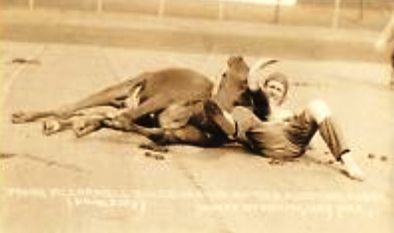
Frank McCarroll steer wrestling at Tex Austin’s rodeo, Yankee Stadium, 1923. From the Collection of P. Gavan

Every time I sit in the nosebleed seats at Yankee Stadium, I laugh at the placards on the back of every seat that say “Be alert for bats and/or balls.” Ha, like a bat or foul ball is going to make its way all the way up to the grandstand seating!

I laugh now, but for 10 days in August 1923, just four months after the brand-new Yankee Stadium opened at 161st Street and River Avenue in the Bronx, the spectators did need to be alert – but not for bats and balls. It was stray bulls they had to worry about.

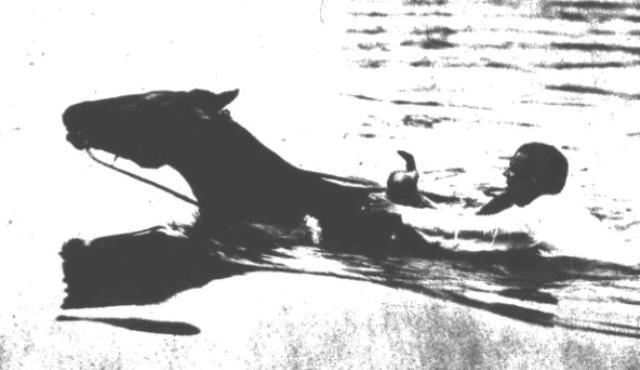
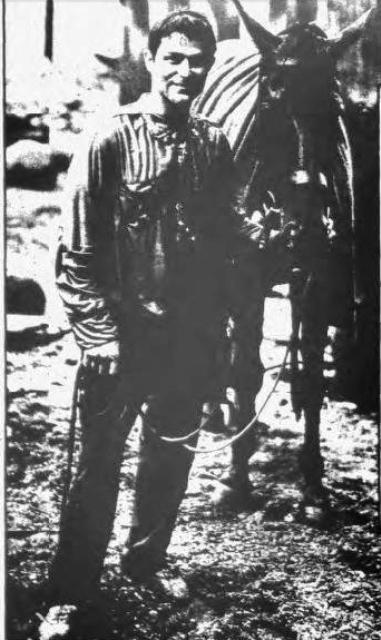
Bryan Roach of Fort Worth, Texas, came in third place in the Great Harlem River Swimming Contest.
Bryan Roach of Fort Worth, Texas, came in third place in the Great Harlem River Swimming Contest. The other contestants were Charles Aldrich, “Red” McDonald, Tony Pagano, Joe Bell, Bill Hurley, Jack Rogers, Roy Kivett, John McDonald, Tim Carmine, Bill Getz, Ed McCarthy and Verne Elliot.


Tex Austin Brings His Rodeo to the Bronx

In 1922, American rodeo promoter John Van “Tex” Austin brought his popular western-style rodeo to Madison Square Garden. The inaugural event was such a big success, he needed a bigger venue. So in August 1923, while the New York Yankees were playing out west, Tex Austin brought the west to Yankee Stadium in the Bronx.

Tony Pagano won $300 in the Great Harlem River Swimming Contest
Tony Pagano won $300 in the Great Harlem River Swimming Contest. To ensure safety at the event, Commander Edward F. Otto of the Orchard Beach Life Saving Station was on hand with 27 men equipped with life rings and Pulmotor artificial respiration devices.

To generate publicity and excitement for the 10-day event, Tex organized a benefit event for Catholic Big Brothers that featured about a dozen cowboys in western garb “riding” cow ponies across the Harlem River. Called the Great Harlem River Swimming Contest, the event attracted 10,000 spectators who loudly cheered on the ponies and cowboys.

The rodeo officially opened at 3 p.m. on August 15. Almost overnight, Yankee Stadium had been transformed into the Wild West. About 900 hands of livestock were corralled under the stadium grandstands. And a huge, 100,000 square foot mat made of cocoa and weighing 58 tons was pegged down with iron spikes over the infield and part of the outfield in order to protect the ground from the cloven hooves.

The running track was widened to accommodate relay races on horseback, and 30 enormous flood lights were perched on the roof for night events (lights and night games didn’t come to Yankee Stadium until May 28, 1946!).

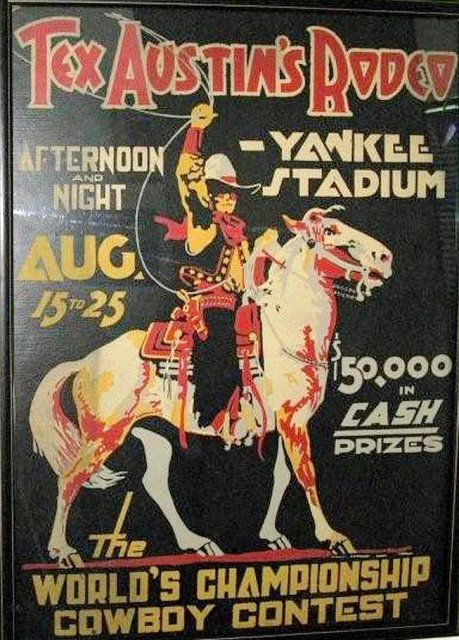
The rodeo featured almost 200 contests, including bronco riding, steer wrestling, cow roping, cowgirl trick and fancy riding, relay races, bareback bronco riding, and more. Just over 100 cowboys and cowgirls competed for $50,000 in prize money, and thousands of spectators paid $2 or $3 to watch all the action.

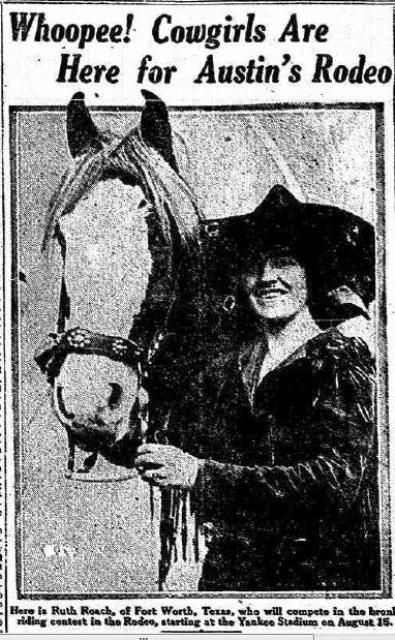
Ruth Roach cowgirl Yankee Stadium
Ruth Roach, the wife of Bryan Roach pictured above, was one of many cowgirls to compete for prize money in the rodeo at Yankee Stadium. “Western girls are at home in the saddle as New York girls are in a subway seat.” —Evening Telegram, August 12, 1923

Be Alert for Foul Bulls

As Time magazine noted on August 20, 1923, “At bronk riding and steer bull-dogging [events], contestants are frequently seriously injured, occasionally killed. Tex Austin imports from the West and Southwest steers and broncos selected especially for their lack of amiability.” In other words, foul bulls.

Speaking to the New York press before the rodeo began, Tex Austin explained that the contestants could ride whatever they pleased at the event — including the subway if they found the horses and steers too tame.

I think some of the cowboys and cowgirls should have stuck to the subway.

Tex Austin Rodeo, Yankee Stadium
Eddie Steidler is thrown from his horse during Tex Austin’s rodeo at Yankee Stadium in 1923.

Each day of the event, the New York newspapers reported on the numerous mishaps at the stadium. Ruth Wheat was thrown and trampled by her horse; Frank Studenick broke his arm when he was thrown from his horse (they both came back to compete the next day).

Buford B. Polk was thrown during the steer riding competition and was taken, unconscious, to Fordham Hospital with a fractured skull. Earl Thode was kicked in the spine by a steer and taken to Harlem Hospital; Floyd Schilling was thrown from a bucking bronco and went to Lincoln Hospital with two broken arms. You get the idea.

Tex Austin Rodeo Yankee Stadium
Wooden promotional poster for the rodeo.

Numerous spectators were also injured — or, at least, almost frightened to death — when several bulls decided to make their way into the stands. One steer went on a rampage and headed into the lower left-field seats, causing people to run for their lives (some cowboys had to jump over seats to catch the animal). And two steers took off into the right-field bleacher seats — it took 12 men to capture them.

A Brahma Steer Goes Wild

A few days after the rodeo ended, a convoy of motor trucks began transporting the livestock from the stadium to the railroad yards at 152nd Street. One particularly brazen Brahma steer who apparently did not want to leave the big city jumped from the vehicle and made a mad dash through Macomb’s Dam Park.

Pursued by rodeo cowboys on horseback and several policemen in commandeered taxi cabs, the steer ran north on Sedgwick Avenue to Jerome Avenue. There, it struck Mrs. Mary Merrill of 407 East 136th Street. Mrs. Merrill was not injured, but the steer quickly met his demise when Patrolman Powers of the Highbridge Station shot him in the head from a moving taxi cab. (And we thought the 1970s were dangerous times!)

Yankee Stadium 1923
This circa 1923 photo provides a rare aerial view of Yankee Stadium, Macomb’s Dam Park, and the Polo Grounds across the Harlem River. It was along these dusty dirt streets that the Tex Austin rodeo steer led cowboys and police on a wild chase.

Yankee Stadium: From Swampland to Cathedral

Although it would be astounding to see a bull running down Jerome Avenue today, in 1923 the Highbridge (formerly Highbridgeville) neighborhood of the Bronx was still quite rural and mostly farmland. Here’s a quick visual history of the 10 acres of hollowed ground that the American Baseball League delegates chose for Yankee Stadium – the Cathedral of Baseball – in February 1921:

Keskeskeck Bronx
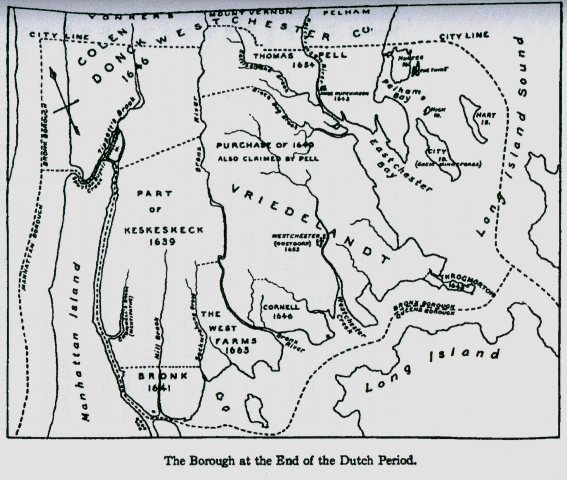
On August 3, 1639, the West India Company received from native tribes a tract of land between the Kil and Great Kil (Harlem and Hudson rivers), which they called Keskeskeck. From this tract, Daniel Turneur was granted 81 acres bounded by the Harlem River and Cromwell’s Creek, and comprising the high lands of Devoe’s Point near today’s Macombs Dam Bridge (Frederick Devoe was a descendent of Turneur’s daughter.) About 1,900 acres of land to the east of Cromwell’s Creek was granted to Colonel Lewis Morris in 1676.
Morrisania map 1879
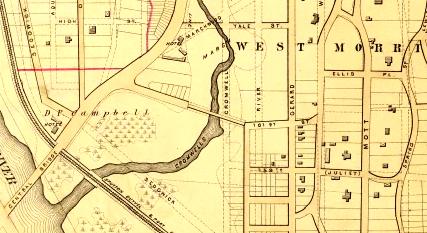
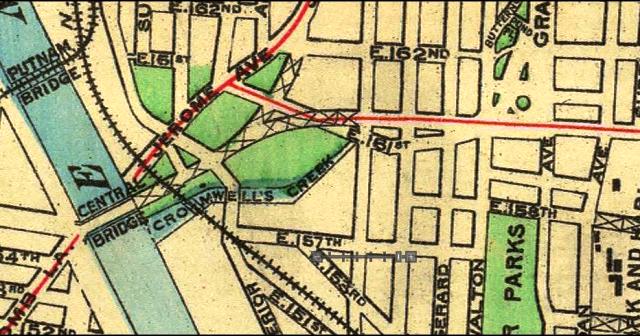
The site of the original Yankee Stadium was once swampland along Cromwell’s Creek, a popular spot for fishing, swimming, and ice skating in the 1800s. Cromwell’s Creek, shown in this 1879 map, was named for the descendants of John Cromwell, a nephew of Lord Protector Oliver Cromwell. In the late 1700s, James Cromwell used the waters of the creek to propel his mill.
Macombs Dam, 1814
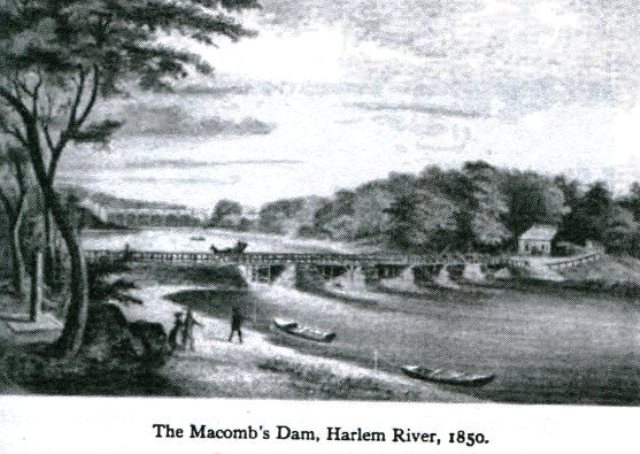
In 1813, Robert Macomb constructed a dam across the Harlem River for his mill on Devoe’s Point (his toll bridge opened in 1816). Although the state required Macomb to operate a lock to keep navigation open, only small boats could pass through the 7 x7 foot lock. In 1838, Lewis G. Morris and irate residents along the riverbank paid a coal barge crew to break through the dam with axes. Charges were filed, but the court declared Macomb’s dam a “public nuisance” (Renwick v. Morris). The Central Bridge opened in 1861 and was replaced by the current Macombs Dam Bridge in 1895.
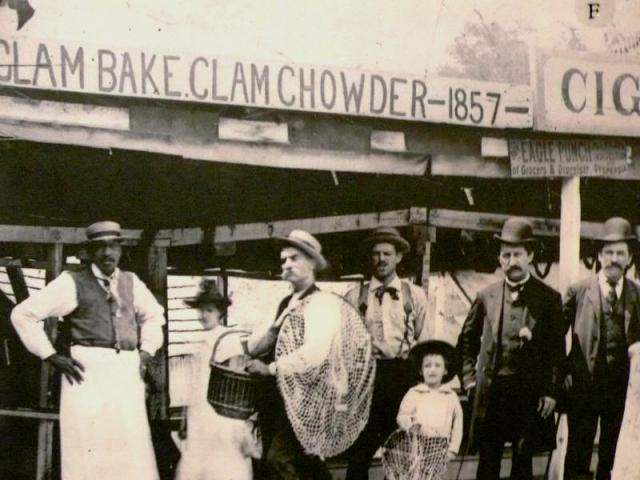
Cedar Jack's Last Stand Clam Bar, on the site of the future Yankee Stadium
In the 1800s, Highbridge was a popular destination for tourists and sporting men who traveled to the area by Harlem River steamers. The town had numerous wood-frame road houses and eateries, like George H.. Huber’s Roadhouse and Casino (formerly Gabe Case’s roadhouse tavern) at Jerome and 162nd Street and Cedar Jack’s Last Stand Clam Bar along Cromwell’s Creek at 161st Street (shown here), which was run by John Burns. There was also Schumacher’s Saloon at 161st and River Avenue, which was the exact spot of the 1923 Yankee Stadium.
162nd Street Bronx 1880s
On April 21, 1880, William H. Morris and his wife conveyed about 500 lots to John Jacob Astor for $437,983. The lots comprised about 140 acres plus water rights, and were bounded by Mott Avenue, Cromwell’s Creek, Central Avenue (Jerome Avenue), 155th and 167th Street. The Astor’s had many tenants, including coal dealers John M. Tierney, William F. Porter, and Carrie T. Porter (Tierney & Porter), who opened shop at 161st Street and Jerome Avenue along Cromwell’s Creek in 1888, and Clifford L. Miller & Co., a brick and cement manufacturer, who began operating on this site in 1891. New York Public Library Digital Collection
Morrisania Map 1900
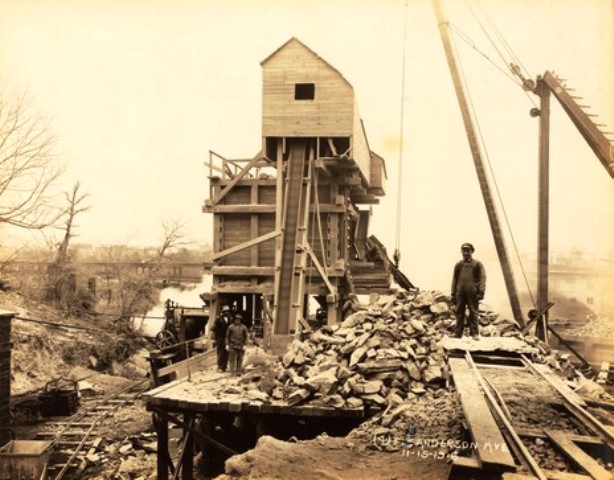
By the late 1800s, the city had begun allowing contractors to dump dirt, boulders, and other excavated materials from building sites into Cromwell’s Creek in order to cover it over. For example, in 1902, when the rapid transit tunnel at Morris Avenue and 149th Street was excavated, all the stones and dirt was dumped into the creek. By about 1905, much of it was covered over; Macombs Dam Park (green) was in use by local ball clubs like the Unions of Morrisania and the empty lot to its west was awaiting something big.
Lumberyard, pre Yankee Stadium, 1921
In 1903, American Baseball League delegates began looking at a swampy piece of land owned by the Astor estate. It wasn’t until February 1921 that the owners of the New York American League Baseball Club, Jacob Rupert and Tillinghast l’Hommedieu Huston, announced that they had selected a location for the future home of the Yankees — a garbage-strewn 10-acre plot between 161st Street and 157th Street at River Avenue that was currently being used as a lumberyard. The owner paid $675,000 for the lot and the lumberyard was demolished. The rest, they say, is history. Brooklyn County Historical Society
Yankee Stadium 1923
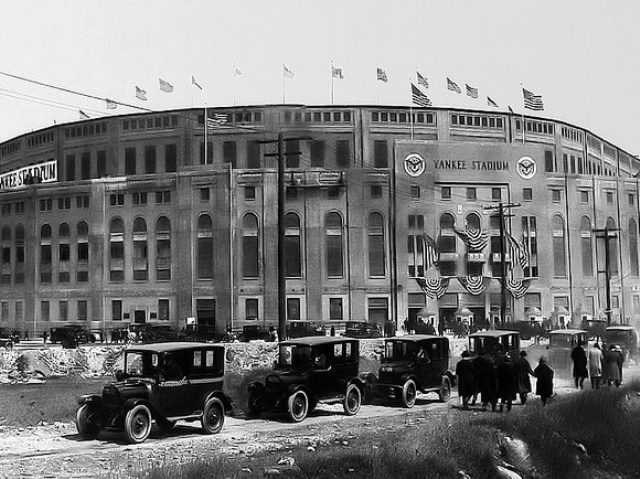
Taxis line up in front of Yankee Stadium during its inaugural season in 1923.
Kitten in police boot
In 1915, the New York Police Department had more than 100 station house cats on the roster, each responsible for ridding the houses of mice and rats.

In the 1800s and early 1900s, many New York police station houses–like the Morrisania station–were located in neighborhoods populated by stables or shanties that were overrun by rats. The policemen of this era were not ashamed to admit that it was quite unnerving to see a large rat scampering across their dormitory at night. It was no doubt very reassuring to know that the rural station house cat was on the job.

The Morrisania police station on Washington Avenue at 160th Street was the perfect candidate for a station house cat. Although today we call it the South Bronx, less than 150 years ago this southwestern section of the borough was a sleepy little village surrounded by farms along the Mill Brook (today’s Brook Avenue). Although I’m sure the station house in Morrisania had many mouse catchers over the years, three such felines that made the New York headlines in the 1900s deserve a special tribute.

But first, a quick look at the history of the Morrisania police station.

From Town Hall to Police Station

In 1639, Jonas Bronck, a Swedish captain for the Dutch West India Trading Company, was granted a purchase of land between the Harlem and Aquahung (Bronx) Rivers. Following his death in 1643, the tract passed through the hands of successive Dutch traders until 1664, when a royal patent for Bronck’s land was issued to Samuel Edsall.

William H. Morris Mansion in Morrisania
Even members of the Morris family were apparently afraid of discovering rats in their bedrooms at night. In 1816, James Morris, the son of Lewis Morris IV, built an estate on the site bounded by the present Findlay and Teller Avenues and East 167th and 168th Streets. This estate, later called the William H. Morris Mansion (William was one of James’ 12 children) had a curious feature: The only stairway was hidden away inside a small room behind a small door leading off the grand hallway. As Common Council Clerk David T. Valentine noted, “The owner evidently took no chances with possible nocturnal visitors of the early days.” Museum of the City of New York.
Morrisania Town Hall
Although the Morrisania Town Hall was erected on “Lot No. 1 of the Village of Morrisania,” it actually was in the Village of Melrose, just south of the true limits of Morrisania.

Edsall in turn conveyed the land to Captain Richard Morris and Colonel Lewis Morris. Four years later, Colonel Morris obtained a royal patent to Bronck’s Land and adjacent lands, which afterward became the Manor of Morrisania – a total of 1,900 acres bounded by the Bronx Kill at E. 132nd Street, W. 170th Street, the Harlem River and the East River.

Fast-forward to 1869, when the original Morrisania police station began its life as the first town hall for Morrisania. The two-story stone and brick structure was erected for about $40,000 under Supervisor William Cauldwell, and was designed by architects John Rogers and Edward H. Browne, who both resided in Morrisania.

When the township was formally annexed to New York City in 1874, the building was adapted for a police station. Morrisania was a large precinct patrolled by mounted policemen, and so a wooden stable was erected on the east for the horses of the mounted unit. Later, an annex was built in the rear for a dormitory for the men.

Police Call Box
The Morrisania police station could receive special signals from three telegraph boxes
The Morrisania police station could receive special signals from three telegraph boxes that were located at the Harlem Bridge; on Eastern Boulevard (today’s Bruckner Expressway) near 175th Street; and near George P. Arcularius’ Jerome Park Hotel at the intersection of Central Avenue and Gerard Street (today’s Jerome Avenue and Gerard Avenue, and the site of the 44th Police Precinct).

The grounds on the triangular lot were reported to be quite lovely, and featured a flower garden and pastures for the horses. School children often stopped by to watch or feed the horses — a particular favorite was Shiner, a cherry bay horse who was on the job for 20 years.

Directly behind the station were the tracks for the Port Morris branch of the New York and Harlem Railroad.

But as time went by and Morrisania became more populated, the old town hall building was no longer suitable for a police station.

As Police Captain Theron R. Bennett noted in 1885, “The accommodations are wretched, but the place is comfortable.” It would be another 20 years before the town got a new police station.

In May 1904, workers began demolishing the old building in preparation for a new, modern station. During the construction, the department was temporarily housed in an abandoned tool factory that the city owned on Brook Avenue near the site of today’s O’Neill Triangle. Finally, on November 1, 1905, the policemen moved into their new home at 830 Washington Avenue, a Neo-Renaissance style palazzo-like police station designed by Charles Volz.

Port Morris Branch New York and Harlem Railroad
In this 1911 map, you can see the tracks for the Port Morris branch of the New York and Harlem Railroad directly behind the police station. Today the overgrown rail bed still exists behind the station, while other portions of the track run under O’Neill’s Triangle and St. Mary’s Park.

1904: Bill is Arrested for Stealing a Steak

In June 1904, when the Morrisania police were in their temporary quarters in the old tool factory, Bill was the precinct’s official mouse catcher under the command of Sergeant William E. Egan. Every day, Sergeant Egan’s son, Albert, would bring his dinner to the station. On June 29, Albert brought his father a large porterhouse steak that he was looking forward to eating.

Morrisania Bronx Washington Ave.
This late 19th-century photo shows Washington Avenue at East 169th Street, which was just 9 blocks north of the police station. In the back is a row of breweries on Third Avenue.

Just as he was about to eat his meal at his desk, another policeman appeared with a prisoner and he was called to assist. As he walked from his desk he heard the dish fall to the floor. Then he saw Bill carry away his prized steak.

This wasn’t the first time Bill had stolen food from Sergeant Egan, but this time he wasn’t going to get away with it. The sergeant told The New York Times that he was “arresting” the cat for larceny, and that Bill would be arraigned later that day by Captain Patrick Byrne.

1911: Pete Goes on a Hunger Strike

In 1911, the Morrisania police had been in the new station house for six years. The population was booming at this point, and one by one the old farms and vacant lots began disappearing as new housing was constructed to meet the heavy demand. It was during this era that a beautiful white cat named Pete ruled the roost as the chief mouser of Morrisania.

42nd Precinct NYPD
The building facade reads “46 Precinct Police Station,” but today the building is home to the 42nd Precinct under the command of Captain Steven Ortiz. The landmark station house was used in exterior shoots during the making of the 1981 movie Fort Apache, the Bronx starring Paul Newman.

Born at the station house sometime around 1910, Pete was the pride of the precinct. He was named after Lieutenant Peter Brady, who adopted him when he was born.

Like many cats, Pete was very stubborn, and he had strong likes and dislikes. His favorite resting place was the top of the station house desk, but when a lieutenant whom Pete disliked was on duty, nothing could persuade him to stay near the desk. If he didn’t like the lieutenant on duty, he sought out a far corner of the station or made mischief.

One time the lieutenant went to the back room for a few minutes, leaving Pete in charge of the station. Pete obviously did not like this man, and he demonstrated his feelings by spilling a bottle of ink all over the police blotter.

Pete liked several of the lieutenants, including Frank O’Rourke, who would blow his police whistle to summon Pete back to the station. Another favorite was Lt. Charles Price. But Pete was most loyal to Lt. Peter Brady.

245 East 60th Street was the station house for Bridge Precinct D
In 1911, Lt. Brady and Pete the cat were attached to the Bridge Precinct D at 245 East 60th Street (middle). This was a small precinct of only 49 officers, most of whom patrolled the streets on bicycle. The three-story brownstone with basement was formerly the residence of Lillie McGovern, who rented the building to the city for $1,200 a year. This station house also served as offices for the Detective Bureau. The Bridge Precinct D was abolished in 1912 and merged with the 31st Precinct.

So in July 1911, when Lt. Brady and Lt. Price were transferred to other stations, Pete went on a hunger strike. For days, he refused to come out of his hiding spot in the basement. The policemen tried coaxing him with cream, milk, and fish, all to no avail. They finally captured the cat and sent him to the Queensboro Bridge Squad (Bridge Precinct D) so he could be reunited with his namesake.


1915: Tabby Gets a Gift from Justice

In 1922, the granite Beaux-Arts Bronx Borough Courthouse on Brook Avenue at 161st Street was home to a flock of English starlings. The birds discovered the building soon after it was completed in 1914, and were particularly fond of “Lady Justice,” who presided over the entrance on the Brook Avenue side of the courthouse.

Bronx Borough Courthouse 1914
Construction of the G.E. Roine’s sculpture “Justice” graces the south facade of the Bronx Borough Courthouse, shown here in 1914, the year it opened. The graffiti-covered landmark has been vacant since 1977.

During an extreme cold spell in January 1922, a woman found several of the starlings on the pavement – they had fallen from the statue, stiff from the cold. She took three of the birds to her home to revive them, and she brought three more to the police station.

I don’t know what happened to the three birds she took home, but I do know that the birds she took to the police were dead on arrival. Lieutenant John Lake summoned chief mouse catcher Tammy, who gladly received the free avian gift (I’m sure she would have preferred a porterhouse steak.)