Since reindeer can’t fly, a crate was used to hoist four reindeer into the skating rink at Rockefeller Center. Democrat and Chronicle, December 13, 1941
The following reindeer story took place on December 12, 1941, just 10 years after the Christmas tree made its unofficial debut at Rockefeller Center — and exactly five days after the Japanese attacked Pearl Harbor.
This year would be the last that the Christmas tree was illuminated during World War II. From 1942 to 1944, all of the city’s outdoor trees had to stay dark after sunset under wartime blackout restrictions.
In 1941, the 83-foot tree featured 800 large plastic globe-like bulbs in pastel shades of blue and red. The windows in the buildings surrounding the lower plaza were also decorated with candles, although these were not lit because of the war (it was easy to flip one switch to turn off the tree lights in a war emergency, but not so easy to blow out hundreds of candles).
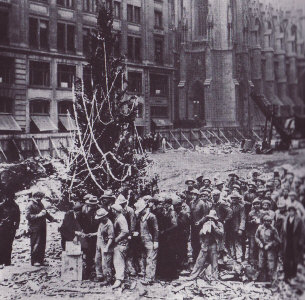
The first tree at Rockefeller Center made its debut during the Great Depression on Christmas Eve, 1931. The 20-foot balsam was erected by construction workers on the muddy construction site, and was a symbol of hope. The men proudly decorated the tree with strings of cranberries, garlands of paper, and tin cans, and then waited in line to receive their paycheck from the clerk.
Despite the reduced illumination, Acting Mayor A. Newbold Morris said there would be “no blackout of Christmas cheer in New York.” To that end, holiday festivities designed to boost everyone’s spirits included two daily Christmas carol performances beneath the tree, seven organ concerts a day, two after-work Christmas concerts performed by the 150+ members of the Rockefeller Center Choristers, four live reindeer from the New York Zoological Society, three French hens, two turtle doves…
(Sorry, no hens or doves, and certainly no partridge in a pear tree.)
The reindeer arrived at Rockefeller Center via truck and were then lowered down onto the skating rink by a giant crane. Universal Newsreel
The reindeer – three does and one buck — were raised in Lake Placid, New York, and brought to the city by the New York Zoological Society. Much to the children’s disappointment, the four reindeer (or what The New York Times referred to as “half of Santa’s motor power”) did not arrive with Santa.
And instead of flying by magic, they arrived at Rockefeller Center via truck and were then lowered down onto the skating rink by a giant crane.
After their humiliating entrance to the lower-level plaza, the dark gray reindeer (actually woodland caribou) were placed in two rustic enclosures, which were placed on either side of the giant bronze Prometheus sculpture.
Each pen was 18 x 30 feet with tan-bark floors, peat moss carpeting, and evergreen lean-tos. A sign read: Please Don’t Feed Our Reindeer. Santa Claus Wouldn’t Like It.
The reindeer is lowered into the pen.
For the next three weeks, the reindeer munched on their fodder and calmly took in the sights as the Choristers sang “White Christmas,” the organists played “Silent Night,” and the skaters waltzed across the ice.
A temporary skating rink replaced the Sunken Plaza at Rockefeller Center in 1936 in an effort to attract more people to the plaza. The rink was so successful, it became a permanent fixture. The two-legged creatures shown skating in this 1941 photo no doubt kept the reindeer entertained.
On January 2, 1943, the reindeer were taken to the Bronx Zoo, where they would spend the rest of their days in a special reindeer range east of the Primate House. They would be the first live reindeer at the zoo since 1907 (four reindeer were displayed at the Bronx Zoo from 1901 to 1907).
More modern reindeer (caribou) graze at the Bronx Zoo in this December 2005 photo.
In April 1942, the first baby reindeer was born at the Bronx Zoo. The 18-inch-tall male reindeer was named Cupid.
If you enjoyed this tale, you may enjoy reading about the sea lions and penguins that made their debut at Rockefeller Center in July 1941.
Felix the Cat made his debut at the Macy’s Thanksgiving Day Parade in 1927.
Whenever the forecasters call for windy weather on Thanksgiving, I always wonder whether the giant balloons are going to appear in the Macy’s Thanksgiving Day Parade. If the wind speeds are higher than 34 miles per hour, the balloons don’t fly.
That’s because in 2006, Macy’s incorporated several safety measures to prevent accidents and balloon-related injuries at its annual parade in New York City. Parade officials installed wind measurement devices to alert them to any unsafe conditions that could cause the balloons to behave erratically. They also implemented a measure to keep the balloons closer to the ground during windy conditions.
None of these safety measures were in place when the parade began in 1924. In fact, you could probably call what took place at the Macy’s Thanksgiving Day Parade during some of its early years “unorganized chaos.”
Macy’s Thanksgiving Day Parade, 1924 – 1931
According to Rob DelBagno of the New York Historical Society, R.H. Macy’s and Co. hired renowned illustrator and puppeteer Tony Sarg in the 1920s to help create its inaugural parade. The goal was to attract children and their parents to Macy’s newly expanded toy department at its Herald Square flagship store. Click here to see the parade in the 1947 classic, Miracle on 34th Street.
Anthony Frederick Sarg (1880 – 1942), better known as Tony Sarg, was a German American puppeteer and an illustrator for The Saturday Evening Post. In addition to the balloons for the Macy’s parade, Tony designed the store’s mechanically animated holiday window displays.
The first parade took place on November 27, 1924, before an estimated 250,000 spectators. It was a mish-mash of floats pulled by horses, a few professional bands, and live animals in cages borrowed from the Central Park Zoo. The parade also featured Macy’s employees, professional entertainers, and many tag-along ragamuffins, who marched six miles from 145th Street in Harlem to Macy’s at Herald Square.
Although it was billed as the Macy’s Christmas Parade, The New York Times called it “a retinue of clowns, freaks, animals and floats.” The parade was such a success, however, that Macy’s decided to make it an annual event.
The first Macy’s parade was billed as the Macy’s Christmas Parade. Elephants and other wild animals in cages borrowed from the Central Park Zoo were one of the highlights of the event.
Bring in the Balloons The floats and clowns were great, but Tony Sarg wanted to feature something in the parade that everyone could see. He thought tall balloons would be perfect, and turned to the Goodyear Tire and Rubber Company in Akron, Ohio, for assistance. The result was Felix the Cat, a toy soldier, and a dragon, who all made their debut in 1927. (These were actually rubber, air-filled puppets held aloft with long poles, but they were impressive.)
Felix the Cat’s son also marched in the parade. He was small enough to require only four handlers.
The trouble with the balloons began in 1928, when five tethered, helium-filled balloons up to 125 feet long (aka “ballooniacs” and “upside down marionettes”) designed by Tony Sarg and Bil Baird, entered the parade. Someone (probably a PR guy) came up with the bright idea to give the balloons an extra shot of helium and then release them at the end of the parade — people could find them and return the balloons to Macy’s for cash prizes. Although the balloons were designed to release air slowly, they unexpectedly burst in the air. So much for the cash prizes that year.
The following year the balloons were redesigned with safety valves to allow them to float above the five boroughs of New York for a few days. Safety-schmafety. Does anyone see a public relations disaster in the making here?
1931: Felix Meets Pilot Clarence D. Chamberlin In 1931, the annual parade started at 1:30 p.m. at 110th and Broadway (the balloons were inflated in front of The Cathedral Church of Saint John the Divine on Amsterdam Avenue). This year the helium balloons included the 40-foot Terrible Turk, a two-headed Martian, Tiamet the dragon, Felix the Cat (and his youngest son), Jerry the Pig, a 40-foot hippo, and a 171-foot dragon.
This bizarre balloon creature was apparently called Tiamet the Dragon. Here he is grinning at spectators on upper floors during the 1931 parade.
During the parade, the Turk ran into an electric sign at 72nd Street, broke in half, and deflated into the crowds. The Martian, who had a tough time getting under the tracks of the 9th Avenue El, bumped into fourth-floor windows and swooped down upon spectators when the winds blew. The pig kept bumping his snout into windows and signs, and the dragon was attacked by a little white dog. All the while, motorists on the northbound side of Broadway were causing traffic jams as they stopped to take in the show (yes, they kept traffic lanes open between Columbus Circle and 110th Street.)
Fritz the dachshund was rescued from the East River following the 1932 parade.
When the balloons were released at 34th Street, a wind from the west brought the giant hippo within inches of the Empire State Building, where three small planes had been flying in anticipation of the release. (The hippo was last seen headed for Brooklyn — a fisherman also reported seeing the hippo 100 miles off of Rockaway Point “walking on water.”) Felix also soared over the Empire State Building as the band played “When the Moon Comes Over the Mountain.” The dragon’s tail narrowly missed several buildings – he was last reported seen sailing in the direction of Governor’s Island.
Clarence Duncan Chamberlin (1893 – 1976) was the second man to pilot a fixed-wing aircraft across the Atlantic Ocean while carrying the first transatlantic passenger. Through the 1930s and 1940s, he barnstormed around New York and trained thousands of men and women in the construction and operation of airplanes. In 1973, Chamberlin was inducted into the Aviation Hall of Fame of New Jersey; in 1976, he was enshrined in the National Aviation Hall of Fame.
Right about this time, ace pilot and barnstormer Colonel Clarence D. Chamberlin was making a flight from Floyd Bennet Airport with several passengers. Needless to say, he was not sure what to do when he saw Felix and Jerry the Pig heading his way. One passenger suggested the pilot try to save Felix because the cat appeared to be headed toward a transatlantic voyage, and cats hate water.
News reports state that Chamberlin lassoed the pig with some rope and snared the cat by his wing. But apparently Felix broke loose. On December 2, he died a horrific death when he got caught in a high-tension wire in West Norwood, New Jersey. A resident said she saw the silk and rubber feline float into the wire and burst into flames. You just can’t make this stuff up.
1932: Tom-Kat Takes Down a Plane and Two Pilots In 1932, Macy’s told the New York press to warn all pilots to stay away from the balloons, and to let them know that no pilots would win a prize for recovering them. Apparently 22-year-old student pilot Annette Gipson of Brooklyn didn’t get the message.
Tom-Kat obviously got one of his lives back: Here he is in 1933 with the 9-story Gulliver and some other balloon buddies.
At 4 p.m. on November 24, a half hour after the balloons were released, Miss Gipson and her instructor, Hugh Copeland, of Woodside, Queens, came upon the 60-foot, yellow-striped Tom Kat. Miss Gibson decided to go for the cat’s jugular and steered the plane right into him. The balloon’s fabric wrapped around the left wing, causing the plane to go into a deep tailspin. She shut off the ignition, thinking this would prevent fire when the plane crashed.
As thousands of people in Queens watched in horror, and the plane continued to fall, Annette and Hugh switched seats so the instructor could take control of the plane. At one point the cabin door flew open and Annette almost fell out of the plane. Luckily her foot got caught in her safety strap and she was able to pull herself back in.
Miss Annette Gipson and her instructor, Hugh Copeland, were flying a small cabin monoplane like the 1930s Caudron C.630 Simoun shown here when they crashed into Tom Kat.
The plane was only about 250 feet above the rooftops near Rosedale when Hugh turned on the ignition. By this time the tattered remains of Tom had flown away, so Hugh was able to resume flying and land the plane safely at Floyd Bennett Field. Following an investigation by Inspector Sanford A. Willetts of the Department of Commerce, Aeronautics Branch, the two pilots were grounded for violations of federal regulations forbidding stunting over congested areas.
Annette Gipson was born in 1912 in Commerce, Georgia. She moved to New York City in 1931 and learned how to fly that same year. Her incident with Tom Kat apparently didn’t faze her: In 1933, she helped create the Annette Gipson All Women Air Race at Floyd Bennett Field. Many famous women fliers participated in these races from 1933-36 — her friend Amelia Earhart was the official race starter.
Souvenir hunters quickly pulled apart poor Tom Kat, and not a single piece was returned to Macy’s. However, a few people were able to claim the last rewards the store would ever give for the helium balloons:
•H.F. Marrit of Garden City snagged Andy the alligator. •Jerry the pig loitered around the Empire State Building before getting rescued in East Islip by William Garrigan. •Fritz the dachshund landed in the East River and was rescued by the tug Long Island, headed by Roy Marques of Weehawken New Jersey. •Georgie the drum major landed in Long Island City, where he was mobbed and torn to bits. Eighty-two people tried to claim the reward money. •Willie Red Bird was last seen about 22 miles off the coast of Fire Island. He had enough gas to last 72 hours, so if no one had claimed him by Saturday night, Macy’s planned to issue warnings to ships on the North Atlantic lanes to be on the lookout.
Following the 1931 Macy’s Thanksgiving Day Parade, the big blue hippo was last seen about 100 miles off the coast of Rockaway Point. After 1932, the helium balloons were no longer released after the parade.
Step back in time 83 years to November 15, 1930. It was on or about this day that a man known only as “Old Tom” passed away in the Lower East Side of Manhattan, leaving his loyal fox terriers behind.
One week after his death, his body still unclaimed at the city morgue, Old Tom’s body was shipped by ferry to Hart Island, where he was buried by inmates from Rikers Island in the country’s largest mass graveyard.
Since 1869, close to 900,000 homeless and poor people, stillborn babies, and unclaimed bodies have been buried without a prayer or eulogy in New York City’s potter’s field on Hart Island. On the anniversary of Old Tom’s death, November 15, 2013, The New York Times published an article about Hart Island, and about the Hart Island Project, a group dedicated to improving access to the 101-acre island and its 45-acre public graveyard.
This Thanksgiving story is dedicated to Old Tom and his fox terriers, and to all the other nameless and unfortunate souls who are interred with him on this island of the dead.
Old Tom and His Fox Terriers Old Tom was a slight African-American man about five foot seven and 150 pounds. He had what the news reports called a “crippled” right foot and walked with crutches. Old Tom made his meager living doing odd jobs in the tenement buildings on the streets that lie in the shadows of the Brooklyn and Manhattan bridges.
Despite his nickname, Tom wasn’t very old: The coroner said he was about 50 when he died from “malnutrition and other causes.” He didn’t appear to have a human family, but he did have two loyal fox terriers and their two newborn puppies to keep him company as he made his rounds along Madison and Pike streets every day.
On the Sunday before Thanksgiving, Benjamin Bressman, who was the janitor for the five-story tenement at 149 Madison Street, noticed that Tom hadn’t been seen for almost a week. Apparently Tom had been doing some work in the building, because Benjamin went straight to the basement to look for him. It was there he found Old Tom lying on the cold cellar floor, his crutches at his side, and his fox terriers standing guard.
Benjamin’s first instinct was to determine if Tom was still alive, but the dogs would not allow it. Famished but faithful, the fox terriers nipped and barked to keep Benjamin away from their master. The janitor summoned the police from the Oak Street police station.
Old Tom was working in the cellar of a tenement at 149 Madison Street near Pike Street (now the site of a city water supply building) when he passed away in 1930. This photo shows 215-19 Madison Street, just two blocks north, in the 1920s. These buildings are still standing.
When the two patrolmen arrived, it took some effort to get the dogs under control. Despite their starving condition, the fox terriers gave it their best: One of the adult dogs even bit Patrolman Edward Kilgallen on the ankle before finally surrendering.
While Old Tom was taken to the morgue, his dogs were taken to the ASPCA hospital and shelter at Avenue A and 24th Street, directly across from the East 23rd Street Bathhouse. The fox terriers were given their own baths and fed, and assigned the following numbers: Dog 141,293; 141, 294; 141,295; and 141;296.
Guarded Dead Master, Dogs Face Execution
The day after Tom’s body was discovered in the cellar, The New York Times reported the story. Two days later, the paper said that the police were seeking homes for the faithful terriers “of undistinguished ancestry” to prevent their execution. The headline read:
Guarded Dead Master, Dogs Face Execution: If they don’t find homes soon, they’ll be executed by the Society for the Prevention of Cruelty to Animals.
This 1920-22 map shows the SPCA Stable and Garage on Avenue A, directly across from the Public Bath and East River, at mid-right. Click to enlarge.
The calls came pouring in. Within two days, more than a dozen people had applied to adopt the homeless and master-less terriers. The dogs were thus saved from the “death chamber,” a small steel gas tank with glass observation windows where the animals were “humanely” asphyxiated (at one time, about 2,500 cats and dogs were euthanized every week in this gas tank).
Because one of the dogs had bitten a police officer, the New York City Health Department ruled that they first had to undergo ten days of quarantine at the shelter to observe for rabies. They also had to be officially released by the Public Administrator, since the dogs were a part, if not all, of Old Tom’s estate.
The SPCA Dispensary and Hospital for Animals was located on Avenue A at the corner of East 24th Street. Across the street was the East 23rd Street Bathhouse, constructed in 1908 (now the Asser Levy Recreation Center). Today this is the site of the Veterans Administration hospital complex on Asser Levy Place.
As a special treat for Thanksgiving Day, the ASPCA bestowed names on the fox terrier family: Spot One (the mom), Spot Two (the dad), Spot Three (the daughter), and Spot Four (the son). The terriers were henceforth known as the Spot Family. For Thanksgiving, the dogs also received boiled beef that was browned in a pan, which was ordered by the shelter’s veterinarian.
One week after the dogs arrived at the ASPCA, William E. Bevan, general manager of the society, told the press that their ribs were no longer protruding and their fur had taken on a healthy sheen. He said they were also making friends with the 130 other canines at the shelter, although Spot One and Spot Two did not seem to appreciate rearing their puppies in the same room as a man-biting police dog and a woman-biting Boston bull terrier.
Offers to adopt the dogs continued to come in (43 total, including several from New Jersey and one from West Virginia), but many of the prospective owners said they could take only one dog. The ASPCA wanted to keep the Spot Family together.
Then one day the society received a phone call and a signed petition from a home for blind women on Long Island, which wanted all four dogs to keep the women company. The society decided that the home for the blind would be the dogs’ new forever home.
Sadly, the night before the dogs were scheduled to go to Long Island, Spot Four passed away. The two pups were only about five weeks old, so the poor thing was apparently too young and weak to survive his ordeal.
On December 2, 1930, the three surviving members of the Spot family went to their new home on Long Island. On that very same day, Old Tom was sent to potter’s field.
A Brief History of New York’s Potter’s Field
Aerial view of Hart Island in Long Island Sound.
A century before unclaimed bodies were buried on Hart Island, the areas now known as Washington Square Park, Madison Square Park, and Bryant Park served as potter’s fields. Madison Square Park served as the first mass grave site from about 1794 until it was full in 1797.
The potter’s field was moved to Washington Square, but after the yellow fever epidemic of 1823, the city barred further burials downtown and routed new corpses north to what is today Bryant Park. When that area was chosen as the site of the Croton Distributing Reservoir (now the site of the New York Public Library) in 1840, the remains of about 100,000 paupers were transferred to Ward’s Island. On April 20, 1869, Louisa Van Slyke became the first person buried on Hart Island.
The Hart Island cemetery is the largest municipal-run graveyard in the world. Close to one million people, including Old Tom, are buried here.
Today, inmates from the prison on Rikers Island, New York City’s main prison complex, receive the dead, which are then shipped to Hart Island on a ferry run by the Department of Corrections. The deceased’s name (if known) and identification number are carved into the coffin, and a packet with other identifying information is attached to the coffin. John and Jane Does constitute one-tenth of all burials, and only about one hundred bodies are identified by relatives or friends each year.
The cemetery on Hart Island is dotted with white markers, each denoting a mass burial of 150 bodies laid out in two rows, three coffins deep. None of the dead have personal grave markers, but there are two large monuments dedicated to all who are laid to rest there.
What happened to the ASPCA dispensary and ambulance house?
The ASPCA dispensary and ambulance house, where the Spot Family awaited their new home, opened in August 1912 at the southwest corner of Avenue A (today’s Asser Levy Place) and 24th Street. The complex featured a one-story structure with kennels for homeless, abandoned, and stray animals, as well as a lethal chamber where they were “humanely” euthanized via a gas chamber. An adjoining three-story structure contained the ambulance house on the ground floor and numerous rooms on the second floor, including a waiting room, examining rooms and operating rooms for small animals, separate wards for dogs and cats, an isolation ward, kitchen, and storeroom.
The second floor also had stalls and operating rooms for horses, which were transported from the ground floor via a sling and an electric trolley. The third floor had isolation stalls for the horses, a janitor’s living quarters, a bedroom for the resident vet, a hay and feed loft, and a repair shop. On the roof of the shelter was an exercise runway for the dogs.
Following World War II, the federal government, under the direction of President Harry Truman, ordered the ASPCA to vacate the premises to make room for a new six-acre Veterans Administration (VA) hospital. The ASPCA moved out in August 1950, and relocated to York Avenue at 92nd Street. Today, the handicap parking lot of the VA NY Harbor Healthcare Manhattan Campus occupies the site of the old dispensary and shelter.
What happened to Oak Street and the Fourth Precinct Police Station?
The Oak Street police station in the 1930s or 1940s.
Oak Street was a short street in the Lower East Side that ran parallel to Madison Street between Pearl and Catherine Streets. In 1870, the Fourth Precinct station house, which was one of the oldest in New York, was replaced by a new brick station house at 9–11 Oak Street, near Roosevelt Street. The complex included a four-story main building and two-story rear building for housing prisoners and vagrants.
The old Oak Street station house of the 4th Police Precinct was among the last structures to be removed when the Lower East Side neighborhood where Snooky was found was demolished. This photo was taken around 1950.
In 1947, the buildings on Oak, Roosevelt, and several other old streets were razed for construction of the Governor Alfred E. Smith Houses, Alfred E. Smith Memorial Park, and Public School 114. Ground was broken for construction of the public housing complex in 1949, and the project was completed on April 1, 1953. Where the old station house once stood is now occupied by the northwest portion of this complex and PS 126 Jacob August Riis School (now Manhattan Academy of Technology).
This 1951 aerial view of Old Tom’s stomping grounds in the Two Bridges section of the Lower Easy Side shows the construction of the Governor Alfred E. Smith Houses between Madison (top of construction site), Catherine (right), and South streets (bottom). The Brooklyn Bridge crossing the East River can be seen in the foreground; the arch and colonnade for the Manhattan Bridge can be seen in the top right-center of the photo.
The movers and shakers of New York City were quite a progressive bunch during the holidays in the late 19th and early 20th centuries, especially on Thanksgiving Day. This story about their efforts at the Essex Market Police Court is just one example of their generosity.
According to news reports in The New York Times from the 1890s to the 1930s, not a court prison in the city, nor a hospital or nonprofit institution of any kind in which “the unlucky and the unfortunate” were sheltered was overlooked. On Thanksgiving Day, tens of thousands of New York City residents in dire straights would receive a free meal with all the fixings, courtesy of the many churches or the settlement houses and other charitable institutions headed by the Department of Charities.
Mrs. William Waldorf Astor, nee Mary Dahlgren Paul, married William Waldorf Astor in 1878. Mrs. Astor was a society leader in New York, but she was not The Mrs. Astor. That title was claimed by her husband’s aunt and social rival, Mrs. William (Caroline) Astor, the undisputed queen of New York society. Artist: Meave Thompson Gedney. NY Historical Society.
Many well-to-do private donors also contributed to the charity feasts, including socialites like Mrs. William Douglas Sloane and Mrs. William Waldorf Astor.
On November 29, 1907, The New York Times noted:
“If any one in New York missed turkey yesterday on account of hard times it was because he had hidden himself so well that a Sherlock Holmes could not have found him, for never was there a Thanksgiving Day here when so much effort was made to bring cheer and a sense of gratitude to all… The day was strikingly one of gratitude expressed in a mighty effort on the part of the fortunate to make glad the less fortunate.”
The Essex Market Police Court and Prison
In 1907, the Essex Market Police Court and Prison (aka, Third District Prison) was a major hub of activity in the Lower East Side. As one of five district prisons in the city – the others were the Harlem Prison, the West Fifty-third Street Prison, the East Fifty-seventh Street Prison, and Jefferson Market Prison — it served as a temporary holding place for criminals being arraigned in the adjoining magistrates’ court, and for prisoners waiting to be transferred to the city prison, popularly known as The Tombs.
The Essex Market Police Court and prison was at the intersection of Essex Street and the old Essex Market Place (pictured at left), a narrow cross street that ran between Essex and Ludlow streets until 1926. The building was designed by John Correja, Sr., and completed in 1857.
In the late 19th and early 20th centuries, it was common to see 50 or more defendants lined up outside when the Essex Market Police Court opened in the morning. Most of the accused served by this court and prison were Eastern European Jewish immigrants, who lived in squalor in the neighborhood’s overcrowded, dimly lit, and dilapidated tenements that first sheltered earlier German immigrants. Tenements across from the court housed the “offices” of attorneys who advertised their services with large signs. The “lawyers” with the largest signs seemed to do the most business.
Thanksgiving at the Prison, 1907 The male and female inmates were not the only cause of overcrowding at the Essex Market Prison. The prison was apparently also overrun with cats, thanks to Minnie, the prison’s mascot cat. According to news reports, Minnie had a record of 45 families of kittens during her tenure. (The big push to spay and neuter pets didn’t start until the 1970s.)
A typical scene outside the Essex Market Police Court in the early 1900s. This photo is from an October 8, 1905, New York Times article about plans to abandon the building.
Nonetheless, on Thanksgiving Day in 1907, all of the prisoners at Essex Market received a big chicken dinner served by veteran matron, Mrs. R.R. Fitzgerald. The men also received cigars and the women prisoners got candy. Minnie was well fed, too: She ate so much chicken that they had to call in a nearby veterinarian the next day.
Many Minnie Felines Minnie was an extremely popular name for cats in the previous century. I wonder if this is because of Minnie Maddern Fiske, one of the leading American actresses and playwrights of the late nineteenth and early twentieth century. Minnie, nee Marie Augusta Davey, not only had numerous triumphs on the Broadway stage in New York, but she was also one of the most prominent animal welfare advocates of her era.
Although she claimed to detest felines, Minnie was actually renowned for her tender feelings toward cats, particularly for all the strays that roamed the city streets. Whenever stray cats came around her house, she would befriend it by feeding it for a few days, and then place a ribbon around the cat’s neck before giving the cat to a friend. She was quoted as saying, “You will never have any trouble in giving away a cat that wears a handsome bow.”
Minnie Maddern Fiske once told a reporter that she detested cats, but she could not bear to see any animal suffer.
The Shyster of Essex Market Police Court If you know any Yiddish words at all, you probably know that a person who is professionally dishonest — especially in the practice of law or politics – is called a shyster. Although most dictionaries state that the word probably originates from the German scheisser (defecator), it may have in fact originated at the Essex Market Police Court in the 1800s.
According to Henry Ford, author of The International Jew: The World’s Foremost Problem, there was once a Clinton Street lawyer named Scheuster, whose practices were not very scrupulous, and who was quite a nuisance to Justice Barnabas W. Osborne in the late 1840s. Whenever another Yiddish lawyer attempted a shady trick, Judge Osborne would declare it a “Scheuster practice.”
The Demise of the Essex Market Court
Two years after this Thanksgiving feast, Borough President John F. Ahearn requested that a committee investigate conditions at the old court building. The committee advised the most practical thing to do was tear down the building. The report noted:
What a disgrace to New York. A vile place like this would not be tolerated in Turkey. Some of the committee have seen the dungeons in the various castles in Spain. We have the same conditions today in the Essex Market Court, which is unchanged from the day it was built in 1856. We take good care of our horses and our dogs. Why not extend the same human feeling for the unfortunates locked up in the cells of this court house? There is not a Grand Juror who would not object to having his dog kept in so vile a place.
Finally on January 13, 1911, the building was abandoned and a moving van carted away whatever furniture and records could be salvaged from 69 Essex Street to the first floor of the Florence Building, a multi-purpose community center located at 22 Second Avenue (near First Street).
The Seward Park Campus houses five different small schools: the High School for Dual Language and Asian Studies, New Design High School, the Essex Street Academy, the Lower Manhattan Arts Academy, and the Urban Assembly Academy of Government and Law.
In 1929, Seward Park High School, named for Governor William H. Seward, was built on the site of the Essex Market Police Court and Ludlow Street Jail. Seward Park High School, formerly P.S. 62 Intermediate, was the first high school built in the Lower East Side. Some famous alumni of the school include Tony Curtis, Walter Matthau, Jerry Stiller, and Keenan Ivory Wayans. The high school closed in 2006.
The Mounted Patrolman of Prospect Park, about 1908: John S.E. McCaughan, Artemas Fish, Charles Hanneman, John Buckley, Joseph Donovan, and Benjamin Leppler. Photo courtesy of Brian Merlis, BrooklynPix.
Before I do, though, I want to give a shout out to author and local historian Brian Merlis of BrooklynPix.com, who has an amazing collection of historical photos and books. Brian sent me the photo above, which led to extensive research that not only revealed the story of Artemas Fish (and the names of the other patrolman in the photo), but also led me to my great-grandfather, Joseph Probst, a mounted patrolman in Richmond Hill, Queens (pictured below).
Mounted Patrolman Joseph Probst, Richmond Hill, Queens
From Country Farm Boy to Big-City Policeman
Artemas L. Fish was born in Sidney, New York, in July 1875. Sidney is a rural town in the foothills of the Catskill Mountains in Delaware County, about 45 miles northeast of Binghamton. In the late 1800s and early 1900s, the farming and milling community was well-known for the New York Ontario & Western (NYO&W) Railway trestles that formed a giant horseshoe curve around the hamlet of Sidney Center.
According to census reports, Artemas Fish spent the first years of his life in the Village of Franklin. When he was about 13 years old, his parents, Martin and Ellen, purchased a 130-acre farm in Sidney, about ¼ mile from the O&W railroad station at Franklin Depot. Martin planted grains and potatoes on the land.
The NYO&W, which ran from Oswego to the terminus at Weehawken, New Jersey (on the site of today’s Port Imperial Ferry Terminal), traversed through Sidney Center via two trestles—one iron and one wooden—that were completed in 1871. Service on the O&W continued until March 29, 1957, when the railroad was ordered liquidated by a bankruptcy judge. Today the building that served as both a creamery and the Sydney Center Depot (aka, the Maywood Station) is home to the Maywood Historical Group.
Artemas Fish and his sisters, Jennie and Mabel, attended school at the three-room Liberty Street School (later called the Sidney Union School), and perhaps graduated high school from the Pleasant Street School, which was erected in 1892. Artemas may have also attended night school: In 1890, the first evening class for adults in Sidney was a class in telegraphy.
In 1900, at the age of 24, Artemas Fish was still living in the family’s 12-room farmhouse with his parents, his sister Jennie, and a servant, Arthur Whitney. Artemas worked as a telegraph operator and was a member of the Franklin Lodge No. 562 of Free and Accepted Masons. His sister worked as a dress maker.
Sometime between 1900 and 1906, Artemas headed south to the big city to join the New York Police Department. By the summer of 1906, he was working as a patrolman for the old 8th Precinct at 19 Leonard Street. It was there that he was assaulted while guarding a wholesale grocery store on Duane Street.
The station house at 19 Leonard Street was erected in 1868 as a dwelling, but was remodeled in 1869 for the 5th Precinct (the 5th became the 8th Precinct on May 1, 1898). This precinct was abolished and the building was closed on December 1, 1913. The building was occupied by Cordley & Hayes Corporation and later a furniture warehouse, until it was converted into condo lofts in the mid-1990s.
The Assault on Duane Street
In December 1905, the union drivers for Clark, Chapin & Bushnell at 177-179 Duane Street went on strike. For many months thereafter, the replacement drivers were harassed by members of the Local 105 of the International Teamsters’ Association in a series of attacks. Several of the non-union drivers were severely beaten in these attacks, and had to be taken to the nearby Hudson Hospital for emergency care.
On July 22, 1906, a bomb was placed in front of the grocers’ building. The bomb went off with a bang a midnight, shattering the windows of the wholesale grocer and of neighboring buildings. To discourage further attacks, Acting Captain George C. Liebers of the 8th Precinct assigned some of his patrolmen to work as plain-clothed guards at the building during evening hours. Artemas Fish was working this detail on Monday night, August 6, when he was attacked.
Wholesale trade grocers Clark, Chapin and Bushnell were located at 177 Duane Street, which was a cobblestone street when this photo was taken in 1897. The building was erected in 1890 and converted to retail and residential lofts in 1977.
According to the news report (The Sun, August 8, 1906), Artemas was standing in front of the building when he was approached by John Malone, 24, of 116 E. 12th Street, and Morris McAleer, 23, of 640 Summit Avenue, Jersey City. After he identified himself as a police officer and told the men to “beat it,” the men said they would beat him instead with the spikes that they pulled from their trouser pockets.
When patrolmen Frederick W. Goodnow and George W. Hoffman arrived in response to his calls for help, Artemas was on the ground and bleeding. He was taken to the Hudson Street Hospital, where he was treated for scalp wounds and other injuries.
Although Malone and McAleer tried to run, they were apprehended by police. Both men appeared before Magistrate Matthew P. Breen in the Tombs Police Court and were remanded to prison on $1,000 bond each.
No. 67–69 Hudson Street, a five-story brick structure designed by Josiah C. Cady, was named the Hudson Street Hospital (very creative) when it opened in 1894. The facility boasted innovative amenities such as a sunstroke ward and a private ward for privileged patients. A small, cast-iron footbridge connected the third story of the hospital to what was originally the hospital stable and laundry building at 9 Jay Street, erected in 1907. In 1975 the hospital was renovated for private medical offices; today both buildings are residential.
The Final Ride on Ocean Avenue
On June 2, 1908, Artemas returned home to marry his high school sweetheart, Nellie Ophelia Ramsdell, the 28-year-old daughter of James and Emily Ramsdell of Masonville, New York. Poor Nellie would never get the chance to celebrate her first anniversary with Artemas in their new home at 620 East Fourth Street in Flatbush.
By the time of his marriage, Artemas Fish was working as a mounted patrolman for the more rural Prospect Park Police Precinct in Brooklyn. I imagine patrolling the park and chasing after runaway horses was much more suitable work for Artemas than dealing with the more menacing crimes in Manhattan. But unfortunately, mounted patrol work also had elements of danger.
One day during the first week of April 1909, Artemas was on patrol on Ocean Avenue when his horse shied at something in the road and threw him violently to the ground. The horse stumbled and fell on top of him, causing internal injuries.
In 1881, George Ingraham Seney, one of Brooklyn’s most generous philanthropists, donated $100,000 and a large plot of land encompassing 16 lots bounded by 7th and 8th avenues and 6th and 7th streets. Plans were drawn up for a new hospital, which was incorporated as the Methodist Episcopal Hospital of the City of Brooklyn, and known as the Seney Hospital, in memory of George’s Methodist minister father. Today it’s called the New York Methodist Hospital of Brooklyn, although none of the original nine buildings of the complex remain.
Artemas was taken to the Seney Hospital on Seventh Avenue, but he contracted lockjaw (tetanus) and never recovered. In the first week of May his parents were summoned to the hospital to say goodbye to their dying son. He died on May 9 and was buried with Masonic honors at the Highland Cemetery following funeral services at the Methodist Episcopal Church in Sidney Center.
Following her husband’s death, Nellie Fish returned to Sidney. On January 2, 1926, she married Robert S. Peck.
Ten years after his son’s death, Martin Fish put the farm, the farmhouse, and barns on the market for $4,000. He passed away in 1931.
Artemas Fish was laid to rest in the Highland Cemetery in Sidney, New York.