Pinky with Frances Borrah at the West Side Magistrates Court.

In 1894, the American Society for the Prevention of Cruelty to Animals (ASPCA) agreed to take over the care and control of New York City’s dogs and cats. In order to empower the ASPCA with this authority, a special law was passed in Albany, titled New York Code – Lost and Strayed Animals (Chapter 115 of the Laws of 1894): “An Act for the Better Protection of Lose and Strayed Animals.”

According to the law, any dog or cat found within the city limits without a collar bearing its name and owner’s residence could be seized and disposed of if not redeemed within 48 hours. If someone claimed the dog or cat seized under the law, he or she could retrieve the animal for the sum of $3 – provided he or she could prove ownership.

If a dog or cat was not claimed, the ASPCA would euthanize it via a gas chamber. This sounds cruel today, but prior to 1894 stray animals in New York City were rounded up, put in cages, and lowered into rivers or ponds to drown. In fact, prior to the ASPCA taking charge, dog-catchers were paid by the dog, not the hour, and so some dog-catchers would steal animals from their owners’ yards.

Therapy bar Hell's Kitchen
Today the lot on West 52nd Street where Pinky the alley cat once resided features a parking lot. Next door is Therapy, pictured here, one of the many gay bars in the area.

Fast-forward to March 11, 1931. The scene is the second-floor courtroom at the West Side Magistrates Court, located at 314 West 54th Street, between Eighth and Ninth Avenues on the outskirts of the Hell’s Kitchen neighborhood. Magistrate Michael A. Ford is presiding.

In the early 1900s, magistrates in New York presided over cases involving misdemeanors or violations of ordinances. On this particular day, the ordinance violation concerned a stray alley cat named Pinky, who appeared at the West Side Magistrates Court.

According to the story, Pinky had been seized by the ASPCA and may have been headed to the gas chamber when John Bonner and Frances Borrah of 354 West 52nd Street each came forth to claim ownership.

“He’s my cat. I’ll show you,” Bonner told Magistrate Ford. The cat, wrapped in a blanket with a red ribbon and an ornamental chain, was placed on the floor. Bonner made a loop with arms and told the cat to jump. The cat simply yawned and began washing his face.

Mrs. Borrah’s daughter than took her turn to prove ownership of the cat. “Pinky, wink at the judge!” she commanded. The cat turned his head toward the magistrate and “executed an unmistakable wink” by closing one eye.

“My, my,” Ford replied. “It’s your cat,” he ruled.

The old West Side Magistrates Court at 314 West 54th Street is now home to the Midtown Community Court. The building still bears its terra cotta visions of justice.

The West Side Magistrates Court

In 1930, Mildred Adams wrote about the “endless drama” in the West Side Magistrates Court in The New York Times:

“To the bar come the common woes of common people, a constant stream of human trouble. ..day after day, week after week, [there is] a demand for decision, patience, and wisdom.”

Formerly part of the Police Justice Courts of the 1880s, the Seventh District Magistrates Court—more popularly known as the West Side Court—was built in 1894. The Renaissance Revival building was designed by architect John H. Duncan. Click here for a street view of the building today.

By the early 1960s, local magistrate’s courts were viewed as being too lenient, as virtually everyone involved in the proceedings were neighbors. West Side Magistrates Court and its counterparts in other neighborhoods were consolidated and moved downtown to Centre Street.

Architect John H. Duncan
Architect John Hemingway Duncan (1855–1929) was better known at the turn of the 20th century for the Soldier’s and Sailor’s Memorial Arch at Grand Army Plaza in Brooklyn and the General Grant National Memorial in Riverside Park.

In the 1970s, the old court building on W. 54th Street was known as the Court House Cultural Center and was occupied by the American Theater of Actors and The Children’s Museum of New York. The building was designated a Landmark Site by the Landmarks Preservation Commission on June 6, 1989.

In their decision, the Commission wrote: “The legal proceedings that occurred in the courthouse played an integral role in the social history of the heavily-populated West Side of Manhattan.”

Midtown Community Court

Today the building houses the Midtown Community Court, an innovative municipal court that focuses on quality-of-life offenses and sentences low-level offenders like prostitutes and shoplifters to pay back the neighborhood through community service.

The fourth floor of the building is still home to the American Theater of Actors, Sargent Theatre, a small off-Broadway venue with seating for 65 patrons. Among the actors who have worked here are Dennis Quaid, Bruce Willis, and Kevin Spacey.

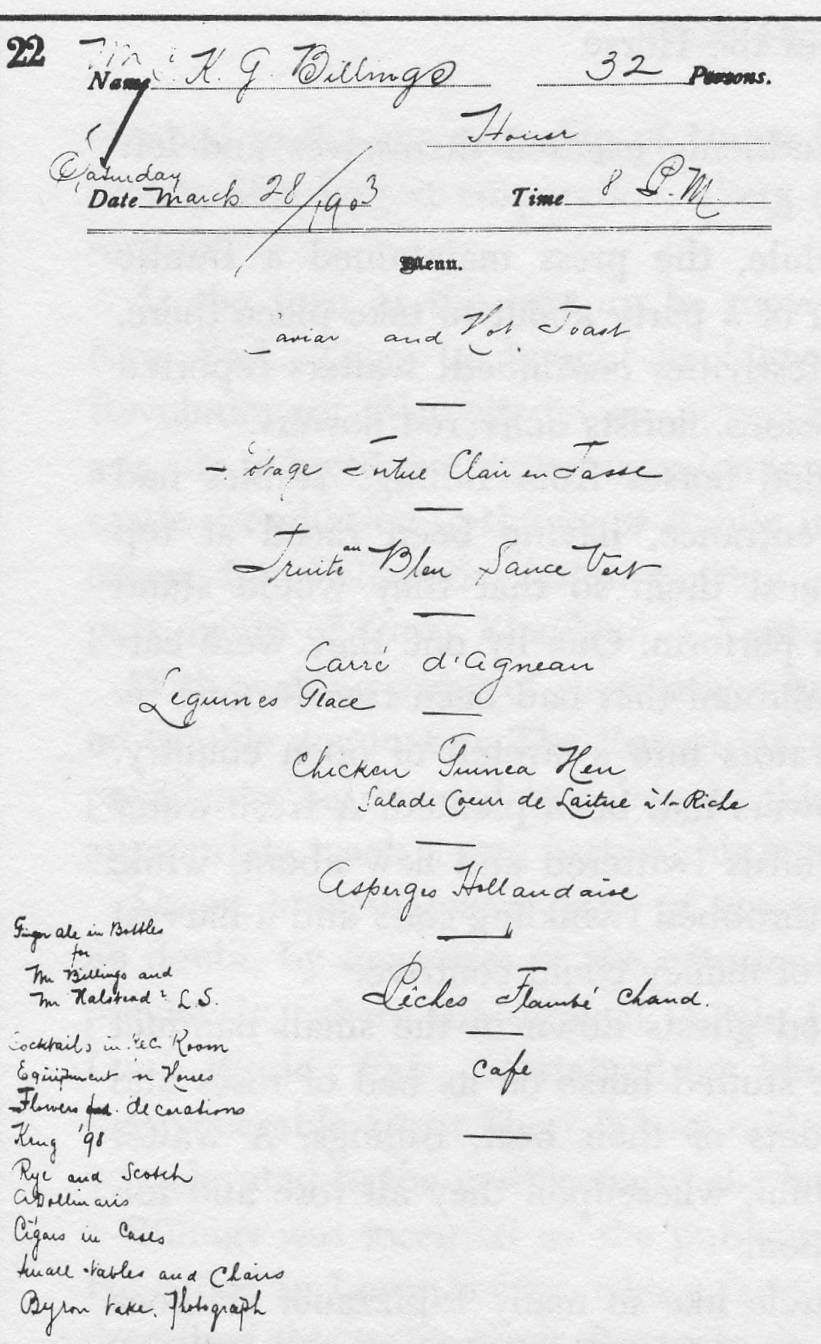
The $50,000 bill for Mr. Billings’ horseback dinner included a photographer from the Byron Company to document the event. As society columnist Lucius Beebe suggested, “The photograph reinforced people’s belief that New York socialites went to bed in full evening dress after brushing their teeth in champagne.” Museum of the City of New York Collections
The $50,000 bill for Mr. Billings’ horseback dinner included a photographer from the Byron Company to document the event. As society columnist Lucius Beebe suggested, “The photograph reinforced people’s belief that New York socialites went to bed in full evening dress after brushing their teeth in champagne. Museum of the City of New York Collections

Talk about the unbridled opulence of the Gilded Age. In 1903, wealthy industrialist and equestrian Cornelius Kingsley Garrison Billings opened a private 25,000-square-foot, two-story trotting stable on 196th Street at Fort Washington Road (what is now Fort Tryon Park).

The $200,000 stable featured stucco walls, a shingled roof, and 22 stalls (each with a brass plaque for the name of the equine occupant). The luxury stable housed about 20 carriages, 33 horses, a gymnasium, trophy room, sleigh room, lounging rooms, and living quarters for two families.

C.K.G. Billings horse stable
The New York Times called C.K.G. Billings’ trotting stable in northern Manhattan “The most luxurious and complete stable ever built.”

To celebrate the opening of his stables, Billings had planned to host an exclusive stag formal dinner at the stable, catered by well-known restaurateur and “society caterer” Louis Sherry. Word of the dinner leaked out, however, and crowds of reporters gathered, hoping to see the stable and wealthy guests.

Billings quietly changed plans, and rented the grand Rococo ballroom on the fourth floor of Louis Sherry’s, a 12-story restaurant with ballrooms and residential suites on the corner of Fifth Avenue and 44th Street.

The ballroom at Louis Sherry's Restaurant
The ballroom at Louis Sherry’s Restaurant

When the 36 guests, all members of the Equestrian Club, arrived on March 28 at 8 p.m., they found the grand Rocco ballroom decorated as a woodland garden, with trees and shrubbery, real birds, a huge harvest moon hanging from the ceiling, and sod on the floor. The guests mounted well-trained rented horses and faced each other in a circle.

They ate from custom-made dining trays covered in crisp linen that were attached to their saddles. And they sipped champagne through rubber tubes from iced bottles in their saddlebags.

An attendant with a horse at Billings Horseback Dinner

Waiters dressed as grooms in scarlet coats and white breeches — one waiter to a rider — served 14 courses. The menu that evening featured Truite au Bleu, lamb, guinea hen, and flaming peaches. Real grooms stood at each horse’s head to reduce the risk of tossed trays, food, and riders. At the end of the evening, the waiter-grooms brought in elaborate feeding troughs filled with oats so the horses could eat with their riders.

And how did the horses get up to the fourth floor? By freight elevator, of course! At the end of the evening, a vaudeville show took place to entertain the guests while the horses were lowered back down to street level.

Here is a copy of the menu from the book Their Turf by Bernard Livingston. The real menus were sterling silver and shaped like a horseshoe.
Harlem River Speedway
Billings built his stables in northern Manhattan because he wanted to have his horses near the Harlem River Speedway, an exclusive dirt track for equestrians and carriage drivers. Built in 1894, the speedway was located between 155th and Dyckman Streets. Today it is known as the Harlem River Drive.

Forty years prior to the horseback dinner, the site of Louis Sherry’s was the scene of a horrific fire at the Colored Orphan Asylum.

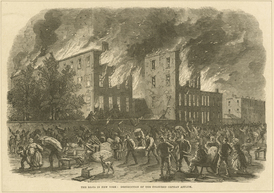
Founded in 1836, the 4-story orphanage extended from 43rd to 44th Street and housed hundreds of African-American children. On July 13, 1863, during the Draft Riots, the orphanage was burned to the ground. The 233 children in residence were all led to safety by the matron of the home.

The Colored Orphan Asylum at 43rd to 44th Street during the Draft Riots in 1863.
The Colored Orphan Asylum at 43rd to 44th Street during the Draft Riots in 1863.

A modern hatching cat

The French Hatching Cat was a large Angora cat from Paris who loved sitting on eggs and being surrounded by the baby chicks she helped to hatch.

In June 1911, the French Hatching Cat journeyed from France to New York City. She then took a short trip across the Hudson River to the Palisades Amusement Park in New Jersey, where she spent six weeks entertaining thousands of adults and children with her baby chicks.

A vintage advertising postcard for Palisades Amusement Park in New Jersey.

I first discovered the French Hatching Cat while reading Palisades Amusement Park: A Century of Fond Memories, by Vince Gargiulo. The feline received only a brief two-sentence cameo in the 200-page coffee table book, but it caught my attention:

The French Hatching Cat.This Angora feline had an affinity for sitting on eggs and being surrounded by baby chicks. In June 1911 Nick Schenk outbid other American amusement park owners for the right to display the famous kitty and booked it for a six-week stint.

I contacted Vince Gargiulo by email, and told him I was interested in learning more about this cat for a children’s book about odd animal tales that I wanted to write.

Vince sent me a scan of an old newspaper clipping touting the arrival of “France’s ‘Freak of Nature’ Hatching Cat” in New York City. The short article stated that the Angora was scheduled to arrive toward the end of June, and was under the care of Fernand Akoud, who was director of the ethnological departments of the Jardin d’Acclimation — Zoological Gardens in Paris.

The Jardin d'Acclimation was the first ever attraction park in France, opened in 1860 by the Emperor Napoleon III and Empress Eugenie in the Bois de Boulogne. The Hatching Cat may have made her debut as an “attraction” at this park around 1910.
The Jardin d’Acclimation was the first ever attraction park in France, opened in 1860 by the Emperor Napoleon III and Empress Eugenie in the Bois de Boulogne. The Hatching Cat may have made her debut as an “attraction” at this park around 1910.

I did some digging, and as the story goes, Fernand Akoud had apparently introduced Europeans to the Hatching Cat at the World Exposition in 1910, which took place at the Luna Park in Brussels, Belgium.

That would be the first of many trips the feline would make from her home base in Paris, as news of the cat who hatched eggs spread across Europe.

Information about the Hatching Cat had reached America in 1911, where amusement parks like Coney Island and family theme parks called trolley parks were attracting thousands of people in every major city. A bidding war for the French Hatching Cat took place, with several amusement park managers aggressively making offers to bring her to America. In early June, Nicholas Schenck, the general manager of Palisades Amusement Park in New Jersey, won the bid.

Aerial view of the once famous Palisades Amusement Park ...
Aerial view of Palisades Amusement Park in the 1960s.

Palisades Amusement Park (originally “The Park on the Palisades”) was an amusement park situated atop the New Jersey Palisades across the Hudson River from New York City. The park operated from 1898 until 1971, and boasted the world’s largest saltwater swimming pool and more than 200 rides and attractions.

The park was featured in several songs, including this one by Johnny Cannon, which was later performed by Bruce Springsteen and The E Street Band on their Tunnel of Love Express Tour in 1988. After the park closed, a high-rise luxury apartment complex was built on its site.

The arrival date of the Hatching Cat in New York made me wonder if she was a passenger on the maiden voyage of the Royal Mail Ship Olympic. The RMS Olympic and the RMS Titanic were sister ships of the White Star Line; the maiden voyage of both ships was under the command of Captain Edward John Smith.

Although Mr. Akoud does not appear on the passenger list of Olympic’s maiden voyage from Southampton in Great Britain to Pier 59 in New York, one can always imagine that the cat did travel on this ship with another caretaker!

RMS Olympic - Wikipedia
Did the French Hatching Cat travel on the maiden voyage of the RMS Olympic? I like to imagine that she did!

No matter which passenger ship the Hatching Cat traveled on, she would have followed this adventure with a hansom cab ride to 125th Street in New York, where she would have then boarded a ferry to Edgewater, N.J.

In Edgewater, the feline and her caretaker would have boarded one of the trolley cars that wound up the cliffs in a series of hair-pin turns to Palisades Amusement Park.

Roller coasters of Palisades Amusement Park are visible atop the ...
Palisades Amusement Park was originally a trolley park designed and built by the Bergen County Traction Company to attract evening and weekend riders by featuring the park as the terminus for the trolley. The scenic railway ran from a ferry slip in Edgewater, NJ, up to the park. The trolley looks like fun to me, but I don’t imagine the Hatching Cat enjoyed the ride.

Another Hatching Cat in Old New York

While searching for information about the French Hatching Cat, I came across a short article in The New York Times dated September 21, 1879: “A Cat Hatching Chickens.”

According to the story, in a “little shanty” at the northwest corner of 15th St. and Third Avenue in Brooklyn (Gowanus/Park Slope area), a cat had hatched three broods of chickens and was now sitting on a fourth. Officer Jonas Evans of the Sanitary Police Squad reported the story to the Times after searching out the kitty to satisfy his curiosity.

Modern-Day Hatching Cats

I also came across a few 21st-century cats with a fondness for chicken eggs, including an Australian barn cat named Bustopher, who was discovered sitting on some eggs in 2010. “I was looking for Bustopher and found him sitting on the eggs, obviously trying to incubate them,” his owner, Naomi Oliver told the Northern Territory News.

Then in 2012, a stray tabby named Lizzy became a surrogate babysitter to a clutch of hen’s eggs in the U.K. According to the story, the tabby and the hen take turns babysitting: the hen watches over Lizzy’s kittens while Lizzy goes out on the prowl and Lizzy watches over the eggs when the hen needs a break. And finally, here is a great video of a modern cat with her hatchlings:
Cat with chicks

If you enjoyed this cat tale, you might also like reading about Herr Techow’s circus cats.