Unidentified sailor with a cat
Unidentified sailor with a cat that very well could have been Joe Fife in the right place and time.

Ten days before the USS President Lincoln troop transport was torpedoed and sunk by a German submarine U-90 while on her way back to the United States, a reporter from the New York Herald paid a visit to the ship at the Hoboken Port of Embarkation. One of the crew members on board the ship during this visit was a ship’s cat named Joe Fife (or Joefife), who had joined the U.S. Navy in August 1917.

Formerly the German steamer President Lincoln of the Hamburg-American Line, the ship was built in Belfast in 1907. Seized in New York Harbor in 1917, it was turned over to the Shipping Board and transferred to the U.S. Navy for operation as a troop transport during World War I.

Prior to being re-commissioned as a Navy troop ship, the USS President Lincoln underwent extensive repairs and conversion at Robins Dry Dock and Repair Company in the Red Hook section of Brooklyn. It was placed under the command of Commander Yates Stirling, Jr., and went into service on July 25, 1917.

According to the Herald reporter, although the ship was stripped of all non-essentials from her days as a passenger vessel, the President Lincoln was “none the less attractive for their absence.”

In place of cabins, smoking rooms, and saloons, there were now large spaces furnished with small tables for cards and games, bright white pine dining tables for each platoon, and enough hammocks to accommodate the 6,000 soldiers on each trans-Atlantic crossing.

Robins Dry Dock and Repair Company
New York Public Library Digital Collections
The President Lincoln underwent extensive repairs and conversion from passenger liner to transport ship at Robins Dry Dock and Repair Company, pictured here in 1931. These buildings were located on Beard and Richard Streets. New York Public Library Digital Collections

Joe Fife the Mascot Cat

During World War I, all of the transport ships and most of the convoying navy vessels had mascots–especially mascots of the feline kind. The USS President Lincoln was no exception.

Joe Fife (probably named for Commodore Joseph Fife, who began his naval career during the Civil War) was described as “a handsome tabby cat of the smoke variety–one of the most aristocratic of the breeds of cat.” He reportedly joined the ship shortly after the liner was placed into service as a troop transport.

As the story goes, just after the ship went into service, there was some discussion in the officers’ mess about acquiring a mascot. Paymaster J.F. Loba was deputized to to “procure the most unusual specimen possible of any well known animal and bring it on board to supply the aching void.” (Apparently, the only animals the men would not consider were apes.)

Having received his assignment, Paymaster Loba started on his mascot quest. The “cunning paymaster” reportedly had a fondness for cats, so right away he knew which kind of animal he was going to select. He also knew just where to find a great cat–and so up to the Bronx he went.

Apparently, Loba had relatives in Kingsbridge, with whom he would occasionally call on when he was on shore leave. During these visits, he often saw, from a distance, “the very king of cats.” In no time at all, he made his acquaintance with Joe Fife, “a splendid silver tabby of registered stock having a coat of beautiful stripes on a smoke background.”

The USS President Lincoln had thousands of hammocks for the crew. Perhaps Joe Fife had his own hammock, like this mascot of the HMS Repulse.

Now, it was one thing to actually find this perfect mascot in the Bronx. Persuading the cat’s adoring mistress to release him from her arms was another thing all together.

According to the nationally published story, Paymaster Loba somehow convinced the woman that it was her patriotic duty to allow Joe Fife to join the navy (reportedly, he got her to believe that she had raised her cat to be a sailor who would serve his country.)

Joe Fife adjusted to his new life at sea fairly quickly. A day or two after he had been inducted into his cabin, he meticulously investigated every dark corner of the ship, made friends with all on board “irrespective of rank,” and carried out “his reputation as a great jollier.” He was a faithful mascot and never deserted the ship–well, except for that one time…

One night before the ship was set to sail, Joe Fife deserted the navy. In other words, the cat went AWOL.

The USS President Lincoln moored at Brest, France, on May 25, 1918. shortly before her final voyage. Joe Fife is somewhere on this ship.
The USS President Lincoln moored at Brest, France, on May 25, 1918, shortly before her final voyage. Joe Fife is somewhere on this ship.

Some suggested the ship cat could smell the upcoming fall cat show in the air and decided to leave in case the ship did not return to port in time for the event. Whatever the reason, two days after his disappearance, a “disreputable cat with a disheveled tail tried to creep unnoticed into the pretty hallway of a villa in Kingsbridge.” (Mind you, the ship was in Hoboken, NJ, when Joe Fife left, so I have no idea how the cat made it across the river to the Bronx!)

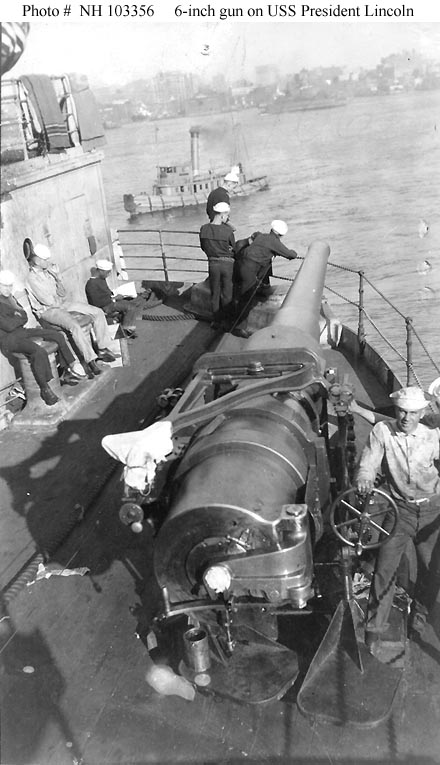
Joe Fife loved lounging on the U-Boat rifle.

Welcoming her soldier cat with love and affection, the mistress cleaned and brushed Joe Fife until he was back to being beautiful. A few weeks later, “he held his usual court at the cat show,” where he won a blue ribbon and two special prizes. As the unnamed mistress told Paymaster Loba, she truly believed that Joe Fife ran away for no other reason than to be in the cat show as usual and capture the prizes.

Although Joe Fife seemed at first to have forgotten his brief flirtation with a life at sea, it wasn’t long before he was back in the navy. Somehow, the prize-winning cat made it back to the ship “gayly and as if returning to his favorite quarters.”

During his remaining time on the President Lincoln, Joe Fife thoroughly enjoyed the seaman’s life. He especially loved resting upon the muzzle of the U-boat rifle, which, as the Herald reporter noted, “would indicate his desire to gain the complete technical equipment of a first-class marine.”

Sadly, Joe Fife didn’t have a long life as the ship’s mascot. On May 31, 1918, during its fifth return trip to New York, the USS President Lincoln was struck by three torpedoes and sank in about 20 minutes. Of the 715 humans aboard, 26 men (3 officers, 23 enlisted) were killed during the explosions; Lieutenant Edouard Izac was taken aboard U–90 as prisoner.

Late that night, after 18 hours drifting in the choppy seas, survivors were rescued from lifeboats by destroyers Warrington and Smith.  They arrived back in France on June 2.

The national news did not report the status of Joe Fife.

The sinking of the USS President Lincoln. Painting, Oil on Canvas; By Fred Dana Marsh; 1920.

Survivors of the President Lincoln on board the USS Warrington (Destroyer #30), June 1918. We can only hope that Joe Fife was among these men. Naval Institute Photo Archive.
Survivors of the President Lincoln on board the USS Warrington (Destroyer #30), June 1918. We can only hope that Joe Fife was among these men. Naval Institute Photo Archive.

Did You Know? Hoboken Port of Embarkation

Pier No. 4, U.S. Army Transport Service, 1917-1919.

During World War I, the command responsible for the movement of troops and supplies from the United States to overseas commands was called the Hoboken Port of Embarkation. Its headquarters were in the seized Hamburg American Line and North German Lloyd Steamship facilities in Hoboken, New Jersey.

The first commander of the Hoboken Port of Embarkation was Major General David Shanks. Operating from the luxurious offices of the Lloyd Steamship lines, he recruited 2,500 officers to manage the twelve piers at Hoboken, eight piers in Brooklyn, and three piers in Manhattan. During WWI, he moved 1.7 million men overseas and was later awarded the Distinguished Service Medal by President Wilson.

It was at the Hoboken Port of Embarkation that a reporter from the New York Herald met Joe Fife the mascot cat only 10 days before the USS President Lincoln sank off the coast of France.

Bronze plaque memorializing the men lost when the President Lincoln was sunk in 1918.
Bronze plaque memorializing the men lost when the President Lincoln was sunk in 1918. I do not see Joe Fife listed on the plaque, so hopefully that’s a good sign. Naval Institute Photo Archive.
This is not a vintage photo of Chappie, a bull terrier, but this pit bull fits his description.

One of my favorite fire-cat stories of Old New York is about Peter and Chops, the beloved firefighter felines of Engine Company No. 14 in New York City’s Flatiron District.

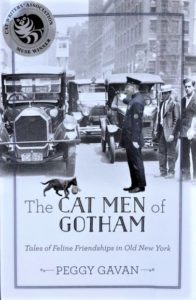
When I wrote the story about Peter and Chops for my book, The Cat Men of Gotham, I didn’t realize that they had a canine predecessor. I recently discovered the wonderful story of Chappie, a pedigree bull terrier* coach dog who also called the Engine 14 firehouse his home.

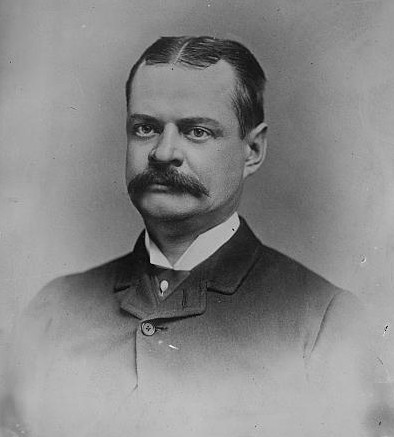
According to The Sun, (and as Virginia knows, if you see it in The Sun it’s so), Chappie came of the best blue blood in England, having been imported to America by William Waldorf Astor, the son of John Jacob Astor III. Astor, who at one time lived in a mansion on the corner of Fifth Avenue and 33rd Street (which he razed to build the original Waldorf Hotel), reportedly presented the dog to the fire company on East 18th Street in 1889.

Everybody in the Flatiron District–or what was then called the Eighteenth Ward–knew Chappie, described as a 45-pound white bull terrier whose “ferocious looks utterly belied him.”

Chappie was especially attached to anyone wearing a fireman’s uniform, but he was also friendly with civilians. He also loved all the children in the neighborhood, who were his playmates.

William Waldorf Astor - Wikipedia
Chappie was reportedly a gift from William Waldorf Astor

The only time Chappie lost his temper was when a policeman was in sight. He could not tolerate that uniform and could tell at a glance that it did not belong to a fireman (apparently, a policeman once used his stick on Chappie, so the police were not his friends).

Chappie was very loyal to his firemen friends, though, whether he was with them at fires or guarding the firehouse. While strangers were permitted to make friendly advances outside the door, “a snarl and a gleam of ugly teeth warned against trespassing inside.”

One time, when Chappie was alone in the firehouse, Police Commissioner James J. Martin dared to come inside. Chappie did not allow Commissioner Martin to leave until the firemen returned.

According to The Sun, Chappie was “a faithful attendant” at all fires. As soon as the gongs started ringing, he would cock his ears and wait to see if he was wanted. He reportedly understood the signals and would not stir if the alarm denoted a fire outside the company’s boundaries in the Flatiron District.

Chappie, fire dog of the Flatiron District, 1892
 The Evening World
Illustration of Chappie, The Evening World, 1892

When the gongs sounded a fire for Engine Company No. 14, Chappie would race around with “an absurd energy” as soon as the doors were thrown open, playfully snapping at everyone, tumbling over himself, and incessantly barking as if he were saying, “Come now, get a move on you; no time to be lost; rush her along.”

Chappie was always in his glory on his way to a fire. He would bound ahead of the galloping team, furiously barking and springing up between the horses’ legs.

Spectators would close their eyes, expecting to see him get trampled or crushed. But on most occasions, he would come racing out from under the flying hoofs and lead the procession once again, biting and barking and urging the horses on.

Once on the scene of the fire, Chappie would calm down and sit on the driver’s seat, comfortably wagging his stub of a tail as he watched his friends work. Sometimes he would bark a few times to encourage them.

During his three short years with Engine Company No. 14, Chappie sustained several injuries. He lost a piece of his tail while leading the horses, his leg was broken, and he was often bruised. But none of those injuries could stop him from doing what he loved most.

One time when Chappie was sick, the men tied him to the oaken staircase in the firehouse and rushed to the fire, thinking he was secure at home. As they rounded a corner, they heard children shouting. There was Chappie, running alongside the horses with a rope still around his neck. (The other part of the rope was still tied to the staircase.)

But then one fateful night, as the engine was responding to a box alarm at Twenty-third Street and Third Avenue, Chappie broke his paw in two places. The firemen bandaged him up and placed him on the sick list.

Determined to respond to every call even when injured, he joined the engine the following night when it responded to a fire on Broadway between Ninth and Tenth Avenues. Chappie reportedly ran to the scene on three legs.

On that call, Chappie got underneath the horses’ feet and went down. As he tried to right himself, either the pan of the engine or the pumps caught him in the back and crushed him to the pavement. The firemen cried as they carried their maimed Chappie back to the station.

Dr. Thomas D. Sherwood, a veterinary surgeon (who was also the vet for General Daniel E. Sickles’ dog, Bo-Bo), examined Chappie and found a fractured spine, a broken leg, and several internal injuries. At first the firemen wanted to shoot the dog to put him out of his misery, but they later decided to try to save him. They rigged a canvas bandage on two billiard cues above an open dry goods box to suspend their injured fire dog.

An illustration of Chappie suspended over the dry goods box.

Dr. Sherwood took great interest in the case, calling several times that day. There was a bit of hope at first, but then Chappie gave evidence that he was suffering even more in his suspended position. The men tried to make him as comfortable as possible in a pile of the horses’ straw. They also gave him some opiates to help ease the pain.

Chappie died in his firehouse home at 2 a.m. on March 23, 1892. Shortly after his death, Peter and Chops took over as mascots of Engine Company Number 14.

A Brief History of the Flatiron District and Engine Company No. 14

Before the Flatiron Building, 1884
Before there was a Flatiron Building, the wedge-shaped intersection of Fifth Avenue and Broadway was occupied by several narrow, three-story shops and residences. Photo circa 1884.

The Flatiron district, which is roughly bounded by Seventh Avenue and Park Avenue from 14th to 30th streets, is named for the iconic Flatiron Building, constructed in 1902 on the wedge-shaped intersection of Fifth Avenue and Broadway. In the early 19th century, before there was a Flatiron Building (and the narrow buildings that preceded it), the district was mostly open pastures owned by farmers such as Isaac Varian, Casper Samler, and John Horn.

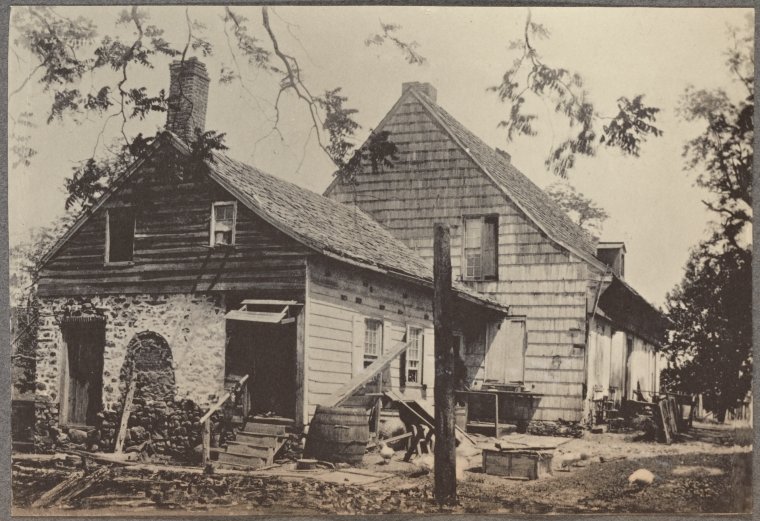
Isaac Varian Homestead, present-day West 26th Street, Flatiron District
At least two generations lived at the old Isaac Varian homestead until it was demolished in 1850 to make way for new townhomes. At that time, a grandson, Richard Varian, was living in the house with his wife and their children, all of whom were born there. With the old homestead gone, Richard had a new home built at 27 West 26th Street, where he died in 1864.

Isaac Varian was born in New York City on September 8, 1740. He was a butcher for a long period, residing and doing business at 176-180 Bowery from 1806 to 1818. He was married three times and had 16 children. In his spare time, Varian established a farm and homestead on a 25-acre plot he purchased from John Horne sometime during the 1780s.

The homestead stood on 26th Street just west of the Bloomingdale Road (Broadway), and was home to at least two generations of Varians until it was demolished in 1850 to make way for new townhouses. Ten years after Varian’s death on May 29, 1820, the many heirs to his estate began selling off their allotted parcels to individual buyers and speculators. One of those parcels on 18th Street was eventually conveyed to a man named John L. Gross.  

Engine Company No. 14, Flatiron District, 1887
This illustration of Engine Company No. 14 in their original firehouse was published in 1887, two years before William Waldorf Astor presented the company with Chappie.

On December 30, 1861, Gross sold his house at 14 East 18th Street to the city for $7,825. Two years later, the Metamora Hose Company No. 29 (organized in 1854) relocated from 21st Street and Broadway to their new firehouse on East 18th Street. Four years later, on October 6, 1865, a new engine company called the Metropolitan Steam-Engine Company No. 14 was created to replace the old volunteer hose company.

Engine Company Number 14, 18 East 14th Street.

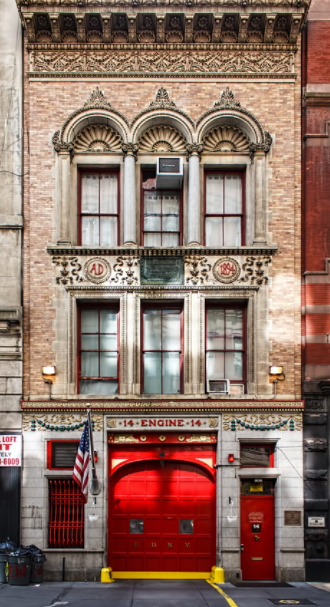
In 1894, two years after the passing of Chappie, Napoleon LeBrun & Son was tasked with designing a new firehouse at 14 East 18th Street.

Featuring Corinthian columns on the third floor that support decorative arches over the windows and large terra cotta medallions that pronounce the date of construction, the firehouse is what the AIA Guide to New York City describes as “A delicate Italian Renaissance town house for fire engines.”

The structure is still as beautiful today as it was during the days of Chappie, Chops, and Peter, albeit the still-active firehouse is no longer home to horses, coach dogs, or fire cats.

*The Sun said Chappie was a bull terrier, and The Evening World called him a bulldog, but the illustration looks more like a pit bull.

New York City's Post Office cats were featured in a news article in 1898
New York City’s Post Office cats and Gustave Fersenheim were featured in a national news article in 1898. In the center is an image of Tom learning sign language. The clerks lovingly referred to Gustave as the “deaf and dumb cat feeder.” (During this time period, it was acceptable to refer to those hard of hearing as deaf and dumb or deaf-mutes.)

A librarian recently asked me what makes an old news story worthy of further research and posting on my website. I told her that not only does it need to be a great animal tale, but it must also be a good people story or have ties to interesting historical buildings or events. The following story about a deaf New York Post Office cat and the deaf postal worker who loved him meets all my criteria for a fabulous animal story of Old New York. Sit back and enjoy.

One of my favorite cat-man stories featured on my website and in my book, The Cat Men of Gotham, is about George Cook, the Superintendent of Federal Cats at New York’s General Post Office. George was responsible for feeding the dozens of New York mousers who were “employed” by the U.S. Post Office Department to kill the mice and rats that were attracted to the glue used on envelopes and packages.

The Post Office had a budget to feed the mousers employed to keep the vermin in check.

When I wrote the story about George many years ago, I didn’t know then that he had a partner who helped care for the cats of the feline postal police. How excited I was to discover Gustave Fersenheim (aka Fersenheimer)!

Gustave Fersenheim was a deaf postal clerk who, according to an article in The New York Times, “was way down on the pay roll as a clerk, but whose principal self-imposed duty was to feed and preserve order among the cats in the cellar.”

In 1901, when the article was written, Gustave was 78 years old and had more than 30 years of service in the post office, having become a government employee on July 1, 1870.

At the General Post Office, his duties as a clerk were considered a side job by the numerous clerks who worked there (including, incidentally, my great-granduncle Henry Gavigan, who also worked as a clerk at New York City’s General Post Office in the early 1900s). Gustave’s main job was helping George feed the postal cats.

Gustave was an animal lover, but for some reason he tried to hide his feline feelings from his fellow employees. That meant getting to the post office very early each morning so he could attend to the cats before there were too many other workers in the building.

Now, Gustave lived in the South Bronx, in a third-floor apartment at 633 East 148th Street. So, every morning he would leave his home by 5 AM and make his way to the General Post Office building, which was then located in City Hall Park in lower Manhattan. That gave him enough time to feed the cats their government-rationed milk and liver from the Washington Market before he had to report for duty at 7 AM in the box delivery department.  

Gustave, the son of Elias and Fredericka Fersenheim, was born in Prussia (Germany) on January 26, 1823. He arrived in New York City in 1850 and was naturalized as a U.S. citizen in 1864. He married his first wife, Elizabeth, in St. Louis, and the couple lived for a while at 84 Marcy Avenue in Brooklyn. Elizabeth died on February 18, 1895, at the age of 74.

Less than a year after Elizabeth’s passing, Gustave met a woman by chance at Dr. Thomas Gallaudet’s Church for the Deaf and Dumb at 511 West 148th Street (also then known as St. Ann’s Church for the Deaf-Mutes). As it turns out, this woman, Sarah Ann Ryer, had been Gustave’s good friend back home in Prussia.

The childless widow and widower reconnected and married at St. Ann’s Church on January 15, 1896. Gustave was 72 and Sarah was about 60 at the time of their wedding.

New York's General Post Office and Courthouse,, designed by Alfred B. Mullett
New York’s General Post Office and Courthouse, designed by Alfred B. Mullett, was erected between 1869 and 1880. Commonly called “Mullett’s Monstrosity,” it was demolished in 1939 as part of efforts to beautify the city for the 1939 World Fair. The site was used to extend City Hall Park to the south.

Gustave and the Post Office Cats

When Gustave first started working at the post office in 1873, he was about 47 years old. Since he couldn’t speak or hear, he spent much of his leisure time caressing two of the cats on the feline force. The cats grew fond of him—not only because he petted them, but because he gave them food from his lunch basket. As the number of his feline friends increased, he started bringing bigger baskets to work.

As Gustave got older and was no longer capable of doing much postal work, it was decided to move him into the cat department. He still continued to collect a salary for office clerk, but most of his time was spent caring for the postal mousers.

In addition to feeding the cats, Gustave also took measures to ensure as many kittens as possible got good homes. He could not bear to drown them, and something had to be done with the progeny of the cats, so he’d pawn them off on his coworkers. Begging his fellow workers to take kittens was reportedly the one thing the other clerks did not like about Gustave.

Tom, the Deaf Cat of the Post Office

One of the most wonderful cats on the job was Tom, a cat who, like Gustave, could not hear or speak. As one newspaper noted:

Would that all cats be like him! Voiceless he never goes out nights to howl and break the rest of hardworking citizens. He simply eats, drinks, sleeps, kills rats and makes signs.
Gustave first took Tom under his wing when he observed some of the other clerks cursing at the cat (as the newspaper noted, he couldn’t hear them cursing, but he could tell they were yelling by their facial expressions.)

General Post Office, City Hall, 1875
Tom couldn’t hear the trucks and wagons bearing mail, so the postal workers would gently nudge him away. NYPL digital collection.

As it turns out, the men were actually trying to protect Tom. While the other cats would leap and run away from the trucks bearing mail, Tom couldn’t hear the vehicles. When the men realized Tom was deaf, they resorted to tapping him or gently nudging him out of the way.

Delighted to find that Tom was a kindred spirit, Gustave adopted Tom by bringing the cat to his desk and feeding him beef. Soon, Tom followed Gustave everywhere as if he were a pet dog.

Gustave began educating Tom by first teaching him to sit up on his hind legs. Then he taught the cat how to make signs for hunger, thirst, and thanks.

Under Gustave’s tutelage, Tom became “a most scholarly and learned cat.” Eventually, man and cat began having long conversations.

Mutilator, The Sun Office Cat
Gustave taught Tom how to sit on his hind legs, just as Mutilator, the legendary Sun office cat, is doing here.

“Do you think we will have war with Spain?” Gustave would ask Tom using his fingers. “Me-yawl-woo!” Tom would reply, spelling out the signs for these cat words on his “educated paw.” As the news reporter noted, you can interpret these words any way you want.

Gustave decided that Tom much preferred polite conversation to killing rats, so he took him home with him, where Tom shared the Fersenheim home with a trained parrot and dog.

The Fersenheim Parrot and Dog

Gustave and his wives were often mentioned in the Deaf-Mutes Journal, which was published in Mexico, New York, from 1874 to 1939. Not only was Gustave a trustee of the Church Mission to Deaf-Mutes and an honorary president of the German Society, he and his wives entertained often, holding parties at their home every year for their anniversaries and birthdays.

Several of the articles published in the journal referred to the Fersenheim’s parrot and dog.

The parrot, Polly, would reportedly greet Gus every night by walking up and down her perch and doing whatever she could to get his attention. The parrot could also lift one leg and twirl its claws in imitation of the deaf whenever the bell rang, which proved to be of great amusement to their guests.

According to The New York Times, one of the couple’s friends taught Polly how to say “Come in” when anyone knocked at the door. She would also fly toward the door to let Gustave and his wife know when a visitor was arriving.

Deaf-Mutes Journal

In addition to the parrot, Gustave and his first wife also had a dog described as a black and tan watch dog. The dog, who spent 12 years with the couple, was able to inform his deaf master and mistress when the doorbell rang or when someone was advancing toward their apartment.

On the day of Elizabeth’s death, Gus could not find her when he returned home from the Post Office. The dog led him to the bedroom, where he found his wife lying lifeless on the floor. Her right side was paralyzed, she was blind in her right eye, and she couldn’t speak.

A doctor told Gustave that she had experienced a paralytic stroke and advised him to take her to a hospital. The first hospital refused to admit her—even though Gus offered to pay in cash—but Bellevue accepted her. According to the article, Elizabeth probably had the attack soon after Gus left for work that morning, and had lain on the floor without help all day long.

The dog, who had adored Elizabeth, refused to eat and did nothing but moan and groan in agony. Elizabeth lived for only a few weeks longer before passing away in her sleep at the hospital at the age of 74. At the time of her death, Gustave was 72, but the Deaf-Mutes Journal said he looked 15 years younger.

The Passing of Gustave Fersenheim

“There is sorrow and gloom in the hearts of the forty cats which are employed by Uncle Sam to keep rats out of the post office building.”—Pittsburgh Dispatch, August 1901

On Friday evening, August 16, 1901, Gustave became very ill. He died of gastritis two days later at his “neat and comfortable little house” on East 148th Street. Just before he died, he muttered one of the few phrases he had learned to speak: “I am done.”

Funeral services were held at his home, with Rev. Dr. Chamberlain officiating. He was buried alongside his first wife in Woodlawn Cemetery.

Following Gustave’s death, Sarah tried to give Polly to her sister, who had a pet dog named Fly. Polly and Fly became fast friends. Sadly, Polly only lived two more days after her master’s death.

Sarah’s sister put Polly in a box, which she then placed on a windowsill. When Elizabeth came to take the box, it was empty. The women found Polly in the Fly’s bed, with the dog trying to warm the dead bird.

As for the postal cats, they were also sad to lose their friend. The Pittsburgh Dispatch reported: “There is sorrow and gloom in the hearts of the forty cats which are employed by Uncle Sam to keep rats out of the post office building. Now [Gustave] is gone, and the cats, every one of which loved him, refuse to be comforted.”

Did You Know?

Gustave and Sarah Fersenheim met at St. Ann’s Church for the Deaf-Mutes on West 148th Street at Amsterdam Avenue. This church dates back to September 1850, when Rev. Thomas Gallaudet began a Bible class for deaf people in the vestry room of St. Stephen’s Church, then at the corner of Chrystie and Broome Streets.

Rev. Thomas Gallaudet and his wife Elizabeth

When the congregation outgrew this facility, it was moved to 59 Bond Street. Dr. Gallaudet eventually decided to establish a new church dedicated to the deaf, leasing the chapel of New-York University on Washington Square.

Christ Church and rectory on West 18th Street.

St. Ann’s was incorporated into the Episcopal Church in 1854. In July 1859, the society purchased the former Christ Church and rectory, located on West 18th Street near Fifth Avenue.

In 1897, St. Ann’s Church was consolidated with St. Matthew’s Church; Dr. Gallaudet was made Rector Emeritus of the new congregation. A new chapel was constructed—the first in the country to be erected solely for the use of deaf congregants.

The Romanesque-style structure, designed by Clarence True, had a cream-colored brick exterior and could accommodate 300 people. The interior featured an inclined floor, as in a theater, so the congregation could have an unobstructed view of the altar as the clergymen prayed and preached using sign language. The church’s many windows provided extra light for those who depended on sight alone.

Today, this building houses the Manhattan Holy Tabernacle Church. Deaf services still take place at St. Ann’s Church for the Deaf, now located at 209 East 16th Street.

Incidentally, Gallaudet University in Washington, DC, the only college in the world where students live and learn using American Sign Language, was named for the Reverend’s father, Thomas Hopkins Gallaudet. His mother, Sophia Fowler Gallaudet, was a founding matron of the school.  

An unnamed, heroic stray cat and a mischievous mouse played a prominent role in a fire that forced a dozen families from the brick double apartment at 561-565 49th Street (present-day Sunset Park neighborhood) on December 4, 1908.

According to the Brooklyn Daily Eagle, the fire began in a wardrobe in the apartment of Mr. and Mrs. Aaron Platt sometime around midnight. Most of the families in the four-story building were probably asleep at the time.

Mrs. John Duffy and her three children were in their apartment on the ground level when the fire started. Unaware of the danger lurking upstairs, Mrs. Duffy was quite alarmed when a stray cat bounded into the room through an open window.

Cat Gave Fire Alarm 1908

At first, she didn’t know what to make of the cat. It ran around the room in circles and scampered about under the table and chairs. When the children attempted to drive the cat out, it leaped into Mrs. Duffy’s lap and would not leave. Mrs. Duffy didn’t know it yet, but the cat was sounding an alarm.

Frightened by the cat’s antics, Mrs. Duffy ran out into the hall with the cat still clinging to her dress. As she reached the hall, nine-year-old Charlie Platt came rushing down the stairs, crying that his room was on fire and that his father and mother were still up there trying to beat out the flames.

As soon as the boy opened the hall door, the cat bolted outside. His work was done here.

Mrs. Duffy warned the family in the adjoining rooms on her floor and then ran back into her apartment to gather up a few belongings.

561-565 49th Street, which is located in the Sunset Park neighborhood.  New York City Department of Records, 1940 municipal tax photo.
The fire took place in the double apartment building at 561-565 49th Street, which is located in the Sunset Park neighborhood. New York City Department of Records, 1940 municipal tax photo.

Unfortunately, it took the fire department longer than usual to reach the scene. The patrolman on post reportedly refused to believe young Charlie Platt’s story at first, and it took a while for the boy to convince him that he was telling the truth.

The flames spread rapidly, extending to the apartment of Mrs. Augusta Benka on the second floor of 565 49th Street. This shut off all means of escape for a dozen families on the floors above, forcing them to climb out on the roof and make their way to a hatchway of a house about a half black away. Mrs. J. F. Sullivan and her daughter May and son Donald, Mrs. Rhind, Mrs. Connolly, Mrs. F.A. Fery, Mr. and Mrs. Platt, Mrs. Benka, and others made this rooftop escape.

While the firemen were busy upstairs with the fire, Thomas Mudridge, who lived across the street, heard that Mrs. Duffy and her three children were still in their apartment. Unable to get in through the front door, he climbed into the apartment through a fire escape.

Mrs. Duffy was in a state of frozen terror as her children huddled around her. Mudridge lead them from the bedroom and rushed them through the burning hallway to the street.

According to the Brooklyn Daily Eagle, it was thought that the fire was caused by a mouse that had gnawed the tips of matches left inside a coat in the Platt’s wardrobe. The total damage was valued at $2,000.

 561 and 565 49th Street, Sunset Park, Brooklyn
Here is 561-565 49th Street today. The full trees add a nice touch to the street.

A Brief History of Sunset Park

The Sunset Park neighborhood stretches from Green-Wood Cemetery to Bay Ridge, and from the Brooklyn shoreline to Borough Park. Formerly known as Gowanus and later as South Brooklyn, Sunset Park adopted its name during the 1960s after a local park of the same name that offers terrific views of Manhattan during sunset hours.

In the 18th and early 19th centuries, Sunset Park was mostly owned by the Bergen family, whose origins in America trace back to Hans Hansen Bergen, a Norwegian ship carpenter who emigrated to New Netherland in 1663 in a company with the colony’s fifth Director-General, Wouter van Twiller.  

Bergen was married to Sarah Rapelje, the first female child of European parentage born in the colony of New Netherland. Although Hans and Sarah never lived in Brooklyn, their descendants owned two large homesteads along its waterfront: the DeHart-Bergen House near 39th Street and Third Avenue and the Johannes Bergen House near 55th Street.

DeHart-Bergen House Brooklyn
The DeHart-Bergen house near 39th Street, circa 1885. It was built sometime prior to 1680 by Symon Aertszen DeHart, who had arrived in New Amsterdam in 1662. Later residents (18th century) included Simon Bergen and his wife, Geerjte DeHart. NYPL Digital Collections

By 1825, as shown in the map below, the Bergens owned all that part of Brooklyn from 31st Street to what was then the Brooklyn City line at Bay Ridge, and from New York Bay to the patent line at New Utrecht.

Map of Farms owned by the Bergens, 1825
Map of farms owned by the Bergens, 1825. Brooklyn Public Library

The land upon which this heroic cat story took place (49th Street) was once part of a 120-acre farm owned by Martenus and Maria Bergen (the farm extended from 48th to 52nd Streets). This land had previously been owned by the Van Pelt family, who owned farmland in Gowanus and New Utrecht. Wouter Van Pelt conveyed the Gowanus land to Peter Bergen, who in turn divided it between his sons Martenus and Peter.

Following his father’s death in 1844, Martenus sold his land as part of a larger parcel to Thomas Hunt, a millionaire with ties to the Brooklyn City Railroad who held contracts for the grading and paving of Brooklyn’s streets.

Bergen Homestead, 1830 oil painting
The Bergens had many homesteads in Brooklyn; this is one of them (1830 oil painting by Andrew Richardson; Brooklyn Historical Society).

Hunt, who owned a house in Brooklyn Heights at 102 Remsen Street, built a country seat on the old Bergen farmland at 49th Street and Third Avenue. This home was destroyed in a fire in August 1866.

Thomas Hunt went on to become one of the largest real estate holders in the city. Following his death in 1878, much of his land was sold for development.

P.S. 2: The Bergen School of Sunset Park

Although I could not find any early photos or illustrations of 49th Street, I did find an old illustration along with some interesting history about one of Brooklyn’s very first schools. Now called P.S. 1 The Bergen in Sunset Park, the school–Brooklyn’s fifth school–dates back to the pre-Revolutionary era on the Bergen farm.

The old P.S. 2 on 47th Street between Third and Fourth Avenues, Sunset Park
The old P.S. 2 on 47th Street between Third and Fourth Avenues in about 1880, when Jacob Sand was principal.

According to published reports, prior to the Revolution, children of the Gowanus district attended school in the dwelling houses on the Bergen farms. During the Revolution, a log school house was built on the Bergen farm lane west of the junction at present-day Third Avenue and 44th Street.

In 1797, the log building was replaced with a frame building, which became P.S. No. 2 in 1810. (The school’s first teacher, Michael Hogan, reportedly slit his own throat after a female student refused his advances and marriage proposal.)

In 1846, a two-story, two-room school was erected on 47th Street near Third Avenue. Four rooms were added in 1865 and 24 classrooms were added in 1875; another 12 classrooms were added in 1896.

The Board of Education added “Bergen School” to the school’s name in 1915, making it P.S. 2 The Bergen School. Today, the Sunset Park school is called P.S. 1 The Bergen, and it serves children in Pre-K through 5th grade.

P.S. 2 The Bergen at 321 47th Street, 1930
 Sunset Park, Brooklyn
P.S. 2 at 321 47th Street, 1930. NYPL Digital Collections

Wednesday, October 20, 2021
6-7 p.m. ET

FURst Responders of Gotham virtual presentation

We’re all familiar with the mounted patrolmen of the NYPD and the horses and Dalmatians that worked for the FDNY. But during the 1800s and early 1900s, most of New York City’s police and fire stations also had cats and other dogs and animals on their rosters. I like to call all of these bravest and finest animals of Old New York the FURst Responders of Gotham.

Feline FURst Responders

For example, in 1915, there were more than 100 cats on active duty with the NYPD. During that same time period, there were reportedly 90 dogs and 120 cats among the 200 fire companies in Manhattan and Brooklyn (and I think these numbers are very low). Most of these mascots served as companions for the men. But many were also working animals that helped protect property and save lives.

Join me on October 20, 2021, as I explore the city’s police and fire history while sharing some amazing stories of Old New York’s four-legged bravest and finest. This will be the debut for my FURst Responders of Gotham presentation, which is a prelude to my (possibly) next book of the same title.

Canine FURst Responders


Hear about:

  • America’s very first police K-9 unit, which was formed in Brooklyn
  • The famous monkey and cat mascots of “The Finest Fire House in the World”
  • The last horse-drawn fire engine in the history of the FDNY
  • Strike, the kitten-saving police dog of Tribeca
  • The canine detectives of the Long Island Railroad Police Force
  • Arson and Homicide, the cats on the job at Police Headquarters
  • Robert Bruce MacMurray, the horse-saving fire dog
  • Tootsey, the feline firefighter who loved to ride on fire engines

Registration

This program is being sponsored by the Boonton Holmes Public Library as part of their Virtual Happy Hour Program. To sign up for this free program, please click here by October 18.

I am available for virtual author events across the United States and for
in-person presentations in the New York City metropolitan region (including northern New Jersey and the Hudson Valley). If your organization or library is interested in hosting a program, please contact me at pgavan@optline.net