We’re all familiar with the mounted patrolmen of the NYPD and the horses and Dalmatians that worked for the FDNY. But during the 1800s and early 1900s, most of New York City’s police and fire stations also had cats and other dogs and animals on their rosters. I like to call all of these bravest and finest animals of Old New York the FURst Responders of Gotham.
For example, in 1915, there were more than 100 cats on active duty with the NYPD. During that same time period, there were reportedly 90 dogs and 120 cats among the 200 fire companies in Manhattan and Brooklyn (and I think these numbers are very low). Most of these mascots served as companions for the men. But many were also working animals that helped protect property and save lives.
Join me on October 20, 2021, as I explore the city’s police and fire history while sharing some amazing stories of Old New York’s four-legged bravest and finest. This will be the debut for my FURst Responders of Gotham presentation, which is a prelude to my (possibly) next book of the same title.
Hear about:
America’s very first police K-9 unit, which was formed in Brooklyn
The famous monkey and cat mascots of “The Finest Fire House in the World”
The last horse-drawn fire engine in the history of the FDNY
Strike, the kitten-saving police dog of Tribeca
The canine detectives of the Long Island Railroad Police Force
Arson and Homicide, the cats on the job at Police Headquarters
Robert Bruce MacMurray, the horse-saving fire dog
Tootsey, the feline firefighter who loved to ride on fire engines
Registration
This program is being sponsored by the Boonton Holmes Public Library as part of their Virtual Happy Hour Program. To sign up for this free program, please click hereby October 18.
I am available for virtual author events across the United States and for in-person presentations in the New York City metropolitan region (including northern New Jersey and the Hudson Valley). If your organization or library is interested in hosting a program, please contact me at pgavan@optline.net
Hook and Ladder Company 10 had a Hayes truck and three of the handsomest and quickest working horses in the department–Larry, Billy, and Dick. I also see a dog in this c. 1891 photo, but no cat (Patsey was probably napping inside). New York Historical Society
On August 1, 1891, Hook and Ladder Company No. 10 on State Street was designated as ready for active service with what was then called the Brooklyn Fire Department. The new company protected the Second District, which was bordered by Johnston Street, Nevins Street, First Place, and Smith Street, and on the west by the waterfront.
According to Our Firemen: The History of the Brooklyn Fire Department, the property in this district of about one square mile represented “more value than that of any other equal portion of the city.” It included all the expensive residential buildings in “The Heights,” a considerable portion of “The Hill,” and all of the large shopping district lying between the Heights and the Hill. Hook and Ladder Company No. 10 responded to calls from 117 boxes on a second alarm, with the most remote box located at the end of Red Hook Point.
Two days after the new company went into service, a new member was added to the roster: a small cat “who wore a fur coat which in color resembled a tortoise shell.”
According to a story in “Our Firemen,” Patsey entered the bay door on August 3, settled into a chair, and, through his general demeanor, indicated that he intended to stay.
The men welcomed him with some warm milk and christened him Patsey. (I have a feeling Patsey was a female cat, as only about 1 in 3,000 tortoiseshell cats are male).
Although Patsey’s name did not appear on the payrolls at Brooklyn’s fire headquarters, the men considered Patsey to be an official fire cat. They even presented him with a silver collar. Life was pretty good for the former street cat, largely due to the all the wonderful features of the new firehouse.
The new firehouse for Hook and Ladder Company No. 10 was quartered in a two-story building at 264 State Street, near Boerum Place. The building was designed by William J. Moran, who also designed a similar looking firehouse in 1890 for Engine Company No. 28 at 436 39th Street (below).
The firehouse for Hook and Ladder Company No. 10 on State Street reportedly looked very similar to this firehouse on 39th Street, albeit, it had a rectangular central bay door.
One of the main features of the firehouse was a large gymnasium in the cellar, where the men could work out with rowing machines, dumb bells, heavy and light hammers, Indian clubs, and something called quoits, which was a traditional game that involved the throwing of rings over a set distance. Patsey loved spending time in the gymnasium–his favorite activity was taking lessons in high vaulting and running jumps.
Another favorite activity for Patsey was napping. He loved to sleep on top of the men’s coats on the extreme end of the extension ladder.
One day as he was taking an afternoon nap, an alarm sounded from a box on the corner of Hoyt and Warren Streets. Normally, Patsey was on the alert as soon as the gong sounded, but on this occasion he did not wake up until the truck was on the way to the fire.
At Dean and Pacific Streets, Fireman Collins discovered Patsey with his claws buried deep into one of the coats. He appeared to be completely enjoying the situation!
When the truck arrived at the scene, Patsey was transferred to the driver’s seat and covered up with a coat. He remained on the seat and seemed to enjoy watching the men in action.
Patsey shared the firehouse with the company’s three horses: Larry, Billy, and Dick. The horses were reportedly black, dark brown, and dapple bay. They could get set up and out of the firehouse in just twelve seconds.
Billy, who was nearly seventeen hands high and more than 1,400 pounds, was the veteran, having served for five years with a prior truck company. He was reportedly so well-versed in the telegraph alarm system that no amount of persuasion could encourage him to leave his stall on a “test run.”
I could not find any other articles about Patsey the fire cat, but hopefully she had a good run with her chosen firehouse.
A Brief History of Hook and Ladder Company No. 10
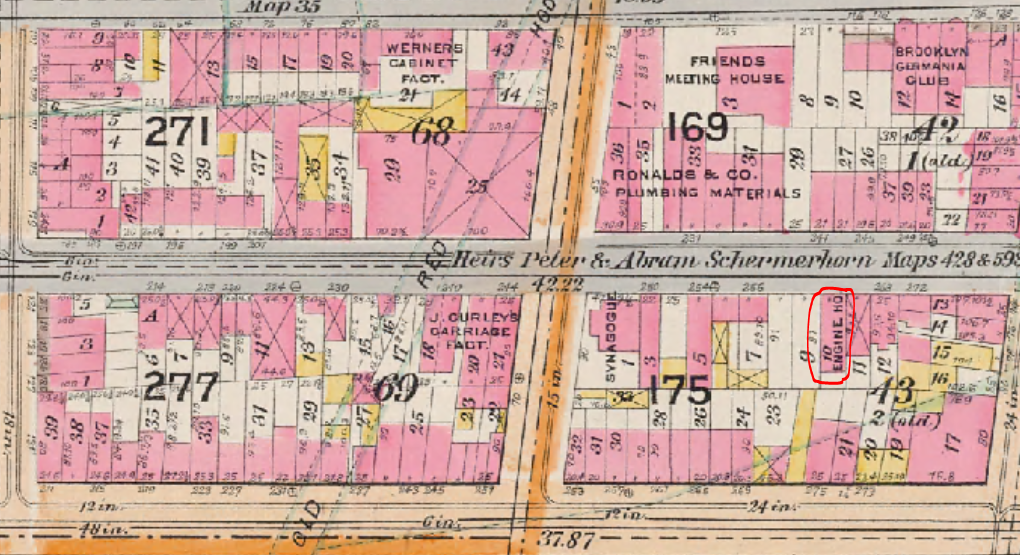
The firehouse for Hook and Ladder Company No. 10 at 264 State Street was built on the former property of Abraham and Peter Schermerhorn.
The new firehouse for Hook and Ladder Company No. 10 was built on lands once owned by Peter and Abraham Schermerhorn. 1898 E.B. Hyde, New York Public Library Digital Collections
Abraham and Peter were descendants of Jacob Janse Schermerhorn, a Dutch settler who arrived in New York in 1636. Jacob first settled in Rensselareswyck and reportedly had a home inside the walls of Fort Orange. He and his wife, Jannetie Van Voorhout, were the first in a long line of Schermerhorns of colonial New York.
Abraham and Peter’s parents were Peter Schermerhorn and Elizabeth Bussing. Peter was a commander and owner of shipping vessels trading between New York and Charleston, South Carolina. The brothers entered the family business in 1808.
Following his father’s death in 1826, Abraham inherited 160 acres of land in the Gowanus section of Brooklyn, which his father and uncle had purchased in 1795.
The main residence on this property, built in 1690, was reportedly the oldest house in Brooklyn in 1915, when the photo below was taken. It stood on the site where Brooklyn’s first house was built in 1836; reportedly, some of the original stone walls from that house were used to construct the 1690 house.
The Schermerhorn family lived in Manhattan, but they used their Brooklyn property as a summer residence. Abraham sold the land in January 1835 for $600 an acre. Part of Green-Wood Cemetery was built on the Schermerhorn property.
The old Schermerhorn house was located on 3rd Avenue (Gowanus Expressway) and 28th Street, circa 1915. It was demolished shortly after this photo was taken.
Peter and Abraham Schermerhorn owned a rope factory with what was once the largest ropewalk in the country. The ropewalk was needed to stretch the rope–which were used in shipping and sailing–a long distance.
The Schermerhorn ropewalk may have looked something like this one.
The 1200-long, two-story ropewalk was bounded by Smith and Bond Streets between State Street and what would eventually become Schermerhorn Street.
The ropewalk was destroyed by a fire that started in the stables on December 29, 1841. Sadly, nine horses and a cow were killed in the blaze, and 90 workmen lost their good-paying jobs. Following the fire, new buildings were erected which were “more in keeping with the neighborhood.”
One of the more interesting developments along Schermerhorn and State Streets was Mr. Edward L. Graeff’s gardens and greenhouses, as noted on the 1855 map below.
Graeff, a German horticulturalist and associate of the Natural History Department of the Brooklyn Institute, established the garden in 1851. The greenhouses featured “a choice selection of horticultural history,” including hyacinths, rhododendron, geraniums, roses, and much more.
According to this 1855 William Perris map, the firehouse was built on the site of what had been a brick store of the second class (eg, book printer, coach maker, or brass foundry) next to a wood and coal yard. Across the street was a “Florist’s Garden” owned by Edward L. Graeff.
Directly across the street from Mr. Graeff’s gardens was a brick store at what would become 264 State Street. Sometime between 1855 and 1880, the store was demolished.
On June 20, 1890, the City of Brooklyn purchased the vacant property at 264 State Street from John Adamson and his wife. The city paid $6,000 for the property. One year later, the men, horses, and cat of Hook and Ladder Company No. 10 moved into their new firehouse.
The city purchased the empty lot at 264 State Street from John Adamson and his wife for $6,000 on June 20, 1890.
In 1898, Hook and Ladder Company 10 of the Brooklyn Fire Department became Ladder Company 10 of the Fire Department of New York.
A year later, the company was renamed Ladder Company 60, and in 1913, the name changed once more to Ladder Company 110.
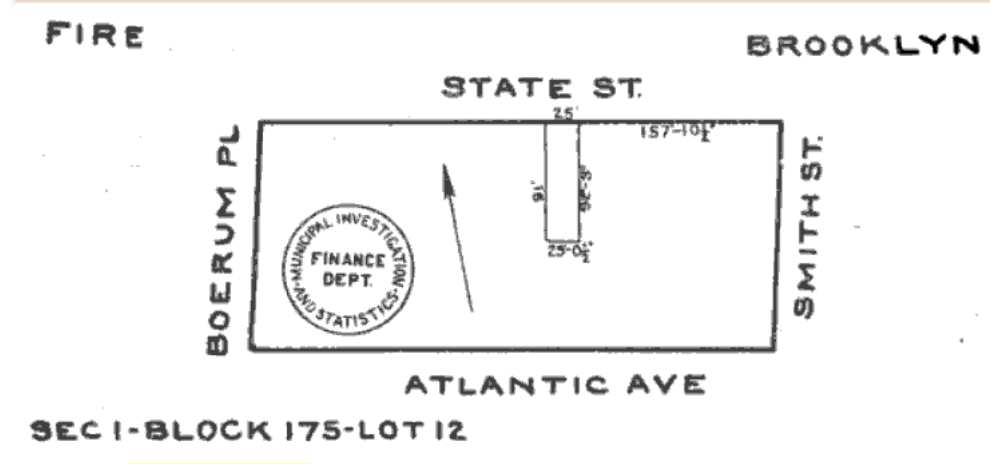
In January 1948, the Board of Estimate acquired the lot bounded by Smith and State Streets, Boerum Place, and Atlantic Avenue. Here, the city would construct a new, modern jail to replace the old Raymond Street Jail.
Brooklyn Fire Headquarters at 365 Jay Street, 1905. Museum of the City of New York Collections
With demolition eminent, the ladder company was forced to move to new headquarters at 365 Jay Street in 1949. This was the original Brooklyn Brooklyn Fire Department Headquarters, a six-story building constructed in 1892.
In December 1853, construction began on the Brooklyn House of Detention for Men at 275 Atlantic Avenue. The 11-story prison could accommodate 817 male prisoners, ages 16-21, awaiting trial or sentencing.
Today, Ladder Company 110 is located with Engine Company 207 in a nondescript fire station at 172 Tillary Street.
The new Brooklyn House of Detention under construction, 1954. NYPL Digital Collections
If you enjoyed this fire cat story, you may also like reading about Tootsey, the feline firefighter of Engine Company No. 27 in 1895.
Somewhere under an apartment building on West 121st Street, on a section of the street just east of Amsterdam Avenue called George Carlin Way, lies the body of a large Newfoundland who was buried on an early spring day in 1896. His grave, once “marked by a floral display seldom equaled by a rich man’s funeral,” is now under tons of concrete and steel. But the story of Nero, the beloved Newfoundland of Fire Patrol No. 5, will live on through this animal tale of Old New York.*
(* Obviously, this is poetic license; his shallow grave was no doubt disturbed during construction.)
Nero was a large, black, good-natured Newfoundland. According to The Sun, every man, woman, and child from Morningside Heights to St. Nicholas Avenue knew and loved the dog. He was the neighborhood pet of Hancock Square and a member of Fire Patrol No. 5 on West 121st Street.
Technically, Nero was owned by Mr. L.C. Pentez, who lived at 315 West 121st Street. Mr. Pentez brought the dog to Harlem in 1890. His son, Willie, introduced Nero to the neighborhood children, and the dog became their playmate.
The kids played all sorts of games with Nero, and he tolerated everything they did with the grace of a good dog. They hitched him to a wagon, rode on his back, pulled his ears, tumbled all over him, and even taught him to walk on his hind legs.
Nero lived with the Pentez family in their third-floor apartment at 315 West 121st Street, pictured here (center) in 1940.
One of Nero’s favorite games was “fire,” in which the children taught him to run at the ringing of a bell. During this game, the children called him their fire dog.
In 1892, when Fire Patrol No. 5 was established at 307 West 121st Street, Nero was eager to join. Soon, Nero got into the habit of responding to fires with the men whenever the bell sounded (sometimes he would jump from an open window in the Pentez’s apartment, which was on the third floor, to respond to the fire gong ringing at the patrol house).
The training Nero had received from the young firefighters attracted the attention of the men assigned to the patrol company. They decided to make him an official member.
It wasn’t long before every firemen in Harlem knew Nero. He never saved any lives, but he did guard over the horses at all the fires until the patrol company was ready to return home. (Actually, he would just sleep under the horses–it gave him a good chance to catch up on some much-needed rest after playing all day with the children.)
When he wasn’t playing with the kids or responding to fires, Nero liked to bask in the sun by the front door of the fire patrol house. Oftentimes on these occasions, the little girls would gather around him or even sleep on his back.
Nero enjoyed sleeping under the horses and basking in the sun in front of the patrol house for Fire Patrol No. 5 at 307 West 121st Street.
On the Sunday before his death, Nero had accompanied the fire patrol to a fire at 108th Street and First Avenue. While the men were working, he disappeared. The men whistled and sounded their signal gong for him, but he didn’t return. The men searched for their dog as long as possible, but he was gone.
A few days later, two men who were “rough in appearance” brought Nero to the fire patrol house. “Here’s your dog,” they said, before hurrying away. The men offered the dog some food, but Nero refused to eat. Upon further examination, they noticed that his throat was badly lacerated, as if he had been attacked by another dog.
The men called for a veterinary surgeon, who said that the dog’s windpipe had been cut. The injury was fatal. Nero died on April 24.
Captain Edgar D. Smith and six other members of Fire Patrol No. 5 served as pallbearers for the dog, carrying him to his final resting place on West 121st Street, in the shadows of Morningside Heights. More than 100 boys and girls attended the funeral. Ten boys with picks and shovels dug the grave, while several girls collected flowers from nearby Riverside Park.
Neighborhood children and the men of Fire Patrol No. 5 buried Nero the Newfoundland in a vacant lot on West 121st Street, just east of Amsterdam Avenue. I’m not sure which the side of the street his grave was, but perhaps it was in the empty lot to the east of this building, pictured around 1910 (or maybe it was under this building). New York Public Library Digital Collections
When the grave was completed, the firemen lowered Nero’s body into it. The dog was still wearing the special collar they had presented to him only a year earlier. The men then covered the site with a large mound of dirt, and the girls decorated it with flowers. Additional flowers were placed in a circle around the grave and used to create a little pathway leading to it.
Toward the end of the ceremony, a little boy appeared with a cross made of white wood. On it was this inscription:
After the cross was placed at the head of the grave, the little crying children returned to their homes. The men of Fire Patrol No. 5 returned sadly to their headquarters.
If I ever find myself on West 121st Street, on a section of the street called George Carlin Way, I’ll think of Nero and the joy he brought to the neighborhood. I think the comedian would agree that Nero was a special dog.
I love every dog I ever had. … In my lifetime, I have had me a bunch of different dogs. Because you do keep getting a new dog don’t you? … That’s the whole secret of life. Life…is a series of dogs. It’s true! You just keep getting a new dog, don’t you? That’s what’s good about them. They don’t live too long… Sometimes, you can get a dog that looks exactly like the dog you used to have. Right? You shop around a little bit, and you find a dog identical to your former dog. And that’s real handy cause you don’t have to change the pictures on your mirror or anything. Right? You just bring the dead one into the pet shop. Throw him up on the counter and say, “Give me another one of them. That was real good.” — George Carlin, comedian, dog lover
A Brief History of Fire Patrol No. 5
The New York Fire Patrol – officially the Fire Insurance Patrol — was organized in 1839 and funded by the New York Board of Fire Underwriters (NYBFU) to patrol lower Manhattan. The job of the patrolman or “Patrolio” was to discover fires and to prevent losses to insured properties.
The men worked alongside the volunteer firefighters, and, later, the paid firemen, and were in fact firefighters trained in the art of salvage and overhaul.
Members of the Fire Insurance Patrol, also referred to as the Fire Patrol or the Salvage Patrol, stood out from the regular fireman by their bright red helmets. Their well-equipped vehicles carried a 16-foot extension ladder, chemical extinguishers, hooks, axes, door-openers, brooms, shovels, buckets, ropes, and various other tools. Museum of the City of New York
In 1867 a state charter was granted to the Fire Patrol to legally extinguish fires and conduct salvage operations throughout New York City. The New York Fire Patrol was the oldest paid fire service in the United States, and was the last insurance-funded fire salvage corps in the country when it was disbanded in 2006.
As the city’s population expanded northward, the Fire Patrol was also expanded to cover Manhattan north of Central Park. Fire Patrol No. 5 of Harlem went into service on February 1, 1892.
Under the command of Lieutenant Edgar D. Smith, the unit covered territory north of 110th Street. In addition to Lt. Smith, the original force also included a sergeant and 12 permanent and auxiliary patrolmen.
Fire Patrol No. 5 headquarters, early 1900s
Fire Patrol No. 5 moved into their new headquarters in January 1892. The four-story and basement building had room for 2 wagons on the first floor, with stalls for four horses. A private office, dormitory, and lounging rooms were on the second floor.
The third floor had a sitting room and a drying room for the blankets used at fire operations. The top floor was also used to dry blankets.
And I love this: In addition to the sliding poles from all the top floors, there was also a trap door for the driver on the second floor. This allowed him to step out of bed, press on the door, and drop directly into his seat on the patrol wagon.
307 West 121st Street, 1940.
Today, the old home for Fire Patrol No. 5 houses 4 apartments. Click here to check out a top floor, 2500-square-foot apartment for $4000 a month (note that it last sold in 1985 for $40,000!).
Present-day West 121st Street, aka George Carlin Way, just east of Amsterdam Avenue.
Part 3 of a three-part series on the popular animal mascots and horses of the Richmond Hill Police Station.
Joseph Probst Jr. about 1895
In Part 1 and Part 2 of this series, we met Tramp and Sport, who were popular cat and dog mascots of the Richmond Hill Police in 1924. For this last story of the series, I will tell you about my great-grandfather Joseph Probst Jr., who served on the Richmond Hill Police mounted unit in the early 1900s. I will also explore the history of the Richmond Hill police station and Mounted Unit Troop G.
During the reign of Tramp the cat and Sport the dog, one of the most popular horses assigned to the Richmond Hill Police traffic unit was Graywood, who was assigned to Patrolman William Schwoebel. Graywood and Schwoebel were best friends and partners for many years. All the school children loved the horse, and often came to visit him at the police stables behind the police station.
Another favorite horse during this time period was Blaze, who gained notoriety at the start of Prohibition for sniffing out booze in a Richmond Hill cellar. Blaze was the horse of Patrolman David Levy.
By 1924, my great-grandfather had already put in 17 years of service with the mounted unit in Richmond Hill. During his years with Mounted Unit Troop G, he had many adventures with his horse.
Sadly, I do not know the horse’s name.
Joseph and Helen Probst lived in this home at 86-24 125th Street. NYC Department of Records 1940 tax photos.
Born in 1873, Joseph Probst Jr. started his career as a ticket agent for the railroad. Five years after his first wife died in 1899, he married my great-grandmother, Helen Emma Berger.
My grandmother Margaret and her brother Charles about 1925.
In 1906, Joseph and Helen moved to a new house at 333 Ward Street (now 86-24 125th Street), where my grandmother Margaret and her three siblings were born.
Joseph Probst joined the police department in 1907, which is when the Mounted Unit Troop G was established in Richmond Hill. One of the first four mounted patrolmen in the precinct, he was responsible for training many of the rookie mounted patrolmen.
For many years, my great-grandfather was assigned to traffic control at the intersection of Merrick Road and South Street (now Merrick Blvd and Liberty Ave). At that time, this was a heavy traffic spot in Jamaica.
During his 20 years in service, he was recognized many times for saving lives, stopping reckless drivers, and apprehending criminals.
The intersection of Merrick Avenue and South Street was considered a heavy traffic area in the early 1900s. This was Patrolman Joseph Probst’s post for many years.
Horse Finds Dying Man in Woods
In May 1910, Mounted Patrolman Probst was riding along Metropolitan Avenue near Forest Park when his horse shied and started sniffing the air towards the trees in the park. My great-grandfather searched around the bushes and found an unconscious man dying from gunshot wounds.
The man died at St. Mary’s Hospital the following day.
According to Brooklyn Times Union, the young man was described as about 30 years old and good looking, with dark curly hair, hazel eyes, and wearing the fine clothes of a gentleman. Alongside the young man lay a .32-calibre rifle and two discharged shells. He had bullet wounds under the heart and on the side of his head.
The bullet wounds were determined to be self-inflicted.
Based on the man’s personal items, including a monogramed watch with the initials A.K., a pin bearing the initials A.F.M. (American Federation of Musicians), several music scores, a tuning fork, and pitch fork, police assumed he was a musician. However, because no one came to claim the body, the man’s identity remained a mystery. He was buried in a Potters’ Field.
Mounted Patrolman Joseph Probst Jr. on his horse in Forest Park, Queens.
Fortunately for the man’s family, a fellow musician and AFM member named John G. Pfeiffer happened to read the article about the suicide in the newspaper. Determined to identify the man in order to give him a proper burial, he did some extensive investigating. Three months later, he identified the man as J. August Kuehis.
Saves Horses in Fire
On July 16, 1910, the Brooklyn Standard Union reported a large fire that had started in a one-story stable and carriage shed owned by J.J. O’Brien at 19 Vine Street (123rd Street). My great-grandfather, another patrolman named E.J. Mayer, and several citizens led a dozen horses from the shed. The horses all had to be blindfolded before they would leave the shed.
The fire eventually spread to a moulding mill owned by William C. Haguaard & Co., which was surrounded by great piles of lumber on all sides. With so much fuel for the fire, it’s truly amazing that all the horses were saved.
Injured in a Riot
New York Times, May 2, 1913
In May 1913, 300 men of Italian descent who were employed in construction work for the Long Island Railroad demanded a 25-cent increase in pay. When their request was turned down, they marched in anger toward Richmond Hill. Along the way, they picked up about 700 more workmen on the tracks.
When the men reached the railroad yards at Richmond Hill, they began throwing stones at the box cars. Four policemen tried to rush the strikers on foot, but they had to retreat from the volley of stones.
News of the riot reached the Richmond Hill police station, where Sergeant Albert Kolson was just about to lead 10 mounted patrolmen in the a drill. The men, including Joseph Probst, began galloping toward the railroad yards, four blocks away.
Patrolman Joseph Probst Jr., around 1910
Finding the four foot patrolmen in danger of being rushed by the mob, they charged into the gang of strikers, using their clubs to strike every head in range. Then they drew their guns and began shooting into the air and the ground (for the most part), sending the strikers fleeing in all directions.
During the intense fighting, the bridle of Patrolman Albert Herter was seized, and Herter was dragged on the ground. He was kicked and beaten and had three ribs fractured.
Sergeant Kolson was thrown from his horse and dislocated his shoulder. My great-grandfather was knocked from his saddle by a large rock that caused a gash in his head. He fell on his head and suffered a concussion.
Sergeant Kolson ordered another charge, which sent the mob in two directions — one along Lefferts Avenue and one down Jamaica Avenue to Clarenceville, a mile away. Six men were eventually arrested, two of whom had suffered considerably from the nightstick blows.
In 1914, my great-grandfather earned membership in the the coveted Honor Legion for helping to quell the riot of the Long Island Railroad strikers.
I have inherited Joseph Probst’s nightsticks. I used to think the gashes on the largest one were caused by knocking on concrete. Now I wonder if they were caused by knocking the strikers’ heads during the 1913 riot.
The Passing of Joseph Probst Jr.
Joseph Probst retired from the police department in 1927. He spent his remaining years entertaining friends at home and sharing stories about his adventures on the job.
In January 1933, at the young age of 60, he died of a heart ailment. My great-grandmother, Helen, passed away in 1943.
My great-grandparents were buried at Maple Grove Cemetery in Kew Gardens. One of the days, when COVID-19 has passed and the world has quieted down a bit, I hope to bring my mother there so we can visit their gravesite.
This ends my story of Joseph Probst Jr. If you are interested in history, the following is a history of the police station and Mounted Until Troop G at Richmond Hill.
A Brief History of the Richmond Hill Police Station
The site of the Richmond Hill police station on Church Street (now 118th Street) was originally the farm of Captain Jeremiah Watson Briggs (1792-1876), a seaman and Navy veteran of the War of 1812.
The site of the Briggs farm is shown on the bottom right of this 1873 map of Richmond Hill. Market Street, later called Johnson Avenue and then Church Street, is present-day 118th Street.
Captain Briggs married Jane Hedges in 1830, and 17 years later the couple moved to the Village of Morris Park in the Town of Jamaica. There, the former Navy man cultivated prized pears on an orchard bounded by present-day Jamaica and Atlantic Avenues.
The original site of the Briggs homestead is noted on this 1891 map. At this time, 117th Street was called Briggs Avenue and 118th Street was called Johnson Avenue. Jamaica Avenue was called the Brooklyn and Jamaica Plank Road.
Jane and Jeremiah Briggs had six children: Joseph L., John S., Mary R. , George S., Jeremiah Watson, and Nina H. The last family member to occupy the Briggs residence was Joel Fowler, a grandson of Captain Briggs (the son of Nina Briggs and Oliver Fowler.)
The home of Captain Jeremiah Briggs originally faced Jamaica Avenue between present-day 117th and 118th Streets. It was later moved to the west side of Briggs Avenue (87-27 117th Street), south of Jamaica Avenue. This is how the home looked in 1922.
A colorized post card of the Briggs house in 117th Street. It has been reported that Captain Briggs spent many hours on the widow’s walk, using a spyglass to watch the ships on Jamaica Bay.
In 1895, Morris Park, Clarenceville, and Richmond Hill merged into the Village of Richmond Hill. To serve the enlarged village, Richmond Hill Village Hall was built on the spot of the present-day police station in 1896.
The police station/village hall and Public Sschool No. 51 are noted on this 1909 map.
In addition to a general village hall, the building served as the first headquarters of the new Richmond Hill Police, then only a sub-station of the Jamaica police precinct. In 1897, the sub-station (the 18th Sub-Precinct) had one captain and seven patrolmen. All of these men would be replaced a year later, when Queens and the other four boroughs were consolidated to form the City of Greater New York.
The village hall building also housed a jail, the Morris Park Hook and Ladder Company, and a meeting hall on the second floor that also served as an opera house with live performances.
Richmond Hill Village Hall, Johnson Avenue (later called Church Street and 118th Street), on the right.
Morris Park Hook and Ladder moved into the left side of the Richmond Hill village hall building in 1902. The horses were Jim and John; also note the fire dog.
Public School No. 51 was next to Richmond Hill Village Hall. Notice the mounted patrolman walking toward the school. I wonder if this was Joseph Probst? An early 1900s floor plan of the Richmond Hill village hall/police station is shown below.
In 1905, The Richmond Hill Board of Trade started looking into getting a new dedicated police station for the growing town. It wasn’t until four years later, when the building was almost washed away in a heavy storm, that first steps were taken to get a new home for the Richmond Hill police.
In April 1910, Police Commissioner William Frazer Baker said he would accept bids for anyone who wanted to buy the barnlike structure for its lumber. By this time, the building was no longer a viable structure for the men of what was now the 283rd Precinct.
As the Brooklyn Times Union reported, the men of the Richmond Hill police station “keep themselves in good training” by constantly dodging plaster falling from the walls and ceiling.
While a new station was being built on the site of the old one, the police leased a two-story frame house with basement and attic at Jamaica Avenue and Sherman Street (127th Street). This was the former home of Colonel William Alexander Jones, a commissioned officer who fought for the Union Army during the Civil War.
The property of Colonel William Alexander Jones is shown on this 1891 map. At this time, Sherman Street has not yet been cut through south of Jamaica Avenue.
A funny thing happened after the police moved into their new home.
According to the report, soon after Colonel Jones’ death in December 1909, the house and grounds were sold and the property was divided. So, to reach Jamaica Avenue, the police technically had to trespass on the land owned by the realty firm that bought the property situated between the house and the roadway. Local residents joked that the police should arrest each other for trespass each time they crossed the property.
The Peter Opper Roadhouse was directly across the street from the temporary police station, on Jamaica Avenue and Sherman Street. According to a 1907 map, there was a bowling alley to the rear of this building.
On November 13, 1913, the police moved into their new station at 275 Church Street (now 87-34 118th Street). The new building was designed by Kirby & Pettit, who were also the architects of Dreamland in Coney Island.
Richmond Hill police station about 1914. Patrolman Probst may be second from the right.
Richmond Hill police station (now the 102nd Precinct) as it looks on 118th Street today.
The Final Years of Mounted Unit Troop G
In the early 1980s, the city attempted to close the Troop G stables at Richmond Hill. The residents fought to keep the horses–and they won. In fact, not only did they get to keep the horses, but the horses also got a newly renovated stable facility at the police station in 1984.
The stables at Richmond Hill were renovated in 1984 and again in 1993.
At this time, there were 11 horses in Troop G at Richmond Hill, which was one of two stables for NYPD mounted units in Queens (the other stable for Troop F was at Cunningham Park in Bayside). There were also two stables in Manhattan and one in the Bronx and Brooklyn.
The men of Mounted Unit Troop G display their skills in 1984.
In September 1999, due to budget cuts, the Mounted Unit Troop G was moved from the Richmond Hill police stables to the old stables in Cunningham Park. According to reports, the city could not afford to have two hostlers (someone who cares for horses) for both Troop F and Troop G.
The move was supposed to be temporary, but it turned out to be permanent. Although the residents fought hard for five years, in 2004 the horses of the old Troop G were transferred to Troop B in the Chelsea neighborhood of Manhattan.
According to the Queens Chronicle, the stables at Richmond Hill were renovated to accommodate 75 school safety officers for the Franklin K. Lane and Richmond Hill High Schools.
Part 2 of a three-part story on the popular animal mascots and horses of the Richmond Hill Police Station.
Part 2: Sport, the Hero Canine Mascot
In Part 1 of this series, we met Tramp, the Richmond Hill Police cat who saved the police horses from rats and mice. Part 2 is a sweet, short story about Sport, a collie who saved a mother cat and her kittens.
Sport was described as an immense collie who adopted the police officers of the Richmond Hill police station in July 1924. He loved all the men in the station, from Captain Herbert Graham to detectives Mierau, Herbert, Cotter, and Newins–and all the way down the line.
Brooklyn Daily Eagle, July 30, 1924
A few weeks after Sport adopted the police, he found a mother cat with newborn kittens in an alley near the police station. After carefully considering the situation, he decided to make preparations to bring the feline family to the horse stables attached to the station.
According to the Brooklyn Daily Eagle, Sport gathered up some loose hay and placed it in a remote corner of the stables. The reporter noted, “Having arranged this to his satisfaction, the dog was now ready for the second part of his knightly performance.”
The horses stables at the Richmond Hill police station, pictured here in 1975, made the perfect home for a mother cat and her kittens.
Sport returned to the alley and placed one of the kittens gently in his mouth. The mother cat must have sensed that the dog was doing a good thing, because she did not put up a fight. Five times Sport returned to the alley to gather a kitten, until they were all safely deposited in the bed of hay.
When all her kittens were gone, the mother cat followed Sport back to the stables and joined her brood in the hay.
Although the police officers did not object to housing the new family temporarily, they would not be able to keep them forever. They already had Tramp, their expert mouser, and I’m sure Tramp was not too pleased about the new arrivals invading his territory.
As the Brooklyn Eagle noted, if the police could not continue to care for the cats, Sport was sure to find another way to provide for them and be their knight in shining armor.
If you’re a horse lover, stay tuned. In Part III, I’ll tell you about some of my great-grandfather’s adventures with his police horse and provide a detailed history of the Richmond Hill police station and mounted unit.