When the United States Navy gunboat Annapolis arrived in New York in September 1899, Commander Ingersol told his crew he would provide them as much shore leave as possible. One crew member, however, was not permitted to go on land. That was Tom the Terror, the official rat killer and feline mascot of the USS Annapolis.
According to the press (the story was covered nationally), Tom “had forfeited all liberty until the completion of the cruise.” Although he was not in irons for having committed the serious offense of attacking an officer, he had a history of being a deserter from the United States Navy. Commander Ingersol was not about to let his champion ratter desert his ship in New York City on his watch.
Tom the Terror was reportedly a noted figure in the United States Navy. He came from a long line of naval cats, having been born on the Cob Deck at the Brooklyn Navy Yard in 1896.* All of his siblings and cousins had also honorably served in the United States Navy as rat killers and mascots.
Tom spent the first two years of his life catching the rats and mice that had overrun the Brooklyn Navy Yard in the 1890s. He officially joined the United States Navy in 1898, when he decided to stroll on board the USS Terror while the ship was laying at the yard. After making a careful survey of the quarters and crew, Tom roamed around the quarter-deck, curled up on the rug in the captain’s cabin, and fell asleep.
By this time, Tom had already made a name for himself as the terror of the Brooklyn Navy Yard. Having fought every cat on land, Tom apparently decided to fight for his country on board the aptly named USS Terror.
Tom the Terror began his naval career on the USS Terror (Monitor #4), which was commissioned in New York City on April 15, 1896.
Tom was immediately adopted by the crew of the Terror, and full enlistment papers were drawn up giving him the rank of rat killer and mascot. The papers were properly filed, and Tom’s life at sea as a member of the United States Navy began.
Following Tom’s service during the Spanish-American War, where he worked alongside other navy cats such as Tom of the USS Maine, the USS Terror returned to northern waters. Tom and the rest of the crew joined the receiving ship Franklin.
From the Franklin, Tom was transferred to the USS Monongahala, which at this time was a ship-rigged sail training ship for the United States Naval Academy. Life on board the ship was made as pleasant as possible for Tom, but as they say, you can take the cat out of Brooklyn, but you can’t take the Brooklyn out of the cat.
Tom was a fighter. He scratched two of the officers, bit another man, “and exhibited an appetite that bordered on gluttony–a sin not to be tolerated in the navy or in any other walk of life.” Although the men continued to love him, they were obligated to report his shortcomings in his naval papers.
Tom spent some time on the USS Monongahela before he deserted this ship to join the Annapolis on a pleasure cruise.
On June 3, 1899, the Monongahela was docked beside the Annapolis at Norfolk, Virginia. Tom no doubt overheard discussions about the pleasure cruise the Annapolis was about to make with the naval cadets on board. The trip included stops at the Naval Station at Newport, Rhode Island, and the U.S. Military Academy at West Point. Tom deserted the Monongahela and joined the Annapolis.
Just before the Annapolis was about to weigh anchor, Commander Ingersol received a message from the Monongahela, asking if they had a tawny stowaway cat on board. The commander ordered a search, but Tom the Terror was nowhere to be found.
When the bugle call for supper was sounded later that day, Tom appeared from the depths of the forecastle. He climbed upon one of the guns, looked around to see if the Monongahela was still in sight, and, finding himself safe, he proudly marched up to the bridge. There, he gazed calmly into Commander Ingersol’s eyes and began purring.
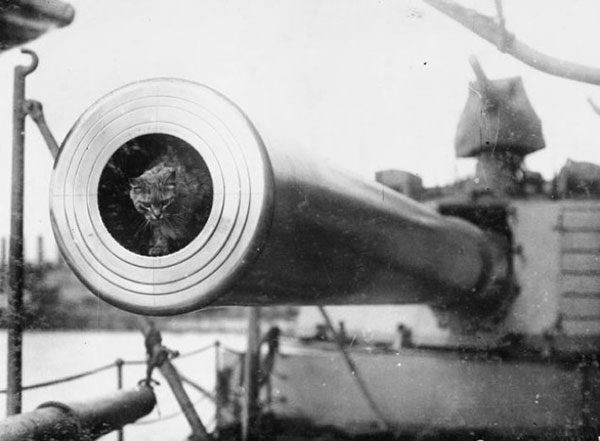
This is not Tom the Terror–this is a Royal Navy cat–but this cat looks like he may have been a little ball of terror on his ship.
Now, Commander Ingersol knew that this was Tom the Terror. He also knew that the cat would now be labeled as a deserter. He couldn’t take him back to land, so he did the next best thing: he adopted Tom as a member of the ship’s company.
Tom quickly made friends with the crew and the cadets. He did not respect rank, and he made his own rules, but the men adored him.
Tom loved to sit and purr for hours at Lieutenant Commander Bartlett’s side. He also enjoyed play-scratching and teasing the cadets, and stealing morsels of food from the crew. He was a great ratter, and over time, he proved himself a worthy mascot of the Annapolis.
As for the Monongahela, Tom was listed in that ship’s books as a deserter. One reporter noted that he may have to face a court martial for that crime, but for the time being, he was very content on the Annapolis.
Tom’s only complaint: the Annapolis didn’t have any other ship cats, so he couldn’t practice the cat-fight moves that made him famous in Brooklyn. That was probably a good thing.
The USS Annapolis was laid down April 18, 1896, at Elizabethport, New Jersey and launched in December of that year. The ship was commissioned at New York on July 20, 1897. Tom the Terror may have spent the rest of his career in the United States Navy with this ship.
*Tom’s place of birth was disputed in July 1899, when a man named T.S. Hamlin from Anaconda, Montana, claimed that Tom was born in Montana and taken away by a man named Hartman Matthews. A search for this man was made, but he was never found, and his name did not appear in the town’s directory.
Dolph the cat could do many tricks, but his skills did not come in handy when he got stuck in the Ice Palace Skating Rink on East 107th Street.
Dolph was the pet of Wolf Falk, an East Harlem resident who worked as the manager for comic opera comedian Thomas Q. Seabrooke. Dolph (perhaps named for John Henry Dolph, the famous cat painter of that time period?) was reportedly not as clever as Snooperkatz, the silk shop mascot cat who stole postage stamps from his master’s desk to exchange them for milk from the milkman. However, he was quite skillful at walking on his hind legs, jumping through hoops, and doing other tricks that ordinary cats could not do.
One of Dolph’s best friends was a Harlem goat (this is not Dolph and his goat friend).
In his prime, Dolph was described as a “nice, plump sleek animal” who pretty much kept to himself. He never associated with any other neighborhood cats, albeit, he was friendly with a Harlem goat. It was this goat that got Dolph into some serious trouble.
According to the tall tale, as reported in The Sun, the trouble centered around the Ice Palace Skating Rink, which was constructed in 1895 in the old Coliseum Hall and armory building on 107th Street between Lexington and Park Avenues.
After construction had been completed, truckloads of brilliant papier mache icicles for interior decoration began to arrive. The icicles were to form a sort of sub-ceiling, and plans called for a space of just under two feet between the two ceilings. (Can you start to see where this is going?)
The goat, who had been living on tomato cans, nails, and broken glass for months, could not resist the smell of papier mache. Following his nose, he ran to the new Ice Palace Skating Rink, only to find that the ice ceiling was almost complete and out of his reach.
As The Sun noted, “He stamped about for an hour, keeping his eye all the while on one particularly appetizing icicle that looked so much like the real thing that the thought that it might ultimately melt and fall off was pardonable even in so wise a goat.”
Unfortunately, there are no photographs of the Ice Palace, but I did find this illustration, which shows the icicles hanging from the ceiling.
The goat ran down Lexington Avenue and stopped in front of Mr. Falk’s house, where he bleated a special signal to summon his feline friend. Dolph saw his goat friend through the window and exited the basement door to join him. “There was consultation and then off the two started, and a few moments later halted in front of the ice palace.”
The goat gave Dolph a few instructions, and the cat took off, scrambling up the felt-covered walls toward the ceiling. He then dodged into a hole that marked the uncompleted part of the sub-ceiling. According to The Sun reporter–who noted that details of the story were not all necessarily true–Dolph bit off a few icicles for his goat friend.
After satisfying his friend’s hunger, Dolph decided to satisfy his curiosity by prowling around between the two ceilings. Meanwhile, workmen continued building the icicle sub-ceiling, eventually sealing the hole through which Dolph had entered.
Like Dan, the fire cat that got stuck between two ceilings in his firehouse only a year earlier, Dolph was stuck for good.
Skaters under the icicle sub-ceiling at the new Ice Palace Skating Rink. New York World, December 1895
A few days later, a watchman happened to look up at the ceiling. He noticed that it seemed to be swaying up and down in a wavy motion. He rubbed his eyes and looked again. Yes, the ceiling appeared to be moving.
The watchman reported the moving ceiling to the workmen, but they just laughed at him and attributed the movement to the wind. The watchman continued to watch the ceiling every night, and every night it continued to move.
Then one night he heard a large commotion followed by a scratching noise. When he told the workers about it the next day, they agreed to remove a portion of the ceiling. A few seconds later, a little cat face appeared at the edge of the hole and made a faint “meow.” The workers reached in, grabbed the cat, and carried him down the ladder.
After spending eight days trapped in the ceiling without food and water, Dolph was no longer recognizable. Like Kelly, the poor kitty who was trapped in a mail sack for eight days, Dolph had lost a lot of weight and was weak with hunger.
The news of the rescue spread about the neighborhood, and many children came to visit the cat to bring him food. As for the goat, Mr. Falk told the reporter that Dolph and the goat were no longer friends. Apparently, the two met up on Lexington Avenue, but while the goat bowed, “Dolph cut him dead.”
A Brief History of the Ice Palace Skating Rink
The Ice Palace Skating Rink on the northwest corner of Lexington Avenue and 107th Street opened in December 1895. With a large ice surface of 20,000 square feet (265 long by 71 feet wide), it was then the largest indoor ice skating rink in the world.
This 1896 Sanborn map shows the entrance room to the Ice Palace on Lexington Avenue. NYPL Digital Collections
The smooth ice surface was five inches thick and comprised about half an acre of dry ice with temperatures of 40 degrees on the rink and about 70 degrees around the galleries and in the lobby. There were 15 miles of one-inch pipe beneath the surface into which immense ice machines pumped a brine mixture.
The rink could accommodate about 2,000 skaters at a time. The building also featured a café, restaurant, cloakroom, and six club rooms, which were occupied by members of the Ice Palace Skating Club, Knickerbocker Skating Club, Ice Palace Polo Club, and the New York Hockey Club of the American Amateur Hockey League. All sorts of ice-related athletic events took place there, including hockey, figure skating, ice lacrosse, and ice polo.
Members of the Ice Palace Ice Polo Club, 1896
According to The New York Times, the arena was “one of the most entrancing sights in Gotham.” All the walls above the gallery and the roof were decorated in icicles and stalactites “and frost everywhere so natural as to be very deceptive—while studded around in all sorts of obscure places are brilliant electric lights.” As the Times noted, “Jack Frost has been completely knocked out by the Ice Palace Skating Rink.”
The Ice Palace was constructed within the walls of an older building called Coliseum Hall, or the Coliseum building. Constructed in 1885 on land that had once been under the Harlem Creek, the Coliseum also served as a skating rink, albeit, for roller skating. The stone and brick building was 440 x 130 feet, and said to be the largest rink in the world at that time.
The Ice Palace Skating Rink was constructed on former marshland adjacent to the old Harlem Creek (aka Benson’s Mill Creek), which was once owned by Benjamin P. Benson and Dr. P. Van Arsdale. (The Harlem Meer in Central Park was built on what was originally part these wetlands fed by the Harlem Creek). Randel Farm Map, created July 24, 1820
New York Times, March 8, 1891. Coliseum Hall featured a roller-skating rink and toboggan slide. A three-mile roller-skating race was 33 trips around the rink.
Coliseum Hall featured some unusual events, including skating races, bicycle exhibitions, and a tobogganing slide (which looked like something you’d see on a large, modern-day cruise ship).
Coliseum Hall had an indoor toboggan slide, like this figure-eight one at a similar skating rink during that time period. How fun and dangerous was this?!
Printers’ Ink, April 1, 1896
The Ice Palace had a very short life as a dedicated ice-skating rink.
Within a year, the arena was also home to the Majestic Bicycle Academy owned by David I Thompson. Tom O’Rourke’s Lenox Athletic Club also used the facility for boxing events.
And by September 1897, the Ice Palace was reportedly operating as a music hall, featuring low admissions to a variety of burlesque shows.
From 1898 to 1899, the old Ice Palace served as an armory for the 71st Regiment, and later, the 8th Regiment, of the National Guard. Then in 1901, an architect named Samuel Cohen filed plans to reconstruct the old Ice Palace as a traditional theater.
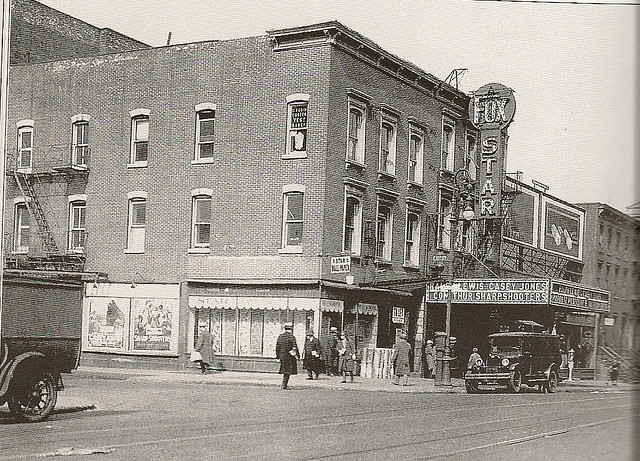
By 1904, the building had been converted into two facilities: The Star Theatre, a vaudeville/movie house that used the old Ice Palace entrance on Lexington Avenue, and the Star Casino, which fronted 107th Street and was operated as a ballroom and sports arena.
The Star Casino and Star Theatre noted on the 1911 George Bromley map. NYPL Digital Collections
Don’t Cry “Fire!” in a Theater
In 1908, the Star Theatre was leased to William Fox, who was then just starting to purchase a chain of theatres throughout the city (his legacy continues to live on in the form of the Twentieth Century-Fox Studios). At this time, the Star Theatre could accommodate 2,300 patrons.
In January 1909, a small child wandered away from her mother during a movie at the Star Theatre. About 2,000 people were in attendance that day. Unable to find her child, the woman shouted “Fire!”
The Star Theatre on the northwest corner of Lexington Avenue and 107th Street. The Star Casino is the building on the far left, adjacent to the tall “Prices” building. Museum of the City of New York Collections.
Soon, others began shouting that there was a fire even though they didn’t see or smell smoke or flames. Everyone in the theater began making a mad rush for the exit doors in the dark.
Two policemen tried to stop the frightened crowd–they even turned on the theater lights and announced that there was no fire–but by that time it was too late. Several patrons ran to the alarm box and called for the fire department. The New York Times did not report on any charges filed against the woman.
The Fox Star Theatre sometime in the 1930s.
The End of the Star Casino and Theatre
Sometime around 1938, the Star Casino was converted back to the building’s original use: an indoor roller-skating rink (without the toboggan slide).
On March 14, 1939, a five-alarm fire destroyed the old Star Casino. The last skater had left the rink less than an hour before the blaze was discovered at midnight, but about 1,000 patrons were still watching the last few minutes of a movie in the adjacent Star Theater.
According to The New York Times, when smoke drifted into the auditorium, assistant manager Frank Garcia calmly asked the patrons to leave the theater. They did so without disorder. The fire was believed to have started by a tossed cigarette from one of the skaters.
Daily News, March 14, 1939This New York City Department of Records tax photo appears to have been taken after the fire in 1939 as noted by boarded up windows and the danger sign. The building was being used as the Skateland Roller Rink when this photo was taken in 1941. NYPL Digital Collections
In later years, a gasoline filling station occupied a portion of this site from 1955 to 1969. For many years, there was only an empty lot on this site until 1985, when the Lexington Gardens residential complex was constructed.
On April 4, 1908, the members of the Junior Aero Club held a meeting on the roof of 282 Ninth Avenue near 26th Street. This six-story building was then a factory owned by pioneer balloonist Albert Leo Stevens, where he made dirigible balloons. The purpose of the meeting was “to liberate” about 200 rubber balloons and several larger balloons and small airplanes that the young boys had made from tissue paper and canvas.
One by one, the boys of the Junior Aero Club made their way up to a small iron ladder in a hatchway that led to the roof. There, they filled their balloons from a hydrogen spigot and released them into the wind. Each balloon had a small parachute with a postal card attached, announcing that everyone who retrieved a balloon was entitled to a free year’s subscription to a children’s magazine.
On July 8, 1911, Albert Leo Stevens ascended in a balloon from the roof of Wanamaker’s Department Store. Although he wanted to head toward Philadelphia, his plans didn’t quite work out. He went north along the Hudson River and landed in West Nyack, New York.
Albert Leo Stevens in his balloon on the roof of Wanamaker’s on July 8, 1911.
Pete the Cat Refuses to Fly
On this particular day, there was a cat named Pete on the roof. According to the New York Sun newspaper, Pete was “just a cat, plain cat, with no claims to distinction save the glossiest of black fur, large eyes the color of New Orleans molasses dripping in the sun and a sunny disposition–sunny when nobody attempts to flimflam him.”
I don’t know how Pete came to be on this roof, but apparently he was the pet of one of the members or organizers of the Junior Aero Club. He was also the club’s unwilling test pilot.
According to The Sun, one time the boys had decided to send Pete off in one of their miniature airplanes. “Less hep to the perils of aeronautics, Pete allowed himself to test the carrying capacity of an aeroplane and spent a most miserable half hour embracing a telephone wire until a junior scientist rescued him with a ladder.”
Now that Pete the cat was wise to their ways, he refused to fly anymore. No matter how many times the boys pet him and called out to him, “Petie, Petie, nice Petie, come on-n-n Petie,” he responded with an arched back and enlarged tail.
The members of the Junior Aero Club wanted to launch Pete from the rooftop of 282 Ninth Avenue (2nd from left), pictured here in 1941. New York Public Library Collections.
Many of the boys thought for sure that Pete would have responded cheerfully to all the milk and cow’s liver they had fed him in the past, but “Pete simply couldn’t see it and that ended the matter.”
Without a willing test pilot, the young boys had to resort to bricks and sticks and stones. As the Sun noted, “While the experiments were measurably successful there was a feeling that the selfish conduct of Peter left much to be desired in the way of aeronautic demonstration.”
The Sun, November 1, 1908
I’m not sure if anyone was injured when the tiny airplanes loaded with bricks and stones came crashing down, but the red and blue balloons did make for quite a display. People in the upper stories of buildings near Ninth Avenue and 26th Street were especially rewarded with a colorful show.
For about two hours, the balloons zigzagged through the sky, coming to “inglorious ends against the steeples of churches, electric wires and the cornices of skyscrapers.” Many of the balloons headed out toward the Atlantic Ocean as far as the eye could see. As one old-time resident exclaimed, “Oh! It’s some more of Leo Stevens’s crazy balloon doings!”
Stevens, a member of the Junior Aero Club Advisory Board, told The New York Times he hoped some of the balloons would stay in flight for a few hours. Miss Emma Lilian Todd, the founder of the club, said she and the other advisors hoped the balloons would encourage other boys to enroll in the new club.
A Brief History of the Junior Aero Club
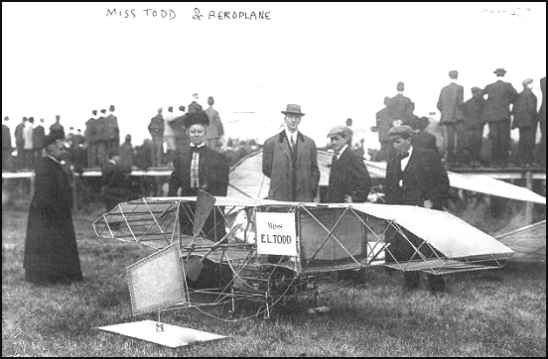
The Junior Aero Club was founded in 1908 by Emma Lilian Todd, a 43-year-old self-taught inventor and aviator who was reportedly the first woman in the world to design airplanes.
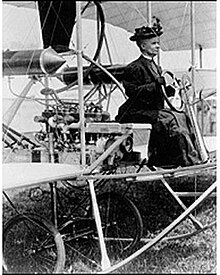
Emma L. Todd in her biplane around 1908.
Born and schooled in Washington, D.C., Emma developed a love for mechanical devices at a young age, having been inspired by a mechanically inclined grandfather. She studied law at New York University and received a patent for a typewriter copy-holder in 1896.
Inspired by the airships she saw in London and at the 1904 Louisiana Purchase Exposition in St. Louis, Emma turned her attention to mechanical and aeronautic devices. She attracted national attention when she exhibited her first design in an aero show at Madison Square Garden in 1906.
Philanthropist Olivia Sage, the widow of financier and cat lover Russell Sage, became Emma’s patron, giving her $7,000 to design and build her aircraft. Emma hired Charles and Adolph Wittemann to build the plane according to her design (the plane was built inside a large shed in Mineola, New York).
When asked about her stance on women’s voting rights in 1910, Emma replied, “I am not a suffragette…but I decided long ago that if a man can fly a woman can.”
Miss E. Lilian Todd (2nd from left) at an aeronautics exhibit in 1906. Library of Congress
Recognizing the importance and future of aviation, Emma started the first Junior Aero Club in New York City in 1908 to educate and spark the interests of future aviators. Some of the first members included Frank King, W.E.D. Stokes, Jr., George Eltz, and Frederick Seymour.
The club held their first meeting at the YMCA on 23rd Street in March 1908. “Ballooning is the king of sports,” Emma told a reporter from the Evening World, noting it was her intention to encourage the boys to take an interest in the new sport.
The club often met at Emma’s residence in New York–Room #19 at 131 West 23rd Street–where she had transformed her living room into a workshop. It was here among aircraft models of her own design and other mechanical toys that she instructed the boys on the science of flight and how to make models themselves.
By May 1909, the Young Aero Club had members in 11 states: New York, New Jersey, Connecticut, Massachusetts, Maryland, Ohio, Illinois, Missouri, Colorado, Oregon, and Washington. By this time, Walter H. Phipps was president and Emma was no longer active in the club–she was now too busy trying to get permission from the Richmond Borough Commissioner of Public Works to fly her own plane on Staten Island (the permit was denied).
Emma Lilian Todd’s living room at 131 West 23rd Street served as a meeting place for the Young Aero Club in 1908.
On November 7, 1910, Emma’s plane traveled 20 feet over the Hempstead Plains on Long Island (now Garden City) with a French aviator named Didier Masson at the controls. Unfortunately, the aircraft was unable to sustain flight.
French aviator Didier Masson “flew” Emma Todd’s plane at Hempstead Plains.
The Junior Aero Club did live on, albeit, not as an aeronautics club. As it turns out, many of the members were also interested in tinkering with wireless apparatus. William Earle Dodge Stokes, who owned the famous Ansonia Hotel, called on the membership to form a new club dedicated to wireless telegraphy and telephony.
Thus, the Junior Wireless Club Limited was formed on January 2, 1909. Emma Todd was made honorary president of this new club. The other charter members included W. E. D. Stokes, Sr., W. E. D. Stokes, Jr., George Eltz, Frederick Seymour, Frank King, Professor R.A. Fessenden, and Faitoute Munn. Today, we know this club as the Radio Club of America.
By 1911, Emma Lilian Todd was working full time in Mrs. Sage’s office as her administrative assistance. Following Mrs. Sage’s death in 1920, Emma moved to Pasadena, California, where she died in 1937. Her cremated remains were buried at the Moravian Cemetery on Staten Island.
The home of Emma Lilian Todd at 131 West 23rd Street still stands today, although plans were filed in 2014 to construct a 39-story hotel and 13-story residential building on this site. Permits were approved in 2018, but so far, the plans have not yet, shall we say, taken off.
This is not Tonias Cervera, but it could be; reportedly his best friend on one of his ships was a small dog.
I once wrote about Tom, the famous cat that survived the explosion and sinking of the USS Maine during the Spanish-American War. The following tale is about several other seafaring cats who similarly survived naval events during the same war: these were the ship cats of the Cristóbal Colón, a Spanish cruiser that ran aground during the Battle of Santiago de Cuba.
The Battle of Santiago de Cuba
The Cristóbal Colón was one of four ships in the Spanish squadron led by Admiral Pascual Cervera y Topete during the Spanish-American War. During this time, Tonias Cervera (aka Thomas) and at least two other cats were members of the Cristóbal Colón crew.
The Battle of Santiago de Cuba was a short battle that came to a head on July 1, 1898. That day, Admiral Cervera decided that his squadron’s only hope was to try to escape into the open sea by running through the blockade of American battleships.
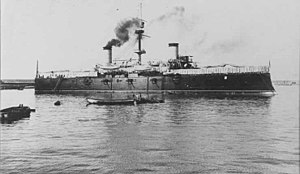
The Cristóbal Colón, an Italian-made ship that launched in 1896 and was delivered to the Spanish Navy in May 1897.
The Spanish cruiser Infanta Maria Teresa lead the escape, thus sacrificing herself by attacking the USS Brooklyn, the fastest American ship. Next in line were the ships Viscaya and Cristóbal Colón, which was the fastest of the Spanish fleet.
One by one, the Spanish ships began to lose power and beach on the shores. The Cristóbal Colón carried on, but on July 3, after taking six hits from the USS Brooklyn and USS Oregon, Captain Emilio Díaz-Moreu y Quintana had a decision to make.
The captain decided that in order to save the lives of his human and feline crew, he’d need to beach his ship near the mouth of the Tarquino River.
Some of the ship’s sailors made it ashore that day, while others were rescued by American sailors who came alongside the wreck in small boats to take off survivors. At least two cats were also rescued on July 3.
According to news reports, “Fighting Bob” Evans of the battleship Oregon took one of the cats, and another feline was shipped to Captain Charles E. Clark of Michigan. A note attached to this cat read:
To a Good American: Treat me kindly and give me food, as I am a prisoner of war from the Cristobal Colon, being forwarded by my captors, the crew of the Oregon, to the gallant commander, Capt. Charles E. Clark, whose brave efforts forced the Colon to surrender July 3, 1898.
For some reason, Captain Clark could not keep the cat, so he gave it to his brother Lloyd, who lived in St. Joseph, Michigan. Lloyd named the cat Cristobal Colon.
For unknown reasons, Tonias Cervera was not rescued with the other two cats. Perhaps he had hid inside the ship, refusing to leave his home at sea.
That evening, a U.S. Navy salvage team from the repair ship USS Vulcan decided that Cristóbal Colón was worth salvaging and towed her off the rocks. But the ship lacked watertight integrity and quickly capsized.
For the next 26 days, Tonias remained on the partially submerged wreck awaiting his rescue.
The International Cat Show
New-York Tribune, January 10, 1899
Fast forward six months to January 1899, when Tonias Cervera was a guest at the International Cat Show at the Grand Central Palace in New York City. There, he attracted much attention under the care of his new master, Ensign Gerald L. Holsinger, who had served on the salvage ship Vulcan.
Here is the eventful story of how Tonias came to be rescued following his long ordeal at sea, according to Ensign Holsinger:
Lieutenant Richard Pierson Hobson
Soon after the Maria Teresa grounded during the Battle of Santiago de Cuba, the ship was recovered and returned to the sea. It headed toward the beached Cristóbal Colón, along with the tugboat Right Arm of the Merritt-Chapman Wrecking Company.
The crew of the tugboat was able to rescue the half-starved Tonias from his old ship. They placed him on the Maria Teresa, in the care of Lieutenant Richard Pierson Hobson.
A few months later, the Maria Teresa grounded again. This time, the ship went ashore at—you can’t make this up—Bird Point on Cat Island in the Bahama Islands.
At first, the now large cat refused to leave his new vessel. Eventually, Tonias was captured by one of the island natives who had looted the ship after the American sailors abandoned it. (The islanders used the wood and brass from the ship to build cabins on Cat Island.)
The Baltimore Sun, November 23, 1898
Luckily for Tonias (or maybe not), Ensign Holsingercame to his rescue. He reportedly purchased the cat from one of the islanders and brought him on board the Vulcan, where he shared the feline with Assistant Surgeon Thomas.
When Tonias first joined the crew of the Vulcan, the men were so superstitious of this feline interloper that they threatened to throw him overboard. Ensign Holsinger protected him by locking him in his room. The cat was eventually allowed to run about the ship and frolic with an unnamed small dog.
When the ship arrived in New York, Tonias went to live with Holsinger for a short while in Norfolk, Virginia. Two months later, Holsinger brought the cat and his canine friend to the Grand Central Palace for the International Cat Show.
One of the many cats at the 1899 International Cat Show in New York City.
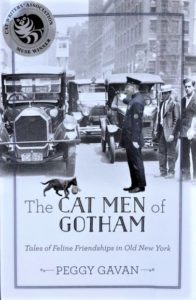
For two weeks, Tonias and the small dog shared the stage with 60 other cats, including Admiral Dewey the “Trick Cat;” Teddy Roosevelt, “the Great Fighter and Great Ratter;” a $200 cat named Coonie, the Pride of Bergen County; and Brian Hughes’ infamous $3000 gray cat Eulata (aka Nicodemus), who is featured in my book, The Cat Men of Gotham.
One reporter for the Philadelphia Inquirer noted that Tonias knew his name, but he “understands English only with difficulty.” As Holsinger told the press, “Tonias is not a handsome cat, but I prize him for the dangers he has passed.”
Unfortunately, by the time Tonias appeared at the cat show, he had already gone through almost all of his nine lives. On January 20, 1899, Tonias passed away following a seizure. At the time, he was getting ready to move into his new home with Holsinger in Rosedale, Kansas.
This story also has a sad ending for Lloyd Clark’s cat, Cristobal Colon. This former ship’s cat died from a fatal cold after appearing at a cat show in Chicago. Both seafaring cats would have probably lived longer had they been left to fend for themselves in their natural homes at sea.
Seaweed and her kittens were among the many feline mascots of the Seamen’s Church Institute in the 1940s. From The Lookout, March 1946
According to the Seamen’s Church Institute of New York (one of the city’s oldest maritime establishments), cats and dogs were the most popular mascots on ships in the good old days. Seamen were especially fond of cats, as they brought good luck to a maiden voyage. The Institute also seemed to favor cats, and in fact had numerous feline mascots at its New York City headquarters in the early 1900s.
Bosun appeared at the Brooklyn-Long Island Cat Show in 1946
The special relationship between sailors and cats dates back thousands of years. Although ship cats were primarily responsible for killing the rats that gnawed at the ship’s ropes and provisions, they also provided companionship and a sense of security for men who were often away from loved ones for long periods of time.
Seafaring cats were especially popular during wartime, when almost every ship had at least one cat. Although some of the cats were born on the piers of Manhattan or Brooklyn, many were refugees that had traveled to New York on the various steamships taking part in the war efforts. American sailors would oftentimes “liberate” the cats of other foreign ships and make them their own.
During the 1930s and 40s, the Institute had several cat mascots — the men called them “The Cat of the Moment” — including Queen Hannah, King Mickey, Stormy Weather, and Bosun. Bosun’s mother, Seaweed, drifted in on a Liberty ship in 1946 and made her home under the desk of game room hostess Christine Albert Hartmann.
Christine Hartmann volunteered in the game room. Seaweed gave birth to four kittens under her desk.
According to The Lookout, on February 9, 1946, Seaweed gave birth to four kittens shortly after she arrived at the Institute. The news of the birth was called “a blessed event on the waterfront.”
The men originally named the kittens Ditto, Quote, Unquote, and Comma because of the white markings on their noses. The mariners hoped to groom the new cats as ship mascots for four new cargo vessels of the United States Lines: Onward, Rapid, Defender, and Whistler.
Mrs. Hartmann set up a basket for the cat family in the game room with a curtain and a sign that said Caternity Hospital. Twice a day, she’d pull back the curtain to let the sailors play with the kittens. The mariners would advise Mrs. Hartmann on the cats’ diets and would offer to bring them to sea on their ships.
Mrs. Hartmann set up the Caternity Hospital for the cats in the Sailors’ Game Room. New York Public Library Digital Collections
Shortly after the kittens’ birth, a contest was held to find better seafaring names for them. James F. Sweeney, a fireman and water tender, came up with the winning names: Fogbound, Skipper, Hatches, and Sea Wolf, who was later renamed Bosun. (Bosun is the ship’s officer in charge of the crew.)
Bosun posing on a speedboat at the Motor Boat Show in 1947.
Of the four kittens, Bosun was the only one who enjoyed stretching out lazily in his bed made by sailors and lapping up egg on toast for breakfast every day. The other cats were lured to the sea: Fogbound went to Greece, Skipper headed to Italy, and Hatches went to the Pacific.
In October 1946, Bosun appeared at the Brooklyn-Long Island Cat Club show at the Hotel Granada (268 Ashland Place) in Brooklyn. The Brooklyn Daily Eagle described the cat as a bum who not only didn’t know who his father was, but who was leading the Life of Reilly amid all the other pampered and more exotic felines at the show.
“An unimportant white color, Bosun is not a cat’s cat. He’s for men and rough talk,” the reporter wrote. His cage was described as being gaudy with pin-up pictures of lady cats in “provocative poses.” None of the other 150 cats in attendance had decorated cages.
Bosun did not compete for any prizes; not only was he not qualified, but his mom, Mrs. Hartmann, was one of the judges.
Boson retired from the Seamen’s Church Institute in 1948 and went to live with the Hartmanns on their farm in Long Island. He made one more public appearance at the Motor Boat Show in 1949, pictured below.
In 1949, Mrs. Hartmann let Bosun visit his old pals at the Seaman’s Booth on the 4th floor of Grand Central Palace Motor Boat Show. Notice the cards and feline pin-up posters around him. From The Lookout, February 1949.
The Seamen’s Church Organ Cats
Although some of the Institute’s cats were described as being “not very religious,” one unnamed female cat was especially fond of the chapel.
In June 1939, Mrs. Janet Ruper, house mother and head of the missing seamen’s bureau, told The Lookout about a cat who spent most of her time in the chapel. She especially enjoyed climbing into the organ chamber and meowing loudly during Sunday services. (Church organs were very popular with Old New York cats.)
One day, the cat gave birth to two kittens in the church organ. “And do you know what?” Mrs. Roper exclaimed. “Those kittens were coal black except for a pure white cross on each of their backs!”
In 1834, a small group of Episcopal men founded the Young Men’s Church Missionary Society on the Lower East Side waterfront. Their first Chaplain, Reverend Benjamin C.C. Parker, presided over church services for seafarers in the Floating Church of Our Savior.
This unique Gothic church was built atop a barge in 1844 and docked, like a large boat, at the foot of Pike Street on the East River. This floating chapel provided not only a place of worship but also a place where seafarers from around the world could feel at home.
The Floating Church of Our Savior at the foot of Pike Street. Today, this church would be under the Manhattan Bridge.
In 1846, the Society built its second floating church, the Floating Church of the Holy Comforter. This church was built at the foot of Dey Street on the Hudson River (right about where One World Trade Center is today) to accommodate seafarers and local residents on the west side of the island. The Holy Comforter provided services until 1868.
Floating Church of the Holy Comforter at the foot of Dey Street (now the site of One World Trade Center).
The Floating Church of Our Savior burned down in 1866 and was replaced with a new floating church in 1870. The second East River church was in use until 1910, after which it was towed to the Kill Van Kull at Mariners’ Harbor in Staten Island and renamed All Saints’ Episcopal Church.
The second floating Church of Our Savior on the East River, 1870-1910.
Here is the former floating church after it was moved from the waterfront to Richmond Terrace opposite Van Name Avenue in 1914.
Throughout the 1800s, the Society built several facilities for mariners, including a reading room at Coenties Slip, a mission house at 34 Pike Street, and a sailors’ boardinghouse at 52 Market Street.
In 1906, the Society formally changed its name to the Seamen’s Church Institute of New York. Two years later, Franklin D. Roosevelt joined the Board; he remained on the Board until his death in 1945.
The old Society missionary at 34 Pike Street, pictured here in 1931, was later home to the Congregation Anshei Slulsk.
Ironically, the Seamen’s Church Institute laid the cornerstone of its new “million-dollar home for seamen” on April 15, 1912. This was the morning of the sinking of RMS Titanic. When the RMS Carpathia arrived in New York with the survivors, the Institute delivered clothing and kits to the surviving Titanic crew members.
The new twelve-story building at 25 South Street accommodated up to 580 seafarers in dormitory-style rooms. The headquarters also housed an employment bureau, savings bank, medical clinic, reading room (stocked with foreign newspapers and magazines), writing room, chapel, and basement storage area for the men to store baggage while at sea. A sign in the lobby read, “This Institute is willing to help men who help themselves.”
Seamen’s Church Institute in 1925. Museum of the City of New York Collections
One of the memorable features of the building was its main door, which was guarded by “Sir Galahad” beside a bell that had been salvaged from the passenger steamer Atlantic, which had wrecked in 1846 on Long Island Sound. The bell rang out the hour and half hour.
In 1917, a memorial to the Titanic was placed on the roof of the building along with a light and a raised ball. The ball was lowered at noon to help ships anchored in the harbor set their clocks. The building was razed in the 1960s, but the Titanic memorial still exists at the comer of Water and Fulton Streets.
The roof of the Seamen’s Church Institute at 25 South Street featured several animal and bird figures and a Titanic memorial.
In 1968, the Seamen’s Church Institute moved into a new 18-story building at 15 State Street in Battery Park. The old cornerstone, ship’s bell, and several bronze memorial plaques were installed at the new headquarters. The Institute sold this building in 1985 for more than $29 million.
The next home for the Seamen’s Church Institute was located at 241 Water Street in the Historic Buildings section of the South Street Seaport Museum. Following the attacks on 9/11, this building was transformed into an emergency relief station for rescue workers, where thousands of meals were served and truckloads of donated supplies were distributed to the workers.
Ten years later, the Seamen’s Church Institute of New York sold its headquarters building on Water Street and donated (permanent loan) its archival collections to CUNY Queens College. The Institute is currently headquartered on the 26th floor at 50 Broadway.
Sadly, I doubt that any modern-day wayward cats ever drift into this new building…