In the early 1900s, a cat named Lillian Russell who liked to fish made a name for herself as the mascot cat of the Dyker Meadow Golf Club. What the feline angler probably didn’t know was that she had a canine rival at the nearby links for the Marine and Field Club in Bath Beach.

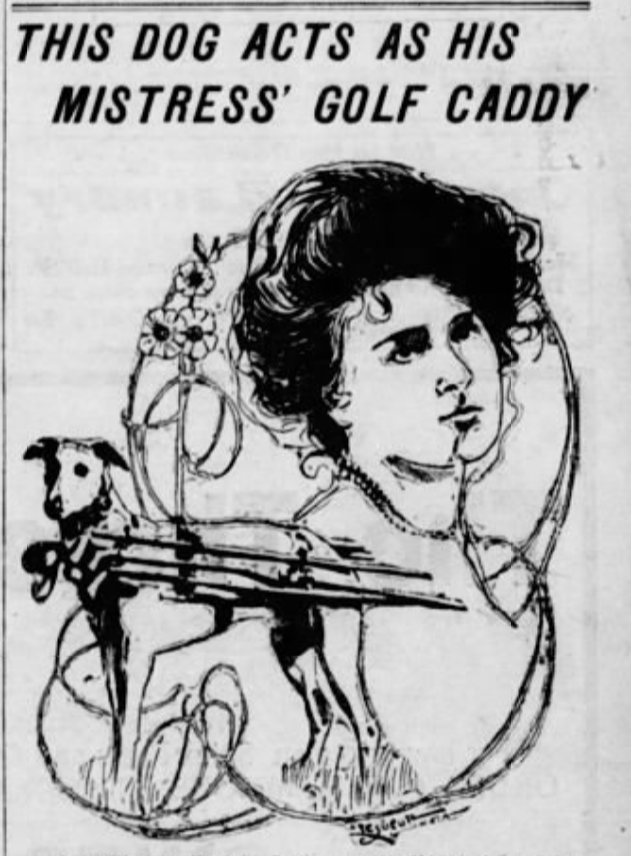
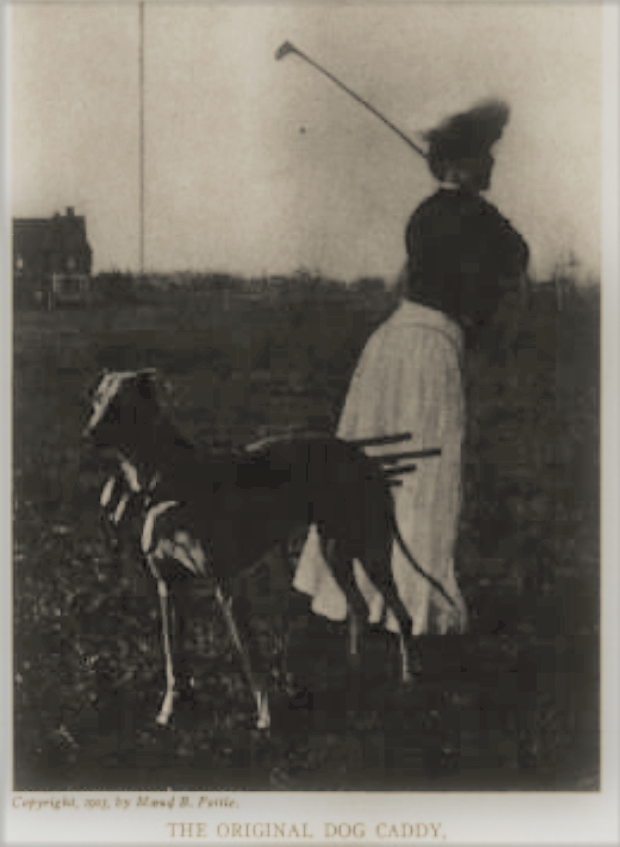
Bob was an intelligent greyhound owned by Miss Maud Beatrice Pottle, age 23, of 8731 21st Avenue in Brooklyn. Bob was specially trained to be Miss Pottle’s golf caddy. She even made a harness for him which allowed him to securely carry her golf clubs.

According to the Brooklyn Daily Eagle, Bob was 15 months old. Maud’s father, James Potter, a Brooklyn merchant in the wine industry, bought the buff-colored dog with amber eyes from a ranch in North Dakota when he was a puppy.

The story of Bob the canine caddy made all the national newspapers. This drawing appeared in the Seattle Star.

The dog was quite pampered in the Potter home: he loved sleeping on a big cushion covered in a blanket, and would cry should the blanket fall off him in the middle of the night. He did not get along well with the cat and other puppy in the household.

It was purely by accident that Bob became a golf caddy. As the story goes, one hot day while Maud was playing golf, she took off her red golf jacket and placed it on Bob’s back. Bob did such a good job carrying the jacket, she thought he could also carry her golf clubs.

Within a few days, Bob was wearing a leather harness devised for this purpose. (Maud was supposedly going to file for a patent for the harness, but I can’t determine whether she did this or not.) The dog also wore a sack around his neck to carry spare golf balls.

At first, Maud led Bob around the golf course on a chain leash. That didn’t last long. You see, Maud had also trained Bob to retrieve. So, as soon as he saw the ball in the air, he would run and follow it “at gratifying speed.”

Bob seemed to know that his caddying job ended as soon as he and Maud left the links. Once the pair returned to the street, Bob would howl until Maud removed the harness. Bob would then happily follow Maud back home, whether she walked, cycled, or drove.

Maud Pottle with Bob the dog caddy at Marine and Field golf.
Bob’s leather harness was designed to hold 3 clubs on each side.

The dog soon became the pride of the members of the Marine and Field Club. In fact, the members thought he was more than equal to Lillian Russell the cat.

Scrap the Dog: Bob’s Rival

During this time, the Marine and Field Club also had another canine mascot. His name was Scrap, aka Pickle (some called him Pickle because he was a mutt of 57 different varieties).

Scrap was owned by H.M. Gotan, a club professional who left the dog at the Marine and Field Club during the winter months when he went to Galveston, Texas. The dog got along with all the golfers, but he did not like any creature on four legs.

One day, Scrap got into a big fight with Bob. It took the strength of several people to hold the greyhound back. A few days later, Scrap was found dead. According to the press, someone had poisoned him.

After 1904, no more articles about Bob the canine gold caddy appeared. One reporter suggested that every golfer would soon have his or her own four-legged caddy, but that prediction does not appear to have come true.

In February 1904, Miss Pottle entered Bob in the Westminster Kennel Club dog show at Madison Square Garden. Bob garnered much attention from the public, but because he did not have pedigree papers, none of the judges paid attention to him.

I don’t know what happened to Bob. I do know that Maud married Frederick Charles Hinkel, a salesman, in 1915. They had one son, Frederick Bruce Henkel.

Maud died on April 27, 1960, and was buried in Poughkeepsie Rural Cemetery. Her husband, who was five years younger, died in 1974.

A Brief History of Bath Beach and the Marine and Field Club

The history of Bath Beach’s development begins with Archibald Young, a young man who made his fortune as a partner in his father’s clothing manufacturing company in Upstate New York. Young has been referred to as the Father of Bath Beach.

In 1852, Young married Mary Ann Wanzer, the daughter of Moses and Mary Wanzer. The Wanzers, who had 10 children, moved from Manhattan to Bath, Long Island, in 1841. They established their home on Gravesend Bay, near the foot of present-day Bay 14th Street (see the map below). This home was later purchased by George Carhart and operated as the Hollywood Hotel in the late 1800s.

During this time, what we now call Bath Beach was a small waterfront settlement known as the village of Bath in the old town of New Utrecht, Long Island.

In the 1850s, as shown on  this 1852 map, the Bath and Fort Hamilton neighborhoods were occupied by several large farms and a small settlement of smaller waterfront lots. Note the Wanzer property on the bay, south of Franklin Avenue, and the L-shaped Lott farm. (Franklin Avenue is present-day Cropsey Avenue.)

Following his marriage to Mary Ann Wanzer, Young used a portion of his family fortune to purchase the old L-shaped Lott farm, which was just east of the Wanzer property (see map above). He cut the farm into building lots and sold them, thus beginning the development of Bath in earnest.

Young built a magnificent home on Cropsey Avenue between present-day Bay 16th and 17th Streets, which featured a windmill that supplied the house and grounds with water. He and his wife had six children, although only a few daughters survived past childhood.

In 1874, Young and Barney Williams, a well-known Irish comedian and actor, reportedly purchased the old Michael Post farm at Fort Hamilton in a foreclosure sale for $30,000. This parcel included Dyker Meadows, which had been used as a public pasture for 200 years. There was much indignation when Young fenced in the land to keep out the cattle–he even received some death threats until he finally opened the land to cattle again several years later.

As I noted in Part I of this story, Dyker Meadows had served as a common pastureland for centuries. This photo was taken at the intersection of today's Cropsey and 7th Avenues around 1895, the year the Dyker Meadow Golf Club was established.
Dyker Meadows had served as a common pastureland for about 200 years, until Archibald Young decided to fence it in. This photo was taken at the intersection of today’s Cropsey and 7th Avenues around 1895, the year the Dyker Meadow Golf Club was established on this site.

Over the next few years, Young purchased other large parcels of land. He opened a public park on the waterfront and planted numerous maple trees for shade. By 1879, when he became director of the Brooklyn, Bath, and Coney Island Railroad, Young owned about 187 acres in addition to numerous lots.

Barney Williams
Barney Williams  

Around this time, Young and former Magistrate John Lott Nostrand began to cut up their farms into building lots. Combined with improved rapid transit options from Manhattan, the tiny village of Bath became a popular place for both summer and winter residents.

In 1885, the name of the village was changed to Bath Beach to distinguish it from the other village of Bath in Steuben County, New York. That same year, Young purchased 40 acres of the old Cropsey farm. At the time of the sale, the Rural Gazette suggested that Bath “might very well be called Youngstown.”

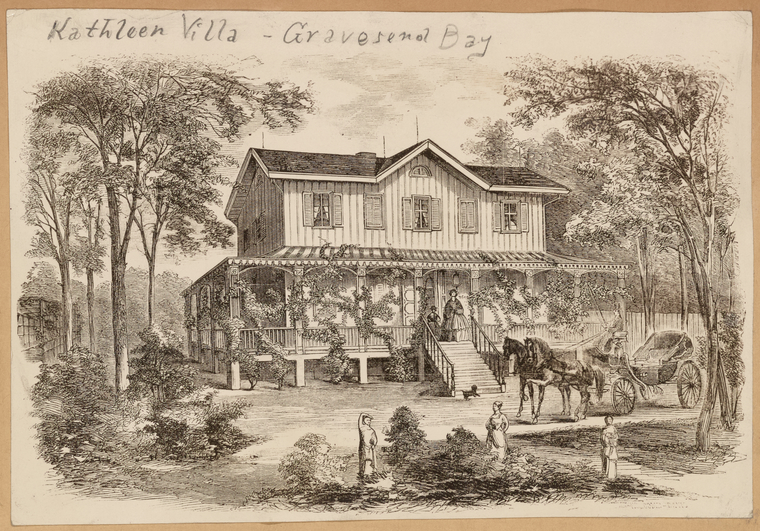
Irish comedian Barney Williams built one of the first homes in Bath Beach. Following his death in 1876, the home became Kathleen Villa by the Sea
Irish comedian Barney Williams built one of the first homes in Bath Beach, which he called Kathleen Cottage, at the foot of Bay 14th Street. Following his death in 1876, the home became Kathleen Villa by the Sea, a boarding house for women, and later, the Hotel Horton, operated by Joseph H. Horton. New York Public Library Digital Collections
This 1873-74 map of New Utrecht shows Archibald Young's large tract of land in Bath.
This 1873-74 map of New Utrecht shows Archibald Young’s large tract of land in Bath.
The Marine and Field Club was located on the Gravesend Bay at Cropsey Avenue and Bay 13th Street, as shown on this 1890 E. Robinson map.
The Marine and Field Club was located on the Gravesend Bay at Cropsey Avenue and Bay 13th Street, as shown on this 1890 E. Robinson map. This map shows the location of the original house and cottage, the boathouse, and the new Tower Hall. Also noted are the Hotel Hollywood, Kathleen Villa by the Sea, and the private residences of Archibald Young. (Warehouse Avenue is now Shore Parkway.)

The Columbia Boat Club                 

Some of the first members of the Marine and Field Club. These men made up the crew of a four-oared rig called Dandy during the days of the Columbia Boat Club.

The history of the Marine and Field Club goes back to 1872, when there were two rowing clubs in Brooklyn located at the foot of Smith Street on the Gowanus Canal. Two single scullers–Charlie Osborn and Joe Purss–were not members of either club. They joined with another oarsman, Jim Foster, to form their own club called the Columbia Boat Club.

The men bought a small floating boathouse that could hold four boats. They fastened this to a float, from which they rented small rowing and sail boats at the foot of Court Street. After a year, the men had made enough money to build a larger boathouse, which they anchored at the same location.

Over the next few years, the members of the Columbia Boat Club had to float their boathouse to new locations as new docks and other land improvements forced them out. They went from the foot of 49th Street in 1877, to the grounds of the Avon Beach Hotel at Bay 22nd Street in 1884, to the foot of 55th Street in Bay Ridge a year later.

The Marine and Field Club boathouse
The Marine and Field Club boathouse, 1900.

Finally, after building a larger boathouse (pictured below), they moved to Bay 13th Street, where the structure stood on spikes over the water.

In 1886, about a dozen members of the boat club joined together to buy several acres of property from Carl L. Recknagel, an importer of pharmaceuticals who owned a home and several rentable cottages on Bay 13th Street. The total cost for the grounds, main house, and cottage was $35,000. Recknagel had built the main home in 1881; at that time, it was considered one of the most elegant in the village of Bath.

The first annual meeting of the new social club was held on January 12 1886, at the Hotel St. George. The men were originally going to call the new club the Brooklyn Land and Water Club, but apparently they changed it to the Marine and Field Club.

A view of the original Marine and Field clubhouse from the dock that lead to the boathouse. Former Carl Recknagel residence.
A view of the original Marine and Field clubhouse from the dock that lead to the boathouse, 1900. The clubhouse, formerly the home of Carl Recknagle, was a large three-story home painted in dark red with a veranda on two sides. From the upper story, one could see Norton’s Point, Staten Island, Fort Hamilton, and the Narrows.

The men’s intention was to form a country club within easy access of New York and Brooklyn. The club would have 10 lawn tennis courts, plus boating, swimming, fishing, sailing, canoeing, and rowing. Charles Stokes was elected president and Hugh Boyd vice president.

In 1888, the Marine and Field Club built a large dormitory for men called Tower Hall. This building, which was off-limits to women, featured a carpeted lounge with a piano, a billiard hall with four tables, a bar, and a wine room. Bedrooms plus a shower and bath were on the upper two floors.

Tower Hall, Marine and Field Club.

Tower Hall was popular with the bachelor members, although there were radio communications for married men to communicate with their wives staying in the cottage sleeping apartments.

In 1896, under the direction of Percy S. Mallett, a nine-hole course was laid out on about 50 acres south of 86th Street adjoining the nine-hole Dyker Meadow course. The course was about two miles from the clubhouse at Bay 13th Street.

According to the New York Journal, “The members of the club, and the women in particular, have taken such an interest in the game that the Green Committee had a temporary seven-hole course laid out” while the full course was being constructed. The temporary course was short, which was perfect for beginning golfers.

About ten years later, in 1909, the two social clubs made an agreement to give members of both clubs access to a combined 18-hole course. The agreement came to an end in April 1914, when the opening of 12th Avenue damaged part of the course that the Marine and Field Club was leasing from the estate of George J. Smith.

This 1906 atlas shows the layout of the Marine and Field Club property.
This 1906 atlas shows the layout of the Marine and Field Club property, including the dock and boathouse.

In 1926, the Smith estate sold the land to a corporation headed by Isaac Perchelsky, a real estate operator and builder. The corporation applied for a building permit, but it was turned down because the Parks Department was already making plans to purchase the land to create what is now the Dyker Beach Park and Golf Course.

In 1935, a bad storm wrecked the pier and tore the roof off the Marine and Field Club boathouse. When the Belt Parkway was constructed a few years later, it left the club high and dry and at least a quarter of a mile from the water. The club moved to 3000 Emmons Avenue in Sheepshead Bay, where it continued to operate as a social club through the 1940s. 

By 1941, builders had taken over the former Marine and Field Club property. The site was soon replaced by a settlement of one-family brick homes that are still standing today.

Tower Hall, Marine and Field Club. New York Public Library Digital Collections
Tower Hall, Marine and Field Club. 1925. NYPL Digital Collections
Another view of the Marine and Field Club property on Cropsey Avenue and Bay 13th Street. NYPL Digital Collections
The same view today.

I recently wrote about Kelly, a cat who survived for eight days inside a mail sack on the RMS Aquitania in 1920. The following cat tale of Old New York is about Dan, the cat of Engine Company 40, who reportedly went for 33 days without food and drink in the ceiling of the firehouse.

Unlike Kelly, Dan did not have an extraordinary amount of extra lives. He did, however, have an extraordinary amount of extra pounds.

The Remarkable Tale of a Shrinking Cat

“This is a tale of a cat. Of a cat with a tail fourteen inches long. It is a true tale. It is vouched for by a fireman, a policeman and the appearance of the cat. A woman, a basket, a hole in a ceiling, a doctor and some medicine also figure into the tale.”—The New York World, January 5, 1894

Dan was a three-year-old cat who once weighed 48 pounds. (I find this hard to believe, but The World says the story is true…). Within a six-week period, between Thanksgiving and New Year’s Day, the tubby tabby had shrunk down to eight pounds.

The tale of Dan, the cat of Engine Company 40, FDNY

He was reportedly a beautiful cat, with glossy-black fur and bright yellow eyes. From the tip of his nose to the tip of his tail, he measured 33 inches—basically just short of three feet. I’m not sure how wide he was, but at 48 pounds, he must have been a tank.

According to the tale, Dan was raised by a kind woman who doted on the cat. Sadly, just before Thanksgiving Day in 1893, the woman found out that she had to move from her comfortable home.

There was no room for Dan in her new tiny apartment (I’m not sure if any small apartment in New York City could accommodate a 48-pound cat!). So poor Dan was alone and homeless.

Now, the woman knew that human vagrants were reported to the police station. So, she went to the 24th Police Precinct station house at 150 West 68th Street to report Dan’s dilemma.

As Sergeant Townsend listened to her woeful tale, he looked out the window and scratched his head. Across the street he saw Assistant Foreman Francis Casey looking out a window in the the newly constructed firehouse for Engine Company 40. That gave the wise sergeant an idea.

Sergeant Townsend invited Foreman Casey to come over for a visit. He then presented Dan to the foreman as a housewarming gift in honor of the new firehouse.

Foreman Casey was a 61-year-old veteran. He joined the fire department as a volunteer when he was 25 years old in 1858 and was made foreman of the new Engine Company 40 in December 1874. Having worked as a foreman for 20 years, Francis no doubt had a lot of experience with firehouse cats.

The old 24th Precinct station house (1890-92) at 150 West 68th Street
The old 24th Precinct station house (1890-92) on West 68th Street was designed by Nathanial D. Bush. It was demolished sometime around 1973, when the precinct (then called the 20th Precinct) relocated to a modern building at 120 West 83rd Street. 1940s tax photo, Department of Records & Information Services.

Dan immediately began purring in the fireman’s ear when Francis bent down to pet him. Trusting that her cat was in safe hands, the woman wiped a few tears from her eyes and walked away.

Well, what happened then is one for the books.

The trouble began when Francis picked Dan up. The cat dug his claws into Francis’ hair, sending the fireman into a full-blown panic. He ran across the street and into the firehouse. Dan clung on tight.

Inside the new firehouse, a carpenter was working on the wood ceiling. He was making a hole for a new steam pipe. He had just taken a three-foot board down when Francis ran into the firehouse, waving his arms frantically over his head.

Yep. You can guess what happened next.

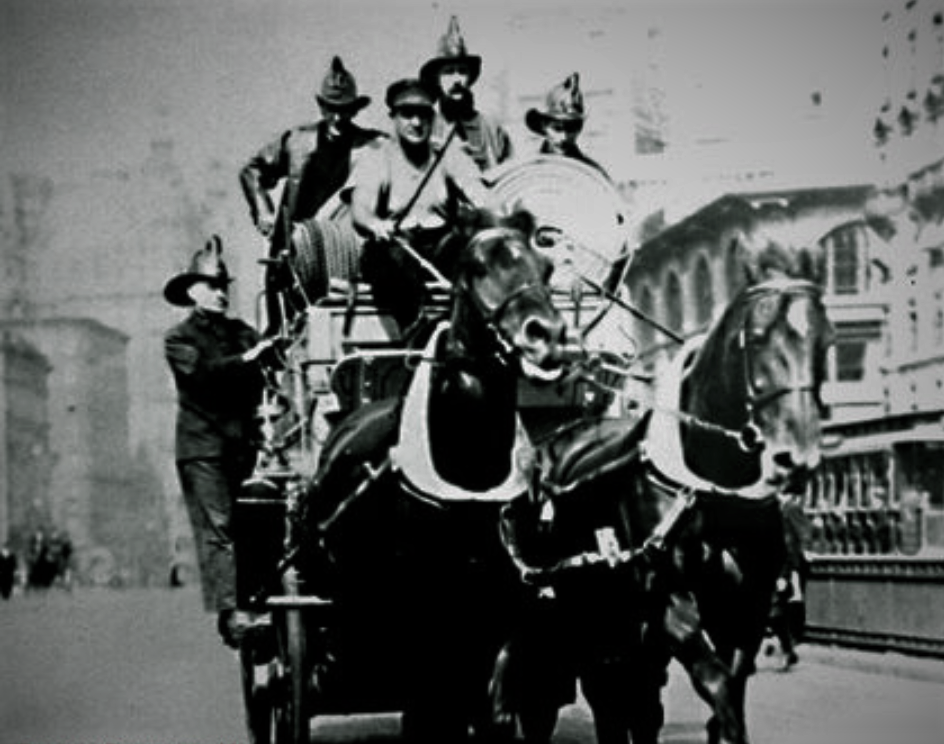
Suddenly, a second alarm for fire sounded. “The gong ranged and clanged. The horses pawed and jumped. Men rushed to and fro shouting and yelling.”

Engine Company 40 firehouse at 153 West 68th Street.
In September 1893, a new firehouse at 153 West 68th Street was constructed for the men of Engine Company 40. It was in this building that Dan got stuck in the ceiling for 33 days. 1940 tax photo, Department of Records & Information Services.

Francis sprang to take charge of the engine. Dan sprang for the hole in the ceiling. The engine pulled out, the doors closed, and Francis didn’t see his new cat for a long time.

Four hours later, when the men returned to the firehouse, Francis searched for Dan. The 48-pound cat was nowhere to be found.

The next day, the carpenter and a machinist finished installing the steam pipe. Then they closed up the hole in the ceiling. Dan was apparently taking a long cat nap, and had no idea his fate was also being sealed.

Four weeks and five days passed with no sight of Dan. These were very long and hard days for Dan. As The World reporter noted, he suffered one day for every inch of his length.

Luckily for Dan, the steam pipe did not work properly. The men were also hearing strange noises between the first and second floors. Some of the more superstitious firemen thought the eerie cries they heard were coming from a ghost and that the new firehouse was haunted.

The carpenter and machinist were called in to remove the faulty steam pipe. They left the hole in the ceiling open.

On Christmas Eve, Francis and Fireman Reynolds were standing on the first floor, directly under the hole. Suddenly, they heard a strange noise, as if a human baby were crying out in distress. They looked up and saw two bright balls of fire glowing back at them.

“It’s a ghost!” Reynolds shouted. “I knew the house was haunted.”

“Meow,” cried Dan in response.

“Worse than ghosts!” Francis said. “It’s Dan the cat!”

While the men spoke, Dan began squeezing and wriggling himself out of the ceiling hole. The men were shocked when the tiny cat fell to the floor. As the news reporter noted:

Yes, it was Dan. But, oh! how he changed! The glossy coat was ragged rough; the bright eyes were dim and glassy. Forty of the forty-eight pounds had gone. The ribs stood out like stripes on a zebra.”

Francis carried Dan up to his cot and called for Dr. Milligan. The doctor felt for the cat’s pulse, which was very weak, and put his ear up to his heart. Then he fed him six drops of milk and brandy.

The milk and brandy treatment continued for five more days in increasing doses. Little by little, the now little cat got better. By New Year’s Eve, he was able to drink some tea from a cup.

While Dan convalesced on the cot, the other pets of Engine Company 40–two all-white cats named Nell and Pete–stood guard. They gently licked his coat and helped nurse him back to health. Somehow they knew that Dan was in bad shape.

New York World, January 20, 1894

Gloom Pervades at Engine Company 40

On January 20, The World reporter returned to the Engine Company 40 firehouse to check on Dan. The men told him that he had had a relapse and taken a turn for the worse.

According to Francis, he had found the cat lying unconscious in the cellar on the morning before. He immediately called for Dr. Milligan.

Dr. Milligan said Dan had suffered from a fainting fit. He put some ammonia on a sponge and held it up to the cat’s nose. Dan shivered, wiggled his tail, and opened his eyes.

“Saved again!” Francis exclaimed.

The doctor advised Francis to keep the cat in his bed for a while and away from any drafts. The next day, Dan was sleeping peacefully on the cot with his right paw resting on the tip of his nose.

It was reported that Dan, the shrinking cat of Engine Company 40, was expected to fully recover.

A Brief History of Engine Company No. 40

Engine Company 40. Date unknown.

The interesting history of Engine Company No 40 dates back to July 29, 1874, when the company was first organized under the Metropolitan Fire Department. Their first quarters, albeit, a very temporary home (about 3 days), was quite unusual: The Empire City Skating Rink, between Second and Third Avenues and East 62nd and 63rd Streets.

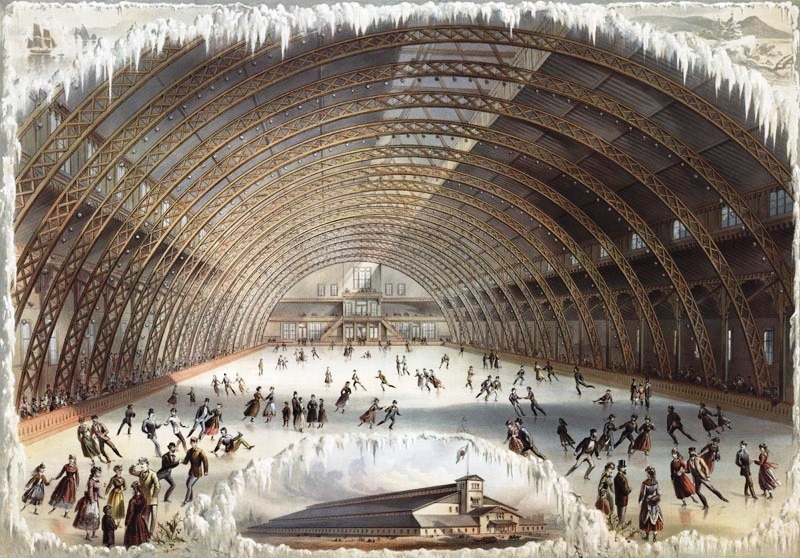
Opened in November 1868, the innovative structure featured arched cast-iron construction and boasted “the largest clear span in America.” The block-long rink was 350 feet in length, 170 feet wide, and 70 feet high. It’s ground floor had a raised platform for spectators, accommodating an audience of 10,000 persons.”

This lithograph shows the enormous building in the inset and the soaring cast iron arches of the Empire Skating Rink.
This lithograph shows the enormous building in the inset and the soaring cast-iron arches of the Empire City Skating Rink. Museum of the City of New York Collections

I was not able to find any additional details on how the large skating rink served as a temporary home for the fire company. Where did the men put their truck? Where did they sleep? Where did they keep the horses? So many questions left unanswered!

Engine Company 40 Moves to Harsenville

Engine Company 40 in front of their original firehouse at 153 West 68th Street. Date unknown.
Engine Company 40 in front of their original firehouse at 153 West 68th Street, date unknown. (Could Foreman Francis Casey be in the photo?)

On August 4, 1874, the men of Engine Company No. 40 moved from the skating rink to an existing firehouse (formerly home to Engine Company No. 23) at 153 West 68th Street. During the 1700s and 1800s, this rural region of Manhattan was known as Harsenville.

The village was named for Jacobus (Jacob) Harsen (1750-1835), eldest son of Johannas Harsen and Rachel Dyckman Harsen. Jacob Harsen was active in New York City’s political life, serving as both alderman and city magistrate. He was also a ruling elder of the Reformed Dutch Church, which was just down the street from the firehouse near Broadway.

The new firehouse for Engine Company No. 40 was constructed on the former lands of Jacob Harsen. One block away was the old Dutch Reformed Church, shown on this Randel Farm Map of 1820.
The new firehouse for Engine Company No. 40 was constructed on the former lands of Jacob Harsen. One block away was the old Bloomingdale Dutch Reformed Church, shown in the top right of this Randel Farm Map of 1820.

The following photo and illustrations demonstrate just how rural this part of Manhattan was in the 1800s.

The Bloomingdale Dutch Reformed Church on West 68th Street
The Bloomingdale Dutch Reformed Church on West 68th Street was just down the street from the firehouse. MCNY Collections
Harsenville was still a bucolic village when this illustration was drawn in 1873, but development was just around the corner. NYPL Digital Collections
Harsenville was still a bucolic village when this illustration was drawn in 1873, just one year before Engine Company No. 40 moved into their new home. But development was just around the corner. NYPL Digital Collections
Jacob and Catherine Harsen lived in this homestead near Broadway and 70th Streets in the late 1700s and early 1800s. This photograph was taken in 1888. New York Historical Society
Jacob and Catherine Harsen lived in this homestead near Broadway and 70th Streets in the late 1700s and early 1800s. This photograph was taken in 1888, 14 years after Engine Company 40 moved into West 68th Street. New York Historical Society

In September 1892, Engine Company 40 moved into a temporary structure that the city erected on a leased lot at 232 West 68th Street. They remained there for one year while a new firehouse was constructed on the site of their old home at 153 West 68th Street. The men moved into their new home on September 9, 1893.
Three months later, Dan the cat entered the new firehouse weighing 48 pounds.

Engine Company No 40 firehouse at 153 West 68th Street. 1940 tax photo
Here’s another tax photo of the old firehouse on West 68th Street.

In May 1918, Engine Company No. 40 moved in with Hook and Ladder Company 35 at 142 West 63rd Street. Their old firehouse then served as headquarters for the city’s Fire Auxiliary Corps, which was formed to augment the uniformed force in the event New York City was attacked during the war years. 

In the 1920s, the building was home to the New York Fire College, founded in 1911 by FDNY Chief John Kenlon. At the time, the college was the only institution of its kind in the world, with classes offered on all phases of fire prevention and extinguishment.

153-155 West 68th Street, New York, 1940s
Engine Company No 40 firehousse
I love this view of the firehouse, because it shows a very old two-story frame building to the left. This frame building was demolished soon after this photo was taken around 1940.
Batallion Chief Thomas Larkin instructs new firefighters on the art of scaling ladders at the New York Fire College.
Batallion Chief Thomas Larkin instructs new firefighters on the art of scaling ladders at the New York Fire College in 1920. Daily News, September 16, 1920.

On November 6, 1961, together with Ladder Company 35, Engine Company No. 40 moved one last time to a new firehouse at 131 Amsterdam Avenue, in the heart of Lincoln Center. Incidentally, a month later, filming began on West Side Story just one block west of the old West 68th Street firehouse.

68th Street between Amsterdam Avenue and West End Avenue, 1961
Much of the prologue of West Side Story was filmed on 68th Street between Amsterdam Avenue and West End Avenue. All of these buildings would soon be demolished to make way for Lincoln Square. The large abandoned P.S. 94 (on the right) on West 68th Street is featured in the opening scenes of the prologue.


137 Amsterdam Avenue, New York, 1940
The future site of Engine Company 40 on Amsterdam Avenue and 66th Street, as it looked in 1940.
The Engine Company 40 / Ladder Company 35 firehouse at 131 Amsterdam Avenue.
The Engine Company 40/Ladder Company 35 firehouse (rebuilt in 1988) at 131 Amsterdam Avenue.

The old firehouse on West 68th Street, along with all its neighboring buildings, was eventually demolished to make way for the Dorchester Towers, a 34-story residential building constructed in 1964.

155 West 68 Street, New York, NY,
FDNY Battalion 9 9-11 Memorial
FDNY Battalion 9 9-11 Memorial. On September 11, 2001, almost every member of Engine Company 40 and Ladder Company 35 who had responded to the World Trade Center attack was killed. Only one of the 12 men survived: Kevin Shea, who had been buried under the rubble. This story is dedicated to these fallen heroes.

Tootsy fire cat
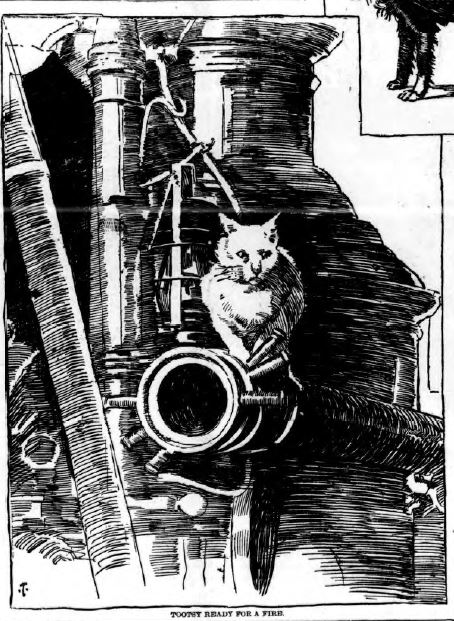
“Tootsy Ready for a Fire.” New York Press, March 29, 1896

Tootsy was the beloved feline firefighter of Engine Company 27 on Franklin Street in Lower Manhattan. Born on the Fourth of July in 1895, Tootsy reportedly loved the smell of smoke as much as she treasured a fresh-caught mouse.

She was a genuine fire cat who loved riding on the fire engine, conversing with the firemen, and sleeping in her favorite horse’s harness. She was also quite beautiful, and drew much praise from the public and the press when she appeared in the National Cat Show at Madison Square Garden. According to the New York Press, the firemen adored Tootsy so much, they would have rather parted with their shields than lose their “white-fleeced feline fire fighter.”

Tootsy was born in the stall of Old Babe, a veteran fire horse who had joined the engine company 20 years earlier. Her mother cat was also a veteran of the firehouse; she joined Engine Company 27 in 1891 when she was a kitten.

Tootsy was a bit shy of the horses, but she loved and trusted Babe, who had always been her mother’s ally. Babe’s bright harness caught the young Tootsy’s fancy, and from the time she was six weeks old, it served as her “boudoir and reception room.” Only when Babe had to don the harness to respond to a call would Tootsy retire to the desk of the house watchman.

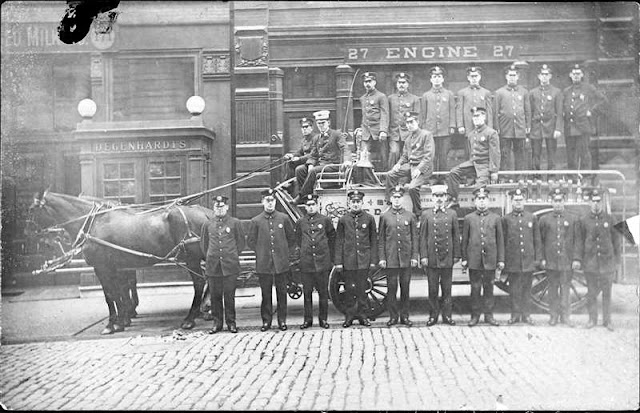
The men of Engine Company 27 about 1907. Museum of the City of New York
The men of Engine Company 27 about 1905. Museum of the City of New York

As a kitten, Tootsy had a reckless, dare-devil spirit. She would have responded to every alarm had the firemen allowed her to join them. Sliding down the brass pole from the third floor to the apparatus floor was second nature to her. Once she was on the apparatus floor, it took all the efforts of the firemen to keep her off the engines and tender before they swung out of quarters.

Tootsy’s persistence paid off one cold winter evening in 1895. According to the story reported in the New York Press, everyone in the company except Tootsy and the night watchman had been asleep upstairs when, a few minutes before midnight, the network of wires and bells broke the silence. “Tootsy saw Babe come galloping toward the harness, and the fierce light of a new resolve came into her eyes and she cleared away for action, and with one bound she landed safely on the pipe on the right-hand side of the engine. She lay close to the big boiler, so that the firemen could not see her.”

As the engine dashed down Franklin Street and rattled over the paving stones, Tootsy held fast to the suction pipe. At one point, Captain Robert R. Farrell saw a man point excitedly in the direction of the driver. He leaned over and caught site of Tootsy, who had just been confronted by the engineer.

The young cat then hopped playfully around the engine, “as though she were in quarters rather than traveling 20 miles an hour on a fire engine with a full head of steam on.” Fearing that she would get lost at the fire, Captain Farrell grabbed the fire cat, opened his coat, and tucked her inside. At the fire scene, he handed Tootsy over to Fireman McCoy, who allowed her to stay on the engine as the men fought the blaze on West Broadway.

Although Tootsy tried to respond to other fires, her efforts were almost always thwarted by her mama cat, who would betray the kitten by meowing whenever she saw Tootsy on the engine’s suction pipe. Despite her mother cat’s efforts, Tootsy was determined to make one more fire run on the engine.

Engine Company 27 at Broadway and Franklin Street in 1905. Museum of the City of New York

Her chance came one snowy night when a second alarm came in for a fire on Broadway. (Engine Company 27 was a two-alarm station, which meant they only responded to the second call. As a two-alarm station, the company’s horses had to remain hitched up long enough for the first officer arriving on the scene to sound a second alarm if needed.)

As was reported in the Press, “Tootsy was dying to get into Broadway, where she could show herself to advantage. She had never been in Broadway, and then she knew that Commissioner Sheffield usually responded to second alarms and she resolved to see the young commissioner, or forfeit one of her nine feline lives in the attempt.”

Two minutes after the first alarm was received, “the gong began its song of danger the second time.” As the company moved out into the street, the firemen looked back and saw a white cat sound asleep in the station. Thinking it was Tootsy, and not her pregnant mama cat, the men decided it was safe to pull out of quarters.

Tootsy saw her window of opportunity and leaped to the suction pipe as the engine started to move. The firemen didn’t see the stowaway feline until they had reached Canal Street. Tootsy balanced herself on the pipe like a tightrope walker as the engine raced to the scene. There, she kept company with the engineer, meowed at the crowd, and kept a close watch on Commissioner James Rockwell Sheffield and Chief Hugh Bonner (they were both reportedly too busy to notice her green eyes riveted on them).

Back at headquarters, Tootsy got a reprimand from Captain Farrell. From that day on, she obeyed his orders and stayed at the firehouse with her mother to care for her younger siblings. To be sure, she still loved sliding down the brass pole, but she never rode to another fire.

I don’t know when she died, but if she passed before 1904, it must have been a sad day for the firemen. As one reporter noted in 1896: “When Tootsy dies there will be sorrow of the genuine kind in the engine house of No. 27.”

A Fatal Fire for Engine Company 27

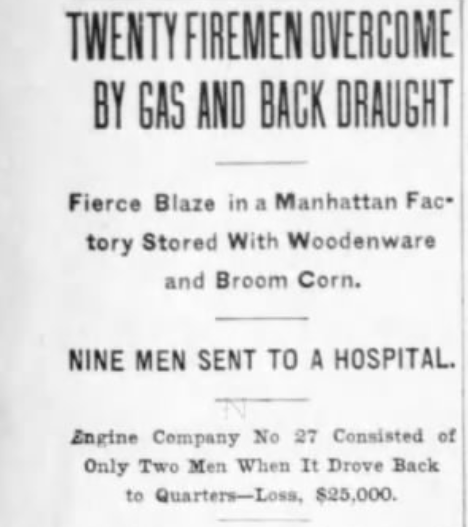
 Brooklyn Daily Eagle, March 26, 1904
Brooklyn Daily Eagle, March 26, 1904

If Tootsy did not die before 1904, she would have been the one to know great sorrow.

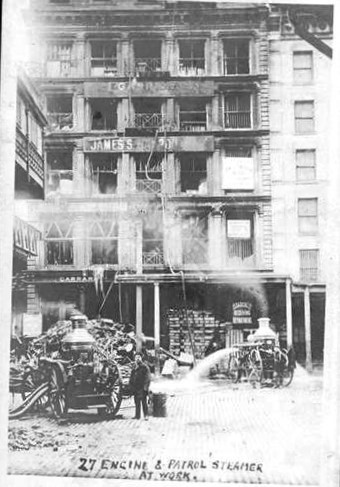
On March 26, 1904, all of the men of Engine Company 27 were disabled and nine men were sent to the hospital in critical condition after falling unconscious during a fire at Charles Plunkett’s broom factory at 205 Duane Street. The factory occupied four floors and the basement of the five-story building. Chemicals used to make the brooms created the lethal fumes.

According to a report of the incident in the Evening World, by the time a second fire company responded, the men of Engine Company 27 were all inside, unconscious or dead. “As they climbed through the smoke from the windows they were overcome and fell insensible into the arms of their comrades, who waited on the street to catch them as they fell.”

Only 30-year-old fireman Thomas McGirr was pulled out alive, but he was not expected to survive. McGirr was at that time the only original member of the company, “all of his old comrades having met death in the past three years.”

A Brief History of Engine Company No. 27

The Metropolitan Steam Engine Company No. 27 was organized on October 16, 1865. Prior to transitioning to the paid fire department, the engine company was known as North River Engine Company No. 30 under the city’s volunteer fire department.

Engine Company No. 27 in 1905. Museum of the City of New York

North River was organized on July 15, 1858, by B.F. Grant, William F. Searing, William McGrew, and other volunteers from Eureka Hose Company No. 54. The company was originally headquartered at 153 Franklin Street, but in June 1861 the company moved into a three-story brick house at 173 Franklin Street, which the city had purchased from Andrew Clarke and his wife for $12,500.

The Engine Co. 27 firehouse at 173 Franklin Street (middle), erected in 1882, was designed by Napolean Le Brun & Son
The former Engine Co. 27 firehouse at 173 Franklin Street, erected in 1882 and designed by Napolean Le Brun & Son

The men continued to occupy the old North River firehouse at 173 Franklin Street until May 1881, which is when the city began accepting proposals to erect a new firehouse at the same location. The firemen relocated to 304 Washington Street while Napoleon LeBrun & Son, the fire department’s official architect from 1879 to 1895, designed their new home.

Napoleon Eugene Henry Charles LeBrun and his son Pierre followed their traditional firehouse layout, which included centered bay doors set within a cast-iron base and two upper floors faced in red brick and trimmed in terra-cotta and stone.

The building was decommissioned as a firehouse when the engine company disbanded on November 22, 1975, and was reverted to a welding shop soon thereafter. However, some of features that date back to the days of Tootsy’s sovereignty remain, including an embellished iron lintel over the apparatus entrance, several wood sash windows, and a foliate frieze above the third-story windows.

If you enjoyed this story, you may enjoy reading about the three little kittens the men of Engine Company No. 27 rescued in 1928.

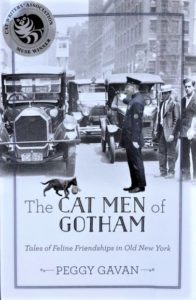
Cat Men of Gotham: Tales of Feline Friendships in Old New York

Tootsy is one of the many cats featured in The Cat Men of Gotham: Tales of Feline Friendships in Old New York. If you are interested in obtaining an autographed copy of the book, please contact me at pgavan@optonline.net.

Second Annual New York City Work Horse Parade, May 30, 1908. Library of Congress
Second Annual New York City Workhorse Parade, May 30, 1908. Library of Congress

The horses that won prizes were real horses, horses that earn their keep and are not ashamed to do a day’s work. Automobiles run us out? Well, I guess not. Who ever saw an automobile get a blue ribbon for seventeen years service in pulling loads?”–New York Sun article about the Workhorse Parade, May 31, 1907

On May 30, 1907, nearly 1,000 work horses who carted produce and lumber and garbage and firefighting equipment and prisoners finally had their day in the sun—and a chance to shine for the people of New York City. For on this Memorial Day, they were all invited to participate in the first annual New York City Workhorse Parade.

The parade, organized by the Women’s Auxiliary of the American Society for the Prevention of Cruelty to Animals (ASPCA), was based on the successful work horse parades in London and Boston, in which horses and their drivers won cash prizes and ribbons. The main purpose of the event was to incentivize owners and drivers to provide their horses with quality care and treatment. In other words, as Mrs. Minnie Cadwalader Rawles Jones noted, “to show men that it pays to treat their horses well.” 

The Workhorse Parade in 1911. Museum of the City of New York

Mrs. Cadwalader Jones explained that although all work horses were invited to participate–including the teams of horses used in the fire, police, correction, and sanitation departments–the parade was intended to showcase the one-horse men, the small expressmen, the junkmen, the small market men, etc., who owned only one horse and perhaps drove it themselves. She acknowledged that these work horses were apt to be older horses that were “picked up for a song” and were often poorly treated and neglected.

The high-society ladies of the Women’s Auxiliary hoped the drivers would be anxious to keep their horses in good shape so they could win a monetary prize every year.

The Workhorse Parade

For four hours, close to 1,000 horses and their glittering, newly painted wagons rivetted the attention of 100,000 persons who packed Fifth Avenue from Washington Square to the reviewing stand at the Worth Monument at 25th Street. In the viewing stand were numerous dignitaries including Mr. and Mrs. James Speyer, Henry Bergh, Mr. and Mrs. Gordon Knox Bell, Miss Mabel Clark, Miss Marie Winthrop, Cortlandt Van Rensselaer, and other upper-crust members of the equestrian world.

Following the parade, lunch for the men and their horses was served at the ASPCA headquarters at Madison Avenue and 26th Street.

The Parade Reviewing Stand, Library of Congress
The Reviewing Stand at the Workhorse Parade. Library of Congress

There were prizes for 47 classes, demonstrating the huge role work horses played in keeping Old New York up and running. The classes included four- and three-horse teams; brewers; lumber and box dealers; coal dealers; ice, hay and grain dealers; milk and cream men; grocers; fish and oyster men, butchers and poultry men; mineral water dealers; truckmen; confectionery men; plumbers, masons, iron and steel workers; produce; furniture; express companies; department stores; light delivery wagons; wines and liquors; laundries; paper men; and manufacturers.

More than 150 cash prizes were awarded to the drivers: $10 for first place, $5 for second, and $2.50 for third. Horses and their owners received ribbons or medals. Mrs. Ellin Prince Speyer, wife of railroad banker James Speyer and founder of the Women’s Auxiliary of the ASPCA (1906), also contributed silver medals for the winners of the classes from the city departments and the ASPCA.

Truck 8 Captain James J. Caberly (not Farley) took third prize (not first) at the Workhorse Parade in 1907.
Truck 8 Captain James J. Caberly (not Farley) took third prize (not first) at the Work Horse Parade in 1907.According to the New York Sun, Truck 8 Captain James J. Caberly (not Farley) took third prize (not first) at the Work Horse Parade in 1907. Museum of the City of New York
In 1907, second prize went to a three-horse team driven by fireman John L. Roth of Engine Company No. 33 from Great Jones Street. The medal was presented by Mrs. Speyer. Courtesy: Ed Sere (ret. Lt. FDNY)
In 1907, second prize went to a three-horse team driven by fireman John L. Roth of Engine Company No. 33 on Great Jones Street. The medal was presented by Mrs. Speyer. Courtesy: Ed Sere (ret. Lt. FDNY)

The Winning Horses

For the fire department teams, first-prize went to the horses driven by Michael V. Corbett of the tender for Engine 33, second prize went to a three-horse team driven by John Roth of Engine 33, and third prize went to Captain James J. Caberly of Truck 8 on North Moore Street.

First place among the police department horses was 17-year-old Frank, who had been in the police department for 10 years and was ridden by Patrolman John Schofield of the Traffic Squad (Frank also won again in 1914).

Traffic Squad Patrolman Otto Walsh, riding 12-year-old Shamrock, took second place (Shamrock also won a medal in 1914), and David N. Wilber took third place riding Irish Lad, the former horse of Captain George W. McClusky.

Frank and his rider Patrolman John Schofield of the Traffic Squad took first place in the police class at the first annual Work Horse Parade.
Frank and his rider Patrolman John Schofield of the Traffic Squad took first place in the police class at the first annual Workhorse Parade.

Other city department workhorses that won prizes included the horses of Edward Thompson of the Department of Correction’s “Red Maria”; Thomas Coughlin of the Bellevue ambulance (Mrs. Speyer told him that if she ever needed an ambulance, she hoped he would be the driver); John Ferguson of the Department of Street Cleaning dump cart; and John Frawley of the New York Parks Department water wagon.

There were even monetary prizes for old men and old horses. The oldest driver prize went to Abner Miller Dexter, who had driving for the United States Express Company for 49 years. Charlie, a 22-year-old truck horse at the R.E. Dietz Company stables with 17 years of service, won first prize in the old horses class. His stall mate, Eddie, who’d been pulling a wagon for 15 years, won first place in the manufacturer’s class.

The Obstacle Course

One of the highlights of the event was an obstacle course for all four-horse teams and upward, in which the men had to steer their teams in and out and around banana crates and barrels. The prize was their name engraved on a loving cup donated by Mrs. Speyer; a driver had to win the event three times in order to be able to keep the cup.

he obstacle course at the Work Horse Parade.
The obstacle course at the Work Horse Parade, Fifth Avenue between 24th and 25th Streets. Library of Congress

Possibly due to the lack of great prizes, only two men entered the contest in 1907. According to the New York Tribune, the contest was won by Brooklyn resident Matthew M. Sullivan, “perched on the quarterdeck of a white and gold truck of the Borden Condensed Milk Company, which looked as big as a battleship as it rumbled behind four squarely built grays that might have posed for Rosa Bonheur with full credit.”

Sullivan, described as a trim man with a waxed yellow mustache, had been with had been with the company for 21 years. Three times his horses did a “left face” and “right face” with military precision, easily maneuvering the obstacles in a slow trot and backing up to within inches of the judge’s stand. Sullivan’s horses also won a third prize in the four-in-hand class of the parade.

Matthew Sullivan with his winning horses in the obstacle course at the parade for the city's work horses.
Matthew Sullivan with his winning horses in the obstacle course at the Work Horse Parade. Library of Congress

On the losing end was Patrick Foley, who, according to the Tribune, “tooled a brilliant red wagon of the proportions of a freight car. It bore the name of the hay and feed company of Frank J. Lennon, and was whisked about by four iron gray Normans, any one of them worthy to have borne William at Hastings.” Foley’s horses also handled the obstacles with ease, but the prize went to Sullivan because his truck was bigger and heavier, and he drove his team in a trot the whole time.

The obstacle course was all the talk among the workmen in the West Street saloons that day. As workman Marty O’Hare told the press, “It beat the Ben-Hur chariot race all hollow.”

Work Horse Parade, [showing Anheuser Busch team], obstacle test, [New York]
Horses line up for the obstacle course at the Work Horse Parade in 1908. That year, it looks like Matthew Sullivan had more competition, including a team from Anheuser-Busch. Library of Congress

The Last Workhorse Parade

The last Workhorse Parade appears to have taken place in 1914. By then, the event was being sponsored by the New York Women’s League for Animals, which was founded by Mrs. Speyer in 1910 as an offshoot of the Women’s Auxiliary.

That year, life-saving medals were also awarded to several canine heroes: Trixie, a Japanese spaniel belonging to James Harcourt, received a medal for waking her mistress using her sharp little paws during a house fire. Bum, the Twelfth Precinct police dog, won a lifesaving medal for tearing off the burning clothes on a child; Great Dane police dog Jim, owned by H.T. Galpin, was awarded for saving his master’s life; and Olaf Hansen’s Newfoundland, Teddy, was recognized for saving two people from drowning in the Hudson River. 

Trixie, a Japanese spaniel belonging to James Harcourt, joined the reviewing stand to help greet the other dogs that passed by with their teams during a parade for work horse, 1914.
Trixie, a Japanese spaniel belonging to James Harcourt, joined the reviewing stand to help greet the other dogs that passed by with their teams during the last Workhorse Parade. New York Times, May 31, 1914

Can curiosity really kill a cat that easily if a cat has nine lives? What if curiosity almost kills a cat; how many lives does the cat still have left? The following tale about a cat that sailed from England to New York on the RMS Aquitania shows that curiosity doesn’t always kill; and perhaps, some cats have more than nine lives.

The poor kitten spent 8 days without food and water in a sealed mail sack on board the RMS Aquitania, which sailed from England to New York in December 1922.
The poor kitten spent 8 days without food and water in a sealed mail sack on board the RMS Aquitania, which sailed from England to New York in December 1920. Brooklyn Daily Eagle, January 2, 1921

On Saturday, December 11, 1920, employees at the New York General Post Office got a big surprise while opening some mail delivered to the United States from England via the steamship RMS Aquitania. Inside one sealed mail sack was a small male kitten.

According to the press, the gray tabby kitten must have been curious and found his way into the mail sack in Manchester, England, on December 3. The bag was placed in the ship’s mail hold with 6,100 other mail sacks and forgotten for eight days.

Every day that the kitten was in the mail sack without food and water, he lost one cat life.

When the Aquitania arrived in New York that Saturday morning, all of the mail bags were loaded onto the pier. A workman noticed a slight movement in the bag and began yelling. “Help! Murder! A bomb!” All the men on the pier ran for their lives in complete panic.

After the frightened men calmed down, one of the workers approached the mail sack and loaded it onto a truck. The package was rushed to New York’s General Post Office on 8th Avenue at 33rd Street.

RMS Aquitania
The Cunard liner Aquitania, built by John Brown & Company, Ltd., arrived in New York on June 5, 1914, on her maiden voyage. The ship accommodated 618 first-class, 614 second-class, and 1,998 third-class passengers, with a crew of 972. The ship was often referred to as Royal Mail Ship (RMS) Aquitania because it also carried mail.

After opening the bag, the employees watched in amazement as the kitten jumped out and staggered across the room. He made his way to a radiator, where he stood shivering and chewing on a piece of paper that he had carried from the mail sack.

The kitten was weak and pale and emaciated. Having gone eight days without food and water, the poor little thing was barely alive. There was no address and no stamps on the feline package, so the men surmised he was a stowaway who had somehow gotten into the mail sack.

In 1937, a white kitten adopted in France got to travel in style about the Aquitania with his new cat mom, Miss Doreas Wood of Springfield, Massachusetts. Miss Wood told the press that the kitten, who could purr in French, was the gift of an admirer in Paris.
In 1937, a white kitten adopted in France got to travel in first-class style about the Aquitania with his new cat mom, Miss Doreas Wood of Springfield, Massachusetts. Miss Wood told the press that the kitten, who could purr in French, was the gift of an admirer in Paris.

The employees purchased a bottle of milk and brought him into the fireroom (perhaps the boiler room) to get warm. Soon, the kitten began eating solid foods and putting on weight. The postal employees adopted the kitten, signed him up for a civil service position as a mouser on the feline police squad, and named him Kelly.

It was later discovered that the paper Kelly had been chewing was the fragment of a love letter. The “scientists” among the postal employees believed that the kitten’s life was saved by this letter. Their reasoning: it was a well-known scientific fact that love letters contain more calories than all the beefsteak and milk in the world.

The Éamon De Valera Mystery

Although many newspapers across the country picked up the story of Kelly the cat, the feline’s tale was upstaged by the story of another reported passenger on the ship’s return trip to England.

When the RMS Aquitania left New York on December 12, reports immediately began circulating that Éamon De Valera, president of the Sinn Fein Irish Republic, was among the passengers on the ship. It was surmised that De Valera was a stowaway, possibly working as a fireman or stoker or otherwise disguised.

Éamon de Valera.jpg

Cunard officials quickly denied the rumors that De Valera was a passenger, but they admitted he could have been a stowaway on the ocean liner.

Those in the Irish circles believed that if he was on the ship, he would not disembark in England, where he would be immediately arrested. He would instead get off on French soil, so to speak.

So, police in Cherbourg were extra vigilant in checking the passports of all 700 passengers getting off at that port.

Harry Boland, secretary to De Valera, said rumors that the political leader was on the ship were “a joke,” and that he was still in New York and preparing to continue his speaking tour in the United States.

Boland’s statement was apparently also a joke. A week after Christmas, on December 31, Boland announced that De Valera had arrived safely back in Ireland.

Boland said it would be treason for him to disclose how his boss left the country and made it to Ireland, but he intimated that he sailed from a United States port. “Just say he went over on the Irish presidential yacht,” Boland told the press.

As one newspaper noted, “The public may never know how De Valera managed to reach Ireland.” Maybe somebody should have checked all the mail sacks on the Aquitania on its return trip to England…

Eamon de Valera (center) met with members of the Friends of Irish Freedom at the Waldorf-Astoria Hotel.
In June 1919, de Valera (center) met with members of the Friends of Irish Freedom at the Waldorf-Astoria Hotel. A native New Yorker, de Valera wanted to “tell the world the prospect for Irish freedom” and to appeal to America to stand by the Irish republic and recognize it before the world. Also pictured are Diarmuid Lynch, Justice Hendricks,, J.W. Goff, Judge Daniel Cohalan, John Devoy, and Justice Edward James Gavegan.