RobertRathbon_ house_HatchingCat
The old Guion/Rathbone house in Washington Heights around 1910, when it was still occupied by the Arrowhead Inn.

In June 1912, New York City Police Commissioner Rhinelander Waldo created a new 42nd Police Precinct in Washington Heights to serve the people of the rapidly developing northern tip of Manhattan along the shores of the Hudson and Harlem rivers.

As I mentioned in Part I of this Old New York police story, the new precinct was bounded by 165th Street, the Harlem River, Dyckman Street, and the Hudson River. It also included the Harlem River Speedway, which was located between 155th and 165th streets.

Although the city leased a new, two-story brick loft building at 1389 St. Nicholas Avenue to serve as a temporary police station for the precinct, the hot and stuffy building was not suitable for sleeping in summer months for the men on call.

Thus, in July 1913, the 196 foot patrolmen and 25 mounted patrolmen of the new 42nd Precinct moved into a rambling, 3-story frame home reportedly built in the 1860s by William Howe Guion (of the Guion line of European steamers), and, later, occupied by Robert C. Rathbone (a successful insurance broker who served with the New York Militia during the Civil War).

The home and wooded property, bounded by Haven Avenue, Fort Washington Avenue, West 176th Street, and West 177th Street in Washington Heights, had commanding views of Riverside Drive and the Hudson River.

Sergeant Major R.C. Rathbone served with the Seventh Regiment, New York Militia, during the Civil War before settling in Washington Heights.
Sergeant Major R.C. Rathbone served with the Seventh Regiment, New York Militia, during the Civil War. 

For the next 10 years, the men of the 42nd Precinct lived in rural luxury in what became known as the best station house in New York City.

During their time off, the men enjoyed swimming, boating, gazing at the neighbor’s cows, gardening, and playing handball and lawn tennis. Some of the men, like Sergeant John McCullum, were members of the Metropolitan Boat Club. These men practiced their skills by rowing canoes from Washington Heights to the Jersey shore.

(The New York Sun once reported that the men of the 42nd Precinct had “greatly reduced their girth” after living at their new location in Washington Heights for about a year.)

They also enjoyed the company of Sir Tom, the station cat (aka rat catcher), and Lady Alice, one of the many hens that lived on the grounds and who adored spending time with her policemen friends.

And, if they were lucky, they may have even had a chance to meet Diamond Jim Brady, W.C. Fields, or any of the many other famous people who were the good friends of their neighbor next door, Ben Riley, the popular proprietor of the Arrowhead Inn.
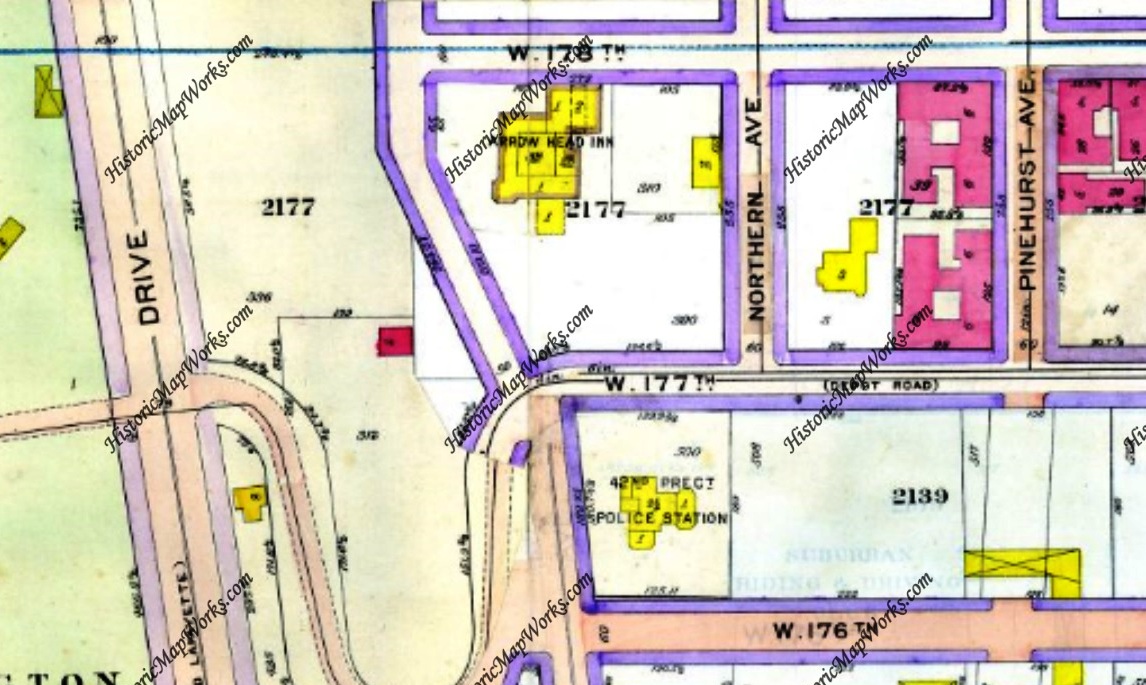
The 42nd Precinct police station of Washington Heights and Ben Riley's new Arrowhead Inn on the old Hopkins/Haven estate are clearly marked on either side of W. 177th Street in this 1914 map. Northern Avenue is today's Cabrini Boulevard and the Boulevard Lafayette at left is present-day Riverside Drive.
The 42nd Precinct police station and Ben Riley’s new Arrowhead Inn on the old Hopkins/Haven estate are clearly marked on either side of W. 177th Street in this 1914 map. Northern Avenue is today’s Cabrini Boulevard and the Boulevard Lafayette at left is present-day Riverside Drive. 

For the men of the 42nd Precinct, landing a beautiful old mansion overlooking Riverside Drive on the banks of the Hudson River was a matter of being in the right place at the right time. I guess you could say they had both Ben Riley and Benjamin Altman to think for their good fortune.

The Hendrick Oblienis Farm

In the late 1600s, the hilly region of Washington Heights was known as the common lands of Jochem Pieter’s Hills (the land to the east, between present-day Broadway and the Harlem River, was called Jochem Pieter’s Flats.)

Captain Jochem Pietersen Kuyter, a sea captain under the King of Denmark, came to America in 1639 with his friend Jonas Bronck and other pioneers. He obtained a grant of 400 acres from Director General Kieft and built a thatched-roof house somewhere in the vicinity of 125th Street. He and his wife were killed by Native Americans in March 1654, in retaliation for a massacre at Corlear’s Hook in 1643, in which 40 Natives were killed.

In 1691, one of the men who was allotted a portion of Jochem Pieter’s Hills was Joost van Oblienis, one of the earliest settlers in Niew Haerlem. The Oblienis farm extended from about 170th to 185th Street, from the Old Post Road (Broadway) to the Hudson River. Their homestead was in the area of today’s West 176th Street, between Fort Washington Avenue and Broadway.

The Hendrick van Oblienis property is clearly noted this Washington Heights map. Archaeological remains of the old homestead were discovered when 176th Street was opened on vacant land between Broadway and Fort Washington Avenue in the early 1900s. OblienisMap_HatchingCat
The Hendrick van Oblienis property is clearly noted this map. Archaeological remains of the old homestead were discovered when 176th Street was opened on vacant land between Broadway and Fort Washington Avenue in the early 1900s. 

When Joost van Oblienis passed away in 1706, his son Hendrick came into possession of the farm. Thirty years later, his son Johannes, the Constable of New Haerlem in 1736, took over the farm. In 1769, Hendrick sold the upper tract to Blazius Moore, a tobacco farmer; the lower part went to his son, also named Hendrick.

This lower tract, bounded by present-day West 173rd and West 178th streets, passed to Jacob Arden, a butcher, during the Revolution. I’m not sure who owned the land between Arden’s death in 1798 (he died in what was then the Hamlet of Kakeat in Rockland County — today this area is the called Montebello in the Town of Ramapo), but I do know that by the 1860s, a portion of the property was owned by William Howe Guion, who constructed the house that would become home to the 42nd Precinct in 1913.

Jacob Arden, a New York City butcher, took over the van Oblienis farm and homestead around 1775, during the start of the Revolutionary War. The homestead was located near today's West 176th Street between Fort Washington Avenue and Broadway. NYPL digital collections.
Jacob Arden, a New York City butcher, took over the van Oblienis farm and homestead around 1775, during the start of the Revolutionary War. The homestead was located near today’s West 176th Street between Fort Washington Avenue and Broadway. NYPL digital collections.

Ben Riley’s New Arrowhead Inn

Fast forward to sometime around 1908, which is when Benjamin Altman of department store fame (B. Altman and Company) leased the old Guion property and house to Benjamin Crawford Riley, the proprietor of the Arrowhead Inn, a popular roadhouse for high-society horsemen.

When his lease expired in September 1913, Ben Riley purchased the large W.H. Summervile (or Somerville) home and two-acre plot one block north on Haven Avenue for about $160,000 (this property was previously owned by John Milton Hopkins and his wife Augusta Haven Hopkins). Ben added a bungalow-style hotel to the site, and he remodeled the existing house to feature a restaurant that could seat about 1,000 people.

The new Arrowhead Inn on the former Hopkins/Haven property fronted Haven Avenue just north of West 177th Street. The police station was across the street on the south side of West 177th Street.
The new Arrowhead Inn on the former Hopkins/Haven property fronted Haven Avenue just north of West 177th Street. The police station was across the street on the south side of West 177th Street.

Although B. Altman had originally intended to improve his real estate holdings and sell the land to developers, for some reason he changed his plans. Instead, he leased “the old Arrowhead Inn” to New York City for use as temporary headquarters for the 42nd Police Precinct.

The Policemen Save Each Other and Their Hens

Fast forward again three years to the morning of January 15, 1916.

At about 10 a.m., Ben Riley noticed flames coming from the second story of the police station. He ran to house and called out to Lieutenant Sauder, and then he sounded the fire alarm.

The 20 men who had been gathered in the assembly room went into action. They first woke up the still-sleeping policemen in the smoke-filled dormitory on the second floor, and then they headed up to the top floor to awaken Captain Abram C. Hulse. A few other men released all the hens from their run, which adjoined the building. (Hopefully someone also saved Sir Tom, the station cat.)

This small house, constructed in 1861, was across the street from the police station on the west side of Haven Avenue at West 177th Street in Washington Heights. NYPL digital collections.
This small house, constructed in 1861, was across the street from the police station on the west side of Haven Avenue at West 177th Street. NYPL digital collections.

While the policemen waited for the firemen to arrive, they set up a bucket brigade. In short time, the seat of the fire on the second floor was extinguished and the building was saved. (A faulty chimney flue was determined to be the cause.) The men spent the next hour or so rounding up Lady Alice and her sister hens.

The old house continued to serve as a “temporary” police station for the next seven years. But by 1923, when many of the country mansions along Fort Washington Avenue were being replaced by large apartment houses to meet the city’s housing shortage, it was time for Ben Riley and the men of the 42nd Precinct to leave their rural home in Washington Heights.

The 42nd Precinct Moves

In the late 1800s and early 1900s, Fort Washington Avenue was known as the best speedway ground for trotters. In this photo from about 1910, the property of the old Arrowhead Inn would have been down the street on the right. (Note the "For Sale" signs on the property in the foreground on right). NYPL digital collections.
In the late 1800s and early 1900s, Fort Washington Avenue was known as the best speedway ground for trotters. In this photo from about 1910, the property of the old Arrowhead Inn would have been down the street on the right. (Note the “For Sale” signs on the property in the foreground on right). NYPL digital collections.

 In October 1923, Ben Riley sold his block of land bordered by 177th, 178th, Haven Avenue, and Northern Avenue (now Cabrini Blvd.), and opened a new Arrowhead Inn in Riverdale, Bronx, at 246th Street and Henry Hudson Parkway. Less than a year later, in January 1924, three six-story brick apartment buildings designed by Gronenberg Leuchtag, architects, appeared on the site of the beautiful old inn.

he new six-story apartment buildings that replaced the Arrowhead Inn on the north side of West 177th Street (including the Ethel Court Apartments at 851 West 177th) were built in 1924 by B.L.W. Construction Company. They featured all the latest amenities, including garbage incinerators and dining alcoves. The building fronts were a tapestry of brick and terracotta. Way in the background is the approach to the George Washington Bridge. NYPL digital collections.
The new six-story apartment buildings that replaced the Arrowhead Inn on the north side of West 177th Street (including the Ethel Court Apartments at 851 West 177th) were built in 1924 by B.L.W. Construction Company. They featured all the latest amenities, including garbage incinerators and dining alcoves. The building fronts were a tapestry of brick and terracotta. Way in the background is the approach to the George Washington Bridge. NYPL digital collections.

In August 1923, under the watch of Acting Captain Alphonse S. Rheaume, the 42nd Precinct moved into the headquarters of the 40th Precinct (later called the 32nd Precinct) at 152nd Street and Amsterdam Avenue. Plans called for the construction of a new station house at 182nd Street and Wadsworth Avenue, but until that was completed, all of Manhattan north of 152nd Street was covered by the station at 152nd Street.

Here's a rear view of the old 42nd Precinct police station on a wintry day in March 1923, just five months before the property was sold to developers. NYPL digital collections.
Here’s a rear view of the old 42nd Precinct police station on a wintry day in March 1923, just five months before the property was sold to developers. NYPL digital collections.

Sometime around 1922 — just before the move to 182nd Street — the 42nd Precinct of Washington Heights was renamed the 17th Precinct. Today, it is known as the 34th Precinct, and the station is located at 4295 Broadway at West 183rd Street. The men and women of the precinct no longer have a view of the Hudson River, and I seriously doubt they have any hens (maybe they have a cat), but I wouldn’t be surprised if many of them still enjoy swimming and boating when they’re off duty.

In 1924, the policemen of the old 42nd Precinct traded in their country home on the Hudson River for this traditional police station on Wadsworth Avenue and West 182nd Street. Today the building is home to the Bea Fuller Rodgers School.
In 1924, the policemen of the old 42nd Precinct traded in their country home on the Hudson River for this traditional police station on Wadsworth Avenue and West 182nd Street. Today the building is home to the Bea Fuller Rodgers School. 
In 1924, construction began on 227 Haven Avenue, which occupies the site of the former Arrowhead Inn/42nd Precinct police station. The building still stands today. NYPL digital collections.
In 1924, construction began on 227 Haven Avenue, which occupies the site of the former Arrowhead Inn/42nd Precinct police station. The building still stands today. NYPL digital collections. 
These apartment buildings, on the west side of Haven Avenue between West 17th and 178th streets,  were condemned by the city and demolished in the 1950s to make way for a new approach to the George Washington Bridge (the apartment buildings on the east side of the street were also demolished.) NYPL digital collections.
These apartment buildings, on the west side of Haven Avenue between West 17th and 178th streets,  were condemned by the city and demolished in the 1950s to make way for a new approach to the George Washington Bridge (the apartment buildings on the east side of the street were also demolished.) NYPL digital collections.

The End of the Arrowhead Inn

BenRiley_HatchingCat
Benjamin Riley

Sometime in the 1950s, the apartments that replaced Ben Riley’s Arrowhead Inn on the northeast corner of Haven Avenue and West 177th Street were demolished to make way for a new approach to the George Washington Bridge, which opened on October 25, 1931.

By this time, Ben’s new Arrowhead Inn was doing very well up in the Riverdale section of the Bronx, at the intersection of West 246th Street and the Henry Hudson Parkway.

ArrowheadInnRiverdale_HatchingCat.jpg
The Arrowhead Inn in the Bronx. The area looks surprisingly similar today.

In 1940, Ben moved his inn one final time to Yonkers, at 385 Tuckahoe Road. Four years later, on February 18, 1944, The New York Times reported that the 73-year-old inn keeper had died during an early-morning fire in the two-story brick inn.

Apparently, he had made it as far as the second-floor hallway when he was overcome by smoke. His wife, Rose Wallace Riley, her brother and wife, Jack and Mary Wallace, and a headwaiter who worked at the inn were rescued by the firefighters (Rose escaped the second floor via a ladder).

Ben Riley died in a hallway on the second floor of his Arrowhead Inn in Yonkers in February 1944. Today, garden apartments occupy this site.
Ben Riley died in a hallway on the second floor of his Arrowhead Inn in Yonkers in February 1944. Today, garden apartments occupy this site. 

Today, what was once the site of the great lawns Ben Riley's second Arrowhead Inn is now occupied by ramps for the George Washington Bridge and a small park (not visible). This looping road leading to West 178th Street is all that remains of this section of Haven Avenue, which once ran all the way to 181st Street.
Today, what was once the site of the great lawns Ben Riley’s second Arrowhead Inn is now occupied by ramps for the George Washington Bridge and a small park (not visible). This looping road leading to West 178th Street is all that remains of this section of Haven Avenue, which once ran all the way to 181st Street.

Here's an aerial view of the former site of the van Oblienis farm, Jacob Arden farm, W.H. Guion homestead, R.C. Rathbone homestead, Arrowhead Inn, and 42nd Police Precinct.
Here’s an aerial view of the former site of the van Oblienis farm, Jacob Arden farm, W.H. Guion homestead, R.C. Rathbone homestead, Arrowhead Inn, and 42nd Police Precinct.

HenCat_HatchingCat

In 1915, give or take a year, a young woman from one of the new fashionable apartment buildings in the Washington Heights neighborhood of Manhattan brought a speckled hen to the Rathbone mansion-turned-clubhouse-turned roadside inn-turned police station on West 177th Street. The hen was set loose among the dozen or so other hens that lived in a broad field behind the station. She spent the rest of her years living in rural luxury with the 207 policemen of the brand-new 42nd Police Precinct of New York City.

Lady Alice, as the men called her, loved spending time with the policemen, and in fact, she preferred being with them than with her fellow hens. She enjoyed sitting on their shoulders and eating out of their hands.

Lady Alice also enjoyed the company of Sir Tom, the police station cat. They would drink out of the same water bowl and play together in the kitchen garden behind the station, where the men had planted vegetables to conserve food during the war years (Lady Alice reportedly never nibbled on the vegetables, preferring to dig for worms.) On cold nights along the Hudson River, cat and hen would lay side by side in front of the station’s wood stove.

SuburbanRIdingClub1_HatchingCat
The police station of the new 42nd Precinct was formerly the estate of William H. Guion (1860s-1880s) and Robert C. Rathbone. Later, it served as the clubhouse for the Suburban Riding and Driving Club, and, from 1908-1913, as a popular roadside inn called the Arrowhead Inn. 

For Lady Alice, Sir Tom, and the men of the 42nd Precinct, life was good in the old Rathbone mansion at 177th Street and Haven Avenue. According to articles in The New York Times, the large, rambling frame structure on the banks of the Hudson River was surrounded by tall fruit and shade trees. The old-fashion kitchen garden had box hedges around the beds, and the grounds featured fine lawns.

1914DepotRoadMap
In this 1914 map, you can see the police station, grounds, and stables of the 42nd Precinct on Haven Avenue between West 177th Street and the newly opened West 176th Street. The Depot Road (or Depot Lane) was a tree-line country road that winded down from the foot of West 177th Street to the Fort Washington Depot of the Hudson River Railroad.

The view from the house “was a very fine one, and extended for miles up and down the Hudson River.” The five-acre parcel also featured large sheds and stables that once accommodated up to 100 horses. (The New York Police Department may have used the stables for its new police dogs in the 1910s.)

ArrowheadInnNYTimes_HatchingCat.jpg
New York Times, August 12, 1914

The ground floor of the building served as a dormitory with about 30 beds for the police reserves. On the floor above was another dormitory for the men on duty. Every day, the men awoke to the sounds of birds. They spent their leisure time swimming, fishing, boating, gardening, watching cows graze in an adjoining field, and playing with Lady Alice and Sir Tom.

The New 42nd Police Precinct

In June 1912, Police Commissioner Rhinelander Waldo created two new police precincts to serve the northern end of Manhattan. The new 37th Precinct, stationed at 407 Lenox Avenue, was bounded by 110th and 145th streets. The new 42nd Precinct, stationed at 1389 St. Nicholas Avenue, was bounded by 165th Street, the Harlem River, Dyckman Street, and the Hudson River. It also included the Harlem River Speedway, between 155th and 165th streets.

In June 1912, the city leased a new two-story brick store with cellar and loft at 1389 St. Nicholas Avenue for $6,000 a year. The plan was to use this building as a temporary police station for the 42nd Precinct until a permanent building could be constructed.

The problem with this building was that it was stuffy and hot in summer months, so the men on duty could not get a good night’s sleep. Newly elected Commissioner Arthur Woods promised them better quarters, and, after a short search, selected the old Rathbone house, or what was by then called the old Arrowhead Inn. The owner of the property at this time was Benjamin Altman, of department-store fame.

1389StNicholas_HatchingCat
Until July 31, 1913, the station house for the new 42nd Precinct was at 1389 St. Nicholas Avenue near 179th Street. This two-story building was constructed in 1912 and owned by Rose C. Newman. Today it is home to a Lucille Roberts fitness center and shops. 

The Home of William Howe Guion and Robert C. Rathbone 

In 1889, Robert C. Rathbone, a Civil War veteran, volunteer firefighter, and insurance broker (he was called “the dean of the insurance business in New York City”), purchased the house and property on what was then called Depot Lane (or Depot Road). This home was reportedly built in the 1860s by William Howe Guion, of the shipping line Guion and Company.

I’m not sure whether Robert Rathbone ever lived in the house —  in the early 1900s, his son, R. Bleecker Rathbone, resided in another home on the other side of Depot Lane — but I do know that in 1897 the home was leased by the Suburban Riding and Driving Club, a popular organization for horsemen established in May 1894 (the blog, My Inwood, has a great article on the Suburban Riding and Driving Club with lots of photos.)

The club added a new wing to the home that featured open glass sides, which, along with a spacious piazza and open fireplace, was quite inviting to visitors on sunny winter days after a sleigh ride. The club also featured a café and main dining hall finished in rich red, and a ladies’ parlor with velvet carpeting, green walls, and big easy chairs and divans.

1900RoadtoDepotMap
In this 1900 Sanborn map, you can see the old Rathbone house on the left (now the Suburban Riding and Driving Club) and Rathbone’s other residence on the right. NYPL digital collections.

In 1904, Robert Rathbone sold all of his property along Depot Lane to Roxton Realty.  The real estate syndicate’s plan was to develop the 105 lots, but for some reason the plans fell through.

Robert, who was about 80 years old at this time, moved into an apartment building at 118 West 130th Street.

RobertRathbon_ house_HatchingCat
The old Robert C. Rathbone house and former horsemen’s clubhouse, sometime around 1910, when it was home to Ben Riley’s Arrowhead Inn.

By 1908, development in Washington Heights was in full swing. All the streets were opened, sewers were installed, and the large rock formations had been removed from the more prominent plots to make way for apartment buildings.

Despite all the surrounding development, the area around the old Depot Road remained bucolic.

That year, Benjamin Riley, an inn keeper from Saratoga, New York, leased the former Rathbone property and opened a roadhouse inn called the Arrowhead Inn in the former horsemen’s clubhouse.

For the next five years, the crowds came to the Arrowhead Inn to feast on Ben’s specialty — frogs’ legs (Ben liked to boast that more frogs legs were consumed at the Arrowhead than at any other place in America). The crowds also came to participate in Ben’s famous four-in-hand road races, which he started in October 1908 to tie in with the horse show at the Madison Square Garden.

The idea was to have all the participants race from the inn to the Garden, where the horses would then be judged in the ring at the National Horse Show. The winners received a $500 cup called the Arrowhead Inn Challenge Trophy.

ArrowheadInn_HatchingCat
The Arrowhead Inn Challenge was a popular four-in-hand race that originated from the hitching post at Ben Riley’s inn. In the first year (1908), entrants included Alfred G. Vanderbilt, Paul A. Lorz, C.W. Watson, J. Campbell Thompson, George W. Watson, Morris E. Howlett, and Morgan P. Leiby. Howlett’s “Fort Washington Road Coach” won in 42 minutes, beating Vanderbilt’s “Brighton to London Coach” by 8 minutes. NYPL digital collections.  

When his lease on the Rathbone house was up in September 1913, Ben Riley decided to build a new and even better inn across the street on the former property of John M. Hopkins and Augusta Haven Hopkins, pictured below. He purchased the two-acre plot, which included a large estate then occupied by W.H. Summerville, for about $160,000.

New ArrowheadInn-HatchingCat
Ben’s new Arrowhead Inn on part of the old Hopkins/Haven estate featured sunken gardens and a restaurant that seated about 1,000 people. Notice the new brick apartments in the background on the right.  

In Part II, I’ll tell you about the final years of the old 42nd Precinct police station and Arrowhead Inn (as is typical for Old New York stories, devastating fires and development are involved)…

I wonder if Lady Alice is among these other hens?
Mille Farm, painted by John Bradley in 1835, is the earliest depiction of a Staten Island.
Mille Farm, painted by John Bradley in 1835, is the earliest depiction of a Staten Island. I’m not certain that Andrew Mille’s farm is the same one occupied by Joel Wolfe in the late 1840s and 1850s before New York State took over the land, but I do know that Wolfe’s Pond Park in Prince’s Bay is now on this very site. From the Staten Island Museum Collections

In 1799, the New York State Legislature relocated the Quarantine Establishment of the Port of New York from Governor’s Island to the northeastern tip of Staten Island, in the present communities of St. George and Tompkinsville.

This move to Staten Island was, for all intents and purposes, the start of the 60-year Quarantine War on Staten Island. The “war,” which pitted the local Board of Health and residents concerned about the spread of yellow fever against the Quarantine Commission, was a Not-in-My-Backyard (NIMBY) battle on steroids, with, sadly, vitriol and civil disorder not too different from what we see in our world today.

Joel and Udolpho Wolfe

In 1774, Benjamin Wolfe, a German Jew, emigrated to London. Two years later, he moved to Virginia, where he served under George Washington in the Revolutionary War for seven years. Major Benjamin Wolfe — now a very successful merchant — joined the army again in 1812, taking command of the troops in Richmond, Virginia. He passed away in 1818, leaving a large estate to his seven sons and one daughter.

Sometime around 1824, Joel Wolfe moved from his father’s home in Richmond to New York City, where he established a counting house at 109 Front Street. His younger brother Udolpho came to the city two years later and joined Joel as a clerk in the business. By this time, Joel was then largely engaged in the importation of brandy and gin from France and Holland.

The Wolfe's counting house at 109 Front Street burned down during the great fire of 1835, which broke out on December 16. The two-day conflagration destroyed the New York Stock Exchange and most of the buildings on the southeast tip of Manhattan around Wall Street. New York Public Library Digital Collections
The Wolfe’s counting house at 109 Front Street burned down during the great fire of 1835, which broke out on December 16. The two-day conflagration destroyed the New York Stock Exchange and most of the buildings on the southeast tip of Manhattan around Wall Street. New York Public Library Digital Collections

In 1839, Joel Wolfe established the first American-owned distillery in Schiedam, Holland. He also established a warehouse for his liquor business in a brick building at 27 Beaver Street (which burned down in July 1946).  Ten years years later, in 1849, Udolpho made some fortunate discoveries that led to the manufacture of the world-famous “Wolfe’s Aromatic Schiedam Schnapps,” which was manufactured at the Holland distillery.

WolfeSchnapps_HatchingCat
I found several Wolfe bottles for sale on eBay.

By this time, Joel Wolfe had retired from the liquor business, having amassed a fortune not only in gin but in real estate. In addition to his Manhattan residence at 305 Fifth Avenue — a four-story brownstone with a stable for his horses —  Joel owned property at 121 and 124 West Houston Street, six lots in the village of Wakefield, Bronx, and a farm on Seguine’s Point in Prince’s Bay (Westfield), Staten Island, which served as the Wolfe’s country seat.

The Wolfe Farm at Seguine’s Point

Following his retirement in 1848, Joel Wolfe and his wife, Rachel, spent much of their time at the family’s country seat on Staten Island. The 131-acre farm featured a large mansion house, a farm house, and several outbuildings, in addition to a very large freshwater pond.

The farm was just east of Prince’s Bay Road (today’s Seguine Road) and adjacent to the 140-acre tract of Joseph Seguine, a farmer, oyster harvester, and factory owner who had a dock and palm oil factory (Staten Island Oil and Candlemaking) at the water’s edge.

(The Sequine Mansion, a Greek Revival-style house built in 1838, still stands on Seguine Avenue, as does the Manee-Seguine homestead, built prior to 1700 near Purdy Place.)

In addition to farming, the “retired” Joel Wolfe served on the first Board of Directors of the first railroad on Staten Island, a 13-mile track completed in 1860 that ran from Vanderbilt’s Landing (today’s Clifton Station) to Etingville. (Joel and Udolpho were also accused of being rebels who were loyal to the Confederates during the start of the Civil War, but that’s another story.)

The Wolfe Farm was directly opposite the Prince's Bay Lighthouse, constructed in 1826 and pictured here in 1885.
The Wolfe Farm was directly opposite the Prince’s Bay Lighthouse, constructed in 1826 and pictured here in 1885. 

New York State Buys the Wolfe Farm

Back to the Quarantine War…

By 1849, infectious diseases from the Quarantine on Staten Island were epidemic among residents of the surrounding area. A Study Committee recommended that the Quarantine be removed to Sandy Hook, but no action was taken. The tipping point came in 1856, when 11 people on Staten Island died of yellow fever. A more remote location had to be found.

On May 1, 1857, the Quarantine Commissioners purchased 50 acres of the Wolfe Farm for $23,000 and vested the property in the people of the State of New York. Wolfe and his family moved out of the mansion and returned to their city residence (the mansion was going to serve as the residence of the quarantine’s physician). Wolfe put his former steward, Martin Morrison, in charge of the property until it could be fully conveyed to the state.

The Wolfe Farm Burns Down

On the morning of May 6, 1857, the Quarantine Commissioners issued an advertisement for the proposal of bids to erect several buildings for housing sick immigrants on the site. The ad enraged the local fisherman and oystermen, who feared that such a facility would contaminate the freshwater pond that they used to wash off their oysters. That evening, just around midnight, about 30 such men burned down one farm building after another in protest of the new quarantine.

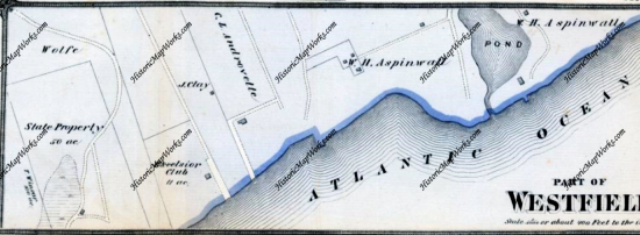
This 1874 map of Richmond County (Staten Island) shows the Wolfe farm at left, most of which by that time was owned by New York State. Today's Wolfe's Pond is also visible.
This 1874 map of Richmond County (Staten Island) shows the Wolfe farm at left, most of which by that time was owned by New York State. Today’s Wolfe’s Pond is also visible.

They men started with the large mansion, which was occupied by Samuel Fitzpatrick (a family waiter), a young boy named James Murray, and a black girl named Mary Atkinson (possibly a slave; it has been reported that Joel and Udolpho had slaves). According to The New York Tribune, all three were sleeping in the house when the fire started. Fortunately, Mary heard the commotion and alerted the young men, allowing all three to escape by jumping from a second-story rear window.

The mob then proceeded to the two-story farmhouse, which was occupied by Martin Morrison, his wife and two children, a civil engineer, and a young boy hired to pack up the Wolfe’s furniture. Awakened by a flickering light from the flames, Mrs. Morrison alerted her husband to the fire. As the men set fire to the farmhouse, Martin shouted to his children and other occupants to make their escape as the flames closed in on them.

Within a few feet of the farmhouse was a large, nearly new cow barn filled with hay, straw, farming equipment, and two cows. One of the cows escaped but was severely burned and had to be killed; the other cow was consumed by the flames. A stable housing Joel Wolfe’s two horses — one a valuable brown mare — was also set on fire. According to news reports, both horses were led out of the stables safely by Mr. Fitzpatrick.

As the New York Herald reported on May 8, all the arsonists escaped:

At a distance, and within the confines of a wooded space, [the victims] saw the forms of men, gazing upon the spectacle with apparent delight. They laughed mockingly at the condition of the poor people, and then, like evil spirits as they were, disappeared in the darkness of night.

In June, the Quarantine Commission constructed two new hospitals, a wash house, and a small cook-house on about three acres of the former Wolfe Farm, all surrounded by a 10-foot-tall fence. The buildings were all constructed of wood on brick foundations. All of these buildings were set on fire less than a year later on April 26, 1858. No effort was made to rebuild or bring the incendiaries to justice.

Following this second fire, the quarantine station was relocated to Tompkinsville (and later, after mobs burned down those facilities, to Hoffman and Swinburne Islands). The state established a burial ground on the old Wolfe farm site — near today’s Holten Avenue — which it used for the burial of yellow fever victims through 1890. (Apparently, the cemetery was so close to the water that coffins sometimes washed out onto the beach.)

On September 1, 1858, leading citizens of Castleton and Southfield set several buildings of the new Quarantine at Tottenville in Staten Island on fire.
On September 1, 1858, leading citizens of Castleton and Southfield set several buildings of the new Quarantine at Tottenville on fire. The following night, the remaining buildings were burned to the ground. One man was killed during the ordeal. Following the fire, New York State brought suit against John C. Thompson and Ray Tompkins. They were acquitted of all charges by Judge Henry B. Metcalfe, a Staten Island resident who had argued for the removal of the old Quarantine in 1849.  

Wolfe’s Pond Park

Joel Wolfe died at his Fifth Avenue residence in November 1880 and was buried at Green-Wood Cemetery. In 1901, his estate sold the remaining 81 acres of the farm at Prince’s Bay. Although the land was sold to a private developer in 1907, it stood vacant, save for a summer bungalow colony, until New York City purchased the land in 1929 for the creation of a public park.

When the City acquired land for Wolfe’s Pond Park in 1929-30, it was a popular recreational spot for Staten Island residents and visitors from other boroughs and New Jersey. More than 90 bungalows and summer cottages that surrounded the freshwater pond were razed as a result of community protest in 1933, and substantial park improvements were undertaken.
When the City acquired land for Wolfe’s Pond Park in 1929-30, it was a popular recreational spot for Staten Island residents and visitors from other boroughs and New Jersey. More than 90 bungalows and summer cottages that surrounded the freshwater pond were razed as a result of community protest in 1933, and substantial park improvements were undertaken.

Located just 100 yards from the ocean, Wolfe’s Pond at Seguine's Point is a freshwater pond that was once a tidal inlet. In the 1700s and 1800s, oystermen used the pond to wash off their hauls of shellfish. Today, Wolfe's Pond Park is one of Staten Island's largest parks, offering numerous facilities including a beach, hiking trails, and tennis courts.
Located just 100 yards from the ocean, Wolfe’s Pond at Seguine’s Point is a freshwater pond that was once a tidal inlet. In the 1700s and 1800s, oystermen used the pond to wash off their hauls of shellfish. Today, Wolfe’s Pond Park is one of Staten Island’s largest parks, offering numerous facilities including a beach, hiking trails, and tennis courts. 

Grumpy the bulldog didn't rise to fame on social media, but his owners treated him to the tallest monument at Hartsdale Pet Cemetery in Wesetchester County, New York, when he died in 1926.  (Photo from the Douglas Grundy collection)
Unlike Grumpy Cat, the Internet feline sensation, Grumpy the bulldog didn’t rise to fame on social media, but his owners treated him to the tallest monument at Hartsdale Pet Cemetery in Wesetchester County, New York, when he died in 1926.  (Photo from the Douglas Grundy collection)

I recently made my annual pilgrimage to the Hartsdale Pet Cemetery in Westchester County, New York, to spend some time with Grumpy. The Hartsdale Pet Cemetery is rich in animal tales and history, which is why I love spending a few hours there to see what stories of Old New York are waiting to be unearthed, so to speak.

Each pet monument is a treasure in its own way, but there are always a few that catch my fancy on every visit. As I’m always drawn to Grumpy Bizallion, I thought it time to explore the story of this beloved bulldog.

For years, Grumpy’s monument was the tallest at Hartsdale Pet Cemetery, standing just over six feet. Unfortunately, the foundation weakened over the years, putting the stone at risk of tipping over. For safety reasons, the cemetery cut the Grumpy monument into two pieces.

Here is the Grumpy monument today, in two pieces. Photo by P. Gavan
Here is Grumpy’s monument today, in two pieces. Photo by P. Gavan 

According to the monument, Grumpy was born on August 4, 1913, and died on September 20, 1926. We also know that his pet parents were Emma and Henry Bizallion, and that they loved him very much. Underneath the bronze relief bearing Grumpy’s likeness is carved, “His sympathetic love and understanding enriched our lives. He waits for us.”

But who were Emma and Henry Bizallion, and what is their story? Why was this bulldog named Grump so important to them – even though he was presumably a grump?

Henry H. Bizallion and Emma Loriett Coy

Henry Herbert Bizallion, the first of three sons born to Eugene Bizallion and Martha A. Seaver, entered the world on May 17, 1870, in a small town in Rutland County, Vermont. His father, a Canadian, excelled as a wood cutter when this skill was in great demand during the construction of the railroads, and then later worked as a cheese maker in Middletown Springs, Vermont.

Henry graduated from Saint Johnsbury Academy, and on June 13, 1893, he married Emma Loriett Coy, the daughter of Martin Coy and Susan Greene of Middletown, Vermont. At some point between their marriage and 1900, the Bizallions moved to New York City, where Henry worked in the banking industry.

From 1900 to 1910, Henry Bizallion moved quickly up the banking corporate ladder.

In 1900, while living with Emma at 32 Hamilton Terrace in the Hamilton Heights section of New York, Henry was working as an assistant cashier at the Riverside Bank on Eighth Avenue near Columbus Circle. Five years later, they were living closer to the bank at the new Hotel Lucerne, an upscale residential hotel at 201 West 79th Street constructed in 1903. By 1908, the year that Riverside Bank merged with the Hamilton Bank and the Northern Bank of New York, Henry was a full-fledged cashier (an officer position) as well as a director of the bank.

In 1905, Henry and Emma were living at  the Hotel Lucerne on  the corner of Amsterdam Avenue and West 79th Street.
In 1905, Henry and Emma were living at  the Hotel Lucerne on  the corner of Amsterdam Avenue and West 79th Street.

Just prior to the merger, Henry resigned from the Riverside Bank. He and a few banking friends collected $200,000 and formed the new Gotham National Bank organization, to accommodate the new automobile trade. They rented the store and basement occupying the Eighth Avenue front of William R. Hearst’s New York American Building at Columbus Circle, and in April 1910,  Henry was named president of new The Gotham National Bank of New York.

By this time, the Bizallions were living in one of the four-story brick apartments at 229-235 East 105th Street in East Harlem. Although they had been married for 17 years, they had no children. I’m not sure what Emma did to pass the time, but Henry kept busy with the bank as well as with his positions as an officer of the Central Park West and Columbia Avenue Association and the director of the Broadway Association.

The Dog Lovers’ Protective Association of America

According to published court reports, the Bizallions left their apartment in New York City and moved to Summit, New Jersey, sometime around 1912. It was here in the suburbs that they adopted a bulldog puppy named Grumpy.

Two years later, in 1914, Henry Bizallion joined Ellin Prince Speyer, Mrs. Vernon Castle, James Gardner Rossman, and several other notable New York and New Jersey dog lovers in forming the Dog Lovers’ Protective Association of America (DLPAA).

The DLPAA, created in response to a dog-phobic atmosphere, was primarily for the owners of “jes’ dogs” – in other words, ordinary canines that were not bred or considered to be pedigrees. It’s not that Henry and the over 100 other members frowned upon dog aristocracy; they just preferred to promote “ordinary, plain, everyday dogs” like Grumpy. (In fact, Agnes Rose Rossman, secretary and wife of association president James Gardner Rossman, raised Maltese terriers and had won “Best in Show” at the Westminster Dog Show.)

GothamBank1_HatchingCat
From 1910 to 1925, the Gotham National Bank was located in the American Building at the junction of Broadway, 8th Avenue, and Columbus Circle. Through mergers and name changes, the bank was later known as the Chemical Bank, Chase Manhattan Bank, and JPMorgan Chase Bank. NYPL Digital Collections

The DLPAA also advocated for a special show for dog heroes – thoroughbred or mongrel — in response to pending legislation to address the large number of dogs running at large in New York City. Apparently, New York Board of Health Commissioner Sigismund Schulz Goldwater was trying to terrify the public regarding the menace of the dog, and wanted to make New York a dogless city.

Here’s a snippet of what Dr. S.S. Goldwater wrote in the January 1915 edition of the American Journal of Veterinary Medicine:

“The dog must go. He must go where he belongs to his proper place — to the country. Assuredly I favor the exile of all dogs from Manhattan Island. I hope to see New York City a dogless town.”

He went on to say that although he was fond of dogs, “In a policed community, the pet dog is superfluous. No true lover of dogs will bring a dog into the wretched and unhappy surroundings of city life.” (Dr. Goldwater also wanted to ban all cars from the city, but that’s another story for another blog.)

In response to Goldwater, DLPAA president James Gardner Rossman wrote:

“Not until the emotions of love, courage, faithfulness, devotion, [and] companionship can be legislated out of the heart of man will man tolerate without resistance legislation which is simply persecution of his dumb companion and most faithful friend the dog.”

SSGoldwater_HatchingCat
Dr. S.S. Goldwater wanted to ban all dogs from New York City in 1915. In 1933, Mayor LaGuardia appointed him as the city’s Commissioner of Hospitals. I bet he’s rolling in his grave over therapy dogs in hospitals!

Obviously, this crazy proposal to ban all dogs from the city went down with the S.S. Goldwater ship, so to speak.

The Wicks-Brown Dog Licensing Bill

In the summer of 1916, New York Senator Charles Wells Wicks proposed new legislation titled “An Act of Encouraging the Sheep Industry.” The law was reportedly designed to help New York sheep farmers by protecting them from the alleged ravages of dogs roaming at large.

Often called the Wicks Law or Wicks-Brown Dog License Law, the law required dog owners to pay a $3.25 licensing fee for females and $2.25 for male dogs. Owners of dogs captured at large  would have to pay a $10 pound release fee. Supposedly, monies collected from these fees would be used to help farmers purchase new sheep to replace those killed by dogs.

The Wicks Dog Law also required that all peace officers kill dogs seen attacking or chasing sheep, fowl, or other domesticated animals (cats and other dogs), or when seen just roaming at large beyond its owner’s premises without wearing a mandated license tag (the officers would first have to make a reasonable effort to secure the dog and fail). In fact, anyone could kill, without recourse of law, any such dog committing these acts.

Many prominent people, including William O. Stillman, President of the American Humane Association, were openly opposed to the bill. Even some sheep farmers thought it was shear madness. As opponents noted, the bill offended nearly 200,000 dog owners in New York State in order to please a few hundred sheep owners who were hurt, not so much by roaming dogs, but by cheap Western grazing lands and foreign competition.

S.O.S. for Dogs in New York City

Although Wicks Law did not apply to New York City and other large cities in the state, it would affect those dogs whose families took them to places like Long Island, Westchester County, or other counties beyond Manhattan. If a city dog such as Grumpy got loose in the country, he could be shot, simple as that.

Henry H. Bizallion and his friends at the Dog Lovers’ Protective Association of America called the Wicks Law “the most vicious dog legislation that has ever been attempted in the United States.” In response to the bill’s passage in the New York Senate (by a vote of 31 to 14), they filed a petition with Governor Charles S. Whitman in May 1917, asking him not to sign the bill into law. The title of their petition was S.O.S. for Dogs.

The association also proposed a new bill that would make dogs the personal property of their owners (so they would have the same status and protection as horses and cattle), and that would hold dog owners responsible through civil court action for damage done by their animals (instead of killing the dog).

Despite everyone’s efforts, Governor Whitman signed the Wicks-Brown Dog License bill into law on June 30, 1917. The final law included a provision requiring that all law-breaking dogs be held 10 days before being killed; also, toy dogs under 10 pounds were excluded from the killing requirements.  

Eighteen months later, the New York World reported that $279,000 in fees had been paid to farmers to cover losses or damages to not only sheep but to horses, cows, pigs, chickens, rabbits, and goats. Some small-town assessors and constables also made out well with their share of the fees.

The Waiting Years

Following the death of Grumpy in 1926, Emma and Henry Bizallion moved again, this time to a house on Brevort Farm Lane in Rye, New York. I’d like to think that they chose a home in Westchester County to be closer to the Hartsdale Pet Cemetery, the final resting place of their beloved Grumpy.

Grumpy did not have to wait long for Emma to join him in the afterlife. She passed away only nine years after his death on June 2, 1935, at the age of 64. She was buried in the Bizallion family plot at Pleasant View Cemetery in Middletown Springs, Vermont.

LottaBizallion_HatchingCat
 Lotta Van Buren Bizallion

Henry, however, hung on much longer. Sometime around 1940, he married Lotta Van Buren, a renowned ancient instrument restorer, collector, and musician, and the grand-niece of President Martin Van Buren. She had taught piano in New York for many years — perhaps she taught Henry — before retiring in 1940. She moved to California and married her “old friend, himself a musician,” in Maricopa, Arizona, on April 6, 1940.

Lotta V. Bizallion died in May 1960.  Henry joined his two wives and bulldog Grumpy on September 4, 1960, when he died in Santa Barbara, California, at the age of 90.

HenryBizallion_HatchingCat.jpg
Although a monument awaits Henry Bizallion in the family plot in Vermont, he was buried at the Goleta Cemetery in California. 

Save

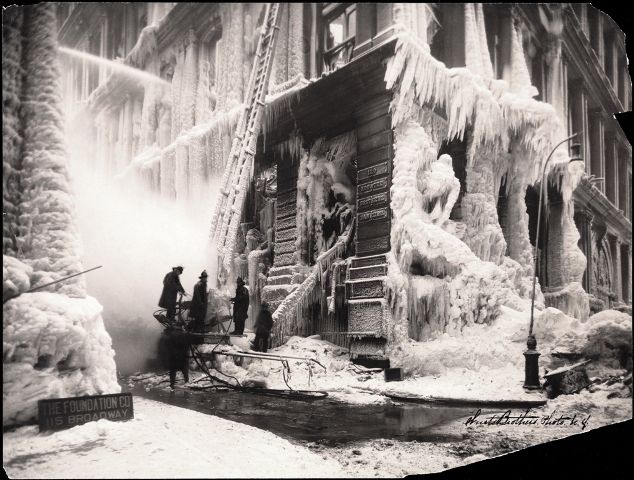
The Equitable Life Building was nothing more than a shell coated in ice.

On January 9, 1912, just after 5 a.m., a careless worker tossed a lit match into a rubbish can in the basement of 12 Pine Street, located in the Equitable Life Building on Broadway at Cedar and Pine streets. Four hours later, when the fire was finally contained, six men, including two firefighters, were dead, and the once formidable Equitable Life Building was nothing more than a shell coated in thick ice.

An actual photo of the Equitable Life guinea pig taken in March 1912
An actual photo of the Equitable Life guinea pig taken in March 1912.

Two weeks after the fire, workmen who were trying to salvage the contents of the cellar vaults and safe boxes rescued a cat named Kaiser. But the cat wasn’t the only animal that had survived the fire.

A black guinea pig later named Miss Bacillus was also discovered during the salvage operation.

Somehow, the poor guinea pig had survived 16 days in the extreme cold, imprisoned in a small cage without any food or water.

Miss Bacillus had been brought to the Equitable Life Building by Dr. A.S. Wolf, who had an office on the third floor of the Pine Street side of the building. Dr. Wolf was reportedly conducting some “experiments” with the guinea pig for medical insurance purposes. (Dr. Wolf seems an appropriate name if this is true.)

Although this part of the building had not been destroyed by the fire, the office had been completely damaged by water and ice, and so no one thought to look in the room for survivors, human or otherwise. It wasn’t until Dr. Wolf heard a very faint squeak while recovering personal items from his office that the guinea pig was discovered.

The guinea pig survived for over two weeks in an office of the Equitable Life Building without food, water, or heat.
The guinea pig survived for over two weeks in an office of the Equitable Life Building without food, water, or heat. 

Dr. Wolf let the guinea pig out of her cage, and she immediately scampered across the office to where he stored her food. When he brought her back outside, hundreds of people who were waiting their turn to go into the building to retrieve their contents from the safe deposit boxes gathered around the cage in awe.

Dr.Wolf turned out to be a pretty good guy. He reportedly gave his guinea pig to Henry W. Ward of Washington, D.C., whose young son was mourning the recent loss of his pet guinea pig. In March 1912, Mr. Ward brought their new pet back to New York City, where “Miss Bacillus” shared the spotlight with Kaiser the Faithful cat at the Woman’s Industrial Exhibition.

Henry Ward holds his new pet guinea pig.

A Look Back on Broadway at Pine and Cedar Streets

The acre of land on which the Equitable Life Building was constructed was previously just a small portion of a large farm owned by an early Dutch settler and trader named Jan Janszen Damen (or Dam). Jan Damen acquired the property through a Dutch land grant in 1644 from Governor William Kieft — just 9 years before the “great wall” was built.

The rolling property extended from present-day Pine Street to Fulton Street on the west side of Broadway, and from Pine Street to Maiden Lane east of Broadway.

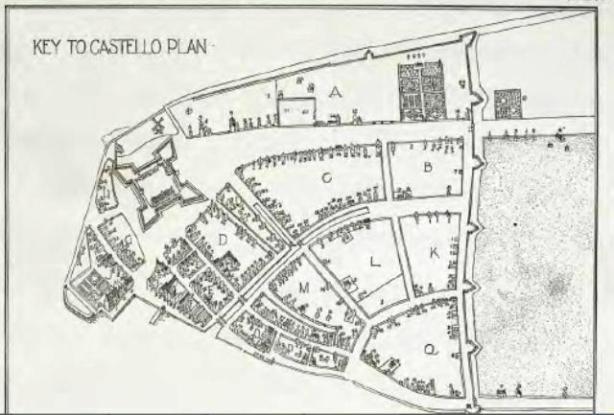
According to the Castello Plan for New Amsterdam of 1660, only six houses and a windmill stood outside the "great wall" (Wall Street) along the Heere Straat (Broadway). Two of those houses -- #5 and #6 on the map -- were owned by Jan Damen (the windmill may have been a very large haystack behind Damen's farmhouse). The Equitable Life Building was constructed on this land in 1870
According to the Castello Plan for New Amsterdam of 1660, only six houses and a windmill stood outside the “great wall” (Wall Street) along the Heere Straat (Broadway). Two of those houses — #5 and #6 on the map — were owned by Jan Damen (the windmill may have been a very large haystack behind Damen’s farmhouse). The Equitable Life Building was constructed on this land in 1870. Click here to zoom in on the map for more details.  

Jan Damen erected a large farmhouse (the “great house”), a few outbuildings, and a “small house” on Heere Straat just north of what we call Wall Street. The great house was near the corner of today’s Cedar Street, and the small house occupied what is now Pine Street and Broadway.

According to the Key to the Castello Plan, the six houses "Beyond the Wall" were as follows: #1  was owned by Sybout Claessen (this is where 96 Broadway is today); #2 was a small cottage owned by Jacques Pyrn; #3-4 were owned by Hendrick Pietersen; #5-6 were the Damen houses. The formal garden on the west side of Broadway was laid out by Jan Pietersen Verbrugge and is today part of the Trinity churchyard.
According to the Key to the Castello Plan, the six houses “Beyond the Wall” were as follows: #1  was owned by Sybout Claessen (this is where 96 Broadway is today); #2 was a small cottage owned by Jacques Pyrn; #3-4 were owned by Hendrick Pietersen; #5-6 were the Damen houses. The formal garden on the west side of Broadway was laid out by Jan Pietersen Verbrugge and is today part of the Trinity churchyard.

According to the Key to the Castello Plan, “The great house stood diagonally across Cedar Street, on Broadway. If it could be reconstructed today, its south corner would probably touch the…Equitable Life Building.”

Surveyors laid out Wall Street along the lines of the original stockade in 1685; the wall was dismantled by the British colonial government in 1699.

Following Damen’s death in 1651, his land was conveyed to his widow and her heirs.  Two years later the city — under the command of Peter Stuyvesant — erected a 12-foot tall stockade across the entire island to fend off attacks from Native American tribes.

In 1672, the Damen heirs sold the farmhouse to Dr. Henry Taylor. Their timing was perfect: A year later, the city ordered Dr. Taylor and all the other property owners north of the wall to demolish their homes because they were thought to be impeding the city’s walled defenses.

The Tulip Garden

In November 1664, Damen’s smaller house was purchased by Pieter Van Stoutenburg (aka Peter Stoutenburgh), another Dutch settler who came to New Amsterdam sometime around 1638. Stoutenburgh was at one time the city’s horticulturist, and is credited with bringing the first tulip bulbs to New Amsterdam. His half-acre tulip garden between present-day  Nassau Street and Broadway  was quite an attraction in those days.

In 1673, Peter Stoutenburgh was also ordered to demolish his home because it was too close to the great wall. However, Peter held onto the land until his death in 1699, when it was conveyed to his heirs.

Sometime during the early 1700s, the Stoutenburgh estate sold the former tulip garden property to the Dutch Reformed Church. The church constructed a parsonage on the site, which served as a residence for the minister of the Middle Dutch Church on Nassau Street between Cedar and Liberty Streets.

The Vauxhall Garden

Fast-forward about 60 years to 1797, when Jacque Madelaine Joseph De La Croix (aka Delacroix), a French caterer and confectioner, purchased the 37 x 140 foot parsonage plot from the Dutch Church for 3,950 pounds (less than $10,000). According to Delacrox, this was “a remarkable lot and large house…with large stone cistern, a very large ice house, handsome water works, and a fine garden of fruit trees.”

Delacroix moved his Vauxhall Garden several times over the years, but I imagine his gardens between Broadway and the Bowery, pictured here, looked similar to those on Broadway between Pine and Cedar streets.
Delacroix moved his Vauxhall Garden several times over the years, but I imagine his gardens between Broadway and the Bowery, pictured here, looked similar to those on Broadway between Pine and Cedar streets.  

Delacroix established a confectionery shop in the old parsonage at 112 Broadway, which he shared with John and M Paff, dealers in musical instruments. Behind the shop, he created a pleasure garden called Ice House Garden (later, Vauxhall Garden).

Opened on July 4, 1797, the garden was a popular resort that featured light refreshments and simple entertainment, including vocal and instrumental concerts. The admittance fee was 6 shillings, which included a glass of ice cream and punch or lemonade.

In 1825, Delacroix enlarged his shop at 112 Broadway to create the National Hotel (112-114 Broadway). Just next door, at 110 Broadway, was the Tremont Temperance House hotel. The New York Athenaeum, established in 1824, was on the corner of Broadway and Pine (from 1821-22, William Cullen Bryant edited the New York Review and Athenaeum in a building on this site). And at 120 Broadway, on the corner of Cedar, Francis Guerin, a celebrated restaurateur, operated a shop that was famous for its French cordials, bonbons, preserves, tarts, and confections.

In 1830, when this illustrated was created, Broadway between Pine and Cedar Streets was occupied by several hotels, including City Hotel on the west side and the National Hotel and Tremont Temperance Hotel on the east side of the street. It was on this site that the Equitable Life Building was constructed
In 1830, when this illustrated was created, Broadway between Pine and Cedar Streets was occupied by several hotels, including City Hotel on the west side and the National Hotel and Tremont Temperance Hotel on the east side of the street. 

In 1836, Delacroix sold the National Hotel to Charles St. John for $100,000. Sometime between then and 1867, the hotel was conveyed to General Daniel Butterfield, the son of John Butterfield, a founder of the American Express Company.

The Equitable Life Building was considered to be the first fire-proof building in the world.
The Equitable Life Building was considered to be the first fire-proof building in the world. 

The Equitable Life Assurance Society Steps In

In 1866, The Equitable Life Assurance Society purchased No. 116 and 118 Broadway, and in 1867, they purchased No. 120 from the American Express Company for $300.000. It was on this site that the original Equitable Life Building was constructed in 1870. This white granite building was six stories and had two steam-driven passenger lifts.

Gradually, the Equitable purchased additional parcels, including No. 112-114 — which they acquired in 1876 from Butterfield for just under $303,000 — No. 12 Pine Street, and a 50-foot plot at Broadway and Pine, which they bought from the Metropolitan National Bank in 1885 for just over $760.000.  After getting control of the entire block — called the Equitable Block — additions and improvements were made to the building.

In May 1868, seven buildings from the southeast corner of Cedar and Broadway downward were razed to make way for the original Equitable Life Building. This image from 1868, looking up Broadway from Pine Street, is the "last look" at these buildings before they were razed. New York Public Library Digital Collections
In May 1868, seven buildings from the southeast corner of Cedar and Broadway downward were razed to make way for the original Equitable Life Building. This image from 1868, looking up Broadway from Pine Street, is the “last look” at these buildings before they were razed. New York Public Library Digital Collections

Life After the Equitable Life Fire

Soon after the Equitable Life fire, the building was razed. This view of the empty lot is looking southeast at the corner of Pine Street and Nassau Street. New York Public Library Collections

In November 1912, ten months after the great fire, several leading bankers proposed turning the site of the former Equitable Life Building into a public park. At the same time, the Du Pont company was plotting to construct a 36-story building on the site.

Eventually, plans were approved for a new 36-story Equitable Building, which was constructed in 1913 on the same site. Noting its fireproof elevator shafts and doors,  the president of the contractors said “the new Equitable Building will be the nearest to an absolutely fireproof building in the world.”

The Equitable Life Building still stands on Broadway, on what was once a tulip garden and pleasure garden.
The Equitable Building still stands on Broadway, on what was once a tulip garden and pleasure garden.
EquitableBuilding20162_HatchingCat.JPG
BADGE_BlackAssoc