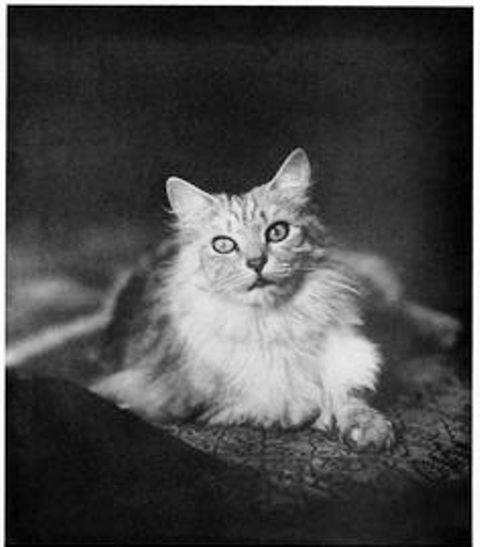
Kaiser, pictured here in the Christian Advocate Vol. 87 in 1914, was described as a glossy black cat with dainty white nose, breast, and mittens.

Many articles have been written about the iconic Equitable Building fire, but few mention Kaiser, the Equitable Fire Cat. I came across one small article published in 1914 that made brief mention of a cat, and I did some research. I’ll share my findings in this two-part cat tale of Old New York.

Philip Lights a Match

On January 9, 1912, just after 5 a.m., Philip O’Brien, an employee at the Café Savarin restaurant in the Equitable Life Building, lit the gas for a stove in his small office at 12 Pine Street, on the corner of Broadway.

The Café Savarin, which opened in 1888, occupied eight floors of the Equitable Building. Philip O’Brien’s office — described more like a small booth — was in the basement among the wine vaults and a receiving room for supplies. Not too far away were the steam elevators and dumb waiters that opened at each floor.

The basement was also a favorite hunting ground for Kaiser, a black and white cat that had been on rat patrol at the Equitable Building since about 1907.

On this morning, Philip O’Brien must have been distracted, because he admitted to throwing the still-lit match in the garbage. Less then 20 minutes later, his office was engulfed in flames. As Philip and other employees tried to extinguish the flames, the fire spread to the elevators and dumb waiters, giving it access to the entire Equitable Building.

When the Cafe Savarin opened in 1888, The New York Times called it a "gorgeous eating house for New Yorkers who appreciate the gastronomic art." The cafe, named after Jean Anthelme Brillat-Savarin, cost "no less than $1 million" to furnish throughout.
When the Cafe Savarin opened in 1888, The New York Times called it a “gorgeous eating house for New Yorkers who appreciate the gastronomic art.” The cafe, named after Jean Anthelme Brillat-Savarin, cost “no less than $1 million” to furnish throughout.

As the fire raged inside, the winds were gusting up to 68 miles an hour outside, making the sub-freezing temperatures even colder. Down in the basement Kaiser was just waking up to start a new day of rat catching.

The Equitable Building

Completed on May 1, 1870, the eight-story Equitable Building at 120 Broadway was considered the first skyscraper in New York City (it held the record for 14 years as the world’s largest building at 130 feet). It also featured the first public elevators in the city (it had 6 Otis elevators).

EquitableLife3_HatchingCat
The Equitable Building, which was actually five buildings constructed over time and connected together, occupied the entire block bordered by Broadway, Nassau, Cedar, and Pine streets. Cafe Savarin was on the Pine Street side of the structure.

The building was home to some of the most well established banking, insurance, and law offices of the Gilded Age, such as the Hanover Fire Insurance Company, Mercantile Trust Company, Union Pacific, and the exclusive Lawyer’s Club.  The main tenant and owner was the Equitable Life Assurance Society, hence the building was often called the Equitable Building or the Equitable Life Building.

In the basement of the Equitable Building, where Kaiser worked as head mouser, safe boxes and vaults were filled with several billion dollars worth of securities, stocks, and bonds.

In 1909, plans were filed to replace the building with the structure (below left), a 62-story building (909 feet) that would have been the second tallest man-made structure (the Eiffel Tower is 984 feet tall).

Those plans obviously fell through. I wonder if I’d even be telling this story if the new building had been constructed as planned.

The Great Fire of 1912

At 5:34 in the morning on January 9, the first fire alarm was pulled at Box 24 on the corner of Pine and Nassau streets. The first due responding fire companies (four engines, two ladders, two battalion chiefs, and the deputy chief of the First Division) arrived within minutes.

The first-in engine company, Engine 6, which was stationed at 113 Liberty Street, immediately stretched a line into the cellar and began operating.

New Equitable building proposed in 1909
New building proposed in 1909

At 5:55, Deputy Chief John Binns transmitted second and third alarms. This brought Chief of Department John Kenlon and Fire Commissioner Joseph Johnson to the scene.

With the fire raging out of control, Brooklyn fire companies were also called in to help – it was the first time in the history of the city’s fire department that Brooklyn responded to a Manhattan fire.

Police Commissioner Rhinelander Waldo (who had resigned as fire commissioner shortly after the deadly Triangle Shirtwaist Factory fire in 1911), ordered police officers to shut down the Brooklyn Bridge to allow the responding companies to get to the Equitable Building as fast as possible.

Nine engines, four hook and ladder trucks, a water tower, a searchlight engine, and numerous hose tenders rolled into the scene under the command of Brooklyn Fire Chief Thomas Lally.

Oblivious to all that was going on around her, Kaiser continued to patrol the basement for rats and mice, just like she’d done for the past five years.

The water from the fire hoses turned the Equitable Building into a giant iceberg on Broadway. Some of the most haunting and yet artistic photographs were taken during and after the fire. Museum of the History of New York Collections

At about 6 a.m., the first of six casualties occurred when three waiters of Cafe Savarin were trapped on the mansard roof after trying to escape to the top floor by elevator. Firefighters tried to rescue them, but the ladders were three stories too short.

By the time the firefighters, including Fireman James F. Molloy of Engine 32, tried to rescue them with a rope-rifle shot from a neighboring building, the roof had begun to collapse.  The trapped men jumped to their deaths onto Cedar Street.

Fire Commissioner Joseph Johnson (left) with icicle-laden Chief John Kenlon.

Fire Battalion Chief William Walsh and Captain Charles Bass of Engine 4 were also killed in the fire when the building caved in while they were doing a search on the fourth floor. Fireman James G. Brown of Ladder 1, who was with Walsh and Bass, survived after being hurled through a door into another wing of the building by the air pressure of the collapse. His efforts to retrieve Walsh and Bass from the building failed, not for lack of desperately trying.

At the time of the collapse, William Giblin, the president of the Mercantile Deposit Company, a clerk, and a watchmen became trapped while searching for important documents in a massive vault. Giblin and the clerk were rescued from the basement two hours later, when firefighters were finally able to hack through the two-inch steel bars in the windows. The watchman did not survive.

FDNY Batallion Chief William Walsh

Kaiser the cat did not escape through the windows during this rescue, even as firefighters continued to pour water into the cellar to control the fire near the trapped men.

As the morning wore on, the temperatures dropped even more. Soon Broadway and nearby streets were coated with layers of ice, hoses were frozen solid, fire apparatuses were jammed, and the firemen were covered in icicles.

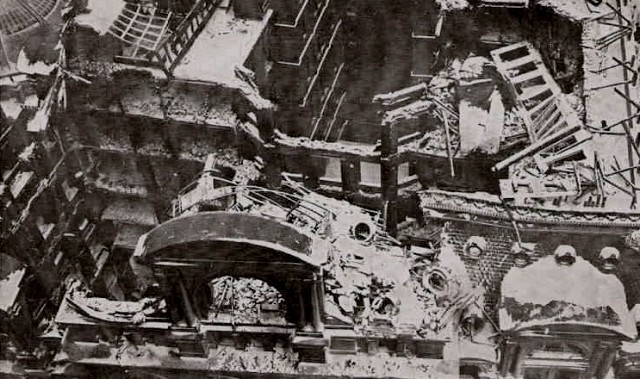
By the time the fire was finally contained at 9:30 a.m., the Equitable Building was an ice-covered tomb in ruins.

Recovery Efforts

On January 13, four days after the Equitable fire started, workers were finally able to crack through the ice and search for the body of Battalion Chief Walsh. It took many hours to free his frozen corpse from the ruins. The following day, the body of watchman William Campion, his hand still frozen to an iron bar on a window, was carefully removed from the cellar.

This haunting scene from the Equitable fire's aftermath is a chilling foreshadowing of the scene following the World Trade Center attacks on 9/11. Museum of the City of New York Collections
This haunting scene from the Equitable fire’s aftermath is a chilling foreshadowing of the scene following the World Trade Center attacks on 9/11. Museum of the City of New York Collections

On January 25, 16 days after the fire started, workmen who were trying to salvage the contents of the cellar vaults and safe boxes found a “sad wreck of a cat” in the front part of the lower floor. Kaiser, who apparently had more than nine lives, had miraculously survived the conflagration.

In Part II of the Equitable Fire Cat tale, I’ll tell you more about Kaiser’s rescue. And in the final part of this story, I’ll tell you about another surprising animal rescue from the building and explore the history of the site where the old Equitable Life Building one stood before a man named Philip tossed a lit match into a rubbish can.

Equitable Life Building Fire
Can you believe that a cat and another small animal survived almost two weeks without food and water in this ice fortress?

Click here for Part 2 and for Part 3 of the amazing cat story of Old New York.

JessieTarboxBeals11_HatchingCat
Say cheese! Cat portraits were one of Jessie Tarbox Beals’ specialties.

In Part I and Part II of this Old New York Bohemian cat tale, many of the photos were taken by photojournalist Jessie Tarbox Beals.

In this final post in the series, I’ll share many of her cat photos and take you on a tour of her Sheridan Square studio in Greenwich Village — then and now.

Born in Canada in 1870, Jessie Tarbox Beals was a young schoolteacher in 1888 when she reportedly won a small camera for selling magazine subscriptions. Much has been written about Jessie, her career, and her husband, Alfred, so I’ll jump to 1905, which is when the couple moved to New York City and rented the old Stanley Studio at 159 Sixth Avenue.

Jessie Tarbox Beals in the Stanley Studio on Sixth Avenue

Jessie was a big fan of the bohemian life in Greenwich Village, and she reportedly loved spending time with movers and shakers like Sinclair Lewis, Edna St. Vincent Millay, and Eugene O’Neill.

These acquaintances — as well her long work hours — put a strain on her marriage. In 1917, when their daughter Nanette was just six years old, the Beals separated.

By then, Jessie had opened her own photo gallery and tearoom in a tiny building at 6 1/2 Sheridan Square.

Jessie Tarbox Beals spent several years in Greenwich Village taking photographs of all that captured its Bohemian nature. Some of her favorite subjects were the tearooms and cafes where writers and artists – and cats — congregated, as well as the Village’s crooked alleys and mews (as in Washington Mews, not kitten mews).

Jessie Tarbox Beals took this photo of Mrs. William S. Hofstra, president of the Atlantic Cat Club, and her cat Laddie Loupin, who won Best in Show at the 1906 Madison Square Garden Cat Show.
Mrs. William S. Hofstra, president of the Atlantic Cat Club, and her cat Laddie Loupin, who won Best in Show at the 1906 Madison Square Garden Cat Show.

The Little Shop at 6 1/2 Sheridan Square

Jessie was drawn to the quaint little tearooms in Sheridan Square, so it’s no wonder she set up shop there, too.

She chose an old, one-story converted stable that had previously been home to a saddle and harness maker (1915 and earlier). She shared her small space with an artist by the name of Flora Ta’Bois, and later, with Elizabeth Koenig’s Crumperie.

Just next door in the same small building was Romayne Benjamin and Teddy Peck’s gift shop called the Treasure Box, which sold everything from handcrafted Persian scarves to odd pieces of jewelry and chinaware.

Jessie called her shop the Village Art Gallery. When she wasn’t busy taking photos, she spent time her in shop selling her prized photographs along with tea and postage stamps.

In this 1915 photograph of Nos. 3-6 Sheridan Square, you can just make out the one-story building at far right, which was occupied by T. Samoski, a saddle and harness maker. Museum of the City of New York Collections
Here's that same tiny building around 1917, when Jessie took this photo. The writing says, "Jane and Howard on their bi-daily preambulatory passage pausing patiently before the celebrated marts of giftery, the Village Art Gallery and the Treasure Box in Sheridan Square." The building to the right was No. 7-8 Sheridan Square. Museum of the City of New York Collections
Here’s that same tiny building around 1917, when Jessie took this photo. The writing says, “Jane and Howard on their bi-daily preambulatory passage pausing patiently before the celebrated marts of giftery, the Village Art Gallery and the Treasure Box in Sheridan Square.” The building to the right was No. 7-8 Sheridan Square. Museum of the City of New York Collections
Jessie Tarbox Beals and her Bohemian pals enjoy some al fresco dining.

Jessie probably would have stayed in Sheridan Square a while longer if she and her neighbors at No. 7, 8, and 9 Sheridan Square and 76 Grove Street had not been forced to leave. In 1919, these properties were purchased by the Corn Exchange Bank. All of the old buildings were torn down and replaced with a new building for the bank.

The Corn Exchange Bank building in 1930. Note the new look for Nos. 6 and 8 Sheridan Square, at left.  Museum of the City of New York Collections
The Corn Exchange Bank building in 1930. Note the new look for Nos. 6 and 8 Sheridan Square, at left.  Museum of the City of New York Collections
The bank is still standing, but all the old buildings at Nos. 3-6 Sheridan Square have been replaced by a large apartment building.

Over the next eight years, Jessie moved about New York City, first renting a large loft at 333 Fourth Avenue (while living at 17 West 47th Street), then moving into a duplex apartment and studio at 13 East 57th Street, and then to 715 Lexington Avenue.

JessieTarboxBeals12_HatchingCat.png
More cats, you say! Here’s another of Jessie’s whimsical kitty photos.

In 1928, Jessie and Nanette moved to California, where Jessie specialized in taking photographs of estates for the wives of motion picture executives. Business slowed down after the stock market crash, so she returned to New York in 1934, where she rented space in a darkroom and lived in a basement apartment at 114 West 11th Street.

Jessie Tarbox Beals continued to take photographs of gardens and estates for many years, although she never regained the success she had enjoyed in earlier years.

Jessie Tarbox Beals, photo of cat

By 1941, a lifetime of hard work and extravagant living had taken its toll on Ms. Beals.  Bedridden and destitute, Jessie was admitted to the charity ward of Bellevue Hospital, where she died on May 30, 1942, at the age of 71.

Although many of Jessie’s photographs and negatives were lost or destroyed because she had no safe place to store them, the photographer Alexander Alland was able to purchase numerous prints and negatives from Jessie’s heirs, which he published in a 1978 biography titled Jessie Tarbox Beals: First Woman News Photographer.

Jessie Tarbox Beals photo of cat


What About Crazy Cat?

This three-part series grew out of one sentence about a black-and-white cat named Crazy Cat, which I read in Anna Alice Chapin’s book Greenwich Village.  Crazy Cat was a popular fixture in Sheridan Square; one of the places he liked to hang out was near the studio of Don Dickerman, who made wooden pirate toys that he displayed in his tearoom on Washington Place, which he called the Pirate’s Cave.

I don’t know if Crazy Cat followed Don when he moved his tearoom to 8 Christopher Street, but I came across an old news article that sent a few chills down my spine. According to the article, on April 22, 1922, a fire broke out at Don’s tearoom, then called the Pirate’s Den. Several birds and 15 cats that all belonged to Don perished in the fire. Only one black-and-white cat escaped unharmed.

Jessie Tarbox Beals photo of cat
The End. Meow.
Photo by Jessie Tarbox Beals; New York Historical Society. Could this be Crazy Cat?
Photo by Jessie Tarbox Beals; New York Historical Society

In Part I of this Old New York cat tale, we met Crazy Cat, a black and white cat that called Sheridan Square in Greenwich Village his home.

Crazy Cat did not belong to any one human in particular, but rather made the rounds from one tearoom to another, no doubt dining on a few morsels or taking a cat nap near a warm fire in every establishment that would welcome him.

During this time, a female photographer who had a small studio in an old converted horse stable at 6 1/2 Sheridan Square was also making the rounds with camera in hand. She captured the Bohemian lifestyle in her photographs, many of which featured women business owners and their cats.

Sometime around 1918, give or take a year, Jessie Tarbox Beals took a series of photos of Grace Godwin Sperry, the proprietor of a tearoom at 58 Washington Square South. As the photo below shows, Grace apparently had a black and white Tuxedo cat — maybe this cat was Crazy Cat, and maybe Grace Godwin’s Garret was one of his neighborhood haunts.

Grace Godwin plays guitar while her cat takes a nap in her tearoom at 58 Washington Square South. The words under the painting on the wall say, "This place ain't bohemian." Could this be Crazy Cat?
Grace Godwin plays guitar while her cat takes a nap in her tearoom at 58 Washington Square South. The words under the painting on the wall say, “This place ain’t bohemian.”

 Grace Godwin’s Garret

Grace Godwin’s tearoom and the site it occupied on Washington Square South has an interesting history going back to the 17th century, when the land in this area was home to a number of freed African-born slaves who received Dutch land grants and established farms near the area of today’s Washington Square Park.

Under British rule, the land in this part of Greenwich Village was owned by Elbert Herring, who had a large farm just south of what was called Skinner Road (present-day Christopher Street). Following the Revolutionary War, around 1780 or so, the city purchased land from Herring for use as a potter’s field for poor and indigent people, mostly victims of yellow fever. A gallows for public executions was also erected on the site where Stanford White’s Washington Square Arch now stands.

In 1819, Daniel Megie (possibly McGee), the city’s gravedigger and hangman, purchased a small plot across from the potter’s field from John Ireland for $300. There, at the southeast corner of present-day Washington Square South and Thompson Street, he lived in a small circa 1800 frame house, where he also stored the tools of his trade. The address of the gravedigger’s house was reportedly #58 Washington Square South.

In this photograph by Jessie Tarbox Beals, Grace Godwin looks out the window of her tearoom -- Grace Godwin's Garret -- at 58 Washington Square South. The adjoining buildings at 244 and 246 Thompson Street were reportedly occupied by a roadhouse of ill repute, which was a famous meeting place for celebrities in the sporting world. The buildings also housed a tavern and coffee house for travelers (the stagecoaches would stop there to change horses).
In this photograph by Jessie Tarbox Beals, Grace Godwin looks out the window of her tearoom — Grace Godwin’s Garret — at 58 Washington Square South. The adjoining buildings at 244 and 246 Thompson Street were reportedly occupied by a roadhouse of ill repute, which was a famous meeting place for celebrities in the sporting world. The buildings also housed a tavern and coffee house for travelers (the stagecoaches would stop there to change horses).  

Daniel Megie lived at this address until 1821, when the city’s potter’s field was removed to the area of present-day Bryant Park. When he moved out that year, he sold the building to Joseph Dean. Over the next 60 years, the property was owned by Alfred S. Pell, Frederick E. Richard, Peter Gilsey, John De Ruyter, and Samuel McCreery (New York Times, March 2, 1913). At some point during the late 1880s, the home was occupied by New York Governor Lucius Robinson.

In the 1910s, #58 was home to a popular soda fountain, candy, and cigar shop on the ground floor and Guido Bruno’s Garret on the second floor, where local artists exhibited their work. (Bruno, who also published a small newspaper at this location, called the building “the most forlorn-looking two-story frame building that can be found in New York.”) The frame buildings were reportedly heavily damaged in a fire in 1916, in which Bruno lost many historical items of great value (including unpublished manuscripts by Bernard Shaw and Mark Twain).

The buildings were apparently salvaged following the fire in 1916. When Jessie Tarbox Beals took the photograph above around 1918, Grace Godwin had taken over the upstairs, where she served breakfast, afternoon tea, spaghetti dinners, and after-dinner coffee to mostly out-of-towners who spotted the garret from the Fifth Avenue bus terminus.

Grace Godwin, who took over the garret in 1917, was known for her spaghetti dinners. I don't see Crazy Cat in this photo, but I'm sure he enjoyed some of those dinners, too.
Grace Godwin, who took over the garret in 1917, was known for her spaghetti dinners. I don’t see Crazy Cat in this photo, but I’m sure he enjoyed some of those dinners, too.

In August 1927,  The New York Times reported that the old brick and timber buildings on the corner of Washington Square South and Thompson Street were set to be demolished and replaced by a 15-story apartment building. At this time, the property was owned by Dr. Joseph J. Lordi, and #58 was Romany Marie’s Tavern.

These plans apparently fell through, probably due to the proposed height and zoning regulations. A photo of the “Red Row” from 1945 shows a small empty lot with a bare tree where #58 once stood; #61, the “House of Genius,” is to the right of the four-story building:

SpeyerWashingtonSquare_HatchingCat.jpg
61WashingtonSquareS_HatchingCat.jpg
Here’s another view of the empty lot where #58 once stood.

In the 1930s, banker James Speyer purchased the parcel along Washington Square South between Thompson Street, LaGuardia Place, and West 3rd Street.

Emery Roth envisioned a modern "premier residence" on Washington Square South, featuring four apartment wings radiating from a large and ornate central tower.
Emery Roth envisioned a modern “premier residence” on Washington Square South, featuring four apartment wings radiating from a large and ornate central tower.

The plan was to construct a very modern apartment complex on the site, which would be designed by architect Emery Roth. Roth’s “winged fantasy apartment house” never took flight, thanks to zoning laws and the Great Depression.

In 1945, James Speyer sold the property for $2 million to Anthony Campagna, who planned on constructing apartments for 302 families on the site after the war ended.

The new apartments would feature garden courts and be called “House of Genuis” in honor of 61 Washington Square South, an old rooming house formerly owned by Madame Catherine R. Branchard, where many writers, poets, and other artists once lived (see photo above).

About 50 residents who lived in the buildings fought against the plan, but the developer secured evictions in January 1948 and reduced the entire block to rubble. In the end, however, the high-rise never rose. Campagna sold the property to New York University, which began constructing its $3.5 million Loeb Student Center in 1952.

An artist's rendering of NYU's Loeb Student Center appeared in The New York Times in 1957. Today a very different looking building houses NYU's Center for Academic and Spiritual Life.
An artist’s rendering of NYU’s Loeb Student Center appeared in The New York Times in 1957. Today a very different looking building houses NYU’s Center for Academic and Spiritual Life.
For 10 years, between demolition of the Red Row on Washington Square South and completion of the Loeb Student Center, the vacant lots served as a pseudo-recreational area for the neighborhood.
In this aerial view of Washington Square from the 1990s, the Loeb Student Center is to the right of the large red brick building. Note the World Trade Center in the background.

Part III: Jessie Tarbox Beals and the Bohemian Cats

In Part 3 of this Bohemian cat tale, we’ll explore more cat photos and take a tour of Jessie Tarbox Beals’ studio in Sheridan Square, where Crazy Cat made his home.

Cats were one of Jessie Tarbox Beals' favorite subjects. Who can blame her? In Part III of this cat tale, I'll take you on a tour of Jessie's Greenwich Village through some adorable cat photos. Could this be Crazy Cat?
Cats were one of Jessie Tarbox Beals’ favorite subjects. Who can blame her? In Part III of this cat tale, I’ll take you on a tour of Jessie’s Greenwich Village through some adorable cat photos.
Could this be Crazy Cat of Sheridan Square? I'm not sure, but I do know that this cat is one of many photographed by Greenwich Village photographer Jessie Tarbox Beals, the first published female photojournalist in America. From 1900 to about 1930, Jessie took numerous photos of the Bohemian village cats, oftentimes in whimsical poses, like this "hungover" kitty.
Could this be Crazy Cat of Sheridan Square? I’m not sure, but I do know that this cat is one of many photographed by Greenwich Village photographer Jessie Tarbox Beals, the first published female photojournalist in America. From 1900 to about 1930, Jessie took numerous photos of the Bohemian village cats, oftentimes in whimsical poses, like this “hungover” kitty.

“When you leave the sunny [Sheridan] square, you will enter the oddest little court in all New York; it has not to my knowledge any name, but it is the general address of enough tea shops and studios and Village haunts to stock an entire neighourhood. The buildings are old—old, and, of course, of wood. These artist folk have metamorphosed the shabby and dilapidated structures into charming places.”– Anna Alice Chapin, Greenwich Village, 1920

Sheridan Square is named after New York native and Civil War hero General Philip Sheridan. In the 1920s, guidebooks called it "the Mousetrap," possibly because the small triangular "square" was created by the intersection of several streets: West 4th, Grove Street, Washington Place, and Barrow Street.
Sheridan Square is named after New York native and Civil War hero General Philip Sheridan. In the 1920s, guidebooks called it “the Mousetrap,” possibly because the small triangular “square” was created by the intersection of several streets: West 4th, Grove Street, Washington Place, and Barrow Street. The odd little court that Ms. Chapin refers to is depicted in this 1915 map — surrounded by yellow (frame) and red (brick) buildings adjacent to Sheridan Square. This interior court was accessible via a doorway in a brick wall. The Pirate’s Cave was in the triangular brick building at #133 Washington Place.

Crazy Cat and the Pirate Man

In 1916, Don Dickerman opened a tearoom called the Pirate’s Cave at 133 Washington Place in Greenwich Village. Tearooms were all the rage at this time, particularly around Sheridan Square, where one could find such quaint eating establishments – many of them in the tiny, dark basements of old frame buildings — such as the Mad Hatter, The Mouse Trap, The Black Parrot, Down the Rabbit Hole, and Will O’ the Wisp.

Don Dickerman in his lair, The Pirate's Cave, in Sheridan Square. The "tearoom" was in the cellar of an old, 4-story, molasses-colored brick building at 133 Washington Square.  Photo by Jessie Tarbox Beals, 1916
Don Dickerman in his lair, The Pirate’s Cave, in Sheridan Square. The “tearoom” was in the cellar of an old, 4-story, molasses-colored brick building at 133 Washington Square.  Photo by Jessie Tarbox Beals, 1916

The Pirate’s Cave was what one would call a “theme restaurant,” and was no doubt the precursor to such places as the Medieval Times dinner theater.  As Anna Alice Chapin wrote in her book Greenwich Village (1920):

“It is a very real pirate’s den, lighted only by candles. A coffin casts a shadow, and there is a regulation “Jolly Roger,” a black flag ornamented with skull and crossbones…There is a Dead Man’s Chest too,—and if you open it you will find a ladder leading down into mysterious depths unknown.”

Although Don would eventually expand and bring his buccaneering concept to other cities, the original tearoom on Washington Place primarily served as a place to display the hand-painted pirate-themed toys that he made in his Sheridan Square studio.

It was this studio that was, at times, guarded by a black-and-white cat named Crazy Cat. As Ms. Chapin writes:

“Following the sign of deep blue with yellow letters which indicates that this is the place where the Hand-Painted Wooden Toys are made, you must climb in the sunshine up the outside staircase, which looks as though it had been put up for scaffolding purposes and then forgotten. You may nearly fall over the black-and-white feline which belongs to no one in any of the buildings, but which haunts them all like an unquiet ghost, and which is known by everyone as the Crazy Cat.”

Ink Pot editor Forest Mann and The Quill editor Peter Newton in front of The Ink Pot at 133 Washington Place in Sheridan Square (The Pirate's Cave occupied the basement of the former boarding house). The Ink Pot was a small monthly magazine published from 1916 to 1920. Photo by Jessie Tarbox Beals
Ink Pot editor Forest Mann and The Quill editor Peter Newton in front of The Ink Pot at 133 Washington Place (The Pirate’s Cave occupied the basement of the former boarding house). The Ink Pot was a small monthly magazine published from 1916 to 1920. Photo by Jessie Tarbox Beals               
he Pirate's Cave had a macaw named Robert, who Don reportedly purchased on a trip to Panama. Sadly, Robert was killed when the new Pirate's Den at 8 Christopher Street burned down in April 1929. Photo by Jessie Tarbox Beals
The Pirate’s Cave had a macaw named Robert, who Don reportedly purchased on a trip to Panama. Sadly, Robert was killed when the new Pirate’s Den at 8 Christopher Street burned down in April 1929. Photo by Jessie Tarbox Beals

Crazy Cat Gets Around
As author Anna Alice Chapin noted, Crazy Cat did not belong to any one person or shop, per se, but rather made the rounds and was known to everyone. So perhaps it is Crazy Cat that New York Tribune reporter talks about in his article, “If You Want to Find Bohemia” (February 4, 1917), as he describes the Will o’ the Wisp tea room at #135 Washington Place in Sheridan Square:

“Ah, this is real Bohemia! Down the narrow alley and through the dingy door in a low room with a cat asleep in the best chair. Two young ladies — story writers, they confide — are the proprietresses.”

Could this be Crazy Cat sitting on the bench seat near the fireplace in the Will o' the Wisp tea room in Sheridan Square? Photo by Jessie Tarbox Beals
Could this be Crazy Cat sitting on the bench seat near the fireplace in the Will o’ the Wisp tea room in Sheridan Square? Photo by Jessie Tarbox Beals
Outside the Will  o' the Wisp tea room in Sheridan Square.
Outside the Will o’ the Wisp tea room in Sheridan Square.

The Will o’ the Wisp was one of several tearooms that occupied an 18th-century, four-story wood frame building next door to the Pirate’s Cave and Ink Pot on Washington Place. The Will o’ the Wisp occupied the lower level; Idee Chic, another tearoom, and the Aladdin Shop, which specialized in coffees and Oriental sweets, were at the top of the steps.

By 1918, The Pirate’s Cave, Aladdin Shop, and all the other tearooms where Crazy Cat made his home had abandoned ship at 133 Washington Place and the old wood frame building next door. (Reportedly, Don had been ordered to walk the plank by the judge in a landlord versus tenant dispute.)

Sometime around 1919, Margaret A. Huntington took some funds she had obtained through cotton and stock speculations to purchase all of the three-, four-, and five-story tenements at 129 to 135 Washington Place. She then partnered with cotton broker Spencer Waters and filed plans to construct a $200,000 theater on Crazy Cat’s former territory. These plans all fell through.

Nos. 129 to 135 Washington Place (right to left) were scheduled to be demolished and replaced with a 1,000-seat theater in 1919. The old Pirate's Cave was in the center building, and next door to the left was the Will o' the Wisp. New York Herald, December 21, 1919
Nos. 129 to 135 Washington Place (right to left) were scheduled to be demolished and replaced with a 1,000-seat theater in 1919. The old Pirate’s Cave was in the center building, and next door to the left was the Will o’ the Wisp. New York Herald, December 21, 1919

The Love Triangle (Love Square?)
According to Supreme Court records, sometime around 1923 Margaret Huntington “married” Clinton Mudge Hall, a stock broker. She had met Mr. Hall a year before through their mutual business partner, Spencer Waters,  when she was still married to Mr. Huntington (first name unknown) and Clinton was married to Mary Austin Hall.

Reportedly, the two couples had taken a trip together to Palm Beach, Florida, in the winter of 1922. The couples were accompanied by Spencer Waters, a New York cotton broker who had recently become separated from his wife.

A few days into the trip, Margaret Huntington and Clinton Hall returned to New York City to “conduct business.” Mary Austin Hall stayed behind on a yacht in Palm Beach with Spencer Waters. (I have no idea what happened to Mr. Huntington, Margaret’s husband.) The new couples become infatuated with each other, and it was decided that if all four got divorced from their current spouses, they could then marry their new loves.

By 1923, Waters had reportedly spent $100,000 on the Washington Place theater project. The project fell through due to zoning law conflicts and Margaret Huntington — now Margaret Huntington Hall — sold the buildings to a woman named Margaret Reilly. Spencer Waters never did marry Mary Austin Hall, and I don’t know if he ever got his money back (although he did sue Margaret in court in 1924).

In the end, the buildings were demolished in 1924 and replaced by 129-135 Washington Place (present-day 13-15 Sheridan Square). The six-story and basement elevator building,  pictured below, was designed by John Wooley. The building has 52 residential units — a first-floor, one-bedroom condo was recently listed at $3,395 a month (sorry, no cats or other pets allowed).

Sheridan Square Arms at 13-15 Sheridan Square

In Part II of this bohemian cat tale, we’ll visit one other Crazy Cat haunt in Greenwich Village. And in the final part, I’ll tell you more about Jessie Tarbox Beals and all the Bohemian cats she photographed in Sheridan Square and around Greenwich Village.

TobyWendel_HatchingCatNYC

“The public clamored for news of this wealthy family—celebrated as much for its celibacy as its eccentricity—and the press obliged. Despite a fortune built on fur and real estate, the eight Wendel siblings shunned high society, ensconcing themselves in an antiquated house of mystery amid the cacophonous commerce of midtown Manhattan. There, starved of society by a tyrannical brother, the seven sisters cuddled lapdogs instead of sweethearts. With stingy allowances and shabby clothes, they slipped into spinsterhood—and perhaps, it was whispered, insanity.”—Lori Chambers, The Fabulous Wendels, Drew Magazine

Wendel memorial FIfth Avenue
A memorial to the Wendel family on Fifth Avenue and 39th Street

The “Weird Wendels”

According to legend, when New York City millionaire Ella Wendel passed away in her Fifth Avenue mansion in 1931, she left her entire estate – valued at about $30 million — to her French poodle, Toby.

This large inheritance, which was reportedly passed on to generations of poodles named Toby, made the Wendel dog and all his heirs the richest dogs in the world.

The story of Toby’s inheritance is a great story to tell, but sadly, it’s only a tall tale. The story of Ella Wendel, however, is extraordinary. Actually, it’s right out of the pages of Charles Dickens’ Great Expectations.

In 1856, John Daniel Wendel built a red brick mansion on the northwest corner of Fifth Avenue and 39th Street. John’s father, John Gottlieb Wendel, an associate and in-law of John J. Astor, had earned a fortune, first in fur (he and John Astor did their fur business in a little on house on Maiden Lane), and then in buying and leasing large chunks of Manhattan real estate. The younger Wendel used some of that wealth to furnish the mansion with every luxury of that age.

Wendel Mansion Fifth Avenue
Double-decker bus passengers gawk at the “Weird Wendel” Mansion, also known as the “House of Mystery,” on the northwest corner of Fifth Avenue and 39th Street. Toby’s $1 million fenced-in exercise yard is to the right. 

According to the 1870 census, John D. Wendel lived in the home — valued at $5,000 then — with his wife, Mary Ann, seven servants, and eight children: John Gottlieb Wendel II, Rebecca, Augusta, Josephine, Henrietta, Georgiana, Mary, and Ella. When the patriarch died, his huge inheritance was divided equally among the eight children.

And therein began the making of the “Weird Wendels.”

Wendel Mansion Fifth Avenue

Even in the late 1800s, the Wendel mansion looked a bit out of place at 442 Fifth Avenue — and passersby couldn’t help but try to peak over the high wall. Drew University Library.

From the moment John Gottlieb Wendel II became the man of the house, he was obsessed with holding on to the family’s money. His biggest fear was that his sisters would marry and take their share of the fortune away from the Wendel family. So he turned the mansion into a prison for his sisters, barricaded the front door, and locked the key.

The Wendel House of Mystery

A story published in The Age newspaper in 1960 provides a glimpse into the Wendel world. According to the article, John locked up 10 of the 20 rooms, closed off the dining hall, emptied the glass winter garden of its tropical plants, and built a 12-foot wall around the yard.

Picture Miss Havisham, the wealthy and eccentric spinster who lived in her ruined mansion in the early 1800s

He kept the front door permanently barred and shuttered, using only the tradesman’s small entrance to get in and out of the home. He nailed wooden boards over the ground-floor windows, and refused to install lights or telephones. He sold the piano and four of the family’s carriages, and refused to spend any money on repairs.

WendelOffice_HatchingCatNYC
Although the Wendels owned over 100 parcels of New York real estate, John Wendel chose to work out of a small, dingy office at 175 Broadway (left). With no elevator, he reportedly had to walk up a few flights of rickety stairs to get to the office, which had no electric lights. New York Public Library Digital Collections

What he did to this grand mansion was a shame, but what John did to his sisters was a travesty and a sin. According to The Age, every evening John would meet with his sisters and warn them of fortune hunters who were out to get their money.

He’d tell them that they were ugly, and that no man would ever marry them except for their money. He banned all male visitors and alcohol from the house, and allowed his sisters to go out only one night a week (wearing Victorian-era clothes), as long as they were accompanied by him. Can you say Taliban?

John Gottlieb Wendel
John Gottlieb Wendel, “The Recluse of Fifth Avenue,” did everything possible to ensure his sisters remained old maids.

One time, Georgiana tried to escape by booking into a boarding house under a false name. John hired 29 private detectives and even paid beggars and boot-blacks to look for her. She was eventually found at the boarding home, and John had her committed to an asylum for the mentally insane, where she spent the rest of her life.

Only Rebecca was able to successfully escape, but that didn’t happen until 1903, when she was 61 years old. She married Professor Luther A. Swope, and, just as John had feared, took her share of the fortune with her.

One by one the siblings passed away. First Augusta and Henrietta, followed by John, who died of a stroke in 1914, and then Josephine, who died four months later. With Georgiana still in the asylum (where she died in 1924), and Rebecca with her husband, only Mary and Ella were left in the old house.

For the next ten years, Mary, Ella, and a small dog (also named Toby) lived within three rooms as the house fell apart around them.  To conserve money, they lit candles and burned only a few gas lamps. Meanwhile, thousands of dollars poured into the bank from the family’s vast real estate holdings every week.

Following Mary’s death in 1925, Ella was left alone in the house with her French poodle, Toby. Understandably, she pampered the dog to no end.

Ella Virginia Wendel
Ella Virginia von Echtzel Wendel in her final years, dressed in Victorian attire and sitting on a horsehair chair in a gas-lamp-lit room of the Wendel mansion. Drew University

According to news reports, Toby had his own silken bed (a miniature four-poster bed that was an exact replica of Ella’s bed) and a velvet-covered dining table, where Ella would bring him breakfast each morning.

He also had his own butler to wait on him, and a fenced-in exercise yard reportedly worth over $1 million (as the story goes, Ella had received an offer of $1 million for the land, but she refused to sell because “it was Toby’s exercise place.”)

In the late 1920s, Ella was reported seen “creeping down Fifth Avenue” every Monday morning wearing a dilapidated hat and unkempt shoes, and wheeling Toby in a baby carriage. At night, she’d let him play in the yard. Other than that, she never appeared in public.

On March 13, 1931, Ella Wendel died in her sleep in the home at the age of 78. Only about 19 “friends” and one distant relative — Stanley Shirk, the nephew of her deceased brother-in-law — attended the services at at her home.

There, at the end of a semi-dark hallway (Ella had put in a few electric lights near the end of her life), with Toby at the head of her coffin, the small group listened to Dr. Nathan A. Seagle, rector of St. Stephen’s Episcopal Church on West 69th Street, read from the First Corinthians.

As the group broke up, Toby ran down the hall following the procession. He stood on guard until the thick oak doors of the Wendel mansion were closed.  His loving mistress was taken away and buried in the Wendel plot at Trinity Church Cemetery, at 155th Street and Broadway.

Wendel Vault, Trinity Church Cemetery
The Wendel plot is located in the easterly section of Trinity Church Cemetery, near Amsterdam Avenue.
ThomasMorris_HatchingCatNYC
Thomas Patrick Thomas

Over 2,000 people eventually showed up to claim a share of the estate, including Thomas Patrick Morris (left), who claimed he was the son of John Wendel. Thomas claimed that John had secretly married Mary Ellen Devine at the Castle Garden in June 1876 (Thomas’ foster mother was Margaret Morris).

In the end, most of the $30 million estate went to various charities, including Drew University, to which Ella Wendel bequeathed the house, now valued around $4.5 million.

Following Ella’s passing, Toby’s life took a turn for the worse. With no special butler left to care for him, Toby was made to sleep in a plain basket in the kitchen and to eat his food like any ordinary dog from a saucer. At night he’d wander inconsolably through the dark, empty house looking for his mistress.

In October 1933, a veterinarian was called in to put Toby humanely to sleep. He was buried on the grounds of the Wendel summer estate in Irvington, New York, in accordance with the last wishes of Ella Wendel.

WendelBathroom_HatchingCatNYC
Ella Wendel had hoped that Drew University would preserve the old mansion, including the old zinc tubs in the bathroom, like this one pictured here. New York Public Library Digital Collections

Although Ella Wendel had requested that the home — complete with its gas lighting, zinc tubs, and 157 family trunks — be maintained as a memorial, Drew University chose instead to create a Wendel memorial room on its campus in Madison, New Jersey.

The university leased the Fifth Avenue property to the S.H. Kress store chain, which demolished the home and built its flagship five-and-dime store there in 1935.

Following a preservation battle, the Kress building was demolished and replaced by the 27-story Republic National Bank, pictured below, which was completed in 1986. Today all that remains of the old Weird Wendel mansion are bizarre tales like this one and a memorial plaque on the bank building (which thousands of people pass each day without even stopping to read.)


Wendel Mansion 1911
The Wendel mansion, right, in 1911. New York Public Library Digital Collections
FifthAvenue3839_HatchingCatNYC
Fifth Avenue between 38th and 39th streets in the 1880s. The corner of the Wendel mansion is just visible to the right.
Site of Wendel Mansion 2019
442 Fifth Avenue today.