Academy of Music (New York City)
Academy of Music at 125 East 14th Street

On September 8, 1902, the operetta “Robin Hood” opened at New York’s Academy of Music. The opera was produced by The Bostonians, a touring theater troupe that performed operettas written by America’s foremost composers.

“Robin Hood” was the first successful operetta written by Americans—librettist Harry B. Smith and composer Reginald De Koven.

The Bostonians
The Bostonians, including Jessie Bartlett Davis, W.H. MacDonald, George B. Frothingham, Eugene Cowles, Tom Karl and Alice Nielsen, lived on the road from September to May, premiering operettas written by some of America’s foremost composers.

On the third night of the show, W.H. MacDonald, who was playing the part of Little John, was spooked by what he thought was a ghost horse.

According to news reports, MacDonald was getting prepared in his dressing room when he saw a horse’s head in the mirror. MacDonald was startled at first, and wondered whether the Academy of Music was haunted by a ghost horse or if he was simply going insane.

Henry Clay Barnabee
Henry Clay Barnabee graced the American musical stage for close to 50 years, earning the title, “the Dean of Comic Opera.” His signature role was the Sheriff of Nottingham in “Robin Hood.”

MacDonald closed his eyes and looked again. Yep, he still saw a horse in the mirror. Maybe, he thought, the Academy of Music was in fact haunted.

A Brief History of the Academy of Music

The Academy of Music was constructed in 1854 at 125 East 14th Street, on the corner of Irving Place. Construction costs of close to $400,000 were funded by a corporation headed by Moses H. Grinnell, a former New York congressman who sold one-thousand-dollar shares to wealthy New Yorkers living near Union Square who wanted a nearby venue for the grand opera.

One of those wealthy residents was James Phalen, who had earned his fortune in real estate. Phalen owned the land on which the Academy was built, and thus, assumed the position of president on the Academy’s board of directors. Phalen and the other stockholders had very lavish privileges–including exclusive possession of a large number of the best seats—which caused numerous rifts between the board and the management.

Designed by architect Alexander Saeltzer in the German Rundbogenstil design, the Academy of Music was lavishly embellished and grand in size, with five seating levels, numerous private and stage boxes, and about 4,000 seats upholstered in crimson velvet. The interior was white and gold and illuminated by thousands of gaslights.

The Academy of Music opened its doors on October 2, 1854, with the performance of Vincenzo Bellini’s “Norma.” For the next 12 years, it was the center of musical and social life in New York.

Then tragedy struck on May 21, 1866.

Academy of Music fire 1866
On May 21, 1866, a three-alarm blaze destroyed the Academy of Music and many other buildings along the entire block from Irving Place to Third Avenue between 14th and 15th Street.

DISASTROUS CONFLAGRATION; The Academy of Music and College of Surgeons Destroyed. Several Other Buildings Partially Burned. Two Firemen Killed and One Very Badly Injured.
The New York Times, May 22, 1866

Following the devastating fire–which I’ll detail at the end of this story for those who, like me, are interested in firefighting and the history of the Fire Department–plans were made to immediately rebuild the Academy of Music on the same site. It was in this new building that actor MacDonald was spooked by the ghost horse—

According to the story, MacDonald tried to get his wits together and make a run for it, but he collided with an actual horse. What was a horse doing in his dressing room? MacDonald wondered while yelling for help.

New York Academy of Music
Construction of the second Academy of Music was completed just two years after the fire, in 1868. Movies were shown in this new building as early as 1897, when films of boxing matches were projected via the Veriscope system.

Within minutes, the door keeper and two policemen arrived on the scene. The policemen said they had seen the horse galloping down 14th Street, and, thinking it had escaped from its stable, started running after it.

They followed as the horse disappeared into the side entrance of the Academy of Music, and watched as it trotted across the stage toward MacDonald’s dressing room.

Uncle Tom's Cabin Academy of Music 1901
A scene from William A. Brady’s production of “Uncle Tom’s Cabin” presented at the Academy of Music in 1901. The show featured Wilton Lackaye as Uncle Tom, Theodore Roberts as Simon Legree, and at a horse that loved sugar.

The doorkeeper said he remembered the horse as one that had been used in the previous spring’s performance of “Uncle Tom’s Cabin.”

One of the members of the company, who had formerly occupied MacDonald’s dressing room, had a habit of feeding sugar to the horse. The horse meant no harm — he had simply returned to the Academy to get a sugar treat from the new occupant.

The Final Demise of the Academy
When the Metropolitan Opera House was built in 1883, the Academy of Music couldn’t compete, and so it began to offer vaudeville; the venue was also rented by labor organizations in the early 1900s for stage rallies.

In 1910, movie mogul William Fox, founder of the Fox Film Corporation, took over the Academy’s lease. Fox presented stage plays with a resident stock company and then switched to vaudeville and later films when feature-length movies became the vogue.

Dewey Theater 14th Street New York
In 1896, the old Grace Chapel was purchased by “Big” Tim Sullivan of Tammany Hall and converted into a music hall called Volks Garden. It was renamed Dewey Theater in 1897 and torn down in 1926 to make way for Fox’s new Academy.

On August 21, 1925, the Academy of Music was sold by the Gilmore and Tompkins estates to the Consolidated Edison Gas Company. The original Academy of Music closed forever with a gala “farewell” performance on May 17, 1926. Later that year, the Academy and several other buildings were demolished to make way for Consolidated Edison’s skyscraper.

Theatre Unique New York
In 1907, John Henry Theiss’ music hall at 136 East 14th Street was renovated as the Theatre Unique, an ornate theater that featured silent films. The 1884 structure was demolished to make way for Fox’s new movie palace in 1926.

In 1926, Fox built a new mammoth theater on the former site of the Dewey Theater, the Theatre Unique, and several other buildings between 126 and 138 East 14th Street. He named the new 3,600-seat theater in honor of the demolished grand opera hall.

Academy of Music New York
The Academy attracted big names in the 1960s and 1970s, including the Rolling Stones, the Beach Boys, Blue Oyster Cult, Lou Reed, and many other top rock groups.

The new Academy of Music, designed by Thomas W. Lamb, operated for decades as an increasingly shabby movie house until 1964, when the venue began showing rock acts at night, while still showing movies during the day.

The Palladium New York
The theater was rechristened The Palladium with a show by The Band in 1976. Numerous bands appeared “Live at the Palladium,” including Springsteen, David Bowie, and Blondie. In 1985, the Palladium was converted into a nightclub by Steve Rubell and Ian Schrager of Studio 54 fame.

It was all downhill from there (or uphill if you prefer progress over history):

• 1976: Renamed the Palladium
• 1985: Turned into a multi-level disco
• Demolished in 1997
• Rebuilt as a 12-story residence hall for NYU in 2001; Trader Joe’s moved into the main level in 2006

The Great Fire of 1866

Elisha Kingsland, Chief Engineer, New York Fire Department
Elisha Kingsland began his career in 1840 with Johnson Hose 32 of the volunteer department, which became Engine Company No. 26 in 1851. He was appointed first Chief Engineer of the paid Metropolitan Fire Department on July 28, 1865. The Academy fire in 1866 was the first real test of the newly created paid department. Following the disaster, embittered volunteers and Tammany Hall politicians argued that the new paid firemen were incompetent, and demanded an investigation of the Chief Engineer. Kingsland resigned in 1869.

On the evening of May 21, 1866, an Italian opera company hired by Academy manager J. Grau to perform Fromental Halevy’s “La Juive.” This was to be their last performance at the Academy of Music; ballet promoters Henry C. Jarrett and Harry Palmer had just brought in a Parisian ballet troupe, which was scheduled to begin production of “La biche au Bois.”

Just before midnight, shortly after the audience had departed and the artistes had left their dressing rooms, Emil Ruhlman, the janitor, and a gasman discovered wisps of smoke coming from under the left side of the parquette as they were making the evening rounds. A huge volume of smoke drove them out of the building, and upon exiting, they saw flames in the windows on 14th Street.

Emil rushed back inside to save his family, who lived in the building. He was able to get everyone out safely, including his wife, two children, and his 89-year-old mother.

One of the first arriving fire companies was Metropolitan Steam Engine Company No. 5, which was stationed at 186 East 14th Street and had been alerted to the fire by Officer O’Brien of the 17th Precinct.

The company was led by Foreman David B. Waters and Assistant Foreman P. McKeever, and was manned by Engineer W. Hamilton, Stoker C.H. Riley, Driver Alonzo Smith, and Privates (firemen) J.F. Butler, P.H. Walsh, J. Corley, Michael Stapleton, F. Rielley, P.J. Burns, and W.H. Farrell.

Metropolitan Hook and Ladder Company No. 3, led by Foreman James Timmoney and stationed just around the block at 78 East 13th Street, also arrived within minutes of the first alarm.

When firefighters arrived, they could see smoke coming from the upper windows under the roof. They also noticed that the gas used for lighting the theater had not been extinguished. Numerous companies responded to the three-alarm blaze, including Engine Companies 3, 13, 14, and 16, and a few companies from the Brooklyn Fire Department.

Even Engine Company No. 36 of Harlem came down to help out—these men worked for more than two hours protecting Horatio Worcester’s piano factory at 117-121 Third Avenue. The men didn’t know it at the time, but the three-alarm blaze would go down in history as the first true test of the newly created paid fire department.

By 12:30 a.m. the flames had gained such headway that, according to The New York Times, “all of the windows of Academy fronting on Fourteenth Street vomited great tongues of living fire…” The smoke was so dense and suffocating that District Engineer Eli Bates gave the order for all firemen inside to leave. His orders came just in time for all but two of the men: Half an hour later, the entire roof had collapsed “beneath the force of the devouring element.”

Eli Bates, New York Fire Department
Eli Bates, a former bricklayer, began his long career with the fire department as a runner with a volunteer company when he was 15. In 1846 he joined Guardian Engine 29, stationed at the supposedly haunted 14 West 10th Street (then Amos Street), where he continued to move up the ranks. When the department converted to a paid force in 1865, he was hired as a District Engineer – what now would be a Battalion Chief. In 1871 he was promoted to Assistant Chief and on May 1, 1873, he was appointed Chief of Department by Commissioner Joseph L. Perley. When he died of heart disease in 1912, Bates was the oldest ex-chief of the department.

As the fire intensified, Chief Engineer Elisha B. Kingsland shifted all of the firefighting resources from the Academy to adjoining buildings. Sparks from the inferno ignited numerous structures along the entire block from Irving Place to Third Avenue between 14th and 15th Street, and many buildings were damaged by smoke and water:

• The College of Physicians and Surgeons, 107 East 14th Street
• Grace Chapel, 132 East 14th Street
• The Dutch Reformed Church
• The St. James English Evangelical Church, 107 East 15th Street
• The Hippotheatron
• Col. James L. Frazer’s restaurant
• The residence of Mrs. Gleeson
• Ihne & Son’s 4-story piano factory, 109 East 14th Street
• Irving Hall
• The Arsenal bar room and Mrs. Romaine’s boarding house at 6 Irving Place
Third Avenue:
• No. 122, occupied by James Hundt (pork butcher)
• No. 122 ½, occupied by Charles Kreitz (a beer saloon)
• No. 124, occupied by Edward Holmes (butcher), and the McKerma, Luckenback, and Glynn families
• Rear of 124, occupied by Brander Robertson, Michael Dalton, Mrs. Fogarty, Mrs. Kennedy, and Mrs. Mack
• No. 124 1/2, occupied by J.H. Green (upholsterer), James Boyle, and Mr. Burns
• No. 126, occupied by Seaman Jones (wall paper and paint store), Mrs. Rooney
• No. 129, occupied by Mr. Mish (clothing store)

Lives Lost
When firefighters first arrived on the scene, the fire appeared to be fierce, but not spectacular. While the steam engines were working up enough pressure to start getting water on the building—this took about 10 minutes–Foreman James Timmoney of Ladder Company No. 3 entered the building and spotted flames shooting up from the basement near the stage.

John Dennin and Hugh Kitson of Engine Company No. 13 took a hose inside and were working the pipe, or nozzle, when they were relieved by Foreman Waters and firemen Walsh and Stapleton, all of Engine Company No. 5. Walsh, only 23 years old, was a rookie and had no volunteer experience, but Waters, 26, had been a volunteer for several years before quitting his job as an engraver to join the paid department.

Meanwhile, as other firemen and theater staff were hauling out furniture and other property, the gas that had been accumulating in the theater exploded, turning the building into an inferno. Kitson and Dennin were knocked down by the blast and burned; Kitson got out, but Dennin became trapped between the flames and the front entrance. He was severely burned but managed to escape by leaping through the flames.

Unfortunately, there was no escape for Waters and Walsh. The bodies of the two men were not discovered until 10 a.m., after hours of frantic searching. A team of firemen from Engine Company No. 5 and No. 3 Truck found Waters near the center of the stage. His arms and legs had burned away, but he was identified by a knife and a key in his pockets.

Walsh’s remains were found near the 15th Street side of the stage, just a few feet from the wall that separated the theater from the dressing rooms. His upper torso had burned, and only his trunk could be recovered.

Both men were single; Waters lived with his parents on the corner of 10th Street and First Avenue and Walsh lived with his mother at 82 7th Street. Their families each received $1,000 in insurance from the fire department. Dennin, who was badly burned, received $5 a week while on disability.

Lent's New York Theater

Horses Were Saved
Directly across the street from the Academy of Music was a large entertainment venue called the Hippotheatron, a domed building that opened in 1864 and was home to L.B. Lent’s New York Circus. This building was in imminent danger during the fire, and firefighters worked hard to prevent sparks from igniting the building.

While the firemen directed streams of water on the structure, the employees of the Hippotheatron worked quickly to get all of the trained horses, performing ponies, and mules out of the building. The horses were led to Union Square, where they remained until it was determined the Hippotheatron was out of danger.

Unfortunately the animals would not be so lucky the next time fire struck, but that’s another story for a future post.

Susie rescued from pier at Bay Ridge
Gaunt, soggy, and covered in grease, Susie barely had enough energy to eat following her five-day ordeal under a pier at the foot of 57th Street in Bay Ridge (now part of Sunset Park), Brooklyn. Photo: Brooklyn Public Library

Weighing 20 pounds and standing about one foot tall, Susie was a jumbo cat. She was also the terror of the rats on the Kerr Steamship Company pier at the foot of 57th Street in the Bay Ridge section (now called Sunset Park) of Brooklyn. Susie would often kill up to 10 rats in a week; her record was eight rats in four hours.

It was rat hunting that got Susie into deep trouble on July 14, 1946. According to news articles from Brooklyn, Pittsburgh, and even Toledo, Susie was chasing a rat that tried to escape the menacing feline by diving from the pier into the New York Bay.

Susie dove in right after the drowning rat, determined to make the kill. When she surfaced, she came up under the pier and had to scramble onto a crossbeam just above the high tide water level to await rescue. The fate of the rat is unknown, although my bet is on Susie.

For five days, workmen on the piers tried to rescue Susie, but to no avail. In desperation, the men called the New York Harbor Police, who thought it best to wait for low tide before attempting a rescue.

Two workmen–Vincent Caramico, a dock handyman, and Peter Arnao, a tractor boss—sensed that Susie was getting hungry, so they decided to take matters into their own hands. Using a crane and three 20-foot planks, they were able to reach up under the pier and rescue the cat.

NYPD Harbor Police Boat 1940s
Many kind men were involved in Susie’s rescue, including the New York Harbor Police, who responded to the scene. Photo ca. 1940s.

Gaunt, soggy, and covered in grease, Susie was too exhausted at first to eat the milk and fish the workmen provided. “Let her eat and in a couple of days she’ll be back to her normal pounds,” Caramico told reporters.

The men said they named Susie the “King of the Wharf” when she first arrived in Bay Ridge, and decided to continue calling her “King” even after discovering that the feline was female.

The M/S Høegh Silverstar

M/S Høegh Silverstar
The M/S Høegh was a general cargo motor ship that sailed out of Bombay, Calcutta, and other South Asian ports in the 1930s and post WWII. Photo: Historical Department, MAN B&W Diesel, Copenhagen

According to the workmen, Susie arrived at the Kerr Steamship pier in November 1945 on a ship that had originated in India. Based on my research, including voyage records from the Norwegian National Archives, it is most likely that Susie arrived in Bay Ridge, Brooklyn on November 12, 1945, on the M/S Høegh Silverstar.

Kerr Steamships Limited was the general agent for the Silver-Høegh Line, which operated freight services and accepted cargo for ports in Egypt, India, Pakistan, and the Persian Gulf. The Høegh Silverstar departed from Bombay, India, on October 15: I have a very strong feeling that Susie the king rat killer was onboard doing rat duty for Captain Alf Slaatten as the ship made its way to Bay Ridge.

1936: The Year of the New York City Swimming Pool

Exactly ten years before Susie took her unexpected swim in the New York Bay, more than 3,000 children and adults attended the opening events for the Sunset Play Center and outdoor swimming pool at Sunset Park. The Sunset Play Center featured an Olympic-size swimming pool that had diving and wading pools and a one-story brick bath house, and could accommodate 4,850 swimmers.

Following on the heels of an oppressive heat wave, the grand-opening of the public pool was a refreshing event for the Brooklyn Bay-area residents.

The opening of the Sunset Play Center Pool Brooklyn
An estimated 3,500 people attended the opening of the Sunset Play Center on July 20, 1936. After Mayor LaGuardia turned on the pool’s lights, shown here, Julia Peters of the Metropolitan Opera Company concluded the ceremony by singing the Star Spangled Banner.

The Sunset Play Center pool was one of 11 immense outdoor pools opened in the summer of 1936 in a series of grand ceremonies presided over by Mayor Fiorello LaGuardia and Park Commissioner Robert Moses. All of the pools were funded by the Works Progress Administration (WPA), one of many New Deal agencies created in the 1930s to address the Great Depression.

The day-long opening events featured parades, blessings of the waters, swimming races, diving competitions, appearances by Olympic stars, and performances by swimming clowns. These festivities continued well after dusk, with Hizzoner pulling the switch to turn on each pool’s spectacular underwater lighting as a grand finale.

I came across the following account in The New York Times archives, which was written by Robert Moses, an avid swimmer, after becoming Parks Commissioner in 1934. I think his words neatly summarize the tragic history of Brooklyn’s waterfront neighborhoods, which, like those of Sunset Park and Bay Ridge, were transformed from sandy beaches, rural farms, and majestic resorts to unsightly shipping and manufacturing districts:

It is no exaggeration to say that the health, happiness, efficiency and orderliness of a large number of the city’s residents, especially in the summer months, are tremendously affected by the presence or absence of adequate swimming and bathing facilities. We are providing additional wading pools for children as fast as we can…This, however, does not meet the problem of any but small children…It is one of the tragedies of New York life, and a monument to past indifference, waste, selfishness and stupid planning, that the magnificent natural boundary waters of the city have been in large measure destroyed for recreational purposes by haphazard industrial and commercial developments, and by pollution through sewage, trade and other waste…We must frankly recognize the conditions as they are and make our plans accordingly…

1880s-1910s: Yacht Clubs and Beaches

About 60 years before Susie the cat found herself in a jam under the Kerr Steamship pier at 57th Street, yacht clubs and bath houses dominated the South Brooklyn waterfront from about 55th to 60th Street (which, prior to 1894, was the boundary between the City of Brooklyn and New Utrecht).

The New York Canoe Club had a club house at the foot of 57th Street, as did the Varuna Yacht Club. The Excelsior Yacht Club was at the foot of 60th Street and the Atlantic Yacht Club owned the property between 55th and 57th. These clubs held numerous regattas in the summers, featuring ¾-mile races that were often followed by swimming matches and silly events like tub races and duck chases.

Atlantic Yacht Club, Bay Ridge, Brooklyn
In 1890, the Atlantic Yacht Club built a clubhouse at the foot of 55th Street, shown here. The two-story frame building had dining, billiard and reception rooms, plus a kitchen, buffet and lavatories on the lower level, and eight sleeping rooms on the second floor.
Photo ca 1890s.

For those who preferred sunbathing and swimming, John P. Stein’s Brooklyn Beach Park Hotel and Bathing Pavilion at the foot of 58th-59th streets offered 1,000 feet of sandy bathing beach “free from rocks and small stones” and “illuminated by electric light,” 1,000 bath houses, springboards, floats, shower baths, excursions in “fast Naphtha launches” (a type of pleasure craft powered by an external combustion engine) from Stein’s South Pier, and bathing at night (up to 9 p.m.).

The former Henry A. Kent mansion, a castle-like estate built for the wealthy merchant in 1855 and located between 59th and 60th streets (formerly Winant J. Bennett’s farm and today the site P.S. 314 Luis Munoz Marin School), was also on the site and known as the Brooklyn Beach Park Hotel. The Congress Park Hotel, which featured 1,000 new bath houses in 1899, also fronted New York Bay from 59th to 61st streets.

Shore Road Bay Ridge Bennett
Henry A. Kent
Numerous mansions lined the Bay Ridge waterfront in the 1800s, including those of Henry A. Kent, Henry C. Murphy, J.A. Perry, Horace Holden, R. Van Brunt, and William C. Langley. After 1940, most of Shore Road’s mansions, like the Bennett estates shown here, were torn down and replaced by high-rise apartment buildings.

The End of an Era

By the early 1900s, the Southern Brooklyn waterfront had begun a rapid transformation. In August 1900, the Morse Iron Works and Dry Dock and Repair Company purchased the property at the foot of 57th and 58th Streets, formally occupied by the Atlantic Yacht Club, for $300,000. In June 1902, John P. Stein died following a two-year illness and the Kent mansion was purchased by developers, bringing an end to the Brooklyn Beach Park Hotel and bath houses.

Sunset Park, Brooklyn
Sunset Park, located between 41st and 44th Street and 5th and 7th Avenue, was once rural farmland owned by John G. Bergen. The City of Brooklyn acquired the land in 1891, when councilmen recognized that rapid transit would bring large-scale development to the area. The park preserves some of the beauty that the neighborhood lost when development accelerated in the late 19th century.

On April 10, 1910, the Commissioners of the Sinking Fund approved a plan for the “improvement” of the Brooklyn waterfront from 53rd to 63rd Street. The plan included the establishment of a wharf and seven new piers. Eight years later, blocks of houses, boat houses, and piers along the water’s edge were demolished to make way for the U.S. Army Military Ocean Terminal, which extends from 58th to 65th Street between the water’s edge to Second Avenue.

Brooklyn Army Terminal and Pier
This aerial view shows the massive Brooklyn Army Terminal and pier. The Kerr Steamship pier, which would have been to the right of the BAT pier, is only a distant memory today.

Today, one can only sit on the grassy knolls of Sunset Park, close his or her eyes, and imagine what life was like before there ever was a passenger ship pier at the foot of 57th Street, when the waterfront along the New York Bay was lined with sandy beaches, yacht clubs, turreted mansions, and rural farms.

blue-ribbon

NYPD Mounted Heroes, Part II

I once wrote about two New York police officers who were killed in the line of duty while patrolling the streets of Brooklyn on a horse named Bulb. Now I’d like to share a happy story about Harry, a wonderful horse who served with the Prospect Park Police from 1893 to 1901 and who won several blue ribbons at the annual Brooklyn Horse Show.

At 16.1 hands tall, Harry was one of the largest horses in the Mounted Unit at the time. The bay gelding was a familiar figure in Prospect Park, and was well-loved by “big and little folks alike” who walked and wheeled or rode and drove about the park grounds. For eight years, he and Patrolman Henry T. Hilton were a team, whether on the job or showing off their skills at the Riding and Driving Club’s popular horse shows.

53 Madison Street Brooklyn
In 1900, Henry Hilton and his wife, Annie, were living at a brand-new townhouse at 53 Madison Street in Bedford-Stuyvesant (far right) with their three young daughters –Grace, Alice, and Mildred–and an 11-year-old mother’s helper named Sarah Spader

The Prospect Park Police – also once known as the 173rd Precinct and later the 73rd Precinct – was assigned to duty in an around Prospect Park, exclusively. Their territory was about 625 acres, and included the Brooklyn Botanic Garden and the Parade Grounds.

Prospect Park was always crowded with bicycles, horse-drawn carriages, and pedestrians, which kept the dynamic duo of Henry and Harry busy. According to news reports, Harry was a natural at chasing runaway horses, and had a knack for knowing when a horse had passed beyond the driver’s control. He enjoyed the pursuit, and when the fugitive was stopped he’d rub his velvet nose against Hilton’s arm.

Runaway horse-drawn carriages kept Henry and Harry busy in Prospect Park.

One day in October 1895, Harry and Patrolman Hilton caught two runaways in Prospect Park. In the first pursuit, they stopped the horse of W.T. Swain, who lived at 122 Van Buren Street. This horse had bolted on Swain and his two female passengers, throwing them all from the wagon on East Drive.

A few hours later, Harry and Henry stopped the horse of T.C. Bowers, of 602 Van Buren Street. Bowers and his wife were thrown from their wagon when it collided with another. Unlike with car accidents, all of the victims in these horse accidents received only bruises.

The Soldiers' and Sailors' Memorial Arch - Brooklyn Historical  Society
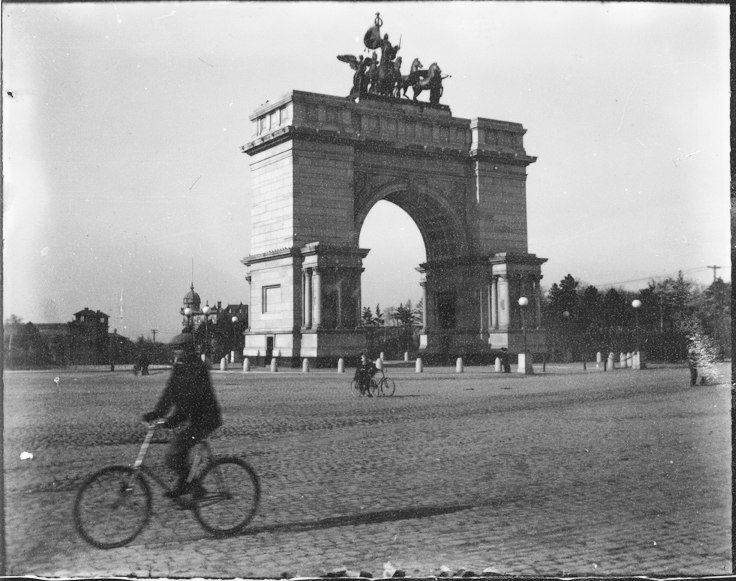
This late 19th-century photo shows a typical everyday scene by the Soldiers’ and Sailors’ Memorial Arch on the Grand Army Plaza at Prospect Park. Adrian Vanderveer Martense collection, Brooklyn Historical Society.
1868 map of Prospect Park Parade Ground
The King County Parade Ground was designed by Olmsted and Vaux in conjunction with the adjacent Prospect Park. Although intended as a military facility, sports took over early, and by 1871 the Parade Ground was one of the finest free ball grounds in the United States. This map was published in the 1868 edition of William Bishop’s Manual of the Common Council of the City of Brooklyn.

Riding and Driving Club of Brooklyn

In 1889, 30 of Brooklyn’s most prominent sporting men, lead by young banker Albert H. Smith, decided to establish an equestrian club near the bridle paths and open spaces of Prospect Park. The men purchased a large, 4-acre triangular parcel of land along what was then called Sportsmen Row, just west of the Grand Army Plaza and bounded by Butler street (now Sterling Place), Plaza Street, and Vanderbilt Avenue.

They hired the renowned architectural firm of McKim, Mead and White (of Madison Square Garden II fame) to design a clubhouse, riding ring, and stables for 200 horses. The club was officially incorporated on June 19, 1889, and the clubhouse opened in 1891. Click here for a more detailed look at the club’s history.

Brooklyn Riding and Driving Club at Prospect Park
The Brooklyn Riding and Driving Club facilities were expanded in 1894 to accommodate unexpected high demand from women and again in 1905 to house the members’ motor vehicles. The clubhouse and riding ring were demolished around 1939 and replaced with a six-story apartment building (20 Plaza Street). The carriage house and garage were used in later years as a public garage, but were both replaced in 1959 by a 15-story apartment building (10 Plaza Street.)

The Riding and Driving Club of Brooklyn was not just a club for men, but also for ladies, giving what the press called “a distinctive social turn.” The clubhouse provided lounging, smoking, billiard, and card rooms for the men, while women had access to reception and dressing rooms.

Although women had no voice in the management of the club, they were eligible for membership and could pay initiation fees when there was no male representative in the family. In addition to being a social club, the Brooklyn Riding and Driving Club also hosted frequent horse shows, including the annual Brooklyn Horse Show, indoor polo matches in Brooklyn armories, and other equestrian events.

The first officers and directors of the club included Albert H. Smith, president; Henry K. Sheldon, VP; William Nelson Dykman, secretary; and John S. James, treasurer.

Just as it does today, corruption reared its ugly head among those in power: In the fall of 1890, Albert Smith was arrested and charged with forgery for doctoring stock certificates – adding zeros to the share amounts – and siphoning the money into his personal account. Unlike today, however, the greedy banker was actually punished for his white-collar crime and sentenced to 17 years at the Sing Sing Correctional Facility in Ossining, New York.

The Prospect Park Police Exhibition at the Brooklyn Horse Show

On May 5, 1899, the Mounted Police performed what the Brooklyn Eagle reporter called a “spectacular drill” at the seventh annual Brooklyn Horse Show. Two platoons — 32 men commanded by Sergeant Egan of Manhattan — went through all sorts of cavalry maneuvers during their half-hour performance, beginning with the walk in single file and working up through a variety of tactics.

Patrolman Henry Hilton won the first-place blue ribbon and a $25 cash prize, Patrolman Robert Uhl of the 64th Precinct took the red, and Patrolman James Lannigan of the Prospect Park squad took yellow.

Riding-and-Driving-Club-of-Brooklyn riding ring at Prospect Park
The RDCB riding ring was 180 x 100 feet—the largest private indoor riding ring in the country at the time. The hall had a narrow seating promenade and 33 box seats; a glassed-in viewing area in the clubhouse overlooked the ring.

By 1899, Harry and Henry were veterans of the Brooklyn Horse Show and accustomed to taking the blue ribbon. The pair also took first place in the Mounted Park Police Exhibition in 1895 and 1896. In the former show, Duke, ridden by Patrolman William Vanderbeck came in second and Joe came in third with his partner, Patrolman John Tennant.

Harry Retires

In April 1901, the police department determined that Harry was too old for police work, so they took him out of service to spare him “the excitement of park police duty…and the heartbreaking strain which accompanies every dash to head off a runaway.” He was purchased by Michael A. McNamara, long-time captain of the Prospect Park Police, and spent the rest of his life at McNamara’s “palatial stable” in Englewood, New Jersey.

Parade Ground Athletic Building at Prospect Park
In the late 1800s, the Prospect Park Police force was housed in a ramshackle wooden structure on the Parade Ground near Caton Avenue. This building was replaced in 1905 by a magnificent Athletic Building designed by Helme, Huberty and Hudswell. For unknown reasons, the Athletic Building was torn down in 1962 and replaced by a nondescript police precinct house (today headquarters for the Brooklyn South Task Force) and recreation building.
Some of the cats featured at the Brooklyn-Long Island Cat Club show in 1930. Brooklyn Public Library

On February 28, 1941, Hitler was preparing to give orders to camp commandant Rudolph Hoss for the expansion of the Auschwitz prison camp, to accommodate 100,000 prisoners of war and 30,000 “peacetime” prisoners. Meanwhile in Brooklyn, New York, Mrs. Silas M. Andrews and Mrs. Edward D. Mudge were holding their first meeting of the Brooklyn-Long Island Cat Club with an afternoon tea in the Tower Room at the luxurious Hotel St. George in Brooklyn Heights.

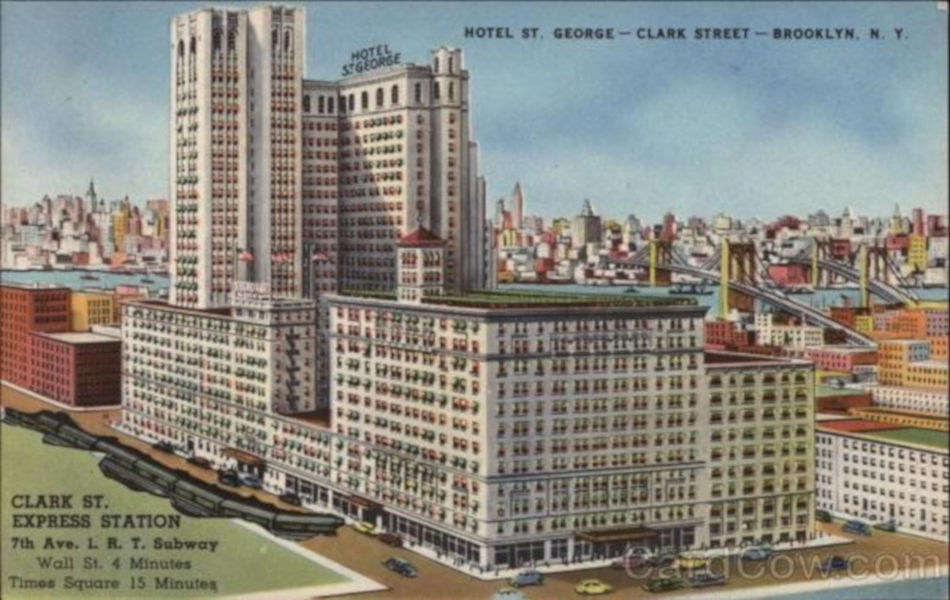
Hotel St. George – NYC LGBT Historic Sites Project
Where the Brooklyn-Long Island Cat Club shows took place in the 1940s.
Only 30 rooms when it was first built in 1885, the Hotel St. George eventually amounted to eight interconnected buildings that occupied the full city block bounded by Clark, Henry, Pineapple and Hicks streets. The St. George boasted 2,632 guest rooms, a huge 11,000 square foot ballroom and a 120-foot natural salt water indoor swimming pool.

“The Hotel St. George is yours.”
The Brooklyn-Long Island Cat Club was the brainchild of Ann Mudge of Brooklyn Heights. Although Mrs. Mudge had a pampered Persian named Chou Chou Bu, the backyard of her federal-style townhouse at 64 Poplar Street was home to numerous alley cats, including one of her favorite strays, Kitten Mitten. Mrs. Mudge was very concerned that Brooklyn had no animal shelter and no clinic for which the poor could take their sick pets.

The Brooklyn-Long Island Cat Club was the brainchild of Ann Mudge, who kept alley cats in the backyard of her home on Poplar Street in the 1940s.

Sometime in 1940, Ann Mudge approached Martin Samuels, manager of the Hotel St. George, which was just five blocks from her home. “Let’s have a cat show,” she told him. “And let’s ask not only champions but the grocer’s cat and the police station mouser and poor children’s pets.” Mr. Samuels, a reported pet lover, agreed to her suggestion. “Fine,” he said. “The hotel is yours.”

The first show in November 1940 featured 50 felines, plus a special appearance by Strato Lizzie, the flying mascot cat of the TWA pilots at La Guardia Airport.

The inaugural Brooklyn Heights Neighborhood Pet Cat Show at the Hotel St. George in November 1940 was so successful that its backers resolved to form a cat club. The purpose of the cat club, which was written in the club’s constitution, was to create a fund for a shelter and clinic that would provide medical attention for poor and homeless animals. Among those who were encouraged to attend the organizational meeting on February 28, 1941, were editors of pet magazines and “other authorities on felines.”

Winner of Brooklyn Heights cat show

Charter Brooklyn and Long Island members of the cat club included Mrs. Helen Picciano, Mrs. Mildred Pike, Mrs. Charlotte Harkness, Mrs. C.R. Hartmann, Miss Marion Dietz, and Mrs. Clara H. Baker. Mrs. Norah Andrews served as president; Mrs. Clara R. Richards and Mrs. Freeman L. Meinertz were vice presidents; Mrs. George L. Packer was recording secretary; and Dr. Irving Altman was the club veterinarian.

In 1941, the cat club had about 50 members and met once a month in the Tower Room at the St. George. A little black and white cat, one of a litter domiciled by the hotel’s housekeeping department, was named Kitten BLI and chosen as the club’s masot.

In order to raise money to establish a cat shelter and clinic in Brooklyn, the ladies hosted numerous cat club shows, the first few of which took place in the exotic Egyptian Club on the rooftop garden of the Hotel St. George.

Mrs. Norah Andrews, a charter member of the Brooklyn-Long Island Cat Club, bred Smoke Persians, like those shown here
Mrs. Norah Andrews, a charter member of the Brooklyn-Long Island Cat Club, bred Smoke Persians, like those shown here. Her cattery, Sunny Knoll, was located at her estate on Merrick Avenue in East Meadow. Norah was also president of the Cat Fanciers’ Federation.

During the war years, the club also purchased war bonds and published an article for women about the benefits of having a cat in the home:

A Cat in Your Home? Plea made for Tabby
Women whose men have gone to war and who have taken a war job for the duration need not come home to a lonely apartment or house these days, according to Mae Wagner Carlysle of the Brooklyn-Long Island Cat Club, whose headquarters are in the Hotel St. George.

Tower Room at the Hotel St. George in Brooklyn.The first meeting of the BLI Cat Club was held in the Tower Room at the Hotel St. George.

The well-known cat’s meow might well be the feline version of the hit, “I’m so nice to come home to,” it is claimed. Cats are easily trained, can be left alone for many hours, are scrupulously clean and are most affectionate, said Miss Carlysle. Mrs. Elsie M. Collins of Riverdale, manager of the Brooklyn-Long Island Cat Show, which will be held in the St. George on Oct. 19 and 20, said that it does not matter whether a cat is a Persian, Siamese or just one of the “alleys,” women will get a lot of comfort and companionship from such a pet. Proceeds of the coming show will go towards building an animal shelter and clinic in Brooklyn. (Brooklyn Eagle, October 6, 1943)

Mr. Chips, Princess Mickey, and Prince

Princess Mickey was Queen of the Brooklyn Cat Club Show
Princess Mickey was Queen of the Brooklyn-Long Island Cat Club Show at the Hotel Granada in 1948.

The Brooklyn-Long Island Cat Club’s shows were not just about showing purebred cats. There were awards for the most heroic cat, the funniest cat, the oldest and the ugliest cats.

A handsome tabby named Prince won the prize for “cat of distinction” in the late 1940s because he kept the mice away from the door at the Norwegian Seaman’s Home on Hanson Place.

In 1944, the club moved from the Hotel St. George to the Hotel Woodstock in Manhattan, where they had their fourth-annual cat show.

Some of the cats of this show included Bonnie Jean, 10, exhibited by Mrs. A.E. Townsend of Ardsley; Bonnie Maid o’the Mist; Silver Boy Brutus, raised from an alley cat by Mrs. Helen Piciano of 55th Avenue, Maspeth; and Mister Chips, a white Angora who played ball, sat up for meat like a dog and enjoyed going for walks on a leash.

In the late 1940s and early 1950s, the club held its shows at the Hotel Granada at 268 Ashland Place in the Fort Greene neighborhood of Brooklyn. There does not appear to be any more mention of the BLI Cat Club after the early 1950s.

Brooklyn Public Library

Today there are several cat clubs in Brooklyn and Long Island, including the Brooklyn Cat Fanciers, Long Island’s Gold Coast Cat Fanciers, and Long Island Cat Fanciers.

NYPD Mounted Police Heroes, Part I

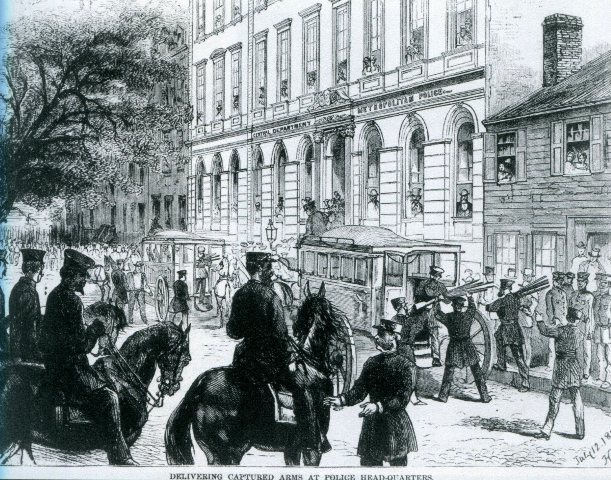
Mulberry Street police headquarters, Orange Riots, mounted police

Since 1871, the year that the Board of Police established the first official Mounted Police Unit in New York City, more than a dozen mounted patrolmen have been killed in the line of duty in horse-related incidents. Most of these men died after being violently thrown from their horses when the horses became spooked.

A few men suffered even greater indignity when they were dragged, kicked or crushed by their equine partners after getting tossed to the ground. Two mounted police patrolmen were killed only three years apart while riding the same department horse, Bulb.

Mounated Police Patrolman Christopher John Tierney

Born December 24, 1884, in Ireland, Christopher John Tierney came to America with his mother, Margaret, and sisters Catharine, Margaret and Ellen, in 1892. According to a 1900 U.S. Federal Census Report, Christopher lived with his family at 222 8th Avenue in Manhattan and worked as a messenger boy. Ten years later, he was single, working as a driver, and living with his mother and younger sister at 156 W. 24th Street.

In November 18, 1912, Christopher Tierney was appointed to the New York Police Department as a probationary patrolman. Six years later, on September 12, 1918, he registered for the World War I draft. According to his draft card, he was of medium build and had blue eyes and brown hair.

Christopher never had a chance to serve his country in the war. On September 20, 1919, he was killed while serving the citizens of Brooklyn. There are very few details about his death, but we do know that he was killed when he was thrown from his department horse, Bulb.

In 1919, the NYPD had 143 mounted police (plus 11 sergeants in the mounted units) and 110 mounted patrolmen in Traffic Regulation. Five other New York police officers were also killed in the line of duty in 1919, in non horse-related incidents:
May 23: Ptl. Emil Carbonell, Motorcycle Sqd. 2 (Highway Unit 2), auto accident
July 27: Det. James S. Maher, shot while investigating a homicide
November 10: John J. McCormack, shot during a domestic dispute
November 19: Ptl. James Hughes and Ptl. John McIntyre, Harbor Unit, drowned when their boat capsized

Mounted Police Patrolman Frank J. Mace

Francis (Frank) J. Mace joined the New York Police Department in 1915 at the age of 24. Just like his brother officer, Christopher Tierney, Frank also registered for the World War I draft. According to his draft card, Frank Mace was tall, of medium build, with grey eyes and brown hair. By 1922, Frank was married and residing at 2621 Newkirk Avenue.

On December 11, 1922, the New York Bureau of Public Safety, under the command of Lt. Martin Noonan, initiated a safety campaign to help reduce the number of bad automobile accidents that had been occurring in and around the city. Under the program, police officers were instructed to stop vehicles and inspect their brakes — bad or inoperable brakes were often the cause of the accidents.

On that same day, Frank Mace was patrolling the Flatlands neighborhood on his horse, Bulb. The partners were at the corner of Kings Highway and Flatbush Avenue when a motorized truck driven by John Johnson of Franklin Avenue struck Bulb.

Frank was thrown from his horse and his head struck the roof of another motor car, killing him instantly with a broken neck and fractured skull. Bulb suffered a broken shoulder blade, but a vet with the police department said he could probably be saved. The driver of the truck was arrested and charged with homicide.

Fifteen other New York police officers also died in the line of duty in 1922:

 Detective Moriarty
Detective John Moriarty died of a gunshot wound he received when he and several other detectives confronted some burglary suspects at 308 Fifth Avenue in Manhattan. One of the suspects fled by way of the roof, and Detective Moriarty gave chase. The two exchanged gunfire, and Detective Moriarty was stuck in the neck with one shot. He died at the hospital eight days later.
 Patrolman Otto Motz
Patrolman Otto Motz of the West 135th Station was lodging an intoxicated prisoner at the West 123rd Street Station House when another violent prisoner snatched his gun and shot Motz. Patrolman Motz lived in the Bronx and had a wife and 6-year-old daughter.

Jan 5: Det. William A. Miller, shot during arrest
Jan 6: Det. Francis M. Buckley, shot during arrest
Jan 19: Ptl. Otto M. Motz, shot by prisoner

Mar 15: Ptl. James H. McMail, shot during arrest
May 10: Henry L. Pohndorf, shot during arrest
May 18: Douglas W Hay, shot by irate citizen
June 24: William Deans, heart attack after being assaulted
July 2: John J. Moriarty, shot during robbery

Officer Kennedy
Officer John Kennedy was struck by a train and killed while conducting surveillance on a criminal.

July 14: Frank S. Mundo, accident
July 22: Arthur Loewe, shot
August 2: Albert S. Duffy, explosion
October 10: Peter J. McIntyre, bicycle accident
November 12: Charles Hoffman, hit-and-run auto accident
November 12: Thomas J. Shine, auto accident
December 3: John Kennedy, struck by train

Kings Highway and Flatbush Avenue

Flatlands Brooklyn map
The Flatlands boundaries in 1870.

In 1922, Kings Highway and Flatbush Avenue were both narrow, curvy dirt roads lined with trees and frame houses with picket fences. It’s interesting to note that the very same intersection where Patrolman Mace lost his life was once called Keskachane (“council fire”), and was the main settlement of the Canarsee band of the Lenape Indians.

Dutch habitation of the area began around the mid-1630s when three plots or “flats” were “purchased” from the Canarsee by Jacobus van Corlear, Wolphert Gerritsen, Andreas Hudde, and Wouter van Twiller, who called their settlement New Amersfoort.

The few dozen residents of New Amersfoort – including the Schencks, Strykers, Van Sigelens and Van Kouwenhovens – lived close to one another in farmhouses near the intersection of Kings Highway and Flatbush Avenue. This town eventually became known as the Flatlands Town Center. In 1664, the town was officially given a charter as the town of Flatlands.

The 73rd Precinct

Both Patrolman Tierney and Patrolman Mace had been assigned to what was known as the 73rd Police Precinct up to July 18, 1924. Prior to this date, the precinct operated out of a station house at 1830 Brooklyn Avenue in Flatlands. (From July 18, 1924, to July 3, 1929, the 73rd was known as the 35th and the 65th in Brownsville was renamed the 73rd; from 1929 to present, the former 73rd of Flatlands has been called the 63rd. Yes, it is all very confusing.)

Today this large 63rd precinct comprises approximately 8.96 square miles with 146.61 miles of street and 1.5 square miles of park, including Flatlands, Mill Basin, Mill Island, Georgetowne, and undeveloped marshlands of the Marine Park area. This precinct also borders a National Park, Gateway National Recreation Area, which it shares related jurisdiction with the United States Park Police. The present-day police station is located just up the street from the former 73rd station at 1844 Brooklyn Avenue.

The New York Mounted Police Unit: The early years

Charles U. Combes joined the NYPD after serving in the US Calvarly
Many of the Mounted Unit’s founding members had served on the United States Cavalry during the Civil War. Charles U. Combes (or Combs), shown here, served as sergeant in the First NY Mounted Rifles of the Seventh NY Cavalry during the Civil War, and afterward joined the NYPD. (Artist: David Edward Cronin, 1891, NY Historical Society)

The New York City Police Department began using horse-mounted officers as early as 1858. At a meeting of the Commissioners of Police on January 12, 1858, General Nye reported in favor of a mounted police unit for the upper wards of the city. Nye pointed out that many criminals tried to flee by running toward or into Westchester County, and a mounted police force would be a good deterrent to these opportunities for escape. General Nye told Mayor Tiemann and the Commissioners that he thought 28 horses would be required for 26 officers, so that there would always be two horses in reserve.

During this meeting in 1858, Mayor Daniel F. Tiemann made the following resolution:

“Be it Resolved, that this Board deem it expedient to organize a mounted police of 24 men and 2 sergeants, for the Twelfth, Nineteenth, and Twenty-second Wards, for the better protection of the lives and property in that section of the City.”

Daniel Fawcett Tiemann, New York Mayor
Daniel Fawcett Tiemann (1805 –1899) was an industrialist who resided in the hamlet of Manhattanville and served as the mayor of New York from 1858 to 1860. The nephew-in-law of Peter Cooper, Tiemann was also a founding trustee of the Cooper Union for the Advancement of Science and Art.

According to a map issued in 1860 for Valentine’s Manual of the Corporation of New York, the 22nd Ward was on the west side, from 40th to 85th streets, and included most of the southern portion of Central Park. Ward 19 was on the east side, from 40th to 85th streets, and the 12th Ward covered everything above 86th Street, including the northern section of Central Park, and the hamlets of Manhattanville (west 120s, where the mayor resided) and Carmansville (West 150s).

In Part II of NYPD Mounted Heroes, I’ll tell you about Patrolmen William H. Galbraith and Artemas Fish, who were also killed in the line of duty while patrolling on horseback.