In a recent post, I wrote about Ginger, a well-loved fire dog for Hook and Ladder Co. No. 5 of New York’s Metropolitan Fire Department. The following tale is also about Ginger, but this mascot was a fire cat for a historical fire company once called the Live Oak Engine Company.

Ginger fire cat Engine 11, Live Oak HatchingCatNYC
This really is Ginger (New York Times, October 17, 1897)

In 1894, an orange tabby cat strolled into the firehouse at 437 E. Houston Street on the Lower East Side, in an area that is now known as Alphabet City. The firehouse was the headquarters for the Metropolitan Steam-Engine Company No. 11, which served the Fifth and Sixth Districts. In the late 19th century, these districts were some of the worst slum areas in the city and home to many Eastern European Jewish, Irish, and Italian immigrants.

Three years later, the fire cat named Ginger had mastered several tricks, including sliding down the brass pole and “boxing” with her trainers — firemen William Lennon and Gus Shaw — while standing on her haunches. Although Ginger was smart enough to stay behind when the men went on fire calls, she earned the title of firehouse mascot and captured the attention of The New York Times.

Live Oak Engine Company No. 44 – “Turk”
Metropolitan Steam-Engine Company No. 11 was organized on November 2, 1865. It was one of 34 engine companies organized that year under a state act titled “An Act to Create a Metropolitan Fire District.” This bill, passed into law on March 30, 1865, abolished New York’s volunteer fire department and created the Metropolitan Fire District, a Board of Commissioners, and the Metropolitan Fire Department (MFD).

Peter Vetter was one of the early members of the Live Oak volunteer fire company.

Prior to the transition from volunteer to paid service in 1865, Engine Company No. 11 was known as Live Oak Engine Company 44. The volunteer fire company was organized August 2, 1824, by the master shipbuilders of the Dry Dock, which was the shipyard district that extended along the East River from Grand Street to 12th Street.

The motto of Live Oak was “We Extinguish One Flame, and Cherish Another.”

The Great Shipyard Fire

In the early 1800s, Adam and Noah Brown operated a shipyard at the foot of Stanton Street on the East River. By 1824, Brown & Bell, who were renown for constructing clipper ships and steam vessels, were also operating in this vicinity, as was Issac Webb & Company.

On March 14, 1824, at about five in the morning, a fire was discovered in Noah Brown’s steam sawmill. The fire quickly spread, destroying the mill and large ship house of Brown & Bell. In the ship house were two steamboats, including the Hudson, which was being built for K.M. Livingston and almost ready to launch. Also destroyed were two brigs and a large quantity of live oak ship timber. The flames then extended to the adjoining shipyard of Isaac Webb & Co., where a frame building and ship timber were consumed.

Engine Company No. 33, “Black Joke,” which was led by foreman James P. Allaire and located at the north end of Cherry Street between Jackson Street and Corlears Street (near present-day Corlears Hook Park), was cut off from the shore end of the shipyard by the sudden spread of the fire. Before the firemen could remove their engine from the scene, it caught fire and was completely destroyed. Several of the firemen were caught between the fire engine and the end of the dock – four of them jumped into the river but were rescued by boats from the shore.

Clipper shipwright Jacob Bell was a founding member of the Live Oak Engine Company
Clipper shipwright Jacob Bell was one of the first organizers of the Live Oak volunteer fire company. Bell and his partner, David Brown, were proprietors of Brown & Bell, a shipyard located at the base of Stanton Street and destroyed by fire in 1824.

This grand fire led to the formation of Live Oak No. 44, which was organized by Jacob Bell, Isaac Webb (foreman), John Demon, Edward Merritt, and Foster Rhodes. The company ran independent of the New York Fire Department for about four years and operated out of a small frame house that the members built themselves on Columbia Street near Houston Street.

At that time the river was almost up to what was then Goerck Street – just three blocks east of Columbia – so the firemen were very close to the shipyards.

In about 1828, Live Oak received the number 44 from the Fire Department, and had a one-story brick firehouse with peaked roof built on Houston Street, about 100 feet west of then Lewis Street (near present-day Baruch Drive and the Island School, PS/MS 188.)

On November 12, 1850, the city purchased a 25 x 180 foot lot on East Houston Street between Columbia and Cannon streets from Jonathan Rider. Live Oak moved its firehouse to this location in 1853, where the company — volunteer and paid — remained for about 100 years. It was in this newer firehouse that Ginger made her home.

The original Live Oak firehouse on Houston Street.

The Turks

As the story goes, in 1830 renowned shipbuilder Henry Eckford took some ship carpenters, including a group from Live Oak, to Constantinople to work on a contract he had there. Eckford died shortly after arriving in Turkey, but the men continued the project and were called “Turks” when they returned to New York. The name stuck with the fire company — the men even carved two Turks standing upright and wearing sabers on their goose-neck hand pump engine.

The Transition to Engine Company 11

At the time of the transition in 1865, Live Oak owned one hand engine, one jumper, 13 lengths of hose, three ropes, one hose washer, three lanterns, two lengths of suction, three cans, three pails, three mops, and a few other odd items – all of which was turned over to New York City.

According to the 1865 Annual Report of Chief Engineer of Fire Department, Live Oak Engine Co. 44 had 50 members in 1865, 10 of whom claimed to reside at the firehouse, including Foreman William F. Squires and Assistant Foreman Peter Maloney. By this time the volunteers were of various nationalities and professions, including clerks, gunsmiths, ship carpenters, blacksmiths, barbers, and printers.

Engine Company 11 1939 Mack
 1939 Mack Hose Wagon of Engine Company No. 11

In 1897, when Ginger the cat was making her home at the East Houston Street firehouse, Engine Company 11 consisted of the following 12 members: foreman Thomas R. Kane; assistant foreman Fred. J. Rothenhausler; engineers James H. Frederick and Charles S. McArthur; firemen (1st grade) Edward F. Haulton, Gustav Shaw, Henry Decker, William J. Lennon, James P. Judge, and Edward F. Birmingham; and firemen (2nd grade) Eugene Silverman and Henry Planson.

1950: Baruch Houses Put an End to Engine Co. 11
In August 1949, Mayor William O’Dwyer – the 100th mayor of New York City — announced a new public housing development for the Lower East Side. The $31.4 million, 28-acre development, which would be called Bernard M. Baruch Houses (today known as Baruch Houses), was a Federal–aided slum clearance development under the national Housing Act signed by President Harry S. Truman.
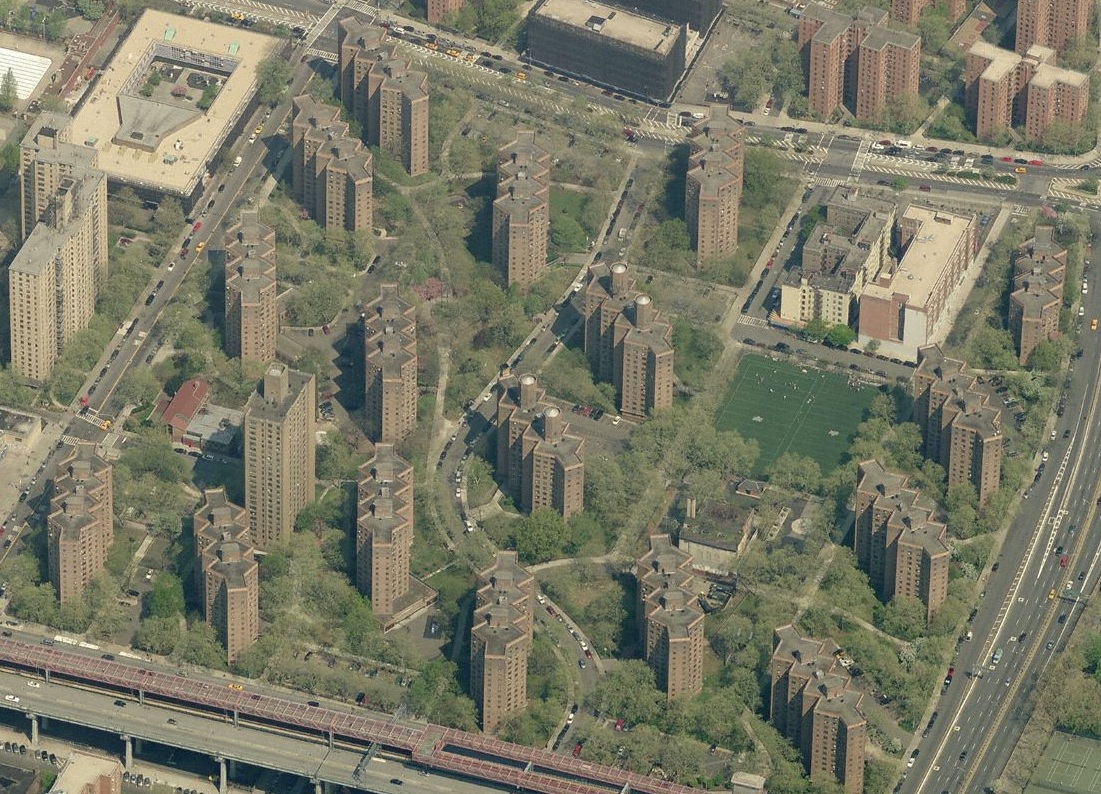
NYCHA - Baruch Housing — ELLANA, Inc.
Aerial view of Baruch Houses

During construction from 1953 to 1959, six blocks of slum buildings between East Houston Street and Delancey Street were razed, including Cannon, Goerick, and Mangin streets. Most of the structures that were demolished were old-law (pre-1901), walk-up tenements with communal bathrooms and either no running water or only cold water.

Baruch Houses was completed June 30, 1959, with 16 thirteen-story structures and one seven-story building – all featuring hot running water and elevators. The development provided homes for 2,194 families in 3- to 6-room apartments, with rents averaging $9 a room.
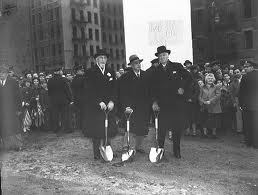
Baruch Houses Ground-Op
The groundbreaking ceremony for Bernard Baruch Houses took place on April 8, 1952. Pictured are Dr. Herman Baruch (left), brother of the financier and presidential confidant Bernard Baruch, Robert Moses (center), City Construction Coordinator and Park Commissioner, and Philip Cruise, the New York City Housing Authority chair.

Between the construction of Baruch Houses and Mayor Fiorello H. La Guardia Houses (completed in 1957), over 1,650 people of the Lower East Side were displaced, including the firefighters of Engine Company 11. On October 15, 1957, Engine Company 11 was officially disbanded. The former site of the Live Oak Engine Company is now only a memory.

This 1852 map shows Engine Company 11 at 437 East Houston Street. Many of these streets were razed for the construction of the Baruch and Mayor Fiorello housing developments in the 1950s.
1862 Map of the Lower East Side

If you enjoyed this story, click here for a true tale about another Ginger — the fire dog of Greenwich Village.

Cat ship
One cat took part in Operation Bow-Wow in 1946.

In January 1946, the United States partnered with the American Express Company and other shipping and custom house brokers to help American servicemen ship their European canine companions to America. By the end of February 1946, about one thousand dogs had been shipped to the states as part of the joint venture unofficially known as Operation Bow-Wow.

One lone tabby cat reportedly joined their ranks.

On February 20, 1946, the Liberty ship SS Warren P. Marks arrived at Chelsea Piers (Pier 60) on the Hudson River carrying 81 dogs and “one live cat from Bremerhaven, Germany.” The dogs and cat had all been obtained overseas during World War II by American soldiers who wanted to keep them as pets back home.

According to the American Express Company, it cost the soldiers $50 to $75 to ship their pets to the United States as part of Operation Bow-Wow. (That was quite a hefty sum to pay, considering some of the mixed-breed dogs were valued at less than a dollar.)

In some cases, the shipments were arranged by friends or other soldiers who were still overseas after the pets’ masters had already returned home.

The Story Behind the Ship of Operation Bow-Wow

Warren Marks
Photo by Ed Stecewicz, courtesy of American Legion Post 70.
Operation Bow-Wow
Warren P. Marks. Photo by Ed Stecewicz, courtesy of American Legion Post 70.

New Jersey resident Warren Prime “Moose” Marks was the oldest child of Sylvester Wade Marks and Arabella “Belle” Florence Prime Marks. He had one sister, Annis Jean, and a brother, Roger. Warren attended public schools in Nutley, N.J., and graduated from Nutley High School in January 1941.

On December 11, 1942, when he was just a first-year cadet in the U.S. Merchant Marine Academy, Warren signed on aboard the SS Timothy Pickering as Engine Cadet at the port of New York. He was joined by cadets Christopher C. Brennan (Deck), William L. Lyman (Deck), Lawrence D. McLaughlin (Engine), and former Cadet Officer George W. Alther, Jr. (Second Mate).

Seven months later, Marks and his fellow cadets lost their lives when their ship was attacked by German dive bombers in Avola, Sicily.

On or around July 10, 1943, the Timothy Pickering arrived off Avola after sailing in a convoy from Alexandria, Egypt, with 130 British soldiers and a cargo of munitions, TNT, high-octane gasoline, artillery pieces, and trucks. On the morning of July 13, the vessel was anchored in the harbor, where the crew had begun unloading the vessel’s cargo.

In a sudden attack, a German dive bomber dropped a 500-pound bomb on the ship at its Number 4 hold.

According to a report from Deck cadet Christopher Brennan, one of only 29 survivors, the bomb detonated in the ship’s engine room, causing a massive explosion that left a gaping hole in the starboard side and nearly sliced the ship in two. As the aft section of the ship began quickly sinking, and with no time to either launch lifeboats or be given an order to abandon ship, the crew began leaping over the side into the water or sliding down ropes and the anchor chain.

“To stunned observers nearby,” the report notes, “the doomed ship seemed to dissolve into thin air.”

According to Brennan’s report, Warren Marks was in the engine room at the time of the explosion, and was killed instantly. William Lyman was in his quarters and was not seen afterward. Lawrence McLaughlin was seen jumping over the side of the ship, but drifted into the burning oil that surrounded the blazing ship.

Along with the Cadet-Midshipmen, 19 other crew members, 8 Naval Armed Guard Sailors, and 100 British soldiers died in the attack.

Second Mate George W. Alther, Jr., only 25 years old, was posthumously awarded the merchant marine’s highest honor, the Distinguished Service Medal, for his heroic actions during the disaster.

Cadets Lyman, Marks, and McLaughlin were awarded the Atlantic War Zone Bar, the Mediterranean-Middle East War Zone Bar, the Combat Bar, the Mariners Medal, and the Presidential Testimonial Letter. Marks, just 20 years old when he was killed, also received the Victory Medal.

The U.S. Merchant Marine Cadet Corps
The U.S. Merchant Marine Cadet Corps was established by Congress under the Merchant Marine Act of 1936 and officially founded March 15, 1938, under the auspices of the U.S. Maritime Commission, chaired by Joseph P. Kennedy (father of President John F. Kennedy). Early training was provided at temporary facilities and aboard government-subsidized ships until the Academy’s permanent site at Kings Point, Long Island, was established in 1942 on the former Chrysler estate.

The Academy was dedicated on September 30, 1943, by President Franklin D. Roosevelt, who noted that “the Academy serves the Merchant Marine as West Point serves the Army and Annapolis the Navy.”

In 1941, when Warren Marks joined the Academy, the requirements for appointment as cadet were:

-American citizen between 18 and 25
-Good moral character, unmarried
-Between 5’4″ and 6’4,” in height
-Meet Navy physical requirements
-Meet requirements for sight, color perception, speech and hearing
-At least 15 high school credits
-Good teeth, good feet, good posture

From 1942 to 1945, the Academy graduated 6,895 officers. As the war came to an end, plans were made to convert the Academy’s wartime curriculum to a four-year, college-level program to meet the peacetime requirements of the merchant marine.

Old Long Island: When 'Forker House' Was For Sale
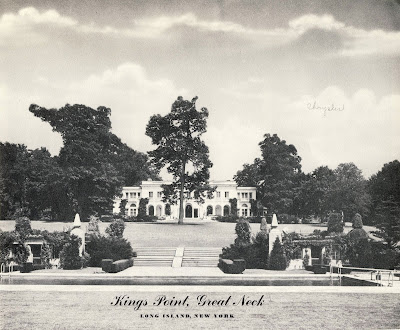
Forker House, originally the estate of renowned fashion designer Henri Bendel, was designed by Henry Otis Chapman in 1916. The house was sold to Walter P. Chrysler in 1923 and later acquired by the U.S. Government for $100,000 and renamed Wiley Hall, to be used as the administration building for the United States Merchant Academy. Click here to see a brochure advertising the Forker House when Walter Chrysler first put it up for sale.
Ginger the Fire Dog
This is not Ginger, but I thought this old photograph was appropriate. 

Although their names were omitted from the payrolls, the fire dogs of the Metropolitan Fire Department played some very important roles in nineteenth-century New York City. This is the story of Ginger, a famous fire dog of Old New York.

Not only were they considered pets of the firehouse and furry friends of the neighborhood, but they also worked hard barking loudly to clear the streets ahead of the horse-drawn engines, guarding the men’s equipment at the scene of a fire, spurring the horses on to greater speed by nipping at their legs, or alerting the firemen to injured fire victims.

For 16 years, Ginger did all of these things and more for Hook and Ladder Company No. 5 of Greenwich Village, New York.

Ginger, a mutt, joined the firehouse at 95 Charles Street in 1872 – just seven years after the hook and ladder company was organized. According to The New York Times, Ginger was a “fireman’s dog” who “took an almost human interest in the affairs of the company.” He would always promptly respond to fire alarms, and his short, sharp barks would mingle with the truck’s loud gong as he ran in front of the horses.

All the children in the neighborhood loved the fire dog, especially the little schoolgirls, who would often stop at the firehouse on their way to and from school to play with the friendly dog they called Ginger.

On November 16, 1888, Ginger met his demise while taking his daily walk on Bleecker Street. The old fire dog was reportedly injured when he was hit by a truck; a police officer used his revolver to put Ginger out of his misery. Ginger was buried in the yard of the firehouse following a visitation for the school children.

A Brief History of Hook and Ladder Company No. 5
The Metropolitan Hook and Ladder Company No. 5 was organized on September 25, 1865. It was one of the twelve hook and ladder companies organized that year under a state act titled “An Act to Create a Metropolitan Fire District.” This bill, passed into law on March 30, 1865, abolished New York’s volunteer fire department and created the Metropolitan Fire District, a Board of Commissioners, and the Metropolitan Fire Department (MFD).

The new hook and ladder company had 12 members, including Foreman Charles O’Shay, an assistant-foreman, driver, and nine privates. The combined annual salary for all the company members was $8,550.

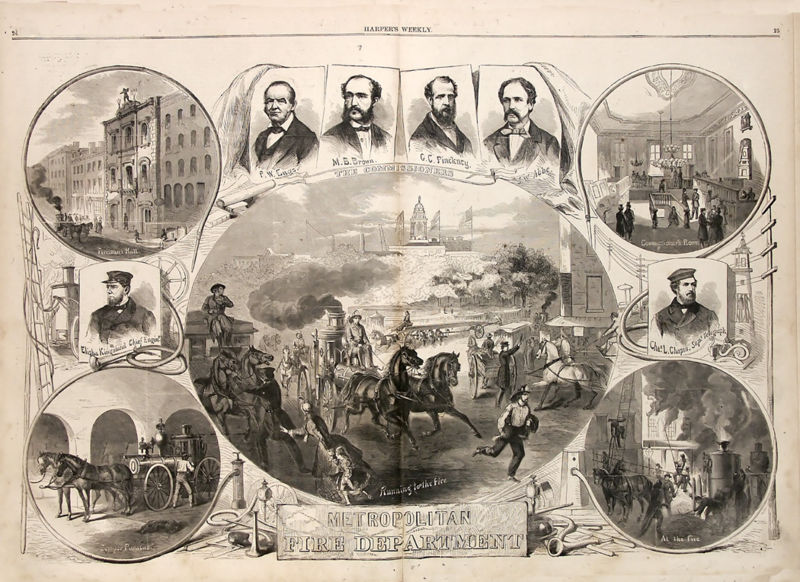
In 1866, Harper's Weekly featured this illustrated print celebrating the official formation of New York City's Metropolitan Fire Department. Museum of the City of New York Collections
In 1866, Harper’s Weekly featured this illustrated print celebrating the official formation of New York City’s Metropolitan Fire Department. Museum of the City of New York Collections

Prior to the transition from volunteer to paid service in 1865, New York City was served by 18 hook and ladder companies as follows:

Mutual No. 1, Chelsea No. 2, Eagle No. 4, Union No. 5, Mechanics No. 7, Empire No. 8, Washington No. 9, C.V. Anderson No. 10, Harry Howard No. 11, Friendship No. 12, Columbian No. 14, Baxter No. 15, Liberty No. 16, Hibernia No. 18, Phoenix No. 3, Lafayette No. 6, Marion No. 13, John Decker No. 17.

During the transition, Columbian Hook and Ladder No. 14, which was housed at 96 Charles St., was replaced by Hook and Ladder Company No. 5. Hook and Ladder 5 occupied the Charles St. firehouse until November 25, 1975, when the company moved into its present quarters at 227 Sixth Avenue.

Columbian No. 14 — “Wide Awake”
This volunteer company was organized May 11, 1854, with Robert S. Dixon as foreman, Kinloch S. Derickson as assistant, Robert Wright as secretary, William Hutchings as treasurer, and ten other members. They worked out of a temporary location on Greenwich Street near Amos Street, which they erected at their own expense in May 1854. In January 1857 the company moved into their new Italianate-style firehouse on Charles Street and took possession of a new truck finished by Pine & Hartshorn of New York City.

The new firehouse was among the best in the city, and featured a grand meeting room and parlor, a well-appointed bunk room and truck room, and a large library. There was also a beautiful little garden attached to the house, where on summer evenings the members would gather to while away the quiet hours. One must wonder if it was in this peaceful garden that Ginger the fire dog of Hook and Ladder Company No. 5 was laid to rest.

96 Charles Street firehouse, where Ginger the fire dog once lived.
Built in 1854 as a carriage house, 96 Charles Street was purchased by the city in 1855 and converted to a firehouse for Columbian No. 14. Hook and Ladder Company No. 5 occupied the firehouse from 1865 to 1975. Today the building houses a contemporary art gallery and two large residential duplexes.

In Memoriam

The following members from Ladder 5 and Battalion 2 made the supreme sacrifice on September 11th, 2001:

LADDER 5
Lt. Mike Warchola
Lt. Vincent Giamonna
Lou Arena
Andy Brunn
Greg Saucedo
Paul Keating
Tommy Hannafin
John Santore

BATTALION 2
BC. William McGovern
BC. Richard Prunty
FF. Fautino Apostol, Jr.

Ladder 5 Battalion 2 memorial
Pictured here are the 11 men of Ladder 5 and Batralion 2 who lost their lives at the World Trade Center on 9/11.

If you enjoyed this story about Ginger the fire dog, click here to read a true tale about another Ginger — the fire cat of the Lower East Side.

Olaf and Larson

Many newspapers took photos of Olaf the Viking cat upon his ship’s arrival in Brooklyn. Here he is with Fourth Mate Hjalmar Larson.

“A mascot there was who almost wasn’t
But he has the life he almost hasn’t.
And the fact is this:
Though he’s somewhat wizened,
Though he almost isn’t—
He is.” — Angus MacGregor, Hartford Courant, October 12, 1930

An old maritime superstition was that if a mascot was lost at sea, a member of the crew would be lost shortly thereafter. Even worse, a lost mascot on a maiden voyage spelled constant disaster for the ship in the future. That is why when Olaf the cat fell overboard on the Sud Americano’s maiden voyage from Kiel, Germany, to Brooklyn, the captain and crew did not hesitate to attempt a daring rescue.

Olaf was described in The New York Times as a “blond Viking” with “tramp traits” who attached himself to the sailors of the South American liner, Sud Americano. The twin-screw steamer was built in Kiel, and was scheduled to go into service as an express passenger and freight liner out of Brooklyn to Rio de Jeneiro, Montevideo and Buenas Aires. Sud Americano and its sister ship, Sud Expresso, were operated by Garcia & Diaz, of Pier 44 in Red Hook, Brooklyn.

Refusing to be left behind on the ship’s maiden voyage to New York, the orange-striped tabby cat reportedly eliminated his competition—a ship mascot parrot named Juan—and signed on as the new official mascot of the Sud Americano. For the next few days, Ofaf prowled all over the boat, inspecting the saloons and staterooms, introducing himself to the men in the engine room, and basically expressing his appreciation of new role in general.

On the morning of July 2, 1929, when the ship was about 800 miles east of New York, Olaf was sunning himself on the foredeck when he was swept overboard by a heavy swell. According to the August 1929 issue of The Lookout, which was published by Seaman’s Church Institute of New York, the watchman saw Olaf get carried out to sea and immediately cried out, “Cat overboard!” Captain Bjor Boettger asked if it was the ship’s cat and ordered an immediate rescue.

First he telegraphed to the engine room for “stop” and “slow astern.” Then he instructed Chief Officer S. Anderson and six oarsmen to man the after lifeboat. The men, including Fourth Mate Hjalmar Larson, lowered the lifeboat in record time and pulled at the oars hard against the heavy seas, turning the boat toward the small dark object bobbing up and down in the waves.

Despite the swells, Olaf swam courageously for about 15 minutes as one would expect a seafaring cat to do, until one of the sailors scooped him up by the end of an oar. Upon returning the waterlogged Olaf to the ship, two “hefty Norwegian sailors,” under the direction of the Officer T. Anderson, started pumping air into his lungs and salt water out, following instructions for humans in the ship’s first-aid manual.

After resuscitating the cat, the sailors wrapped Olaf in a blanket and brought him to the engine room to dry out. Later that night, the crew threw a large party on the ship to celebrate the heroic rescue.

Atlantic Basin, Red Hook

The Dutch established the village of Red Hook (Roode Hoek) in 1636, making it one of the earliest areas in Brooklyn to be settled. The area was named for its red clay soil and the hook shape of its peninsular corner that projects into the East River. By the 1850s, Red Hook was one of the busiest ports in the country.

Several days after the rescue, the Sud Americano steamed up to Pier 44 at the foot of Conover Street, with Olaf reportedly standing in the bow, head and tail held high, purring. When Manuel Diaz of Garcia & Diaz heard about the rescue, he said the Spanish Humane Society would undoubtedly award medals to the sailors who rescued him.

Many New York and Associated Press reporters came to interview Olaf, take his picture, and offer praise for him and his fellow officers. As a reporter for the Oakland Tribune (California) wrote, “We shall have to thank Olaf for new proof that men are interested in things which are not sensational and sordid. The sailors who went to the rescue and the captain who turned the ship back are surely other fellows worth knowing. Most of us would like to sail with that bunch.”

Rescue Prepares Crew for Lifeboat Race

Two months after Olaf’s rescue, the crew of the Sud Americano took part in the third annual international lifeboat race on the Hudson River. The race was sponsored by the Neptune Association, an organization of shipmasters and dock officers who recognized the need for better lifeboat skills for rescue and emergency work at sea.

On September 2, 1929, crowds of people lined up from 86th Street to 126th Street to watch the crews from various passenger ships compete in the two-mile race. As reported in The New York Times, the Garcia and Diaz lifeboat crew from the new motor freighter Sud Americano pulled to victory against seven competitors, with a winning time of 17 minutes and 11 seconds.

On September 6, William H. Todd of the Todd Shipyards Corporation presented the Todd lifeboat racing trophy to the crew at a luncheon aboard the ship at Pier 44. Captain C.A. McAllister, president of the American Bureau of Shipping and referee, inferred that the crew may have won because they were all under the age of 30 and “they were Norsemen whose ancestors were rowing boats while some of ours were shooting bows and arrows.”

Other news articles reported that the crew cheated by spreading grease on the bottom of the boat. But maybe the crew of the Sud Americano won simply because they had recent lifeboat practice with Olaf.

Here are the men of the Sud Americano during their winning lifeboat race on the Hudson River.

Here are the men of the Sud Americano during their winning lifeboat race on the Hudson River.

Olaf with Captain Boettger in Brooklyn.

Olaf with Captain Bjor Boettger (left) in Brooklyn.

About a year after the rescue, a reporter from the Hartford Courant asked Captain Boettger why he thought his ship was having such good luck with the weather and the crew. The captain reached under the mess table and grabbed Olaf for the reporter to see. “Olaf is the plan this ship sails under,” he said. “We saved Olaf’s life, and he’s bringing us good luck in exchange.”

The Sud Americano Meets German Sub U-558 in 1941

Shortly after the Sud Americano went into service, she and her sister ship were returned to their builders in Kiel for failure to reach the contracted speed. The ship was renamed Schleswig and some time later, was under charter to the Blue Star Line of London as Yakima Star. In 1934 she was re-engined and lengthened; her two funnels were replaced by a single one, and she renamed Weser for Norddeutscher Lloyd, Bremen.

In October 1940 she was captured while attempting to run the British blockade by HMCS Prince Robert. The Weser was taken over by the Ministry of War Transport, handed over to Merchant Marine Ltd, Ottawa, and renamed Vancouver Island . This was to be her last name.

On October 15, 1941, Vancouver Island was torpedoed by German submarine U-588 under the command of Günther Krech. The ship sank in the North Atlantic west of Ireland. On 31 October, a lifeboat with the bodies of two officers from the ship was found by a British warship. Master Eric Lacey Roper, 64 crew members, eight gunners, and 32 passengers were lost. There was no mention of a mascot.

1884: The Goats that Bucked a Swimming Race in East Harlem | Italian Harlem

In my last post about old New York, I wrote about a Newfoundland who almost lost his life while taking part in a swimming race from Randall’s Island to the Harlem Beach Bathing Pavilion in July 1884. Apparently, the manager of the Harlem beach, Frederick Kenyon, wasn’t fazed by this close call on the East River.

Three weeks later, he invited people to let their goats compete in a similar swimming race. The prizes included a mammoth cabbage, large turnip, a double-sheet circus poster, and a tomato can.

On August 10, 1884, 11 goat owners led their goats to a float on the East River at 116th Street, where they were to be thrown into the water. The owners struggled quite a bit as the goats butted and kicked and flat-out refused to get into the water.

During all this commotion, a man came rushing out to the float, brandishing a large silver shield. He told the goat owners to desist in the name of Henry Bergh and the law. He then threatened to arrest the first person who tried to throw a goat into the water.

The goat owners just laughed at him. But then four more men arrived on the scene and the goats were taken away from the water.

The man who came to the goats’ rescue was Henry Bergh, founder of the American Society for the Prevention of Cruelty to Animals, and the other men were some of the first officers of the ASPCA.

Henry Bergh ASPCA
Henry Bergh’s impassioned accounts of the horrors inflicted on animals convinced the state legislature to pass the charter incorporating the ASPCA on April 10, 1866.

One of the goat owners, a Mr. James Gordon, was not happy that the swimming race was canceled. “By thunder, I’ll sue Henry Bergh for damages,” he told a New York Times reporter.

“I bought my goat last week and paid 50 cents for it – a good price, too. I put it in my garden, and it ate up all my flowers and plants and paint and oyster shells and the nails out of my house, besides all the corn I gave it. Now, when I come here to get the benefit of my outlay, Mr. Henry Bergh steps in and says he shan’t go in the water. What the devil does the goat care? He can’t think or do anything but eat and butt, and would just as soon swim as not.”

After the main attractions were led away, some of the crowd that had gathered stayed to watch a race for “fat men” and a tub race. You can’t make this stuff up.